

Managing all outreach, volunteer activity, and voter data from a single platform without causing delays or friction is a challenge for growing campaign teams. Many options are locked behind sales calls, tie pricing to campaign size, or require a steep learning curve for new users. This comparison covers features, integrations, and pricing across five political campaign software options so you can match one to your team's needs before committing to demos or trials.
Table of contents
Campaign buddy HQ
At a glance
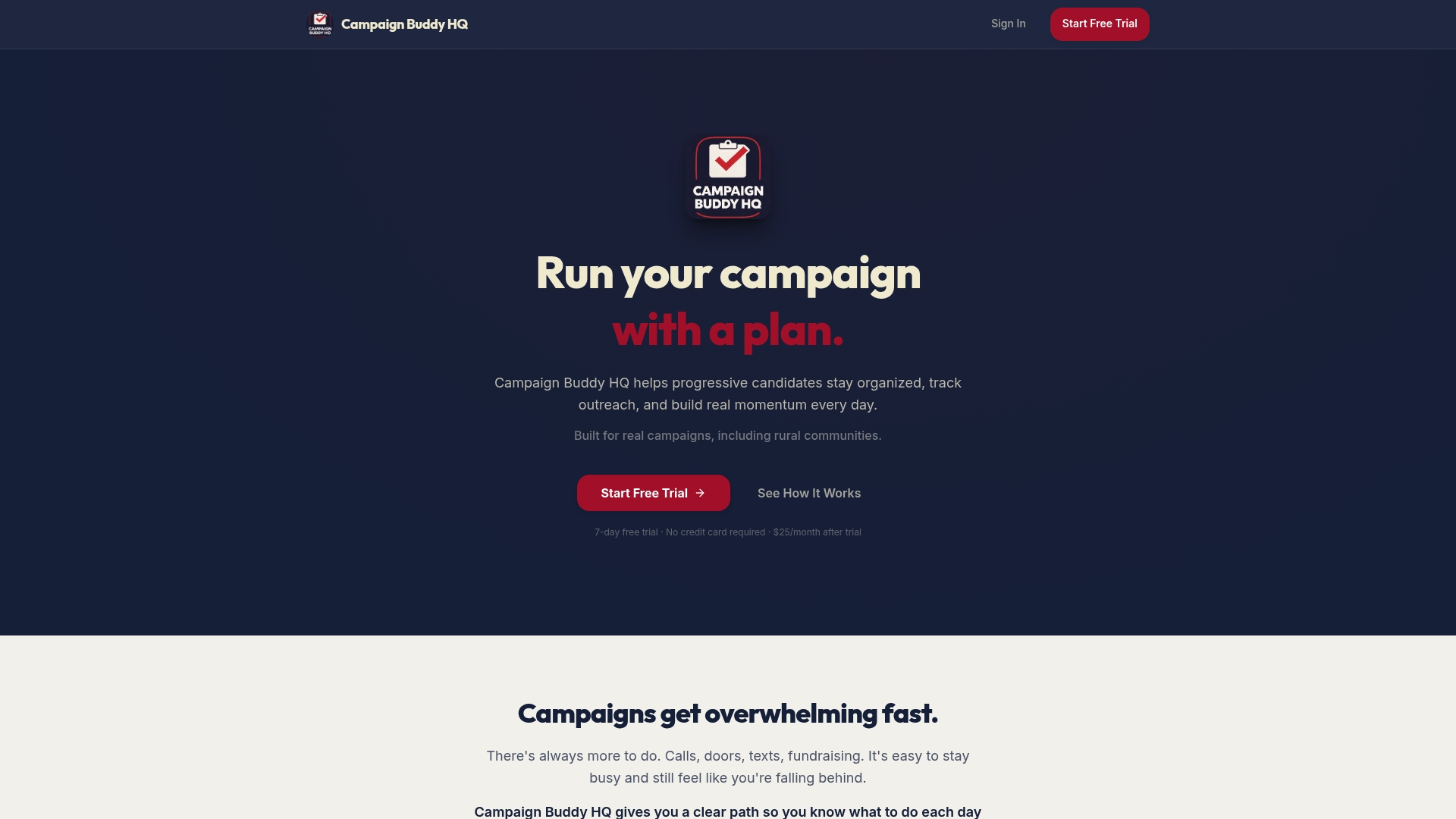
A free seven day trial requires no credit card. That low barrier makes it easy for small teams to test features before paying. Campaignbuddyhq focuses on daily and weekly planning, outreach logging for doors, calls, texts, and registrations, and supporter tracking. The product targets progressive candidates and campaign teams, including those running in rural and low density districts.
Core features
- Daily campaign planning tailored to the campaign stage, so volunteers and staff get clear tasks each day.
- Outreach tracking for doors, calls, texts, and registrations with simple logging fields for each contact.
- Supporter tracking that records contacts and shows progress toward engagement goals.
- Weekly planning overview for pacing adjustments and redistribution of volunteer work.
- Campaign phases support such as Launch, Build, and Maintain to match activity expectations to each stage.
Key differentiator
Built specifically for real campaigns, Campaignbuddyhq prioritizes day to day outreach scheduling and tracking rather than broad marketing features. The product adapts planning to campaign phases so teams know what activities to run at each stage. That focus makes it practical for dispersed or rural districts where contact lists and volunteer time vary. Teams that need tight daily pacing and a straightforward record of voter contact will find this approach useful. The product does not try to replace specialized voter databases or advanced analytics tools.
Pros
- Clear daily and weekly planning helps campaign teams keep volunteers focused and reduces planning friction. This improves follow through on voter contact goals.
- Outreach tracking for doors, calls, texts, and registrations creates a simple accountability trail for staff and volunteers. Managers can review activity without complex reports.
- Designed for rural and low density environments, the interface reflects outreach that happens across long travel distances and smaller contact counts.
- Simple price point and a seven day, no credit card trial make adoption low risk for small campaigns. Teams can cancel anytime after the trial.
Cons
- Limited integrations with voter databases or fundraising platforms restrict data import and automation options. Campaigns that rely on external CRMs will need to manage imports manually or run parallel tools.
Who it's for
Progressive political candidates and small campaign teams that need an easy daily planner and a straightforward way to log outreach will benefit most. Field directors running rural districts will find the design reflects real travel and contact patterns. Larger campaigns that need advanced analytics or marketing automation will likely outgrow the feature set.
Unique value proposition
At $25 per month after a free seven day trial, Campaignbuddyhq delivers focused outreach planning that small teams can afford. That price makes it feasible for volunteer run campaigns to keep a live planning tool without a large budget. The subscription model and trial lower the barrier to test whether daily planning and simple outreach logging will fit an existing field workflow.
Real world use case
A candidate in a rural district opens the app each morning and assigns door canvass blocks and call lists to volunteers. Volunteers log each contact as doors, calls, texts, or registrations so the campaign can see who needs follow up. The campaign uses weekly overviews to rebalance work and move through the Launch, Build, and Maintain phases.
Pricing
The service charges $25 per month after a free seven day trial that requires no credit card. Teams may cancel at any time. The model targets small campaigns that want a low cost, always available planning tool.
Website: https://campaignbuddyhq.com
NGP VAN
At a glance
NGP VAN connects directly to MiniVAN, Mobilize, ActionKit, and Votebuilder. That tight integration supports high-volume supporter mobilization across canvassing and events. Campaigns that need linked voter file, volunteer, and fundraising flows will see that interconnected design immediately.
Core features
NGP VAN combines fundraising and compliance tools with voter targeting and canvassing management. The platform tracks supporter interactions in real time and stores campaign data for reporting and compliance. It includes low-cost contribution processing and tools for organizing volunteers and advocacy actions. The product also supports member engagement workflows for unions and nonprofits.
Key differentiator
The clearest difference is the deep links to MiniVAN and Mobilize for field operations and event mobilization. That focus makes NGP VAN better suited to statewide and national campaigns that run large canvass and event programs. Campaignbuddyhq targets smaller, day-to-day planning and simpler outreach workflows for grassroots teams. NGP VAN aims at scale and at programs that rely on specialized field tools.
Pros
-
Comprehensive voter targeting. The platform centralizes voter data and mapping for canvass planning and list building.
-
Strong canvassing and mapping tools. Integration with MiniVAN supports mobile field collection and volunteer routing.
-
Scales to large campaigns and movement organizations. It handles multi-office operations and statewide volunteer programs.
-
Reliable connections to other campaign platforms. Native links to Mobilize and ActionKit reduce duplicate effort across teams.
-
Fundraising and compliance in the same system. That helps legal reporting and donation tracking in one place.
Cons
-
Confusing interface and steep learning curve reported by users. New staff need prolonged onboarding to use advanced features.
-
Reporting options can feel rigid. Teams that need custom analytics may find limits in exported reports.
-
Some users report data accuracy problems. That requires verification workflows before high-stakes mail or call lists.
-
Customer support response times are slow according to reviews. Time sensitive fixes can take longer than expected.
When it may not fit
Small campaigns or volunteer-led teams that need a simple daily planner may find the product overwhelming. Organizations that require highly flexible, custom reporting could prefer a tool with more export or dashboard options. Teams that need fast, hands-on support during crunch periods may be frustrated by reported response delays.
Notable integrations
- MiniVAN
- Mobilize
- ActionKit
- Votebuilder
These integrations link canvassing, events, advocacy, and voter file systems without inventing additional connectors.
Who it's for
Large political campaigns, unions, national nonprofits, and advocacy groups that run high-volume outreach will get the most from NGP VAN. The platform suits organizations that require combined fundraising, compliance, and field operations in one environment.
Real world use case
A statewide campaign uses NGP VAN to target specific voter segments, coordinate thousands of canvass shifts, and record volunteer contacts in real time. The team also runs fundraising appeals and compliance reporting from the same dataset to reduce reconciliation work.
Pricing
The product data lists pricing as "Not applicable — informational only." The vendor does not publish standard consumer pricing in that data set. Prospective buyers should expect to discuss scope and licensing directly with the vendor.
Website: https://ngpvan.com
Reach
At a glance
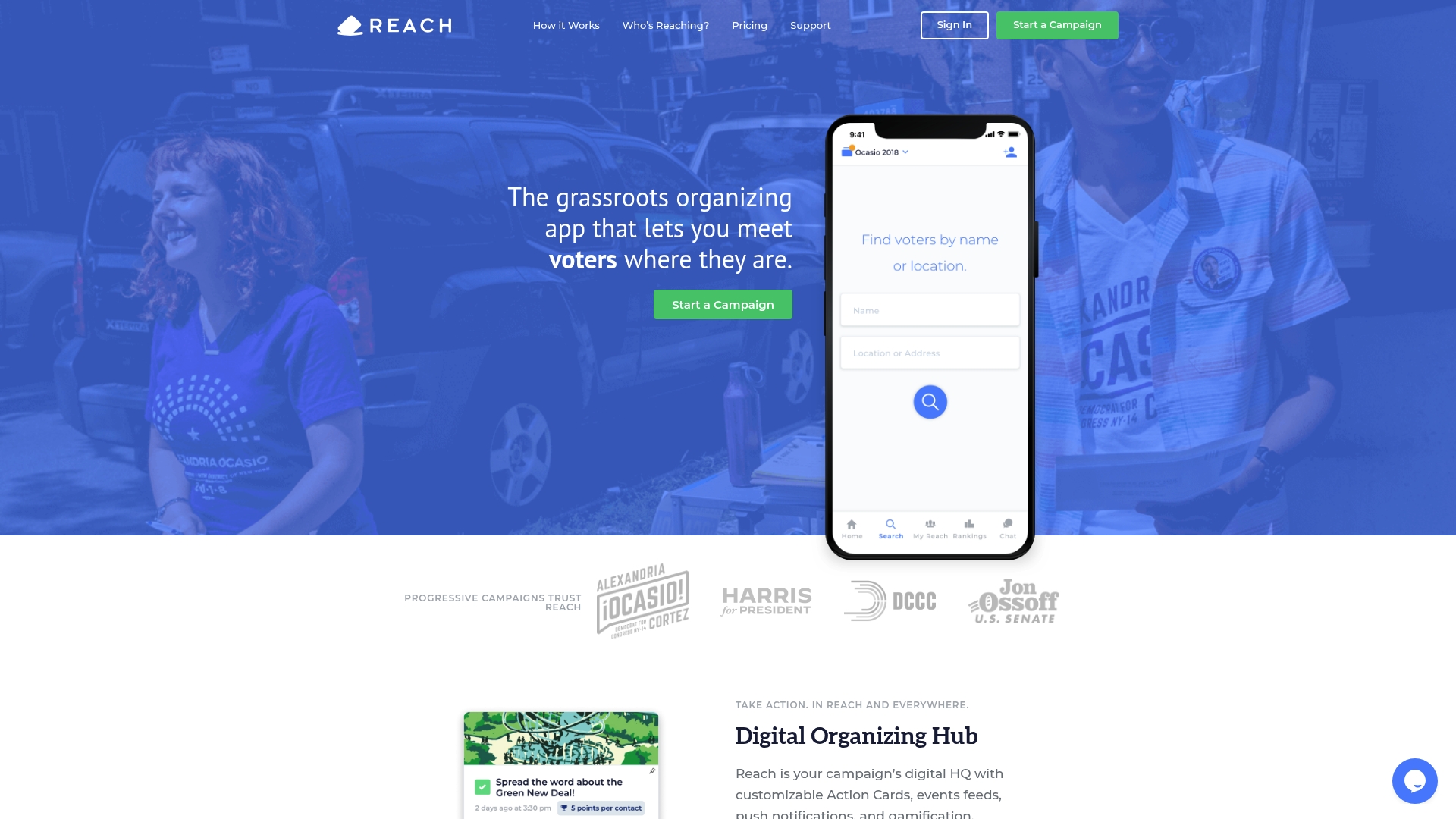
Relational contact importing, matching, and network building from supporter contacts and household data happens in real time. Reach supports offline canvassing and data collection during internet outages, which keeps volunteer teams productive in rural or low‑connectivity areas. The product also operates as a public benefit corporation with an explicit focus on progressive organizing and social justice values.
Core features
Reach groups the tools organizers use most often into one platform so teams can run voter contact, community engagement, and volunteer coordination from the same place. It emphasizes relational organizing while also handling voter registration pipelines and content sharing for supporters.
- Action Cards for task assignment, event feeds, and basic gamification to motivate volunteers.
- Community canvassing and relational organizing tools for direct supporter engagement and network building.
- Voter registration pipelines with batch messaging and tracking for list work.
- Social media content library that volunteers can share to amplify outreach.
- Offline canvassing support, real time survey collection, and APIs for exports and custom connections.
Key differentiator
Reach centers relational organizing and network mapping in a way that prioritizes community ties over raw contact volume. That focus makes it a stronger match for groups that recruit through existing relationships, leaders, and households rather than cold outreach alone. Compared with more operations oriented tools, Reach threads social justice values into templates and workflows used by organizers.
Pros
-
Highly responsive customer service. Campaign staff report quick, friendly help when onboarding or troubleshooting.
-
Combines relational organizing, voter ID, and supporter management in one place. Teams avoid switching between separate tools during a canvass.
-
Scales from local races to larger efforts. Organizers can run neighborhood canvasses or wider volunteer mobilization without changing platforms.
-
Built with values visible in workflows. The platform supports outreach styles common to progressive and community based groups.
Cons
-
Some features require direct representative assistance, which can slow setup and fixes for active field days.
-
Resource demands can be high for very small volunteer shops. Smaller teams may need to simplify workflows to match staff capacity.
-
Integrations and custom setups sometimes need advanced IT support. That raises the bar for teams without technical help.
When it may not fit
Reach is primarily suited for United States campaigns and civic groups. Organizations running outside the US will find the voter file and legal workflows misaligned. Also expect administrative setup and occasional tech support for integrations, so teams without an admin or IT contact may face delays.
Who it's for
Progressive organizers, campaign staff, and civic groups focused on grassroots recruitment and relational outreach will get the most from Reach. It fits teams that recruit through friend and family networks, run volunteer driven canvasses, and prioritize mission aligned messaging over purely transactional contact lists.
Real world use case
A progressive field program uses Reach to import supporters network data, match contacts to households, and assign relational canvass routes. Volunteers collect surveys offline, sync the data after shifts, and push shareable social posts to expand turnout work. The campaign tracks progress and keeps small teams coordinated through leaderboards and push notifications.
Website: https://reach.vote
OpenField
At a glance
OpenField uses machine learning to automatically segment canvassing lists into walkable turf areas. It also records full conversations and syncs responses in real time. The platform targets field teams running community outreach, political campaigns, and advocacy drives.
Core features
OpenField bundles tools for organizing field work and tracking conversations.
- Automates community organizing tasks such as door to door canvassing, phone outreach, and voter registration logging.
- Uses machine learning to create walkable turf segments and assign areas to volunteers.
- Provides real-time syncing of responses and complete conversation history for follow up.
- Offers analytics and segmentation tools to prioritize outreach and plan targeted follow ups.
Key differentiator
OpenField stands out for its turf segmentation driven by proprietary machine learning and live conversation tracking. That focus shortens planning for canvass directors and makes volunteer assignments more efficient. The emphasis on field-level operations means OpenField concentrates on outreach execution rather than internal planning workflows found in Campaignbuddyhq.
Pros
-
Strong support team praised for responsiveness by users. Good support reduces onboarding friction for volunteer teams.
-
Effective at reaching hard to contact communities, according to vendor messaging. This helps canvassers convert limited contact attempts into meaningful conversations.
-
Organized data tracking that logs full conversation histories. Teams can revisit responses and tailor follow up with context.
-
Easy turf segmentation with automated walkable areas. Managers spend less time drawing maps and more time coaching volunteers.
-
Supports a broad set of organizing activities from phone work to registration drives. That flexibility fits mixed outreach campaigns.
Cons
-
Limited publicly available third party reviews make independent validation sparse. That scarcity raises questions for teams that rely on peer feedback.
-
Platform may feel complex for organizers new to digital canvassing. Smaller teams without a tech lead may need extra training.
-
Feature set appears tailored to political and community campaigns. Organizations running noncampaign outreach may find some capabilities irrelevant.
When it may not fit
OpenField may not fit teams that need a lightweight, nontechnical roster management tool. Small volunteer groups without any digital organizing experience could struggle to configure segmentation rules. Programs wanting broad campaign planning features beyond field execution should compare to solutions with task planning and daily scheduling.
Who it's for
OpenField suits campaign field directors, community organizers, and advocacy groups focused on door to door and phone outreach. It works best for teams that can assign a tech lead to set up turf segmentation and manage conversation workflows. The platform rewards teams that prioritize field execution metrics.
Real world use case
A local campaign uses OpenField to plan door to door outreach for a voter registration push. Managers run turf segmentation, assign walkable routes, and monitor incoming conversation logs. Volunteers follow assigned turf and staff run targeted follow up from the conversation history.
Website: https://openfield.ai
Pulsar
At a glance
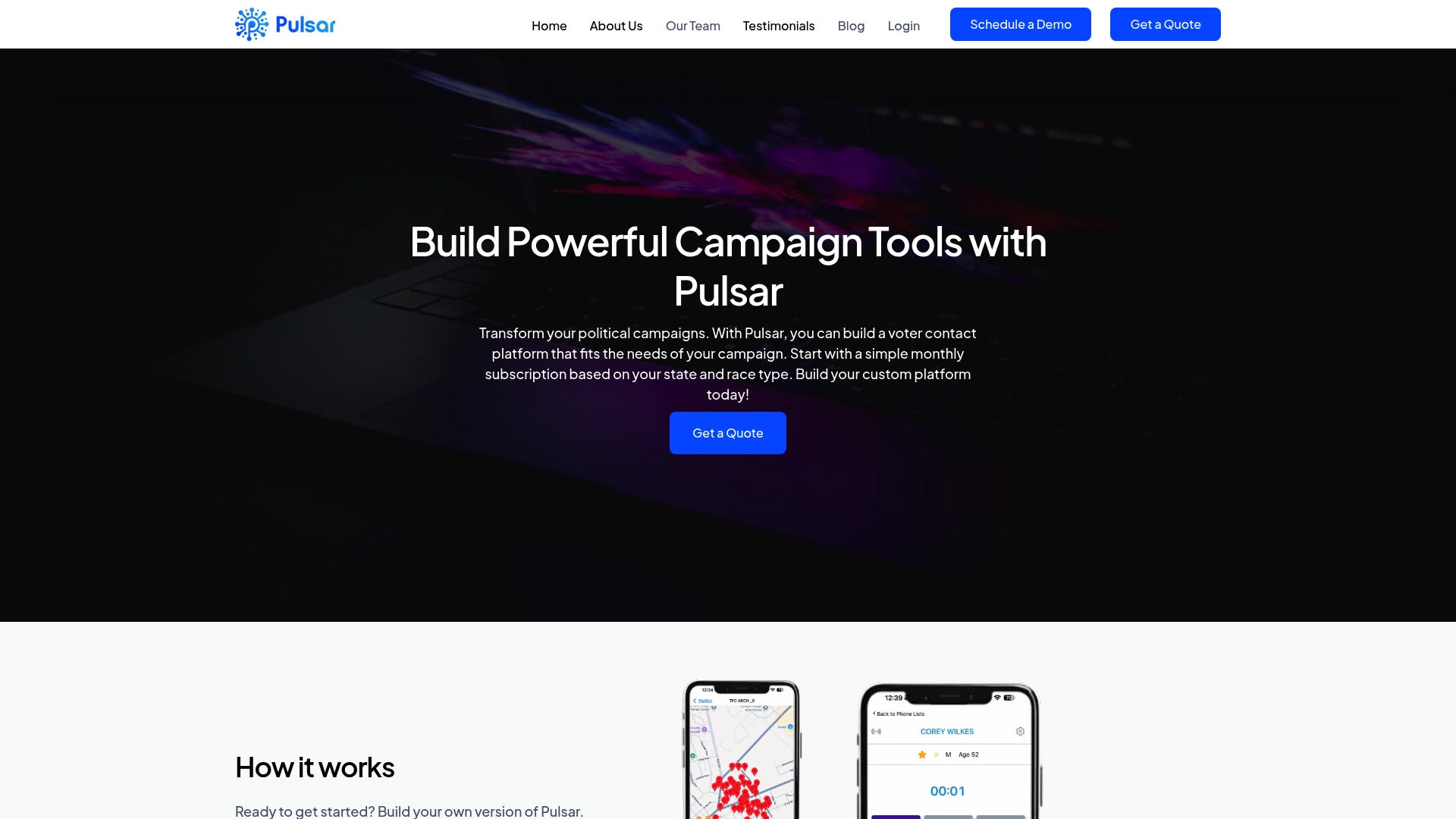
Preferred GOP vendor status and preloaded voter files give Pulsar a fast starting point for many state and local campaigns. Subscriptions are built to match state and race type, and pricing requires a campaign-specific quote. That model makes it simple to request a setup scoped to your campaign size and goals.
Core features
- Powerful Political CRM for tracking contacts, volunteer assignments, and outreach history.
- Preloaded Voter File that reduces initial data preparation for targeted outreach.
- Customizable subscription options based on state and race type so you pay for the features you need.
- Add-on tools for phone banking, texting, polling, and modeled data to support multiple outreach tactics.
Key differentiator
The central distinction is a customizable subscription model that combines a campaign CRM with ready voter data and a preferred vendor relationship. That mix supports campaigns that want a single vendor to handle data, outreach channels, and vendor compliance. Teams that need a tailored package by state or race will find the pricing and feature bundling easier to match to budgets.
Pros
-
User friendly interface that reduces training time. Campaign staff with limited tech experience can start basic outreach quickly.
-
Highly customizable platform that adapts to different campaign types. You can scale features up or down as the race changes.
-
Positive testimonials describe reliable support and steady feature updates. Those reports suggest active vendor engagement with customers.
-
Comprehensive voter contact toolset including CRM, phone banking, and texting. Running multiple outreach channels from one platform simplifies coordination.
-
Dedicated support offerings aimed at campaign setups and ongoing troubleshooting. That reduces reliance on in-house tech staff.
Cons
-
No verified third party reviews appear on major platforms, so independent user feedback is limited.
-
Pricing is quote only, which reduces upfront transparency for budget planning.
-
Publicly available independent assessments are scarce, making it harder to compare performance against other vendors.
Who it's for
Campaign teams that want a vendor to deliver voter data and contact tools in one package will benefit most. This fits operations that need state-specific subscriptions and prefer a single contract for CRM, outreach channels, and vendor compliance.
Real world use case
A state legislative campaign uses Pulsar to preload a voter file, assign canvass sheets to volunteers, and run scheduled phone banking sessions. The team tracks contact outcomes in the CRM and buys modeled data as the campaign moves into the final weeks.
Pricing
Pricing is build a quote based on your campaign specifics. You request a campaign quote that reflects state, race type, and chosen add-ons such as texting or modeled data. Expect tailored proposals rather than fixed public tiers.
Website: https://campaignsidekick.vote
<scratchpad>Competitor eligibility:
- Excluded products (discontinued / inaccessible / under construction): None
- Usable competitors remaining: [Campaign Buddy HQ, NGP VAN, Reach, OpenField, Pulsar]
Intro pre-write:
- Does campaignbuddyhq.com clearly outpace every usable competitor on a single dimension? NO
- If NO: best tradeoff dimension for the primary reader — Adaptability to small progressive campaigns with limited resources without compromising key campaign tracking functionalities.
- First sentence draft: Political campaign teams have access to several platforms offering features tailored to various organizational needs while addressing specific challenges.
Competitor win pre-write:
- Which competitor wins which dimension: NGP VAN wins scalability for large-scale, intricate campaign operations due to its integrations and compliance support.
- Does this dimension matter to the primary reader? YES
Best Fit uniqueness check:
- List each bullet scenario in one clause: Needs focused on small-scale campaigns / Requires integration with voter databases / Advocates for familial and relational connections.
- Can any two be swapped without changing meaning? NO
Our Pick pre-write:
- The ONE capability unique to campaignbuddyhq.com in this set: Offering rural-focused, straightforward, daily planning tools suitable for smaller teams.
- Evidence from the reviews: "Built specifically for real campaigns, Campaignbuddyhq prioritizes day-to-day outreach scheduling and tracking rather than broad marketing features."
- Closing sentence draft: Campaigns requiring simplified yet effective planning tools designed for smaller or rural teams will appreciate Campaign Buddy HQ’s attention to detail and ease of use.
- Substitution test: Campaigns requiring simplified yet effective mass outreach tools designed for larger operations will appreciate NGP VAN’s attention to detail and ease of use.
- Does the substituted version still work as a recommendation? NO
- If YES: rewritten closing sentence: N/A
Comparison of alternatives
Political campaign teams rely on management platforms to maximize their outreach efforts and resource allocations. Evaluating prominent options reveals several unique strengths and tailored solutions.
Scalability and integration
For large-scale campaigns with intricate needs, NGP VAN outshines others with its advanced features, such as voter data, detailed compliance tools, and integrations with platforms such as MiniVAN and Mobilize. While these capabilities empower larger campaigns, they may overwhelm smaller teams due to a steep learning curve and higher costs.
Community and relational organizing
Reach provides strong relational organizing tools, emphasizing familial and social ties in outreach. This focus provides unique benefits for campaigns prioritizing community-driven connections, though its requirements for setup and technical support may challenge smaller volunteer teams. Additionally, the inclusion of offline capabilities supports environments with limited connectivity.
Best fit
- Campaigns needing focused features for small-scale operations value Campaign Buddy HQ, with its straightforward daily planning and outreach tracking optimized for volunteers and limited budgets.
- Teams prioritizing integrations with established voter databases and complex compliance features benefit from NGP VAN.
- Field organizations that emphasize relational and community-based organizing should consider Reach, which excels in supporting linked supporter networks with accountability.
- Efforts requiring automated segmentation and real-time feedback thrive using OpenField's field prioritization and analytical tools.
- Campaigns desiring preloaded voter data and adaptable outreach manageability may find Pulsar appealing for its tailored structuring.
Our pick
Campaign Buddy HQ is particularly suited for smaller campaigns, offering tools that simplify planning and tracking while catering to dispersed volunteer networks. However, teams that require advanced integration capabilities or manage extensive field operations might find NGP VAN a better match.
Choosing the most suitable political campaign management software relies on specific needs and how each solution aligns with campaign goals.
| Product | Core Features | Key Differentiator | Best For | Notable Limitation | Pricing |
|---|---|---|---|---|---|
| Campaignbuddyhq | Daily/weekly planning, outreach and supporter tracking, tailored planning | Focused on day-to-day outreach scheduling | Progressive candidates and small teams | Limited integrations with external CRMs | $25/month; 7-day free trial |
| NGP VAN | Fundraising and compliance, voter targeting, canvassing tools | Deep integration with MiniVAN and Mobilize | Large campaigns with high-scale outreach | Steep learning curve for new users | Not disclosed |
| Reach | Relational organizing, voter registration, social media sharing | Prioritizes community ties and social justice | Grassroots campaigns and civic groups | High resource demands for smaller teams | Not disclosed |
| OpenField | Automated turf segmentation, real-time conversation syncing | Machine learning for walkable turf creation | Community outreach and advocacy efforts | Technical setup may be daunting | Not disclosed |
| Pulsar | Contact tracking, preloaded voter files, customizable subscriptions | Combines voter data with outreach tools | State-specific, vendor-compliant campaigns | Pricing requires a custom quote | Quote-based pricing |
Discover why Campaignbuddyhq stands out among Campaignheadquarters.us alternatives
Campaign teams often struggle with managing daily outreach tasks while keeping volunteers focused and energized. Common pain points include overwhelming data systems, unclear task planning, and limited tools for rural or low-density districts. Campaignbuddyhq offers a clear solution by tailoring daily and weekly planning, outreach tracking for doors, calls, texts, and registrations, plus supporter progress monitoring all wrapped in a user-friendly design.
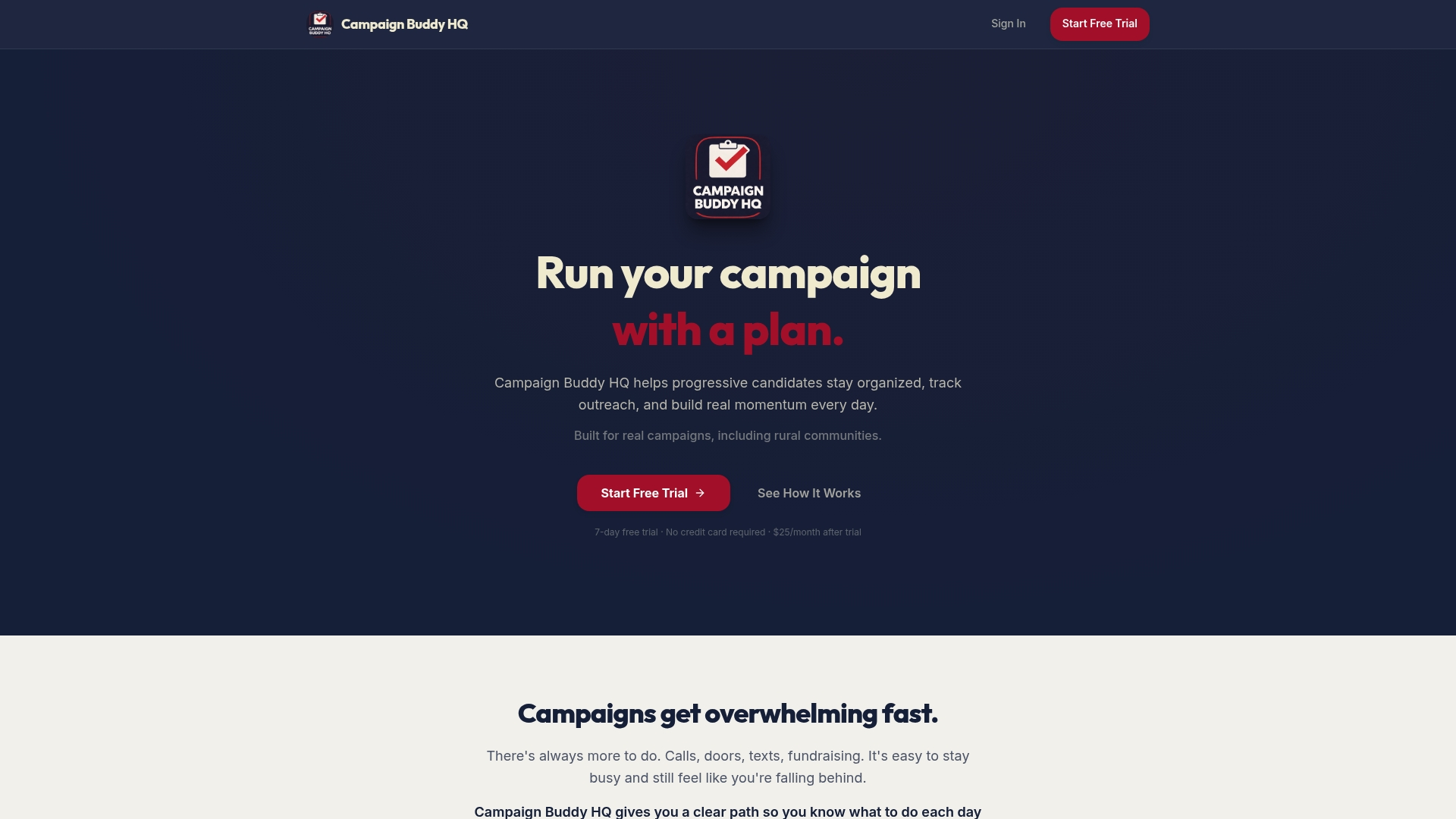
If you want to simplify your campaign operations and boost follow-through on voter contact goals, explore Campaignbuddyhq. Start with the free 7-day trial requiring no credit card and experience how focused daily planning can transform your outreach workflow. Take control of your volunteer coordination and outreach logging with tools designed just for grassroots and progressive campaigns. Visit Campaignbuddyhq today and assign clear daily tasks that your team can accomplish confidently.
FAQ
What features make Campaignbuddyhq a good choice for small campaign teams?
Campaignbuddyhq offers tailored daily campaign planning that assigns clear tasks to volunteers and staff based on the campaign stage. This feature ensures that teams remain organized and focused, which is crucial for small campaigns where volunteer time is limited. Small teams can leverage this structured approach to effectively track their outreach and engagement goals.
How does Campaignbuddyhq compare to NGP VAN regarding user interface?
NGP VAN is known for its strong voter targeting and canvassing tools, making it suitable for larger campaigns. In contrast, Campaignbuddyhq excels in providing a simpler daily planning interface tailored for grassroots teams needing straightforward outreach workflows. Choosing Campaignbuddyhq may better suit teams that prioritize ease of use and direct task assignments.
Does Campaignbuddyhq support the logging of outreach activities?
Yes, Campaignbuddyhq allows for simple logging of outreach activities, such as doors, calls, texts, and registrations. This feature helps create an accountability trail for both staff and volunteers, facilitating easy review of campaign efforts without complex reporting.
What limitations should i consider when using Campaignbuddyhq?
A notable limitation of Campaignbuddyhq is its restricted integrations with voter databases and fundraising platforms, which may hinder automation and data import options for campaigns relying heavily on external tools. It's important for teams that need these capabilities to weigh this consideration against their needs.
Is Campaignbuddyhq suitable for rural campaign teams?
Yes, Campaignbuddyhq is specifically designed to support rural and low-density environments, as its interface accounts for outreach across long distances and smaller contact counts. This makes it an ideal choice for campaigns operating in less populated areas.