

Setting more goals and logging more doors knocked doesn't automatically translate into winning campaigns. In fact, a closer look at large-scale Democratic outreach reveals a troubling gap between activity and actual voter contact. The real problem isn't effort. It's strategy. Without clear, outcome-focused goals, even the most passionate field teams burn out chasing numbers that don't move votes. This guide walks you through research-backed frameworks to help you set smarter campaign goals, shift your team's focus from raw output to real results, and build a plan that actually delivers on election day.
Table of Contents
- Why campaign goal setting matters more than ever
- Frameworks for setting winning campaign goals
- Shifting from vanity metrics to meaningful outcomes
- Applying the strategy: From goal to campaign plan
- What most guides get wrong about campaign goals
- Next steps: Campaign tools to support your goals
- Frequently asked questions
Key Takeaways
| Point | Details |
|---|---|
| Outcomes matter most | Focus on engagement and persuasion, not just counting calls or outreach. |
| SMART goals win | Use SMART criteria to make campaign targets actionable and trackable. |
| Measure what counts | Prioritize relationship quality and local knowledge over vanity metrics. |
| Flexibility is crucial | Be ready to adapt goals as campaign realities and local feedback evolve. |
Why campaign goal setting matters more than ever
Every campaign manager has felt the pressure to do more. More calls. More doors. More texts. More events. But raw volume is a trap, and the data makes this painfully clear. The DNC's 300M calls produced only a 3% voter contact rate. That's hundreds of millions of attempts that mostly reached voicemail, wrong numbers, and people who had already moved. The lesson isn't that outreach is worthless. It's that unfocused, goal-less outreach is.
At the same time, digital ads shifted turnout by only 0.4 percentage points among Biden-leaning voters, according to a Yale study on digital persuasion. That's a nearly invisible effect for an enormous investment of time and money. Yet many campaigns still pour budget into digital because it's easy to measure clicks and impressions. Those are outputs, not outcomes.
Here's the critical shift: outputs measure what your team did. Outcomes measure what actually changed for voters. Goal setting that confuses the two leads to campaigns that look busy but lose close.
The risks of skipping clear goal setting are real:
- Wasted resources: Teams chase the wrong targets and exhaust budgets early.
- Poor morale: Volunteers lose motivation when their work feels disconnected from results.
- Missed victories: Close races are decided by a handful of persuaded voters, and without precision goals, you're flying blind.
- Shallow accountability: Without specific targets, it's impossible to know whether adjustments are needed.
"Local expertise and relational organizing consistently beat data-driven vanity metrics when it comes to real voter persuasion."
The most effective grassroots campaigns treat goal setting as a strategic foundation, not a checklist item. They define what winning looks like before a single door is knocked, and they build every activity around that definition. This shift in mindset, from busyness to purpose, is what separates campaigns that build momentum from those that fizzle out in the final weeks.
Frameworks for setting winning campaign goals
Once you accept that purposeful action beats raw volume, the next question is practical: how do you actually write goals that work? The most reliable framework is SMART, and it translates directly to campaign contexts. SMART goals for campaigns are Specific, Measurable, Achievable, Relevant, and Time-bound.
Here's what that looks like in practice:
- Specific: Instead of "increase volunteer numbers," write "recruit 15 new canvassers in the Eastside precinct by March 15."
- Measurable: Attach a number. "Collect 200 pledge cards" beats "get more pledges."
- Achievable: Calibrate to your actual capacity. A team of 5 volunteers cannot knock 1,000 doors per week.
- Relevant: Connect every goal to your win number. If you need 4,200 votes, every goal should trace back to that target.
- Time-bound: Set hard deadlines and weekly check-ins. Vague timelines kill urgency.
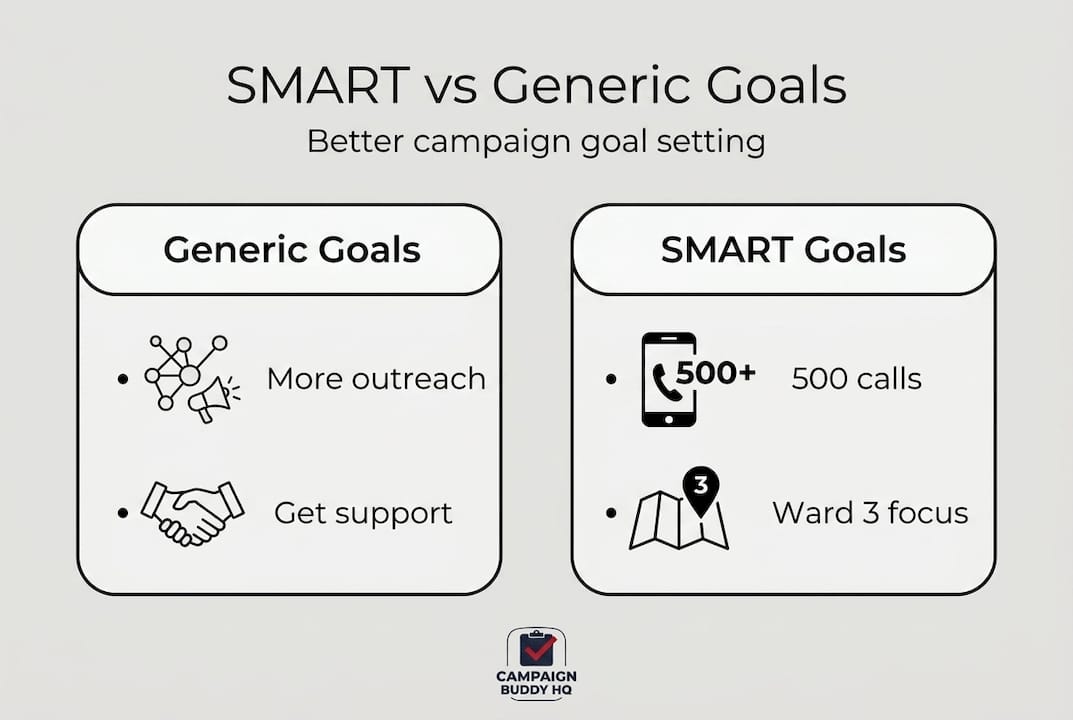
Here's a direct comparison to show the difference between generic and SMART campaign goals:
| Generic Goal | SMART Campaign Goal |
|---|---|
| "Call more voters this month" | "Make 500 persuasion calls in Ward 3 by October 31" |
| "Raise more money" | "Raise $8,000 in small-dollar donations by the end of Q3" |
| "Get volunteers" | "Recruit 20 trained canvassers by the campaign kickoff event" |
| "Reach young voters" | "Text 1,000 voters aged 18-29 in zip code 48205 before the primary" |
Practical campaign goal setting also means writing different goals for different functions. Fundraising goals track dollars and donor counts. Voter contact goals track conversations and commitments, not just attempts. Volunteer goals track trained and retained team members, not just sign-ups.
Pro Tip: Before you finalize any goal, share it with two or three of your frontline volunteers. If they can't tell you in one sentence what success looks like, rewrite the goal. Field clarity is the final test.
The SMART framework isn't new, but campaigns consistently underuse it because goal writing feels abstract compared to the urgency of canvassing. Make it a ritual. Set aside 30 minutes each week to review and refine goals with your team leads. That habit pays off.
Shifting from vanity metrics to meaningful outcomes
Most campaign teams track what's easy to count: doors knocked, calls made, texts sent, social media likes. These numbers feel good to report. They rarely correlate with winning. That's the vanity metric trap, and it's more common in progressive grassroots campaigns than anyone wants to admit.
The DNC's updated organizing strategy explicitly prioritizes quality relationships and "listening-first" engagement over output volume. That's a significant shift from years of chasing contact numbers. The playbook now emphasizes layered follow-ups, digital integration that supports field work rather than replacing it, and coalition-building that reflects community trust.
Here's a practical breakdown of the difference:
| Vanity Metric | Outcome Metric | Why It Matters |
|---|---|---|
| Doors knocked | Committed supporters identified | Commitment predicts turnout |
| Calls made | Meaningful conversations completed | Quality drives persuasion |
| Texts sent | Response and pledge rate | Engagement signals real interest |
| Social media impressions | Volunteer sign-ups from digital | Conversion shows real impact |
| Email list size | Repeat donors or volunteers | Loyalty measures depth |
Measuring relationship quality sounds harder than counting doors, but it isn't if you build it into your tracking system from the start. Rate every conversation: was the voter persuadable, committed, or hostile? Log follow-up needs. Track whether a supporter showed up to a second event. These data points tell you whether your field program is working.
"Local knowledge often yields better results than top-down data metrics because it captures context that spreadsheets miss."
The pitfalls of quantity-first thinking are also human. Volunteers who feel like data entry machines instead of community organizers burn out faster. When every conversation is just a tick on a spreadsheet, the relational depth that actually moves votes disappears. Campaigns that celebrate quality encounters alongside raw numbers build teams that last through a long general election cycle.
Applying the strategy: From goal to campaign plan
Good goals are useless without execution plans. Here's a workflow you can adapt to any campaign context:
- Set your win number first. Calculate the votes you need to win based on historical turnout and your district's voter universe. Everything else flows from this.
- Break it into phases. Divide your campaign calendar into phases: pre-primary, primary, post-primary, and general. Assign goal targets to each phase.
- Map goals to activities. Each goal should link directly to specific activities. If your goal is 300 new commitments this month, map out how many doors, calls, and events it takes to get there.
- Assign clear ownership. Every goal needs one person who is accountable for it. Shared ownership usually means no ownership.
- Schedule regular reviews. Weekly check-ins keep goals alive. Daily stand-ups for field teams catch problems early.
- Adjust without shame. If a goal was set too high or conditions changed, revise it. Refusing to adapt wastes time and discourages your team.
Research confirms that in-person relational organizing is essential because digital outreach shows only modest turnout impact. Your plan should weight face-to-face and phone conversations heavily, especially in the final weeks.
Common traps to avoid when moving from goal to plan:
- Overgeneralizing your voter universe: Treating all low-propensity voters the same ignores neighborhood-level differences that field volunteers know firsthand.
- Shifting targets mid-stream without documentation: Changing a goal without recording why creates confusion and undermines accountability.
- Ignoring local conditions: A goal built for a dense urban precinct won't work in a rural county. Calibrate always.
- Skipping the tool layer: Manual tracking at scale breaks down. Use tools for organizers to automate reporting and keep your team focused on people, not paperwork.
Pro Tip: Build a simple one-page goal dashboard that every team lead can update daily. Visibility creates accountability, and accountability drives consistency.
What most guides get wrong about campaign goals
Most goal-setting guides treat the process like a one-time event: write your goals in week one, then execute. That model doesn't survive contact with reality. Campaigns are living operations. Candidates change their message. Endorsements shift the playing field. A key organizer moves. Local issues emerge that your original plan never anticipated.
Conventional wisdom around output metrics often misses the power of local expertise precisely because it assumes data collected months ago still reflects what's happening on the ground today. It often doesn't. The campaigns we've seen succeed are the ones that treated their goals as adaptable guideposts, not rigid scorecards.
This means building a regular review ritual into your campaign structure. Not to excuse missing targets, but to ask honestly: are we chasing the right thing? Sometimes the answer is yes, push harder. Sometimes the answer is that the environment shifted and the smart move is to redirect resources. The campaigns willing to ask that question out loud, even when the answer is uncomfortable, are the ones that stay competitive through to election day.
Next steps: Campaign tools to support your goals
With these strategies in hand, the right tools make all the difference between a goal that lives on a whiteboard and one that drives daily action across your whole team.
Campaign Buddy HQ was built specifically for grassroots campaigns like yours. Start with the vote goal calculator to anchor your entire strategy in a real win number. From there, explore the AI overview to see how automated tracking and smart reporting can save your team hours every week. The Campaign Buddy HQ platform brings goal setting, outreach logging, and supporter tracking into one place, so your team spends less time managing spreadsheets and more time building the relationships that win elections. Try it free for 7 days with no credit card required.
Frequently asked questions
What are SMART goals in political campaigns?
SMART goals are Specific, Measurable, Achievable, Relevant, and Time-bound objectives that help campaigns focus effort and measure progress against concrete targets rather than vague intentions.
How do I measure the success of grassroots campaigns?
Focus on outcomes like supporter commitment rates, repeat engagement, and actual conversions rather than raw contact volume. The DNC's current approach centers on relationship quality over output numbers as the true measure of organizing success.
Why not just set higher outreach targets every time?
Higher targets without better strategy produce diminishing returns. With 300M calls yielding only a 3% contact rate, the evidence is clear: depth of engagement matters far more than volume of attempts.
Do digital ads significantly increase turnout?
Digital ads shift turnout by only about 0.4 percentage points, so they work best when they support and amplify relational field organizing rather than substitute for it.