

Running a political campaign without a solid daily plan is like canvassing without a map. You burn energy, miss doors, and lose momentum fast. Campaign organizers face a relentless stream of decisions: who to call, where to deploy volunteers, which neighborhoods need another pass, and how to keep a distributed team moving in the same direction. This guide breaks down the criteria, frameworks, tools, and real-world tactics that help progressive campaign organizers build daily planning routines that actually hold up under pressure. Whether you're running a small local race or a large statewide effort, structured daily planning is the engine that powers everything else.
Table of Contents
- Core criteria for effective daily planning
- Recommended daily planning frameworks for organizers
- Modern tactics and tools to maximize daily impact
- Making the frameworks work: Adapting to your campaign's needs
- Why conventional campaign routines aren't enough: A proven organizer's take
- Next steps: Put powerful daily planning into practice
- Frequently asked questions
Key Takeaways
| Point | Details |
|---|---|
| Structured planning wins | Phased daily routines anchor campaign teams and foster accountability. |
| Modern tools boost results | Blending digital and relational tactics increases outreach effectiveness. |
| Flexibility is crucial | Effective organizers adapt frameworks to meet changing campaign needs. |
| Data drives improvements | Daily reviews and feedback loops power smarter, more responsive organizing. |
Core criteria for effective daily planning
Now that we've set the stage, let's break down what every organizer should look for in a daily planning method.
Not every planning system is built for the speed and complexity of a political campaign. A framework that works for a corporate project manager will collapse in week two of a contested primary. So before you adopt any routine, you need to evaluate it against criteria that matter for campaign life specifically.
The four pillars of effective daily planning are flexibility, accountability, communication, and data-driven decision-making. Flexibility means your plan can absorb a last-minute canvass cancellation or a sudden news cycle shift without falling apart. Accountability means every team member knows their daily targets and reports back on them. Communication means information flows between field, digital, and data teams without bottlenecks. And data-driven decision-making means you're adjusting based on what your numbers actually show, not gut instinct alone.
A phased daily structure is one of the most proven ways to embed all four pillars into your routine. Here's what that looks like in practice:
- Morning goal check: Review overnight data, confirm daily outreach targets, and align your team on priorities before anyone hits the doors or phones.
- Active execution window: Deploy volunteers, run call banks, send texts, and log results in real time. This is the production phase.
- Evening debrief: Review the day's numbers, flag problems, celebrate wins, and set up tomorrow's priorities. This is where learning happens.
- Weekly review: Step back from daily noise to assess trends, adjust your campaign phase strategy, and redistribute resources.
A phased daily/weekly approach provides structure and adaptability for campaign teams, which is exactly what separates campaigns that build momentum from those that plateau mid-cycle.
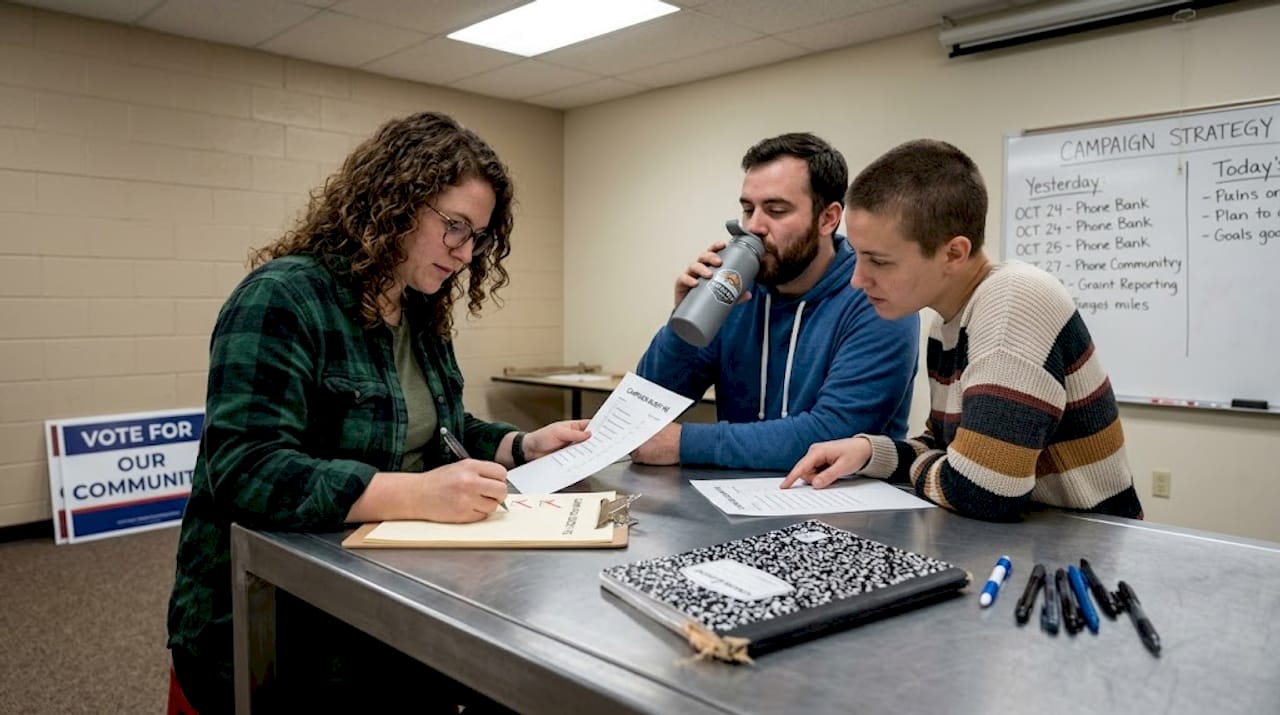
Pro Tip: Assign a specific daily outcome to each team or volunteer cohort at the start of every morning check-in. When each group owns a measurable goal, accountability becomes peer-driven rather than top-down, which is far more sustainable across a long campaign.
You also need to integrate your weekly review with your daily tasks so they reinforce each other. Weekly reviews should surface patterns: which turf is underperforming, which volunteer shift times yield the best contact rates, and which messaging is landing. Then those insights feed directly into the next week's daily plans. For a broader overview of campaign routines, it helps to see how experienced campaigns structure this cycle from the start.
"The most effective campaigns anchor their day around measurable goals and structured intervals, not just raw activity volume."
This distinction matters more than most organizers realize. Logging 500 doors means nothing if you can't tell what conversations happened, which voters moved, and what follow-up is needed. Measurable goals tied to structured intervals give you that clarity.
Recommended daily planning frameworks for organizers
Once you know what to look for, it's time to explore practical frameworks that have powered modern winning campaigns.
There is no single correct daily planning framework, but there are a handful of structures that consistently outperform improvised approaches. The key is choosing one that fits your campaign's scale and then adapting it as you learn.
Here is a step-by-step outline for phased daily planning that works across campaign sizes:
- 7:30 a.m. Data pull: Pull overnight VAN or CRM data to see where you stand on weekly targets for doors, calls, texts, and registrations.
- 8:00 a.m. Team standup: A 15-minute check-in where each team lead reports their daily goal and any blockers. Keep it tight.
- 9:00 a.m. to 12:00 p.m. Phone banking and digital outreach: Early morning is the best window for call banks and text programs before people get into their midday routines.
- 12:00 p.m. to 6:00 p.m. Field canvassing: Deploy door-to-door teams with turf assignments already loaded and contact scripts ready.
- 6:00 p.m. to 8:00 p.m. Follow-up and re-contact: Use this window for digital follow-ups on voters who were contacted but not fully engaged earlier in the day.
- 8:30 p.m. Evening debrief: Review the day's contact numbers, log any notable conversations, and confirm tomorrow's priorities.
Phased daily planning supports morning goal-setting, targeted midday voter contact, and evening debriefs, plus weekly team reviews, all of which compound into measurable progress over a campaign cycle.
The DNC Playbook emphasizes daily "listening first" interactions, digital-field integration, and follow-up "layering," which means every initial contact should have a planned second touchpoint built into the workflow before the day ends.
Pro Tip: Use a real-time dashboard, whether it's built into your campaign platform or a shared spreadsheet, so every team lead can see live progress toward daily goals. When people can see the number moving in real time, motivation stays high and course corrections happen faster.
Here's a sample daily planning schedule broken down by team size:
| Task | Small team (1 to 5 people) | Large team (20 or more people) |
|---|---|---|
| Morning standup | 10-minute all-hands call | Breakout by department, 15 minutes each |
| Daily outreach goal | 50 to 100 contacts | 500 or more contacts |
| Data logging | Manual entry after each shift | Real-time CRM updates by field leads |
| Midday check-in | Optional text update | Required check-in with team leads |
| Evening debrief | Group text or quick call | Structured debrief meeting with data review |
| Weekly review | Saturday morning, 30 minutes | Friday afternoon, full team, 60 minutes |
Frameworks like this empower teams to pivot and iterate based on what the daily results actually show. If your call bank is hitting a wall at 11 a.m., you shift resources to texts. If a particular turf is yielding high contact rates, you double down. Rigid plans break. Structured frameworks flex.
Modern tactics and tools to maximize daily impact
With solid frameworks in place, let's look at the latest tools and tactics that can raise your daily success rates.
Here's a reality check that most campaign manuals won't give you: some campaigns are generating massive daily outputs and still seeing declining contact rates because traditional script-heavy canvassing no longer breaks through the way it once did. Voters are harder to reach, more skeptical of cold outreach, and more responsive to genuine, relationship-based conversations.
That's why non-traditional tactics like relational organizing and high-traffic canvassing are becoming standard tools in the progressive campaign toolbox. Relational organizing means activating your existing supporters to reach their own networks, which produces far warmer conversations than a stranger at the door. High-traffic canvassing means setting up in places where people already are: farmers markets, transit stops, community events.
The DNC's shift to relational, service-based organizing supports year-round scalable engagement, which is a significant departure from the sprint-and-collapse model many campaigns still default to.
Here are the most effective tools and tactics for maximizing daily impact:
- VAN (Voter Activation Network): The industry standard for voter data, turf cutting, and contact logging. Essential for any field program.
- Hustle or ThruText: Peer-to-peer texting platforms that allow volunteers to send personalized messages at scale.
- Relational organizing apps: Tools like Empower or OutVote let supporters reach their own contacts using campaign-approved messaging.
- Slack or GroupMe: Internal communication tools that keep your team connected without flooding personal inboxes.
- Campaign Buddy HQ: Designed specifically for progressive campaigns, it integrates daily planning, outreach logging, and progress tracking in one place. Especially useful for campaigns in rural or low-density areas where turf management is complex.
Here's a comparison of traditional versus modern outreach tactics:
| Criteria | Traditional tactics | Modern tactics |
|---|---|---|
| Scale | High volume, broad reach | Targeted, network-based reach |
| Personalization | Script-driven, low variation | Conversation-based, adaptive |
| Sustainability | Sprint-heavy, volunteer burnout risk | Year-round, relationship-building model |
| Data feedback | End-of-day manual logging | Real-time digital tracking |
| Contact quality | Variable, often transactional | Higher depth, trust-building |
Blending new and classic approaches consistently improves both output volume and relationship quality. You still need the doors and the calls. But layering relational tactics on top of traditional field work is what separates campaigns that build genuine voter loyalty from those that just rack up contact numbers. For more on campaign organizing trends, the shift toward hybrid models is accelerating heading into 2026.
Making the frameworks work: Adapting to your campaign's needs
Having reviewed tools and tactics, the next step is making these frameworks truly work for your unique campaign context.
A daily planning framework is only as good as its fit with your actual campaign. A five-person team running a city council race needs a completely different structure than a statewide operation with 40 field organizers. The mistake most campaigns make is adopting a framework wholesale without stress-testing it against their real constraints.
Here's a step-by-step process for adapting any planning framework to your campaign:
- Assess your current state: Map out how your team currently spends its time. Where are the gaps? Where is time being wasted? What data are you not capturing?
- Pilot test for one week: Choose one component of the framework, such as the morning standup or the evening debrief, and run it for seven days straight. Don't try to implement everything at once.
- Collect honest feedback: Ask your volunteers and staff what's working and what feels like friction. Frontline organizers will tell you things your data won't.
- Iterate with intention: Make one or two adjustments based on feedback, then run another week. Small, deliberate changes beat big overhauls.
- Lock in what works: Once a routine is producing consistent results, document it and make it a standard operating procedure for your campaign.
Staff burnout and team silos are two of the biggest threats to daily planning consistency. Script-heavy routines versus listen-first approaches, siloed departments versus unified organizing structures, and quantity outputs versus quality relationships are real tensions that every campaign has to navigate consciously.
Communication routines are your best defense against both burnout and silos. When field, digital, and data teams share a daily debrief, information flows freely and no one is working in isolation. When staff know that their feedback will actually change the plan, they stay engaged instead of just going through the motions.
Pro Tip: Schedule a brief weekly feedback loop, separate from the debrief, where staff can flag planning problems without it feeling like a performance review. A 10-minute anonymous check-in on Friday afternoons can surface issues before they become crises.
Balancing traditional and new approaches based on real-time performance metrics is the final piece. If your relational outreach is producing higher conversion rates than your cold canvassing, shift more resources toward it. Let the data guide the balance, not habit or assumption. For teams looking to build effective organizing routines that flex with real-world results, this iterative mindset is what separates good campaigns from great ones.
Why conventional campaign routines aren't enough: A proven organizer's take
Standard daily routines are a starting point, not a destination. Too many campaigns treat their planning framework as a fixed structure rather than a living system, and that rigidity is what causes them to stall when conditions change.
The honest truth is that script-heavy, traditional routines miss the relationship depth and adaptability that modern campaigns require. We've seen campaigns log tens of thousands of contacts and still lose because those contacts were transactional rather than relational. Numbers on a dashboard don't vote. People do.
The campaigns that win are the ones that treat every daily debrief as a learning session, not just a reporting exercise. They ask: what did we learn today that changes how we work tomorrow? They blend digital efficiency with genuine human connection. And they give their organizers the freedom to adapt in the field rather than robotically following a script.
Adopt a learning mindset. Experiment with your planning structure. Track what actually moves voters, not just what's easy to count. That's where real campaign momentum comes from.
Next steps: Put powerful daily planning into practice
Ready to take action? Here's where you can find the best tools to get started.
If you've been building your daily planning routine in spreadsheets and group chats, there's a better way. Campaign Buddy HQ is built specifically for progressive campaigns that need to organize outreach, log contacts, and track progress toward real goals, all in one place.
You can use the platform's AI daily planning tools to generate structured daily schedules based on your campaign phase and outreach targets. The vote goal calculator helps you work backward from your win number to set realistic daily and weekly goals. There's no credit card required for the free 7-day trial, so you can test it against your current workflow immediately and see the difference structured planning makes.
Frequently asked questions
What is the most important part of daily planning for campaign organizers?
Setting clear, measurable goals for each day and reviewing outcomes as a team ensure everyone is aligned and accountable. Phased daily planning fosters both structure and accountability across the full campaign cycle.
How do I choose the right planning framework for my campaign?
Select a framework that matches your campaign's size, resources, and outreach methods, then test it, gather feedback, and adjust as you go. Frameworks should be adapted and iterated based on the specific needs and constraints of each campaign.
What should I do if outreach contact rates are low?
Try relational organizing strategies, digital follow-ups, and high-traffic canvassing to build more genuine connections with voters. Non-traditional tactics can raise engagement significantly when standard contact rates begin to decline.
How can digital tools help with daily planning?
Digital dashboards and field data integration boost transparency, coordination, and real-time decision-making across your entire team. Digital-field integration enhances both follow-up consistency and overall engagement quality throughout the campaign.