

Running a political campaign without a clear checklist is like navigating a city without a map. You might eventually get where you're going, but you'll waste time, miss turns, and exhaust your team in the process. The distance between a disorganized campaign and a winning one often comes down to structure. When you translate your goals into phased, actionable checklists, your volunteers stay focused, your digital and field operations stay aligned, and your outreach numbers go up. This guide walks you through what every effective campaign checklist needs, phase by phase, so you can build momentum from day one.
Table of Contents
- Criteria for an effective campaign checklist
- Pre-launch preparation: Setting campaign foundations
- Outreach and engagement: Building community power
- GOTV checklist: Mobilizing supporters for maximum turnout
- What most checklist guides miss: Integrating lessons from past failures
- Next steps: Level up your campaign with smart tools
- Frequently asked questions
Key Takeaways
| Point | Details |
|---|---|
| Checklist criteria matter | Effective checklists enable campaigns to handle complex workflows and avoid missed steps. |
| Integrate digital and field | Combining online and offline engagement increases outreach and voter contact rates. |
| Adapt to feedback | Updating checklists based on campaign progress and challenges ensures lasting effectiveness. |
| Use tech solutions | Leveraging platforms for campaign management streamlines tasks and makes outreach easier. |
Criteria for an effective campaign checklist
Not all checklists are created equal. A list of random tasks stapled together won't get your team across the finish line. The best campaign checklists share a few defining characteristics that separate organized, high-output campaigns from scrambling ones.
The essential criteria include:
- Phased structure. Your checklist should map to clear campaign phases: pre-launch, voter outreach, and Get Out The Vote (GOTV). Each phase has its own priorities, and mixing them up creates confusion.
- Integration of digital and field operations. A checklist that only covers door knocking or only covers social media is incomplete. Both must work together.
- Accessible onboarding steps. New volunteers need a clear entry point. If your checklist assumes prior knowledge, you'll lose half your team before they knock a single door.
- Accountability built in. Every item should have an owner and a deadline. "Update the voter list" is not a checklist item. "Volunteer coordinator uploads updated voter list by Tuesday at noon" is.
- Feedback loops. Effective checklists leave room to capture what's working and what isn't, so your team can adapt in real time.
The DNC organizing playbook introduced what it calls the Organizing Re-Model, which emphasizes listening first, dismantling silos between departments, and improving volunteer onboarding. This framework is now a foundational approach from the DNC Playbook that many progressive campaigns have adapted into their own workflows.
"The best checklists are living documents. They reflect the reality on the ground, not just the plan on paper."
Pro Tip: Before your campaign kicks off, do a dry run of your checklist with two or three core team members. Ask them what's confusing or missing. This one-hour exercise will save you weeks of friction later.
When you're thinking about structuring nonprofit campaign stages, the same principles apply. Clarity, ownership, and phase-specific focus are non-negotiable no matter your organizational type.
Pre-launch preparation: Setting campaign foundations
The work you do before you launch publicly determines whether your first week looks like organized momentum or controlled chaos. Most campaigns rush this phase, and they pay for it later with inconsistent messaging, confused volunteers, and data problems that take weeks to fix.
Here's a numbered checklist to build your pre-launch foundation:
- Define your campaign goals and vote target. How many votes do you need to win? Work backward from that number to set weekly outreach targets for doors, calls, and texts.
- Clarify your core message. Every volunteer and spokesperson should be able to answer "Why this candidate?" in two sentences. Write those two sentences and train everyone on them.
- Assign team roles with clear responsibilities. Identify your field director, digital lead, volunteer coordinator, and data manager. Put names next to titles before day one.
- Set up your digital tools. This includes your CRM (Customer Relationship Management system), voter file access through NGP VAN or a similar platform, and your texting and calling tools.
- Build your onboarding materials. New volunteers should receive a one-page overview of the campaign, their specific role, and their first week's tasks. Don't make them ask.
- Schedule your first team training. Cover the campaign message, the tools, and the voter contact plan. Record it so future volunteers can watch it on their own time.
- Conduct your first listening sessions. Before you start persuading voters, spend time in the community asking questions. What issues matter most? What are people frustrated about?
Phased approaches ensure a clean workflow from pre-launch all the way through GOTV, especially when digital and field operations are integrated from the start rather than bolted together later.
"Campaigns that rush the pre-launch phase often spend the first month of outreach cleaning up messes they created in week one."
Following campaign optimization tips from experienced political consultants reinforces the same point: investing in structure early pays dividends throughout the entire campaign cycle.
Pro Tip: Use a shared project management tool like Trello or Airtable to house your pre-launch checklist. Give every team member access so accountability is visible and real-time updates keep everyone on the same page.
When you're structuring nonprofit campaign stages, pre-launch is the phase where most of the infrastructure is built. Don't treat it as a formality. It's the foundation everything else rests on.
Outreach and engagement: Building community power
With your foundations in place, it's time to move into active outreach. This is where your checklist expands to cover both digital and in-person touchpoints, and where the difference between a siloed campaign and an integrated one becomes visible in your contact numbers.
Core outreach checklist items:
- Schedule weekly phone banks and text banks with volunteer sign-up sheets
- Plan community events that let voters meet the candidate in person
- Track every voter contact in your CRM with outcome codes (supportive, undecided, opposed)
- Follow up with undecided voters within 48 hours of first contact
- Assign specific neighborhoods or precincts to volunteer teams
- Run targeted digital ads to reinforce the message voters heard at the door
- Share field stories on social media to build credibility and recruit more volunteers
- Meet weekly with your digital and field teams together, not separately
The hybrid O2O integration (online-to-offline) is now considered critical for boosting contact rates and expanding voter reach beyond what either channel can accomplish alone. When a voter sees your candidate's ad on Facebook and then gets a knock at their door three days later, the combined effect is significantly stronger than either touchpoint in isolation.
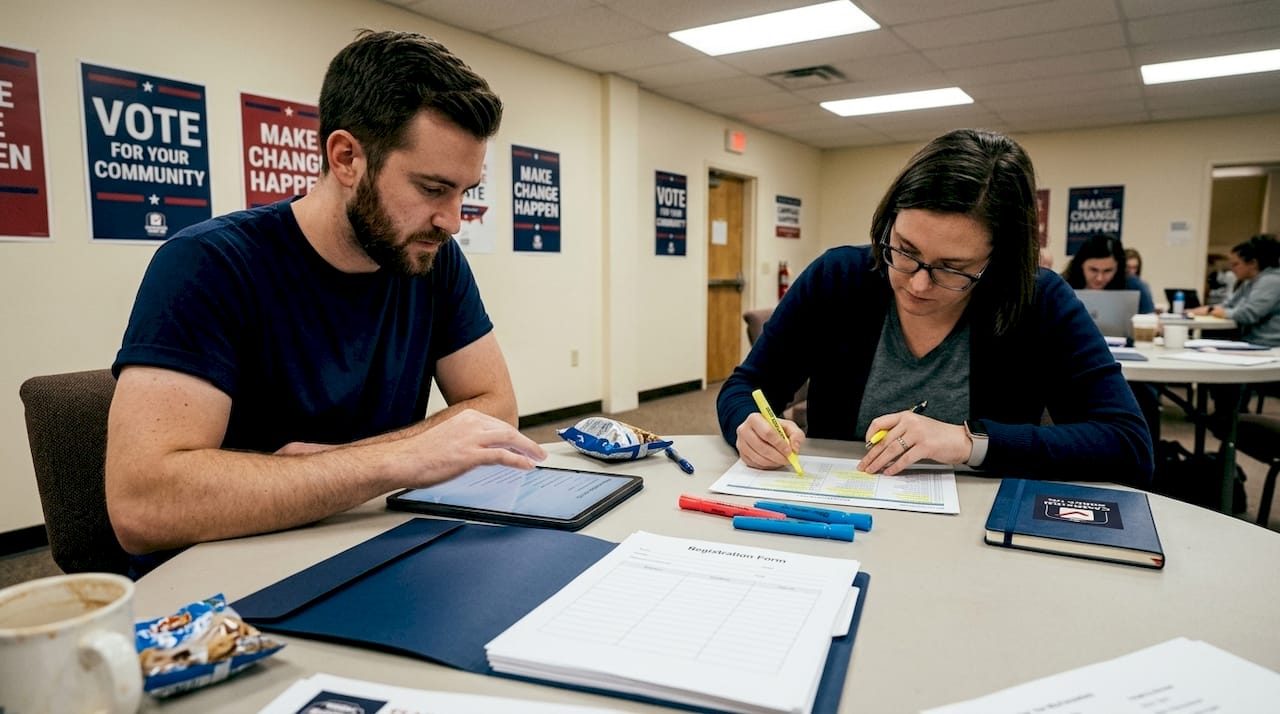
Contact rate comparison by method:
| Outreach Method | Average Contact Rate | Best Use Case |
|---|---|---|
| Door knocking | 20 to 35% | Persuasion and GOTV |
| Phone banking | 8 to 15% | ID and volunteer recruitment |
| Text banking | 10 to 20% | Reminders and event invites |
| Digital ads | Broad reach, low depth | Reinforcement and awareness |
| Combined O2O | 40 to 55% | Maximum voter impact |
The DNC's own review acknowledged plummeting contact rates and a loss of 2.4 million voters in key races, attributing much of the failure to siloed departments that didn't coordinate their outreach. The lesson is clear: your digital team and your field team must operate as one unit, not two separate ones.
For examples of how digital-field integration has worked in real organizations, look at nonprofits that have built community trust through consistent multi-channel communication.
Pro Tip: Use your CRM data to prioritize your outreach list by persuadability, not just geography. Reaching 100 genuinely undecided voters is worth more than reaching 500 people who will never vote for your candidate.
When you're logging outreach activity and structuring nonprofit campaign stages, consistent data entry habits are what make your reports trustworthy. Build data hygiene into the checklist itself.
GOTV checklist: Mobilizing supporters for maximum turnout
GOTV (Get Out The Vote) is the phase where all your preparation, all your outreach, and all your relationship-building gets put to the test. The checklist for this phase is more intensive and more time-sensitive than any other. Execution speed matters enormously.
Layered GOTV checklist:
- Identify your confirmed supporters from your voter contact data and build your GOTV universe
- Schedule multiple contacts for confirmed supporters in the final 10 days
- Organize volunteer shifts for door knocking, phone banking, and poll monitoring on Election Day
- Confirm transportation to polling locations for voters who need it
- Set up a rapid response team to handle Election Day problems in real time
- Send text reminders 48 hours before, the evening before, and the morning of Election Day
- Deploy digital ads targeting your confirmed supporters on Election Day morning
- Track returns against your vote goal throughout the day and redeploy volunteers where needed
"Momentum in GOTV is not built on Election Day. It's built in the weeks before it. By the time polls open, your supporters should already know exactly when and how they're voting."
Comparison: Traditional GOTV vs. new tech-integrated approaches:
| Approach | Strengths | Weaknesses |
|---|---|---|
| Traditional field GOTV | High trust, personal touch | Slower, resource intensive |
| Digital-only GOTV | Fast, scalable, measurable | Lower personal engagement |
| Hybrid tech-integrated GOTV | Best of both, higher turnout | Requires coordination and tools |
Recent DNC pilots have focused heavily on integrating new technology into GOTV mechanics while preserving the trust-building power of in-person contact. Tools like Winnable and other voter contact platforms have been tested to improve how campaigns track supporter commitment and follow up efficiently.
Learning from creative GOTV strategies used in other campaigns can give your team new ideas for making that final push resonate with voters who might otherwise stay home.
The GOTV phase is also where your checklist should explicitly address equity. Make sure your outreach plan includes communities that have historically lower turnout, including rural voters, young voters, and communities of color. Those votes are often the margin.
Structuring nonprofit campaign stages with GOTV in mind from the start means you're not scrambling to build your supporter list in the final two weeks. That list should be growing the entire campaign.
What most checklist guides miss: Integrating lessons from past failures
Here's what frustrates us about most campaign checklist guides: they're static. They assume a campaign runs on a clean track from start to finish, and they hand you a list as if the same tasks, in the same order, will work for every race, every district, and every team. That's not how campaigns actually work.
The most important thing your checklist can do is build in the expectation of change. After every major phase, your team should sit down with the data and ask: what contact methods are working? Where are we losing people? Which volunteers are burning out? What are voters actually saying at the door?
The DNC's hybrid O2O strategy emerged directly from acknowledging what failed in previous cycles. Siloed departments. Declining contact rates. Losing voters who should have been reachable. The playbook wasn't born from theory. It came from hard data and honest conversations about failure.
Your campaign checklists should do the same thing. Build a standing weekly review into your workflow. Make it a cultural norm that checklists get updated based on feedback, not just completed and filed. The campaigns that win tight races are almost never the ones with the most perfect plan at the start. They're the ones that adapt fastest when the plan meets reality.
Structuring nonprofit campaign stages with built-in reflection checkpoints is how you turn a static document into a living tool that actually serves your team.
Next steps: Level up your campaign with smart tools
Checklists give you direction, but the right tools give you execution. If you're managing a campaign or issue advocacy effort and spending more time tracking tasks in spreadsheets than actually organizing, it's time for a smarter system.
Campaign Buddy HQ is built specifically for progressive campaigns that need to plan daily and weekly activities, log outreach contacts, and monitor progress toward vote goals without getting buried in complexity. From phase tracking to supporter logging, the campaign management platform puts every part of your outreach workflow in one place. You can even use the vote goal calculator to work backward from your win number and build a realistic field plan. Start your free 7-day trial today with no credit card required.
Frequently asked questions
Why is a listen-first approach important in campaign organizing?
A listen-first approach builds deeper relationships with voters by prioritizing genuine conversations over scripted talking points. The DNC Playbook's re-organizing model places this at the center of effective community organizing.
What is the benefit of integrating digital and field operations?
Combining both channels dramatically boosts voter contacts and expands reach beyond what either method alone can achieve. Hybrid O2O integration is now considered essential for competitive modern campaigns.
How should campaign checklists be updated throughout an election?
Checklists should be reviewed and revised regularly based on real-time contact data, volunteer feedback, and changing voter sentiment. Dynamic workflow revision, as shown in recent DNC case studies, leads to measurably better outcomes.
What technology tools are recommended for campaign organizers?
CRM systems, voter file platforms like NGP VAN, and online-to-offline coordination tools are the core of a modern campaign tech stack. Tech pilots and CRM integrations featured in recent organizing playbooks show how these tools significantly improve workflow efficiency and supporter tracking.