

Most political campaigns collect more data than they actually know what to do with. Voter files, canvassing notes, survey results, digital engagement metrics — the pile grows fast. But the campaigns that win aren't the ones with the biggest databases. They're the ones that integrate data across sources, test relentlessly, and make disciplined decisions based on what the numbers actually say. This guide breaks down what campaign data truly is, how to turn it into strategy, how to measure whether it's working, and how to avoid the traps that sink even well-resourced campaigns.
Table of Contents
- What is campaign data? Building the foundation
- Transforming insights into action: Targeting and strategy
- From numbers to results: Measuring the impact of campaign data
- Common pitfalls in campaign data and how to overcome them
- A new mindset for data-driven campaigners
- Move forward with smarter campaign data
- Frequently asked questions
Key Takeaways
| Point | Details |
|---|---|
| Data integration matters | Simply collecting data is not enough—integrating and acting on it is essential. |
| Target with precision | Use segmented data and rapid testing to maximize outreach effectiveness. |
| Measure real outcomes | Prioritize turnout, persuasion, and fundraising results when evaluating data strategies. |
| Avoid common pitfalls | Watch for integration failures and overreliance on intuition, which can undermine campaign results. |
What is campaign data? Building the foundation
Campaign data is not just a list of names and phone numbers. It is a living, layered resource that tells you who your voters are, what they care about, how likely they are to turn out, and how persuadable they might be. Most campaigns touch three primary data sources, and understanding each one is critical before you can do anything strategic with them.
Voter files are the backbone. These are official, government-generated records that include registered voters, party affiliation, address history, and voting participation across past elections. A voter who has voted in six of the last eight elections is fundamentally different from one who voted once in a presidential year and hasn't shown up since. That distinction matters enormously when you're deciding where to invest your canvassing time.
Survey results add attitudinal data that the voter file simply cannot provide. You learn why someone hasn't voted, what issues move them, and how they feel about your candidate versus the opponent. This is where campaigns build persuasion scores and prioritize messaging by issue.
Canvassing input captures real-time ground-truth data. When a volunteer knocks a door and notes that the resident is undecided but concerned about housing costs, that tag adds something no algorithm can generate on its own.
The real power, as political analytics research confirms, comes from integration. Campaign data functions across three core levels: collection from voter files, surveys, and canvassing; integration across sources using tools like Catalist for Democrats; and data-informed decision-making for targeting and strategy. Without that integration, you're making decisions from incomplete pictures.
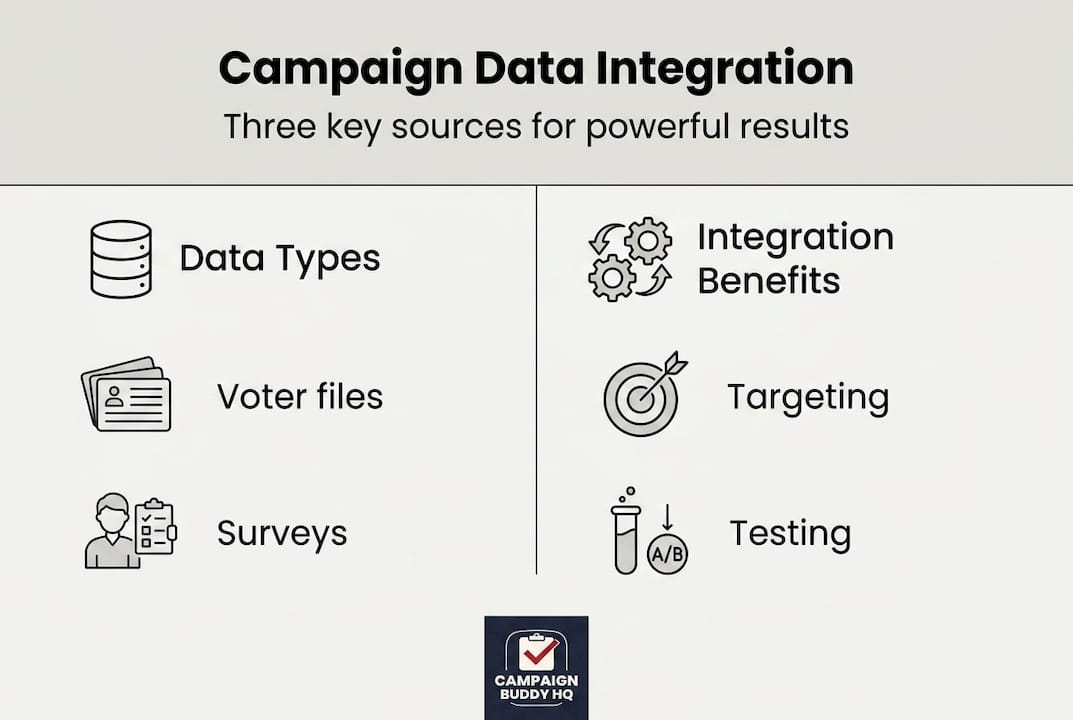
Here's a sample of what raw data looks like versus the insight it generates:
| Raw data field | Derived insight |
|---|---|
| Voting history (6 of 8 elections) | High-propensity base voter, prioritize GOTV |
| Survey: undecided, cares about housing | Persuasion target, use housing message |
| Canvassing tag: door knock, no answer x3 | Switch to phone or text contact |
| Party registration: unaffiliated | Low-partisanship target, issue-based messaging |
| Age + zip code | Likely demographic profile for digital targeting |
Common pitfalls to avoid at the collection stage include:
- Collecting data across multiple systems that never talk to each other
- Relying only on the voter file without layering behavioral or attitudinal data
- Treating all unregistered or infrequent voters as a single undifferentiated group
- Logging canvassing data inconsistently, making aggregation impossible later
The cost of skipping integration isn't just inefficiency. It's wrong decisions. Analytics applied correctly can generate meaningful ROI, but that only holds when you're working from a complete, unified data picture rather than fragmented inputs.
Transforming insights into action: Targeting and strategy
Once you have your data foundation, here's how strategic integration and testing elevate your campaign decisions.
Raw data becomes strategy when you use it to segment voters and decide where to focus limited time and budget. Not all persuadable voters are equal. Some are reachable by phone. Others respond only to direct mail. Some are on Facebook; others aren't online at all. Data-driven segmentation lets you stop running a "spray and pray" outreach operation and start making intentional, prioritized contact.
Effective voter targeting typically runs through these steps:
- Define your vote goal. How many votes do you need to win? Work backward from that number to understand the universe of voters you must contact.
- Segment by propensity. Separate high-turnout base voters, persuadable low-propensity voters, and truly unlikely voters. Each needs a different strategy.
- Layer in issue data. Use survey results or modeled scores to match messaging to the voter's top concerns.
- Prioritize by contact method. Match your outreach mode (door, call, text, mail) to what the data says actually works for that segment.
- Test your messaging before you scale it. Never assume a message works. Prove it.
That last point is critical. Data-driven campaign methodology includes A/B testing messages against real voter responses, running field experiments, and iterating rapidly. The most famous example: the Obama campaign's email signup tests, which yielded a 40% lift in signups and ultimately contributed to roughly $60 million in additional fundraising. That wasn't luck. It was disciplined message testing applied at scale.
Here's a quick comparison of traditional versus data-driven outreach:
| Approach | Traditional | Data-driven |
|---|---|---|
| Voter targeting | Geography-based, precinct-wide | Score-based, individual-level prioritization |
| Messaging | One message for all | Segmented by issue, demographic, propensity |
| A/B testing | Rarely done | Embedded in every major decision |
| Resource allocation | Gut instinct | Impact modeling and experiment results |
| Feedback loop | Post-election review | Real-time iteration during campaign |
Pro Tip: If your campaign runs short cycles (think: a special election with a 30-day window), standard A/B tests may not generate enough data fast enough to be actionable. In those cases, consider bandit algorithms. Unlike A/B testing, which splits traffic equally until you have statistical significance, a bandit algorithm continuously shifts more traffic to better-performing messages in real time. You're optimizing while you're still collecting.
The strategic value of testing goes beyond just messaging. You can run experiments on contact timing, ask amounts for fundraising, canvassing scripts, and even volunteer recruitment language. Every element of your data-driven campaign decisions is potentially improvable through disciplined testing. The campaigns that use creative approaches alongside data tend to outperform those that rely on either one in isolation.
From numbers to results: Measuring the impact of campaign data
Targeting and testing strategies matter, but how do you evaluate if your efforts are truly working?
Measuring campaign impact is harder than most campaign managers assume. The challenge is attribution. When you run digital ads, phone bank, and send mail simultaneously to the same voter universe, how do you know which touch actually moved the needle? The only rigorous answer is randomized controlled experiments, where a true control group receives no treatment and a test group does.

Here's what strong KPI measurement looks like for a progressive campaign:
| KPI | What it measures | Why it matters |
|---|---|---|
| Voter turnout rate by segment | Whether contact increased actual votes | Core outcome measurement |
| Persuasion rate (shifts in support) | Message effectiveness with undecideds | Drives targeting decisions |
| Cost per contact | Efficiency of outreach channels | Resource allocation guide |
| Volunteer recruitment conversion | Health of field operation | Scalability indicator |
| Fundraising response rate | Digital and mail performance | Adjusts ask strategy |
The empirical evidence on what data-driven digital advertising can actually achieve is more sobering than most campaigns expect. Academic research on political advertising reviewed an $8.9 million digital ad campaign targeting 2 million voters and found no average turnout change overall. But the segmented results told a different story: Biden-leaning voters showed a positive 0.4 percentage point increase in turnout, while Trump-leaning voters showed a negative 0.3 percentage point shift. That 0.7 percentage point net difference is actually significant in a close race.
Key insight: The average effect of a campaign intervention can be close to zero while the segmented effect on the right groups is exactly where you need it. This is why aggregate metrics mislead and segment-level measurement is essential.
What this means practically:
- Stop measuring average effects on your entire voter universe. Drill into results by segment.
- Downballot races respond differently. Research shows larger persuasion effects with wider variance in state legislative and local races, which means data discipline pays off even more at lower levels.
- Focus persuasion resources on low-propensity voters in your target segment. They're harder to reach but more movable when you do reach them.
- Reallocate budget in real time. If mid-campaign data shows phone calls outperforming texts for your senior persuasion universe, shift resources immediately rather than waiting for the post-election review.
Using optimization tools for campaign ROI alongside your own field data creates a compounding advantage. Each cycle, your measurement gets sharper and your targeting gets tighter.
Common pitfalls in campaign data and how to overcome them
Even with powerful data tools, there are critical mistakes that can undermine everything.
The most common failure isn't a lack of data. It's fragmented data that never gets synthesized into a single usable picture. When your canvassing app, your voter file vendor, your texting platform, and your volunteer management system don't share information, you end up with four partial pictures instead of one complete one. Campaigns that fall into this trap often discover only after the election that they were making contradictory decisions in different departments simultaneously.
Common pitfalls that campaigns repeatedly face include:
- Integration failures. As research on campaign analytics confirms, data integration failures leave campaigns ineffective, overriding models with gut instinct loses elections, and low-propensity voters, while more persuadable, are volatile and need special handling.
- Trusting instinct over model outputs. Campaign veterans have strong pattern recognition from past cycles. That's valuable. But when their gut contradicts what the model says, the data usually wins. Not always, but usually.
- Treating low-propensity voters as a stable universe. They are inherently volatile. Their likelihood of voting shifts with news cycles, weather on election day, and personal circumstances. Don't build your entire win number around a group you can't reliably mobilize.
- Skipping data hygiene. Outdated addresses, duplicate records, and unverified contact information corrupt even the best targeting models. Data quality is not glamorous, but it is foundational.
"Overriding well-built models with gut feelings is one of the most common and costly mistakes in campaign operations. The model doesn't have emotions. It doesn't have a story. It has patterns across thousands of voters. Respect that."
Pro Tip: Build formal review checkpoints into your campaign calendar. At the end of each week, your data lead should confirm: Are voter file updates current? Is canvassing data syncing correctly? Are contact rates by segment hitting benchmarks? Catching a broken data pipeline in week three is far less damaging than discovering it in week eight.
The discipline required to maintain data quality under campaign pressure is significant. Volunteers rotate. Systems break. Staff get overwhelmed. The campaigns that build verification routines into their weekly rhythm are the ones that actually trust their data by the time early voting opens.
A new mindset for data-driven campaigners
Here's the uncomfortable truth that most campaign data vendors won't tell you: having more data is not the same as having better strategy.
The instinct to collect everything makes sense. More information feels like more safety. But the campaigns we've seen struggle hardest are often drowning in metrics they can't act on. They track 40 KPIs when five would drive better decisions. They buy every available data enhancement when their voter file and two good survey waves would be enough. The result isn't clarity. It's paralysis.
The winning mindset treats data as a tool, not a trophy. You collect what you can act on. You integrate it so it actually tells a coherent story. You test rigorously on the questions that matter most to your win number. Then you iterate fast and stay disciplined when the temptation arises to override the model because a consultant has a strong feeling.
Integrating data for better campaigns is not about sophistication for its own sake. It's about making the best possible decision with the information you have, faster than the other side does. The highest-performing campaigns we observe aren't the ones with the most data. They're the ones with the most disciplined process for acting on the data they have. That's a mindset shift that no tool can make for you. It has to come from how your team is trained, structured, and held accountable.
Move forward with smarter campaign data
Ready to take the next step toward better campaign outcomes? Here's how you can put these insights into practice.
Campaign Buddy HQ is built for exactly the kind of data-integrated, action-oriented campaign operation this article describes. Our platform helps progressive campaigns track outreach across doors, calls, and texts, while keeping your team aligned around a shared vote goal and daily action plan.
Whether you're exploring AI campaign data tools to sharpen your targeting or using the vote goal calculator to define exactly how many voters you need to win, Campaign Buddy HQ gives you the infrastructure to turn raw data into organized, consistent action. Start your free 7-day trial today, no credit card required, and see how structured campaign management changes what's possible for your team.
Frequently asked questions
What types of data should campaigns prioritize collecting?
Focus on voter files, survey responses, and canvassing data, since these directly feed outreach targeting and messaging decisions. As political analytics research confirms, these three sources form the core collection layer of any effective campaign data operation.
How do we know if our campaign data is actually making a difference?
Measure turnout, persuasion shifts, and fundraising response using controlled experiments, not just averages. Empirical research found that a large-scale digital ad campaign showed no average turnout effect but meaningful segment-level shifts, which means segment-level measurement is where the real answers live.
What's the main risk when using campaign data?
Relying on gut instinct over data models or letting your systems stay fragmented are both high-risk failure modes. Research confirms that data integration failures leave campaigns ineffective, and overriding well-built models with intuition consistently loses winnable elections.