

Campaign momentum gets credited to luck far more often than it deserves. A viral clip lands, donations pour in for a week, and everyone assumes the campaign "caught fire." But campaign momentum is actually the sustained positive energy, volunteer engagement, voter support, and fundraising growth that propels a campaign toward victory, built deliberately through early planning, lead gifts, volunteer activation, and performance tracking. This article breaks down exactly how experienced managers and organizers engineer that momentum step by step, from the first planning session to election eve, with real benchmarks and field-tested tactics you can apply immediately.
Table of Contents
- What is campaign momentum and why does it matter?
- Core mechanics: Structuring for early wins and growth
- Structured grassroots outreach: The engine of momentum
- Tracking, adapting, and avoiding momentum stalls
- Why momentum is engineered, not 'caught': Hard-won lessons
- Turn knowledge into next-step campaign wins
- Frequently asked questions
Key Takeaways
| Point | Details |
|---|---|
| Momentum is engineered | Deliberate planning, early wins, and structured outreach drive campaign momentum, not luck. |
| Early action compounds | Setting up infrastructure, onboarding volunteers quickly, and initiating outreach create lasting growth effects. |
| Track with leading metrics | Focus on real-time engagement and retention instead of vanity statistics for actionable momentum insights. |
| Small, cohesive teams matter | Core volunteer crews outperform large, inconsistent teams in sustaining campaign energy. |
What is campaign momentum and why does it matter?
To understand how to build and harness momentum, let's unpack what it actually means and why it matters.
Most people confuse campaign momentum with temporary excitement. A big endorsement drops, social media lights up for 48 hours, and the team feels invincible. Then the buzz fades, volunteers stop showing up, and the poll numbers barely budge. That's not momentum. That's a spike.
Real momentum looks different. It compounds. It shows up in weekly volunteer retention numbers, in steadily growing contact totals, and in small donation averages that climb month over month. Think of it less like a wave and more like a flywheel: hard to start, but increasingly difficult to stop once it's moving.
"Campaign momentum is the sustained positive energy, volunteer engagement, voter support, and fundraising growth that propels a campaign toward victory, built deliberately through early planning, lead gifts, volunteer activation, and performance tracking rather than occurring by chance."
The fundamentals of campaign momentum rest on four interconnected pillars:
- Volunteer energy: Are people actively recruiting others, or just showing up when asked?
- Voter contact growth: Is your weekly contact total increasing, holding steady, or slipping?
- Fundraising trajectory: Is average donation size and frequency trending upward?
- Narrative control: Are you setting the conversation, or reacting to your opponent's frame?
When all four move together, something real happens. Volunteers bring friends. Donors give again. Reporters start calling. Local leaders who were sitting on the fence make endorsements. Each of those actions feeds the next.
The reason sustained momentum matters for winning is straightforward. Campaigns that maintain consistent outreach activity over months generate far more persuasion contacts per dollar spent than campaigns that rely on late-stage ad buys. Voter turnout correlates strongly with personal contact, particularly repeated contact from a trusted neighbor or community member. Fundraising grows faster when previous donors see visible activity and hear from friends about the campaign's energy. None of that happens by accident. It happens because someone planned it that way, tracked it weekly, and adjusted when the numbers signaled trouble.
Ignoring momentum in favor of chasing moments is one of the most expensive mistakes a campaign can make. You burn staff, burn donors, and burn volunteer goodwill on spikes that leave no lasting infrastructure behind.
Core mechanics: Structuring for early wins and growth
With a clear definition in place, let's examine the exact levers that drive momentum from idea to action.

The most important insight for early-stage campaigns is that the first few weeks set the ceiling for everything that follows. Infrastructure decisions made in week one, such as your voter file setup, volunteer onboarding flow, website launch timing, and weekly reporting cadence, determine how fast you can scale later. Get them right early, and every subsequent push compounds. Get them wrong, and you spend the entire campaign fixing foundation issues instead of winning votes.
Here's a practical sequence for building momentum mechanics from day one:
- Secure lead gifts before announcing publicly. Nothing signals a serious campaign like launching with visible financial backing. Early financial support and visible endorsement create social proof that attracts more donors and volunteers within days of launch.
- Onboard volunteers within 24 hours of sign-up. The data is clear: volunteer engagement within 24 hours of their first contact dramatically increases retention. A volunteer who waits three days for instructions often never comes back.
- Launch your website and digital presence before your public announcement. Having a live, functional site on day one means every piece of press coverage, every social share, and every word-of-mouth conversation immediately converts interested people into donors or volunteers.
- Set up real-time tracking from the start. Early planning and performance tracking are not optional extras you add later. They're the core operating system of a momentum-driven campaign.
- Publish content on a consistent schedule. One strong post per day beats seven posts on Monday and silence for the rest of the week. Algorithms and voters alike respond to reliability.
Pro Tip: Build your weekly reporting template in week one, before you have any data to fill in. When the numbers start coming in, you'll have a consistent baseline to compare against, and you'll catch momentum stalls weeks before they become crises.
Campaigns that focus on sustained campaign growth from the start outperform those chasing reactive boosts because their systems are already running when opportunities appear. When a major endorsement lands, a campaign with strong infrastructure can instantly route that surge of interest into a volunteer recruitment push. A campaign without systems just watches the interest evaporate.
Structured grassroots outreach: The engine of momentum
Building on the need for a structured approach, let's look at what field-proven outreach actually delivers.
Outreach isn't just knocking on doors. It's a deliberate system for building relationships at scale. The campaigns that consistently outperform expectations treat outreach as an ongoing operation, not a series of disconnected events.
Structured outreach strategies that deliver results typically combine four elements: relational organizing with neighborhood-based volunteer teams, listening-first canvassing that prioritizes conversation over scripted pitches, coalition coordination that integrates digital and field efforts, and service-based organizing that gives community members ongoing reasons to stay engaged beyond election day.
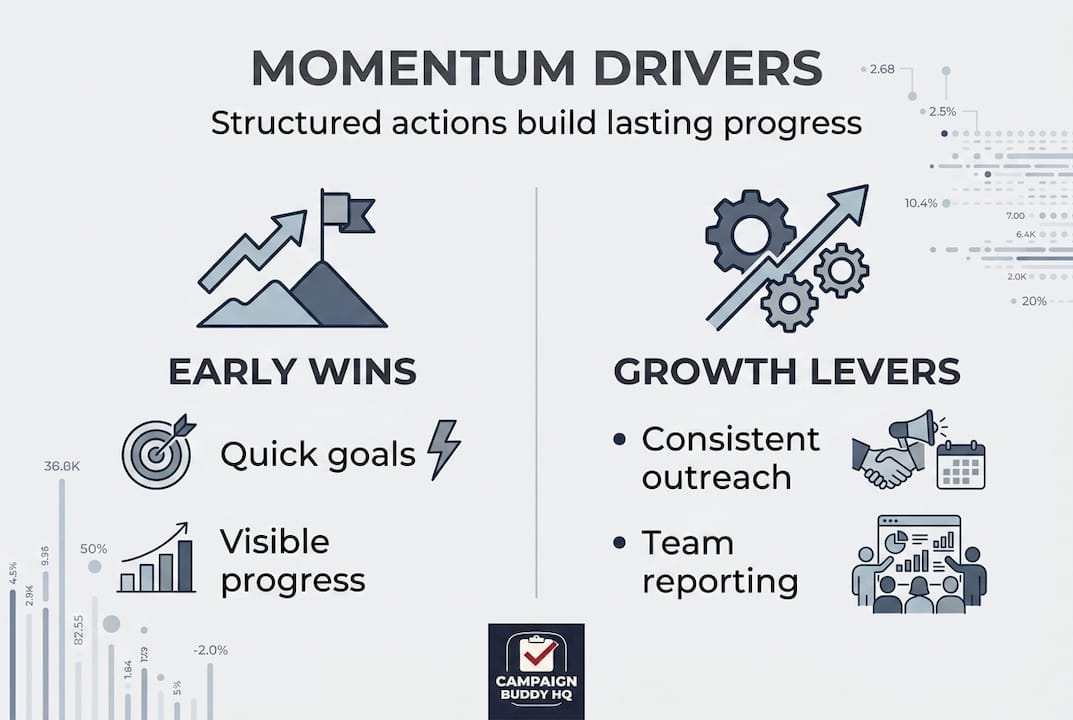
The neighborhood team model deserves particular attention. Instead of sending a stranger to knock on your door, imagine a neighbor you've met at community events coming by to talk about the local race. That's the model Obama 2008 pioneered at scale, and the numbers behind it remain a benchmark for field organizers everywhere.
| Metric | Traditional canvassing | Neighborhood team model |
|---|---|---|
| Voter contact rate | Baseline | 30 to 40% higher |
| New voter registrations | Baseline | 2.2 million net gain |
| Vote share per field office | Baseline | +1% per office added |
| Volunteer retention (30 days) | ~35% | ~60% |
Those empirical benchmarks from Obama 2008 aren't just historical trivia. They represent a tested operational template that scales down to local races and up to statewide campaigns. The principles transfer because they're built on human psychology, specifically the fact that people trust neighbors more than strangers and respond better to conversation than to scripts.
Here's what separates outreach programs that build momentum from ones that burn out:
- Consistency over intensity. Hitting the same neighborhood three weeks in a row with light contact outperforms a single massive blitz that leaves volunteers exhausted.
- Relationship tracking. Knowing that this voter was skeptical last week but warming up this week changes how you prioritize your next contact.
- Digital and field integration. Text banking, phone banking, and door knocking work best when they reference each other. A voter who received a text yesterday responds differently to a door knock today.
- Long-term relationship design. Outreach programs built around maximizing campaign impact with signage and community visibility reinforce in-person contact and keep the campaign present between active canvassing windows.
When outreach is consistent, tracked, and relational, it doesn't just generate votes. It generates the kind of community energy that produces referrals, donations, and the peer-to-peer conversations that no ad budget can buy.
Tracking, adapting, and avoiding momentum stalls
While execution is crucial, tracking your progress and knowing when to shift separates winning campaigns from the rest.
Most campaigns track outputs: doors knocked, calls made, texts sent. Those numbers feel productive, but they tell you almost nothing about whether you're actually winning. The distinction between outputs and outcomes is one of the most important concepts in modern campaign management.
An output is doors knocked. An outcome is persuasion lift, meaning the measurable shift in voter preference directly attributable to that contact. Distinguishing output from outcome metrics and tracking real-time sentiment over lagging poll numbers allows campaign teams to detect momentum shifts weeks before they show up in public polling.
| Metric type | Example | What it tells you |
|---|---|---|
| Output (vanity) | Doors knocked | Activity volume only |
| Leading indicator | Net sentiment shift | Direction of momentum |
| Leading indicator | Volunteer retention rate | Organizational health |
| Leading indicator | Elite cue uptake | Coalition strength |
| Lagging indicator | Public poll numbers | Where you were 2 weeks ago |
The table above isn't academic. It represents a real operational shift in how winning campaigns allocate staff time and decision-making attention.
Pro Tip: Set a weekly "momentum check" meeting where you review three leading indicators alongside your output totals. If doors knocked is up but volunteer retention is dropping, that's an early warning sign your team is burning out. You want to catch that in week six, not week twelve.
One of the most dangerous momentum stalls comes from chasing 72-hour windows after endorsements or earned media hits without a system to capture and convert that interest. When a major endorsement lands, emotional and narrative momentum shifts immediately, while polling data won't reflect it for days. Campaigns that have sign-up flows, volunteer welcome sequences, and donation pages ready before those moments convert the burst into lasting organizational growth. Campaigns that scramble to set up those systems after the fact lose most of the opportunity.
Other common stalls to watch for include late infrastructure launches (a website that goes live after press coverage misses the entire conversion window), inconsistent volunteer teams where a core of five to ten highly committed people outperform large but unreliable rosters, and metric confusion where the team celebrates high door counts while ignoring declining voter persuasion rates.
Building win numbers into your backward planning process is one of the most effective ways to keep your team focused on outcomes. Calculate exactly how many votes you need to win, work backward from election day to determine weekly contact targets, and measure your outreach activity against those targets every single week.
Why momentum is engineered, not 'caught': Hard-won lessons
Here's the uncomfortable truth most campaign consultants don't put in their pitch decks: a fundraising surge and a momentum surge are not the same thing, and confusing them is one of the fastest ways to lose a race you should have won.
Fundraising signals momentum but it doesn't guarantee victory. Dollars in the bank mean nothing if your field program is hollow. Campaigns have out-raised their opponents two to one and still lost because visible force deployment, yard signs, and ad buys never reached the voters who actually needed personal contact to shift their vote.
What we see consistently from the ground is that the campaigns that last, the ones that close strong and turn out their base, are the ones that made boring, consistent investments in early systems. They set up their tracking tools before they had anything to track. They onboarded volunteers before the volunteer surge came. They built neighborhood relationships before those relationships mattered in polls.
The contrarian lesson here is that organizing to win in 2026 is less about inspiration and more about infrastructure. Inspiration gets people in the door. Infrastructure keeps them engaged, measured, and deployed effectively for months.
If your campaign is betting on a viral moment to carry you to election day, you're gambling with your candidate's future and your volunteers' investment of time and trust. Engineer the momentum instead.
Turn knowledge into next-step campaign wins
Ready to put these insights to work? Here's where to start, with tools designed specifically for action-oriented organizers.
Campaign Buddy HQ gives you the operational backbone that turns this guide's strategies into daily, trackable action. From logging doors and calls to planning weekly outreach sprints, every feature is built for real-world campaign conditions, including low-density and rural districts where every contact matters more. Start by using the vote goal calculator to set your win targets, then calculate your win number and work backward to your weekly outreach goals. No credit card needed for the free 7-day trial. Just bring your campaign and start moving.
Frequently asked questions
What is the single biggest driver of campaign momentum?
The biggest driver is sustained, structured outreach backed by real-time tracking and rapid volunteer engagement. Relational organizing with neighborhood teams consistently outperforms sporadic high-volume pushes in both contact rate and voter persuasion lift.
How soon should campaign infrastructure (like websites or data tools) be live?
Campaign infrastructure should be operational before your public launch, because late infrastructure stalls momentum by causing you to miss conversion windows during early press coverage and endorsements.
Does fundraising alone indicate campaign momentum?
No. Fundraising signals momentum but doesn't guarantee wins or voter persuasion. Organized, consistent outreach is what converts financial resources into actual votes on election day.
How do you measure real progress during a campaign?
Track leading indicators like net sentiment, volunteer retention, and coalition growth rather than just counting outputs like doors knocked. These signals reveal where your momentum is heading days or weeks before polls reflect it.