
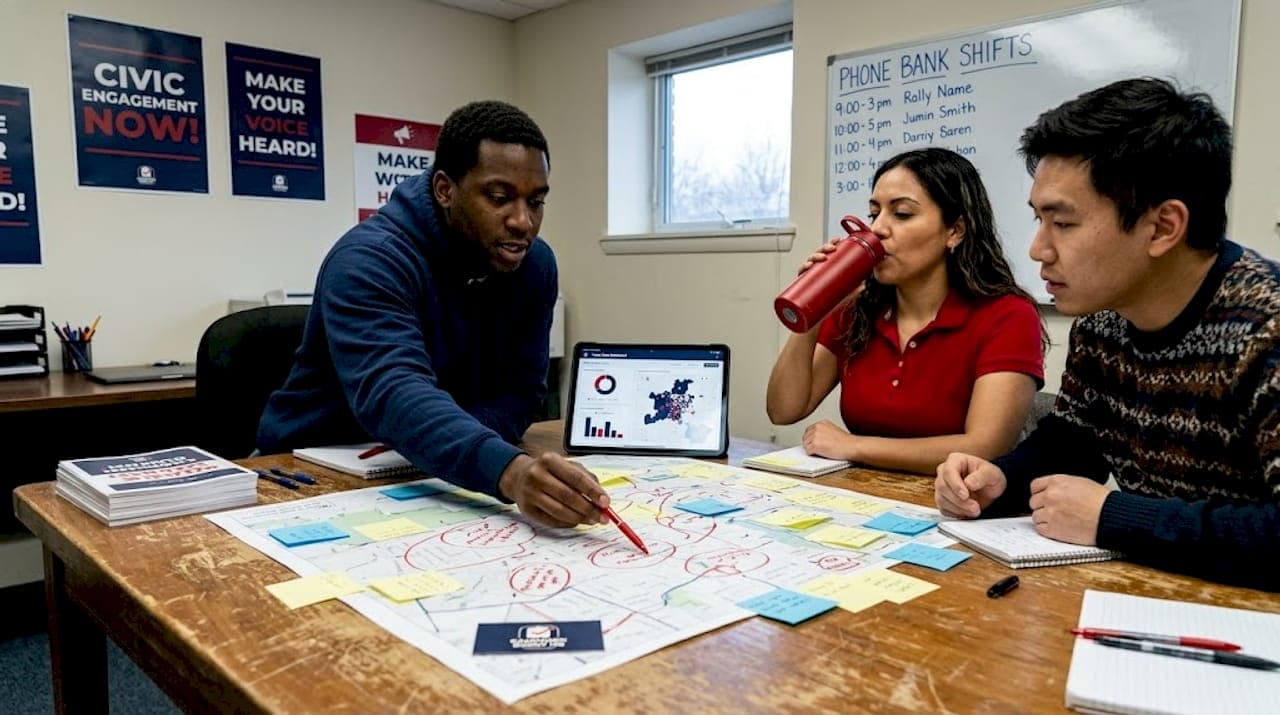
Campaign jargon gets a bad reputation. New volunteers assume it's insider code designed to keep outsiders out, but the opposite is true. Every term your field director drops in a briefing, from GOTV to persuasion universe, represents a specific action, a measurable outcome, or a legal boundary. When you know what those words mean, you stop guessing and start executing. This guide breaks down the most essential political campaign terminology for progressive organizers, covering field operations, campaign mechanics, messaging, and finance, so you can communicate clearly, train volunteers faster, and run smarter outreach from day one.
Table of Contents
- Decoding grassroots, field, and organizing lingo
- The core mechanics: Buckets that structure every campaign
- GOTV, persuasion, and contact tools: Terms in action
- Message framing: The language that wins (or loses) voters
- Navigating political finance terminology
- Why mastering terminology is more than 'talk': Lessons from the field
- Take your campaign knowledge further with Campaign Buddy HQ
- Frequently asked questions
Key Takeaways
| Point | Details |
|---|---|
| Understand core terms | Knowing essential campaign language helps you communicate clearly and organize effectively. |
| Sort jargon by mechanics | Organizing campaign words into buckets reduces confusion and speeds volunteer onboarding. |
| Apply framing wisely | Selecting the right language can dramatically improve your outreach results. |
| Respect finance rules | Familiarity with finance terms helps you avoid compliance mistakes and run smoother campaigns. |
| Keep learning | Mastering terminology is just the start—smart tools and ongoing training make campaigns win. |
Decoding grassroots, field, and organizing lingo
With the importance of clear communication established, let's dive into some of the key organizing terms you'll use every day.
Grassroots refers to local-level organizing that relies on face-to-face contact and ordinary supporters rather than party leadership channels. It's the foundation of progressive movement building. When a campaign says it's "grassroots," that means power flows from neighbors talking to neighbors, not from a top-down command structure.
Field is the operational arm of a campaign that handles direct voter contact. Think of it as the engine room. The field director designs strategy, sets targets, and manages staff. Volunteer coordinators recruit, train, and schedule the people doing the actual outreach. Without a strong field program, even the best messaging falls flat because nobody delivers it door to door.
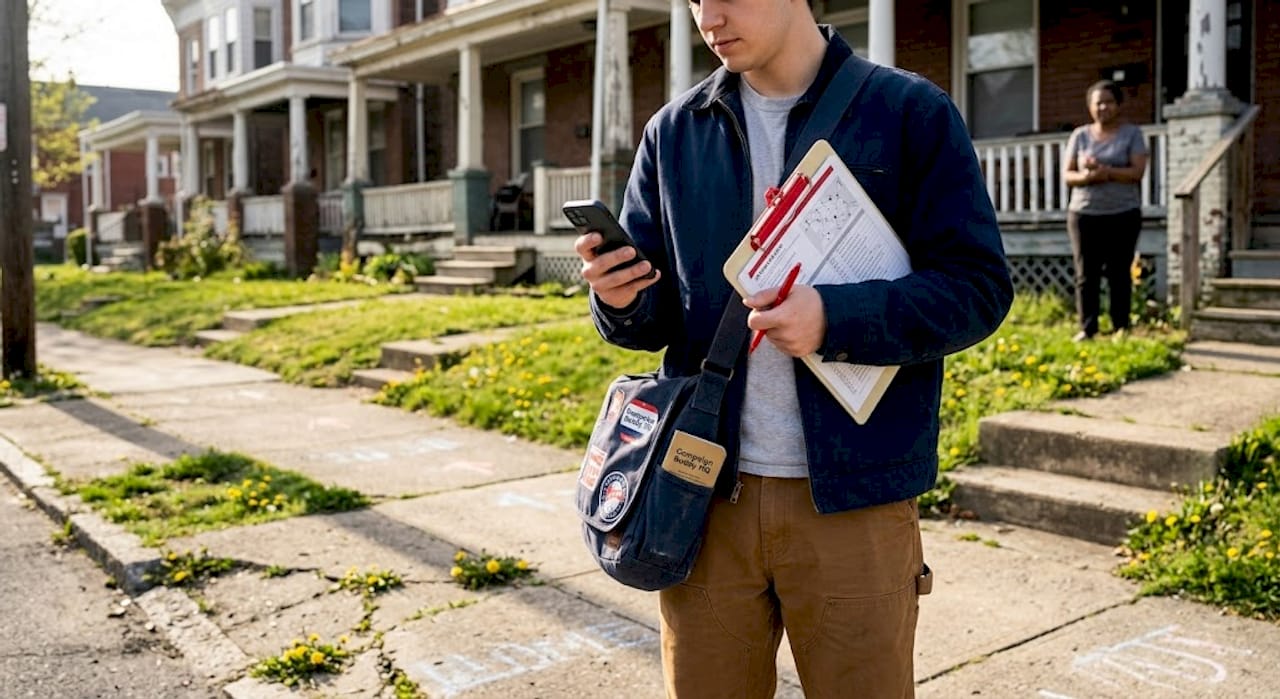
Organizing is broader than field work. It means building lasting relationships and power structures within communities, not just turning out votes for one election. Community wealth building and long-term civic engagement are natural extensions of genuine organizing work.
Here's a quick-reference table of the terms you'll hear most often in field operations:
| Term | Definition |
|---|---|
| Canvassing | Door-to-door voter contact |
| Phone bank | Organized volunteer calling sessions |
| Walk list | Assigned list of addresses for canvassers |
| Turf | A geographic area assigned to a canvasser |
| Universe | The total pool of targeted voters |
| Data entry | Logging contact results into the campaign database |
| Shift | A scheduled block of volunteer time |
Daily tasks that organizers track typically include:
- Doors knocked and conversations completed
- Phone calls made and contacts reached
- Texts sent and responses logged
- Voter registrations collected
- Volunteer sign-ups secured
- Follow-up appointments scheduled
"Grassroots refers to organizing and campaigning at the most local level, often relying on face-to-face contact and ordinary supporters rather than party leadership channels." — Political Dictionary
Pro Tip: When building your volunteer base, lean into existing local networks like faith communities, neighborhood associations, and union halls. People respond to outreach from someone they already trust. A custom merch fundraising guide can also help you create branded materials that strengthen community identity and keep volunteers engaged between shifts.
The core mechanics: Buckets that structure every campaign
After understanding day-to-day field terms, it's helpful to see how organizers bucket the entire campaign's work.
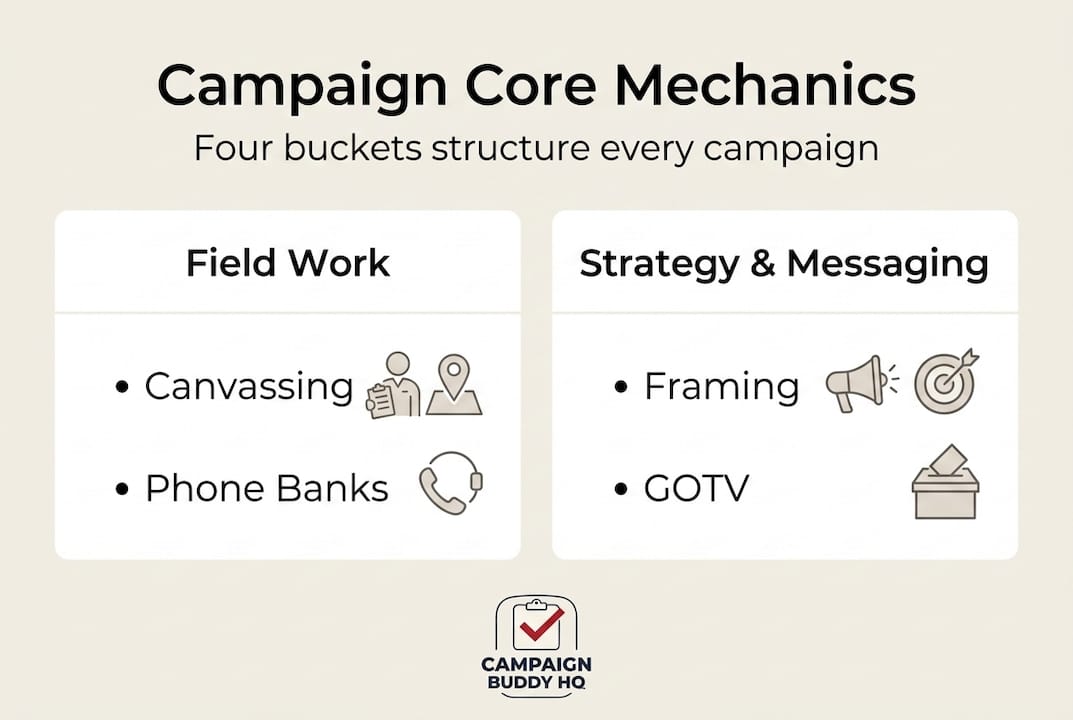
Every campaign, regardless of size or geography, operates across four core mechanics buckets. Progressive organizers can reduce confusion by mapping campaign terms to these four areas: persuasion, GOTV, field and organizing logistics, and communications framing and message testing. When volunteers understand which bucket their work falls into, they grasp the "why" behind their tasks and make better decisions in the field.
| Bucket | Sample terms | Typical activities | Who's responsible |
|---|---|---|---|
| Persuasion | Persuasion universe, script, ID | Canvassing undecided voters, phone banking | Field staff, trained volunteers |
| GOTV | Ride-to-polls, early vote, chase list | Reminding and mobilizing committed supporters | GOTV coordinator, all volunteers |
| Field logistics | Turf, walk list, data entry, shift | Organizing canvass packets, entering results | Field director, data manager |
| Communications framing | Message testing, frame, talking points | Drafting scripts, testing language, media prep | Communications director, campaign manager |
Here's how to assign tasks by bucket when onboarding a new volunteer:
- Identify which bucket their role falls into before their first shift.
- Explain the goal of that bucket in one plain sentence.
- Show them one specific term from that bucket and what it looks like in action.
- Give them a task within that bucket on day one so the language becomes real.
- Debrief after their first shift using the same bucket vocabulary to reinforce learning.
This system works because it gives new volunteers a mental map before they're overwhelmed by specific jargon. Instead of memorizing 40 terms at once, they learn four buckets first, then fill in the details. Campaign teams that use this framework during onboarding report fewer miscommunications during high-pressure GOTV weeks, when clarity matters most and there's no time to explain basics.
GOTV, persuasion, and contact tools: Terms in action
Now let's see the most essential terms in action, those that make up the bulk of campaign outreach.
GOTV, which stands for "get out the vote," covers all campaign operations intended to increase voter turnout. It's not about changing minds. GOTV targets people who already support your candidate or cause and makes sure they actually cast a ballot. GOTV efforts typically intensify in the final two weeks before Election Day and include door knocking, phone calls, texts, and ride-to-polls programs.
Persuasion is the opposite bucket. Here, you're talking to voters who haven't made up their minds. The goal is to move them toward your candidate using values-based conversation, not pressure.
Walk list is the printed or digital list of addresses assigned to a canvasser for a specific shift. A well-built walk list is geographically efficient and filtered to the right voter universe, so canvassers aren't wasting time on houses outside the target group.
Phone bank refers to an organized session where volunteers make calls from a shared list, often using a dialer tool or campaign software. Phone banks can happen in person or remotely, making them one of the most flexible contact tools available.
Ride-to-polls programs arrange transportation for supporters who lack reliable access to their polling place. This is especially critical in rural areas and communities with limited public transit, where voter turnout can drop significantly without logistical support.
Common contact tools used in progressive campaigns include:
- Door knocking: The highest-impact contact method for both persuasion and GOTV
- Relational organizing: Asking supporters to contact people in their own networks
- Peer-to-peer texting: Personalized texts sent by volunteers, not automated blasts
- Robocalls and robo-texts: Lower-touch, high-volume reminders for GOTV
- Direct mail: Physical mailers timed to reinforce canvassing messages
- Social media outreach: Digital contact that supplements but rarely replaces field work
Campaigns that combine door knocking with at least two additional contact methods in the final week before Election Day consistently outperform single-method programs.
Pro Tip: Always tailor your persuasion scripts to local context. A script that works in a dense urban precinct will fall flat in a rural township where neighbors know each other by name. You can explore definitions of GOTV and related field terms in Campaign Buddy HQ's resource library to build scripts grounded in real campaign practice.
Message framing: The language that wins (or loses) voters
With tools and mechanics clear, it's time to explore how words themselves shape outcomes, both in one-on-one canvassing and online.
Framing is the practice of presenting information in a way that emphasizes certain values or interpretations over others. Two candidates can describe the same policy using completely different frames, and voters will respond differently based on the language used, not just the facts. Message framing and word choice are operationally important, with research-based use and avoid lists that campaigns rely on to sharpen their communication.
Message discipline means everyone on the team, from the candidate to the newest volunteer, uses the same core language consistently. When your canvassers say something different from your mailers, voters notice the inconsistency and trust erodes.
Microtargeting refers to using data to identify specific voter segments and deliver tailored messages to each group. A message about healthcare access hits differently in a precinct with high rates of uninsured residents than in a wealthier suburb.
Terms and phrases that campaigns actively use and avoid:
- Use: "Affordable care," "working families," "community investment," "fair wages"
- Avoid: "Government handout," "spending," "entitlement," "tax burden"
- Use: "Clean energy jobs," "local economy," "neighbors helping neighbors"
- Avoid: "Regulation," "mandate," "socialist," "radical"
The reasoning is straightforward. Words carry emotional associations built up over decades of political use. "Investment" signals growth and return. "Spending" signals waste. Your canvassers are not just delivering information; they're activating emotional responses. Choosing the right frame can mean the difference between a voter who leans your way and one who tunes out entirely.
Statistical callout: Research from message testing programs shows that frames emphasizing shared community values outperform policy-detail-heavy scripts by a significant margin in persuasion conversations, particularly with low-information voters who decide based on feeling rather than fact.
For organizers building their own messaging, start by asking: what does this voter already care about? Then find the frame that connects your issue to that existing value. Test your language with real volunteers before deploying it in the field. If your own team looks confused, voters will be too.
Navigating political finance terminology
Besides field and messaging terms, every organizer needs to understand basic political finance vocabulary.
PAC stands for Political Action Committee. A PAC raises money from members, employees, or donors and can contribute directly to candidates within federally set limits. Super PAC is a newer category that can raise unlimited funds from corporations, unions, and individuals, but it must spend independently and cannot coordinate directly with a candidate's campaign.
527 organizations are tax-exempt groups named after the IRS code section that governs them. They can raise unlimited money for political activity but face restrictions on direct candidate advocacy. 501(c) organizations include nonprofits that can engage in issue advocacy but face strict limits on electoral activity.
Hard money refers to contributions made directly to a candidate or party committee that are subject to legal limits and disclosure requirements. Soft money historically referred to unregulated funds given to parties for "party-building" activities. The Bipartisan Campaign Reform Act (BCRA), also known as McCain-Feingold, banned most soft money contributions to national parties. OpenSecrets provides clear definitions for these terms and explains how BCRA reshaped the money-in-politics landscape.
| Entity type | Allowed activities | Contribution restrictions |
|---|---|---|
| PAC | Direct candidate contributions, independent expenditures | Federal limits apply |
| Super PAC | Independent expenditures only | Unlimited, no coordination |
| 527 | Issue advocacy, voter registration | Unlimited, restricted on direct candidate ads |
| 501(c)(4) | Issue advocacy, limited electoral activity | Unlimited, disclosure varies |
"Transparency in campaign finance is not just a legal obligation. It's the foundation of voter trust in the democratic process."
For volunteers, the practical rule is simple: if someone asks you about accepting a large donation or spending money on campaign materials, stop and ask your compliance officer before acting. The legal distinctions between these entity types carry real consequences, and a well-meaning mistake can create serious problems for the campaign.
Why mastering terminology is more than 'talk': Lessons from the field
Here's an uncomfortable truth most campaign training programs skip: the biggest risk for new activists isn't looking uninformed. It's misunderstanding a term and acting on that misunderstanding. A volunteer who confuses the "persuasion universe" with the "GOTV universe" will knock on the wrong doors at the wrong time, wasting hours of effort and potentially alienating voters who were already committed.
The most effective progressive campaigns we've seen make language learning part of onboarding, not an afterthought. They don't hand new volunteers a glossary and move on. They use the terms in context, correct gently in real time, and build a shared vocabulary that makes the whole team faster.
The best organizers don't just repeat jargon. They translate it. When a field director explains that "we're chasing our GOTV universe this weekend," the best organizers turn to their volunteers and say: "That means we're calling everyone who told us they'd vote for us, to make sure they actually do." That translation builds trust, reduces errors, and keeps volunteers from feeling like outsiders.
Precise, plain language also protects your campaign legally. Knowing the difference between coordinated and independent expenditures, or between voter registration and voter mobilization, keeps your team on the right side of compliance. Terminology isn't just vocabulary. It's operational clarity, legal protection, and team cohesion all at once.
Take your campaign knowledge further with Campaign Buddy HQ
If you want to go beyond the basics and put your new vocabulary to work, Campaign Buddy HQ has what you need.
Understanding campaign terminology is the first step. Applying it through organized, trackable outreach is where campaigns actually win. Campaign Buddy HQ gives progressive organizers the tools to log doors, calls, and texts, track volunteer activity, and monitor progress toward your vote goal in real time. You can even use the how many voters to win calculator to set realistic targets before your first canvass. Whether you're coordinating a small local race or managing a multi-precinct field program, organizing with Campaign Buddy HQ means your new vocabulary translates directly into measurable campaign action. Try it free for 7 days, no credit card required.
Frequently asked questions
What does 'GOTV' mean in political campaigns?
GOTV stands for "get out the vote," a set of strategies to boost voter turnout, especially just before Election Day. It targets committed supporters rather than undecided voters.
What's the difference between a PAC and a super PAC?
A PAC can give money directly to candidates within legal limits, while a super PAC raises unlimited funds but must spend independently and cannot coordinate with candidates. The distinction matters for compliance and campaign strategy.
Why do campaigns avoid certain words in messaging?
Campaigns avoid words that test poorly with target audiences and choose terms aligned with local values, because word choice shapes voter attitudes and emotional responses more than most organizers expect.
How does 'framing' help a campaign?
Framing guides how campaign issues are presented to resonate with target voters, and message framing can increase persuasive impact significantly when grounded in audience values rather than policy details.
What is 'field' work in political organizing?
Field work involves direct voter contact like canvassing and phone banking, managed at the local organizing level by field directors and volunteer coordinators working within assigned geographic areas.