

Running a political campaign without a clear system for managing outreach is like trying to win a race blindfolded. You have volunteers making calls, staff knocking doors, texts going out, and events to fill, but without structure, activities get duplicated, contacts get missed, and momentum stalls fast. This guide walks you through setting clear objectives, building a multi-channel approach, tracking every contact, and troubleshooting the inevitable curveballs, so your campaign stays coordinated, accountable, and moving forward.
Table of Contents
- Set your outreach objectives and structure
- Diversify outreach channels for resilience
- Track outreach actions and measure results
- Troubleshoot outreach challenges and common mistakes
- Why tech resilience is the hidden factor in outreach success
- Campaign Buddy HQ: Tools for streamlined outreach
- Frequently asked questions
Key Takeaways
| Point | Details |
|---|---|
| Set clear objectives | Define outreach goals and deadlines before launching any campaign activities. |
| Diversify channels | Use multiple platforms like SMS, email, phone, and canvassing to maintain resilience. |
| Track and review | Monitor outreach actions and schedule regular check-ins to stay accountable and adjust quickly. |
| Build relationships | Relational organizing supports long-term resilience and flexibility against tech disruptions. |
| Utilize campaign tools | Leverage specialized platforms to streamline planning, outreach, and measurement for campaigns. |
Set your outreach objectives and structure
Every effective outreach operation starts with a specific, measurable goal. Not "talk to more voters," but "make 2,000 voter contacts in the next 30 days across phone and doors." That level of specificity is what separates campaigns that build momentum from those that spin their wheels.
Start by defining your core contact targets:
- Total voter contacts needed to hit your vote goal
- Event attendance targets per phase
- Volunteer recruitment numbers to sustain the operation
- Specific registration or pledge-to-vote commitments
Once those numbers are set, break your campaign into time-based phases. The 30-60-90 day model is widely used by organizers to structure outreach, assign tools like EveryAction and Mobilize, build in regular check-ins, and create relational recruitment pathways with flexible event options. It forces teams to think in sprints rather than one long marathon that exhausts everyone before Election Day.
Why phases matter so much:
Breaking outreach into phases does more than organize your calendar. It gives your team clear checkpoints to evaluate whether your strategy is working. During the first 30 days, you're building your list, training volunteers, and testing your message. Between days 31 and 60, you're scaling up contact volume and identifying your highest-performing channels. In the final stretch, you're maximizing intensity and making sure every commitment converts to action.
| Phase | Primary Goal | Key Activities |
|---|---|---|
| Days 1-30 | List building and setup | Volunteer recruitment, tool setup, message testing |
| Days 31-60 | Volume and velocity | Scaled phone, text, canvassing, data review |
| Days 61-90 | Conversion and GOTV | Pledge follow-up, event mobilization, final push |
Choosing the right tools from the start is also critical. Spreadsheets work in a pinch for very small operations, but growing campaigns need CRM tools or purpose-built nonprofit outreach tools that centralize data and reduce duplicated effort. Whatever you choose, commit to it early. Switching systems mid-campaign burns time and creates data gaps.
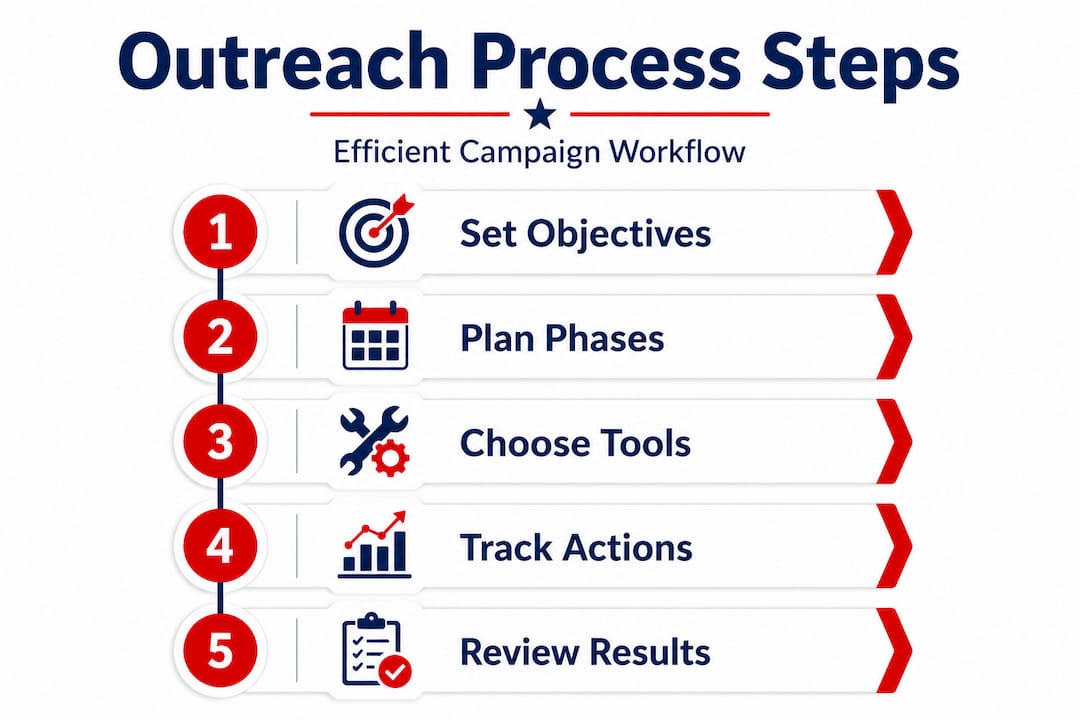
Pro Tip: Schedule a weekly 30-minute debrief with your team leads. Even five minutes of structured review saves hours of confusion later. Make it a standing meeting, not optional.
One of the most overlooked structural elements is accountability. Assigning a specific person to own each outreach channel, such as one person responsible for text banking and another for canvassing coordination, creates clear ownership. When something falls short, you know exactly where to address it. You can explore integrated campaign outreach strategies that help you build this kind of structure without starting from scratch.
Diversify outreach channels for resilience
Here's something that catches campaigns off guard every election cycle: the platform they built their entire outreach operation on suddenly changes its terms, increases costs, or gets blocked. If your entire voter contact strategy lives on a single app or service, one policy change can gut your operation overnight.
Multi-channel resilience means building your outreach across SMS, email, social media, phone banking, and canvassing simultaneously, so no single disruption kills your momentum. This isn't just about backup plans. It's about reaching voters where they actually are, because different people respond to different channels at different times.
The most common channels and their strengths:
- SMS and text banking: High open rates, fast response, works well for event reminders and GOTV nudges
- Email: Good for longer updates, donor communications, and policy-focused messages
- Phone banking: Best for personal conversations and persuasion with undecided voters
- Door-to-door canvassing: Highest conversion rate for pledges and volunteer recruitment
- Social media: Useful for organic reach and paid targeting, but never rely on it as your only connection point
The channel mix you choose should reflect your voter universe and your team's capacity. A small rural campaign with 10 volunteers cannot staff a call center, but they can absolutely run a tight door program combined with targeted texts. Urban campaigns with larger teams can layer in more channels simultaneously.
| Channel | Cost | Reach | Conversion Rate | Platform Risk |
|---|---|---|---|---|
| SMS | Low | High | Medium | Medium |
| Very Low | Medium | Low | Low | |
| Phone Banking | Low | Medium | High | Low |
| Canvassing | Medium | Low | Very High | None |
| Social Media | Variable | Very High | Low | High |
Relational organizing deserves special attention here. Rather than relying on tech-mediated contact alone, relational organizing activates your supporters to reach out to their own networks: friends, coworkers, neighbors. These conversations carry far more weight than a cold text from an unknown number. Campaigns that invest in this approach build community outreach capacity that is genuinely platform-independent.
Pro Tip: Never let a single channel account for more than 40% of your total outreach volume. If it does, you're one policy change or technical failure away from a real crisis.
Mapping your outreach channels also gives you something valuable: flexibility. When you know your redundancy options, you can pivot fast without losing ground. Campaigns that document their channel mix as part of their written outreach plan are far better positioned to adapt when unexpected problems arise.
Track outreach actions and measure results
Defining goals and choosing channels means nothing if you're not tracking what actually happens on the ground. Outreach tracking is the mechanism that turns activity into accountability, and accountability into results.
How to build an effective tracking system:
- Choose a central tool: a CRM, a purpose-built platform, or at minimum a structured shared spreadsheet that every team member can access and update.
- Define what gets recorded: at a minimum, every contact attempt, the outcome (answered, left message, refused, etc.), and any follow-up needed.
- Set data entry standards so everyone logs contacts the same way. Inconsistent data makes analysis impossible.
- Review data weekly, not just before major deadlines. Patterns only become visible over time.
- Use analytics to identify which channels, times of day, and volunteer teams produce the best contact rates.
The 30-60-90 day planning model, combined with tools like EveryAction and Mobilize, helps campaigns build check-in rhythms that keep data fresh and teams aligned. Without those regular review moments, tracking becomes a historical record instead of a decision-making tool.
"Campaigns that review outreach data weekly adjust their strategy twice as fast as those that only check in monthly. Real-time feedback is what separates campaigns that coast from campaigns that accelerate."
This matters because outreach data tells you more than how many doors you knocked. It tells you which neighborhoods are responding, which volunteer teams are underperforming, and which messages are landing. You can use campaign tracking tools to automate some of this analysis and surface insights faster than manual review allows.

| Metric to Track | Why It Matters | Review Frequency |
|---|---|---|
| Contact attempts per channel | Measures team effort and volume | Daily |
| Contact rate (reached vs. attempts) | Identifies effective channels | Weekly |
| Pledge or commitment rate | Tracks persuasion effectiveness | Weekly |
| Follow-up completion rate | Ensures nothing slips | Weekly |
| Volunteer retention rate | Flags burnout early | Monthly |
One critical mistake campaigns make is tracking inputs (calls made, doors knocked) but not outputs (pledges secured, volunteers recruited, events attended). Both matter. You want to know if your volume is generating results, or if you're just running up numbers without converting them. This is exactly where reviewing your campaign outreach strategies in detail pays off, because having a structured framework means you're measuring things that actually connect to your vote goal.
Troubleshoot outreach challenges and common mistakes
Even well-structured campaigns run into problems. Platform changes, volunteer burnout, inconsistent data, and message fatigue are facts of life in any extended outreach operation. The difference between campaigns that survive these challenges and campaigns that fall apart is preparation and a bias toward action.
Common outreach challenges and how to address them:
- Platform disruption: A text banking tool goes down, or social media reach collapses. Always have your volunteer phone list and email list backed up and accessible outside the primary platform.
- Volunteer burnout: Rotating tasks across your team prevents any one person from carrying the entire operational load. If your top phone banker is making all the calls, you're one bad week away from losing capacity.
- Data inconsistency: When people log contacts differently, your reporting becomes unreliable. Solve this with a simple training session at the start of each new volunteer cohort.
- Message fatigue: If voters or supporters receive the same message from you every week, open rates drop and responses thin out. Vary your content, tone, and call to action regularly.
- Low event attendance: If turnout to phone banks or canvasses is falling short, examine your recruitment message, your event timing, and whether you're offering flexible options for different schedules.
Relational organizing builds resilience against technology disruptions in a way that no backup app can match. When your supporters have genuine relationships with other supporters, the community sustains itself even when platforms fail. This is why progressive organizing training programs emphasize building people-to-people networks rather than people-to-platform networks.
"Resilient outreach means never putting all your eggs in one tech basket."
Pro Tip: After every major event or push, run a 15-minute debrief with your team. Ask three questions: What worked? What didn't? What do we do differently next time? You'll surface problems early, before they compound into larger failures.
One underestimated challenge is the invisible accountability gap. This happens when everyone assumes someone else is following up on a contact, logging a pledge, or confirming an event attendee. Building a clear written workflow with named owners for each step closes that gap. If it's everyone's job, it's no one's job. You can also lean on campaign outreach strategies that are designed to help teams manage accountability without creating extra administrative burden.
Why tech resilience is the hidden factor in outreach success
Most campaign advice focuses on tactics: which channel to use, how many contacts to make, what message to send. But the campaigns we've seen struggle most weren't short on tactics. They were short on resilience, specifically tech resilience.
Here's the uncomfortable pattern: a campaign builds an impressive digital operation on a single platform, often the trendiest one in progressive circles at that moment. It works great, until it doesn't. A terms change, an algorithm shifts, an API breaks. Suddenly thousands of contacts are inaccessible, and the campaign has no fallback.
The campaigns that weather these moments have two things in common. First, they maintained multiple contact channels the whole time, even when the primary one was performing well. Second, and more importantly, they invested in relationships, not just reach. Their volunteers know each other. Their supporters have been asked to connect with their own networks. Their organizing infrastructure isn't stored on a server somewhere. It lives in the community.
This is not a nostalgic argument against technology. It's a practical argument for using technology strategically, rather than letting it become the foundation your entire operation rests on. Use EveryAction and Mobilize to scale and systematize. But make sure your team can function if those tools are unavailable for a week.
Flexible teams are also underrated. Campaigns that cross-train volunteers, so the phone banker can also canvass, and the data person can also recruit, can reallocate resources when one channel underperforms. Rigid specialization feels efficient until it isn't. Investing in broader volunteer skills pays dividends every time you need to pivot. The most durable campaign outreach strategies treat relationship-building as infrastructure, not just a nice-to-have.
Campaign Buddy HQ: Tools for streamlined outreach
Keeping all of these moving parts organized, tracked, and visible to your entire team is a genuine operational challenge. That's exactly what Campaign Buddy HQ is built to solve.
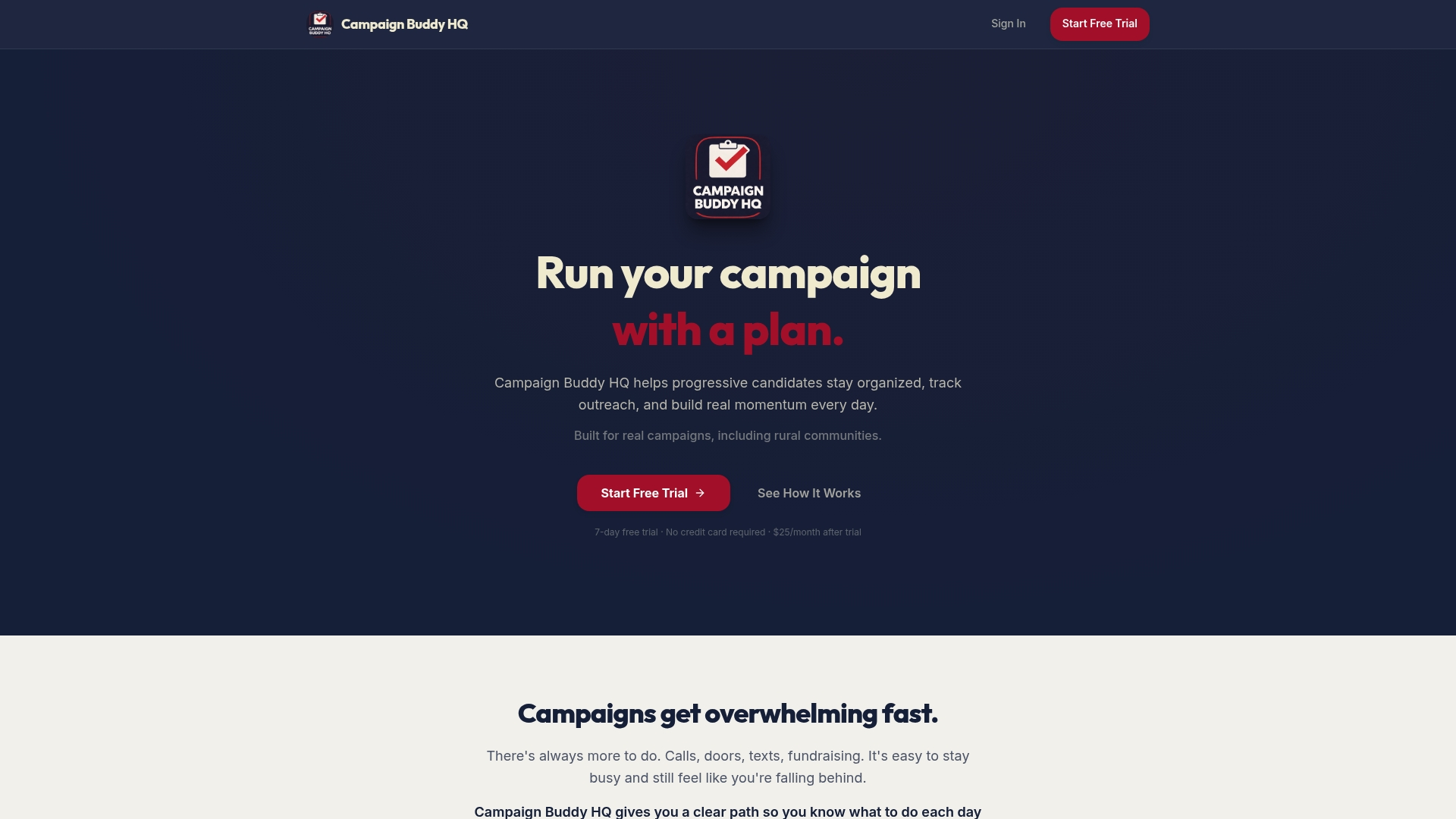
Campaign Buddy HQ gives progressive campaigns a purpose-built platform for planning daily and weekly outreach, logging doors, calls, and texts, and tracking progress toward your vote goal in real time. You can use the vote goal calculator to translate your win number into daily contact targets, and explore AI campaign tools to streamline planning and reporting. Whether you're managing a large coordinated effort or running a lean grassroots operation, Campaign Buddy HQ keeps your team accountable, your data clean, and your outreach moving forward. Try it free for 7 days, no credit card required.
Frequently asked questions
What is the most effective outreach channel for campaigns?
A mix of SMS, email, phone banking, and canvassing is the most resilient approach, since single-platform reliance creates vulnerability to service disruptions or algorithm changes. No one channel reaches every voter effectively.
How can campaign managers track outreach activities?
Managers should use tools like EveryAction or Mobilize, or custom spreadsheets with clearly defined logging standards, to record every contact attempt, its outcome, and required follow-up actions.
What is relational organizing and why does it matter?
Relational organizing means activating supporters to reach their own personal networks, which builds community-level resilience that no technology platform can replicate or take away.
How often should campaign outreach activities be reviewed?
Weekly check-ins and debriefs are the recommended cadence because they surface problems early, allow rapid strategy adjustments, and keep the full team aligned on what's working and what needs to change.