

Running a progressive campaign means fighting on multiple fronts at once. You're competing for voter attention, managing volunteer attrition, and trying to stitch together canvassing, texting, phone banking, and social media into something coherent. Most campaigns lose not because their candidate is weak, but because their outreach is scattered. The good news: a systematic approach changes everything. Multi-channel outreach that contacts voters 3-5 times across integrated channels consistently outperforms single-channel efforts. This guide walks you through every stage, from strategy to execution to optimization, so you can run outreach that actually moves voters.
Table of Contents
- Planning your outreach strategy
- Building and training your volunteer team
- executing outreach: Deep canvassing and relational organizing
- monitoring, troubleshooting, and optimizing outreach
- What most campaigns are missing and how to stand out
- Next steps: supercharge your outreach with Campaign buddy HQ
- frequently asked questions
Key Takeaways
| Point | Details |
|---|---|
| Use multi-channel outreach | Combine canvassing, phone, text, mail, email, events, and social media for best results. |
| Recruit and retain volunteers | Over-recruit and build a structured hierarchy to maximize volunteer retention and impact. |
| Prioritize deep conversations | Quality interactions and relational organizing drive higher turnout and lasting engagement. |
| Track and optimize with KPIs | Establish feedback loops and monitor KPIs to continually improve your outreach effectiveness. |
| Leverage digital tools | Campaign management platforms streamline planning, tracking, and optimizing outreach efforts. |
Planning your outreach strategy
Before a single door gets knocked, you need a plan that maps channels to goals. The biggest mistake campaigns make is picking one or two outreach methods and hoping for the best. The most effective campaigns treat outreach like a coordinated campaign, not a series of disconnected tasks.
The core channels available to you are:
- Door-to-door canvassing: High contact quality, best for persuasion and voter ID
- Phone banking: Cost-effective for volume, good for low-density areas
- Text banking: High open rates, ideal for reminders and event invites
- Direct mail: Strong credibility signal, reaches voters who ignore digital
- Email: Low cost, good for supporter updates and fundraising
- Events: Deep engagement, coalition building, and earned media
- Social media: Brand awareness and volunteer recruitment
The reason multi-channel outreach works is simple: voters have different habits. Some people open every text. Others only read mail. By covering multiple channels, you catch voters where they actually are, not where you assume they are. Research confirms that integrated messaging with 3-5 voter contacts boosts ROI significantly compared to one-touch outreach.
For progressive campaigns specifically, early engagement matters more than it does for incumbents. You're often building name recognition from scratch and assembling diverse coalitions, which means you need more touchpoints, not fewer.
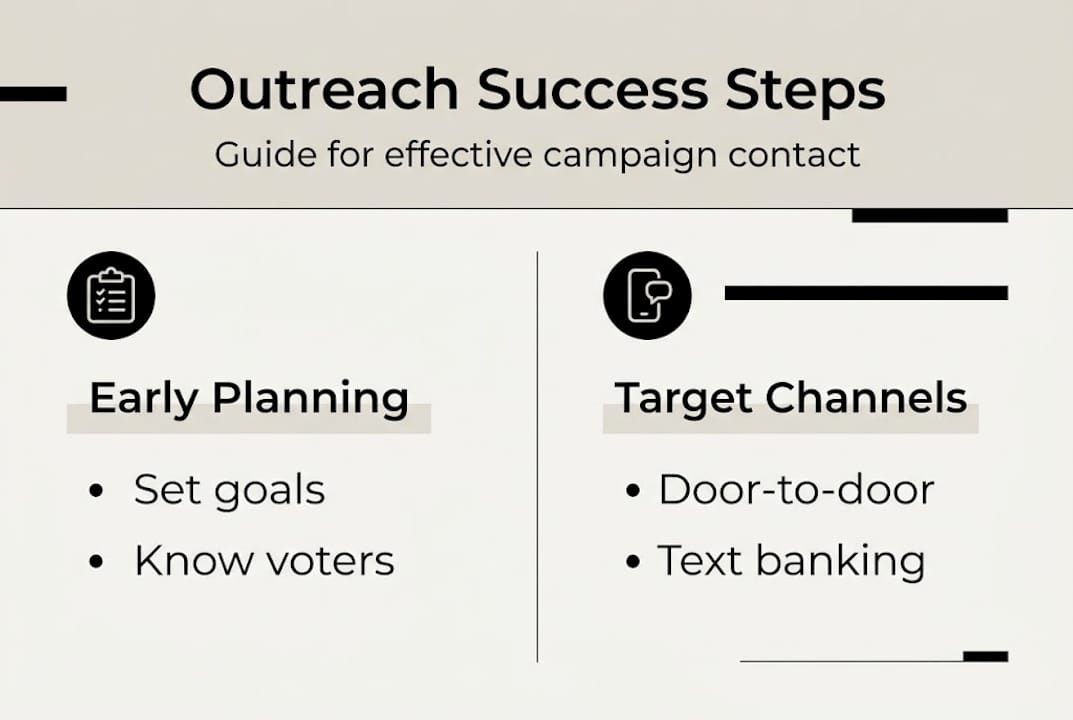
| Channel | Average cost | Contact rate | Best use case | Key limitation |
|---|---|---|---|---|
| Door canvassing | Medium | 45-50% | Deep persuasion | Time intensive |
| Phone banking | Low | 10-20% | Volume outreach | Call screening |
| Text banking | Very low | 90%+ open | Quick reminders | Legal opt-in rules |
| Direct mail | High | Near 100% delivery | Trust building | No two-way dialog |
| Very low | 20-30% open | Updates, fundraising | Low engagement | |
| Events | Medium | High quality | Coalition building | Limited scale |
Pro tip: Don't treat digital and traditional as separate programs. The strongest campaigns use direct mail to prime voters before a canvass visit, then follow up with a text. That layered approach makes each touchpoint more effective than it would be alone.
For comprehensive campaign outreach, the planning phase should also include a voter universe analysis. Know who you're targeting: low-propensity supporters, soft persuadables, or reliable base voters. Each group needs a different message and a different channel mix.
Building and training your volunteer team
With your outreach plan set, the next step is assembling the right team to execute it. This is where most campaigns underestimate the work involved.
Here's a step-by-step recruiting process that works:
- Post on social media with a clear, specific ask. "Join us Saturday to knock doors in your neighborhood" converts better than a vague volunteer appeal.
- Use peer networks. Ask existing volunteers to recruit two friends. Personal asks convert at a much higher rate than cold outreach.
- Host low-barrier events. A casual canvass kickoff or phone bank night lets people try volunteering before committing.
- Follow up within 24 hours. Speed matters. A volunteer who signs up and hears nothing for a week is already gone.
According to structured organizing guidance, campaigns should recruit 3-4 times the number of volunteers they think they need, because attrition typically runs 70-75%. That's not a failure of your program. It's the reality of volunteer-driven work. Plan for it.
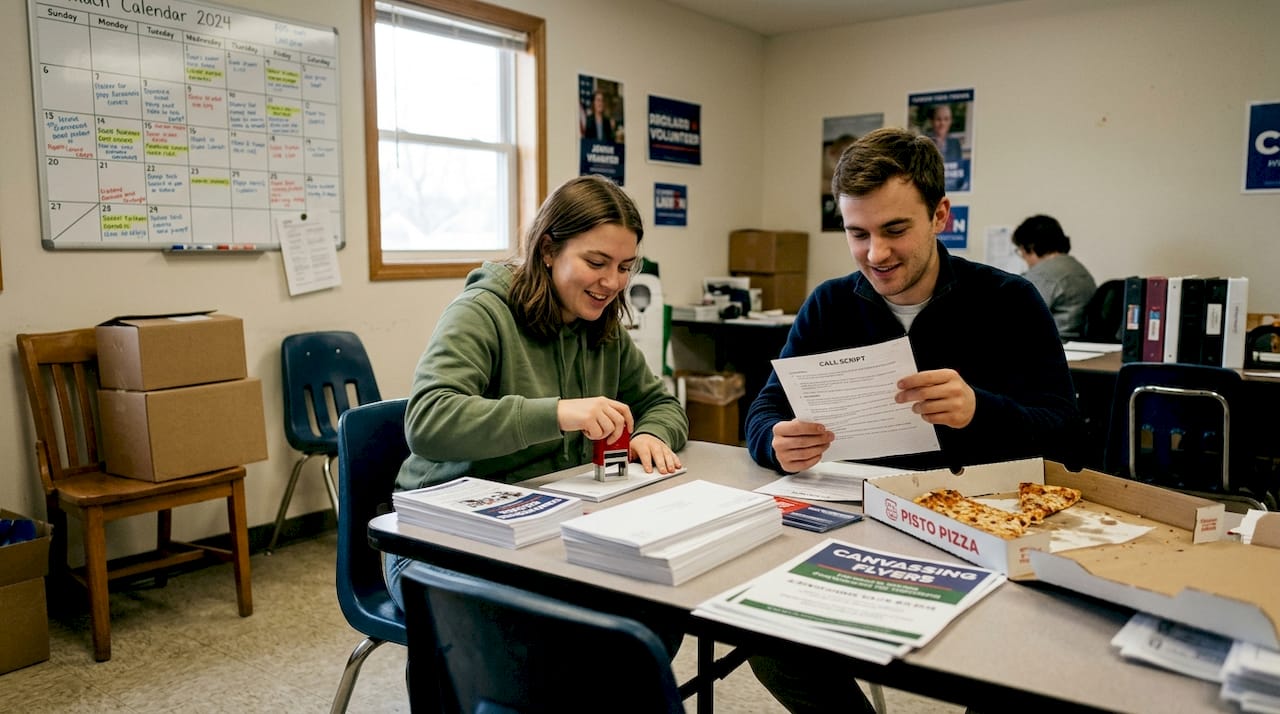
Your volunteer hierarchy should look like this:
| Role | Reports to | Team size | Weekly output target |
|---|---|---|---|
| Field Director | Campaign Manager | Full operation | Strategy + oversight |
| Regional organizer | Field Director | 4-6 captains | 500+ contacts/week |
| Team captain | Regional organizer | 8-12 volunteers | 150-200 contacts/week |
| canvasser/caller | Team captain | Individual | 20-30 contacts/shift |
Training should run 60-90 minutes and cover four things: the script, door and phone etiquette, data entry procedures, and role-play practice. Role-play is the part most campaigns skip, and it's the part that matters most. A volunteer who has practiced handling a skeptical voter is ten times more effective than one who hasn't.
Pro tip: Build in recurring weekly huddles, even short 15-minute check-ins. Tools for organizing volunteers that track attendance and output help team captains spot disengaged volunteers before they disappear entirely. Structure alone can improve retention by 47%.
executing outreach: Deep canvassing and relational organizing
Once your team is ready, you can begin meaningful outreach that goes beyond simple contact. This is where progressive campaigns have a real strategic advantage, if they use it.
Deep canvassing flips the traditional model. Instead of racing to hit a door count, volunteers spend 10-15 minutes in genuine conversation with each voter. They listen first, share a personal story, and connect the campaign's message to what the voter actually cares about. It feels slower. It produces better results.
Deep canvassing strategies show that relational organizing, where outreach comes from someone the voter already knows, boosts turnout by 8.6 percentage points compared to stranger contact. That's a massive lift for a single tactic.
"When a friend texts you about an election, you pay attention. When a stranger calls, you hang up. Progressive campaigns that invest in relational organizing are tapping into the most powerful persuasion tool available: trust."
Effective conversations share these traits:
- Open with a genuine question, not a pitch
- Listen for at least 60 seconds before speaking
- Connect the candidate's platform to a specific local issue
- Ask for a commitment before leaving
- Log the outcome accurately, every time
Coalition partners are equally important. Faith communities, labor unions, tenant organizations, and cultural groups all have existing trust with specific voter segments. Year-round engagement, not just pre-election asks, is what builds real coalition relationships.
Pro tip: Target infrequent and low-propensity voters early. These are the voters who could support your candidate but need more touchpoints to get there. Progressive outreach best practices consistently show that early investment in low-propensity voters pays off more than late-cycle persuasion of undecideds.
monitoring, troubleshooting, and optimizing outreach
As outreach unfolds, rigorous tracking and iterative improvement are critical for maximizing results. A campaign that doesn't measure its outreach is flying blind.
Here's a numbered process for staying on top of your data:
- Set weekly KPI targets for contacts made, voter IDs collected, and doors knocked per volunteer.
- Review data daily. Don't wait until the end of the week to find out a team captain's entire squad went offline.
- Run weekly debriefs with regional organizers. Ask what's working, what's not, and what support they need.
- Flag data quality issues immediately. A voter ID that's logged incorrectly is worse than no data at all.
- A/B test your scripts. Run two versions with different teams for two weeks and compare conversion rates.
Data quality target: 95% or higher. According to campaign outreach KPIs from the DNC, campaigns should aim for 95%+ data accuracy to ensure their voter contact records are reliable enough to inform targeting decisions.
Quick tips for monitoring and optimization:
- Use a shared dashboard so team captains can see their own numbers in real time
- Set a floor, not just a ceiling. If a volunteer logs fewer than 10 contacts in a shift, follow up
- Watch for geographic gaps in your contact map and redirect resources
- Compare contact rates by channel weekly and shift budget accordingly
- Track campaign results tracking metrics against your vote goal, not just raw activity numbers
Troubleshooting common problems: If contact rates drop, check whether your voter universe is stale. If volunteers stop showing up, check whether team captains are following up after each shift. If your data quality slips, retrain on entry procedures before the problem compounds.
What most campaigns are missing and how to stand out
Here's the uncomfortable truth: most campaigns optimize for volume because volume is easy to measure. Door counts go on a whiteboard. Quality conversations don't.
But quality vs. quantity in outreach research shows that targeted outreach strategies deliver a 340% lift in response rates compared to generic high-volume contact. That number should stop you cold. Three hundred forty percent. And yet campaigns keep running the same spray-and-pray field programs.
The distributed organizing model that Obama's 2008 campaign pioneered, where local leaders owned their turf and made real decisions, remains a benchmark that few campaigns actually replicate. Most campaigns call it distributed organizing but run it as top-down coordination with extra steps.
Ask yourself these questions that most campaign managers never do:
- Are my volunteers having real conversations, or just logging contacts?
- Do my coalition partners actually trust us, or do we only call them in October?
- Am I measuring voter persuasion, or just voter contact?
Relational organizing is the single most underused tool in progressive campaigns. It's harder to scale than texting, but the turnout impact is real and measurable. If you're not investing in it systematically, you're leaving votes on the table.
Next steps: supercharge your outreach with Campaign buddy HQ
Putting these practices into action requires more than a good plan. It requires tools that keep your team organized, your data clean, and your progress visible every single day.
Campaign buddy HQ tools are built specifically for progressive campaigns that need to manage outreach at scale without a massive staff. From daily planning and outreach logging to supporter tracking and campaign phase management, the platform handles the operational complexity so your team can focus on voters. Use the vote goal calculator to set realistic targets, and explore AI-powered outreach features that help you prioritize the right contacts at the right time. Try it free for 7 days, no credit card required.
frequently asked questions
What is the optimal number of voter contacts per campaign?
Aim to contact each voter 3-5 times across multiple channels for maximum impact. Each additional touchpoint reinforces your message and increases the likelihood of turnout.
How many volunteers should I recruit for my campaign?
Recruit 3-4 times the number of volunteers you think you'll need, since attrition typically runs 70-75%. Over-recruiting is not pessimism; it's smart planning.
Which outreach channels have the highest contact rates?
Door-to-door canvassing achieves 45-50% contact rates, while text banking sees open rates above 90%. Each channel serves a different purpose in your overall mix.
How can I reach infrequent or low-propensity voters?
Start outreach early, use listening-first conversations, and lean on relational organizing and local events. These voters need more touchpoints and more trust before they commit.
What KPIs should I use to track campaign outreach?
Track contacts made, voter IDs collected, and maintain 95%+ data quality for reliable targeting. Activity without data accuracy is just noise.