

Incomplete outreach data is one of the fastest ways to derail a campaign. When volunteers knock doors without logging results, when call sheets go unreconciled, or when no one knows which precincts are 60% complete versus untouched, your campaign loses momentum and wastes precious time chasing voters you've already contacted or missing ones you haven't. Strong campaign tracking strategies are the backbone of every successful grassroots operation, and yet most campaigns treat tracking as an afterthought rather than a daily discipline. This guide delivers the framework, tools, and step-by-step workflow you need to track outreach progress accurately, catch errors early, and hit your targets on election day.
Table of Contents
- Why progress tracking matters in political campaigns
- Tools and materials for tracking campaign progress
- Step-by-step process to track campaign progress
- Avoiding common tracking mistakes in grassroots campaigns
- How to measure campaign success and verify progress
- Our perspective: Why true progress tracking requires more than tools
- Take your campaign tracking to the next level with Campaign Buddy HQ
- Frequently asked questions
Key Takeaways
| Point | Details |
|---|---|
| Digital tools boost outreach | Apps achieve higher completion rates and fewer errors compared to paper lists. |
| Preparation drives accuracy | Well-defined lists and clear criteria ensure reliable campaign progress data. |
| Avoid tracking mistakes | Consistent tool use and regular updates prevent data gaps and confusion. |
| Measure outcomes weekly | Review outreach data and benchmark against goals every week for best results. |
| Training and transparency matter | Proper volunteer training and open tracking practices produce long-term campaign success. |
Why progress tracking matters in political campaigns
Tracking isn't just bookkeeping. It's the mechanism that tells you whether your campaign is on pace to win or quietly falling behind. Without it, you're flying blind through one of the most time-sensitive operations in civic life.
The core problem most organizers face is duplication and gaps. Volunteers contact the same voters twice while entire blocks go untouched. Outreach logs sit in someone's personal spreadsheet instead of a shared system. Canvass captains report "we hit that turf" without any data to back it up. These aren't small inefficiencies. They translate directly into lost voters, inaccurate targeting, and missed vote goals.
Here's what solid tracking actually protects against:
- Wasted volunteer hours on contacts already made
- Data gaps that make it impossible to forecast turnout
- Missed persuasion targets in tight precincts
- Inaccurate progress reports that give false confidence to campaign leadership
- Volunteer burnout from disorganized operations that feel chaotic
Modern digital tools have measurably improved these outcomes. Paper lists average 58-65% completion compared to 75-85% for app-based tracking, and progressive tools like NGP VAN prioritize Democratic voter files while cross-ideology platforms like Ecanvasser integrate with a broader range of progressive tech stacks.
"The difference between a campaign that tracks well and one that doesn't isn't just data quality. It's the difference between knowing you're on pace to win and finding out on election night that you weren't." — Campaign Buddy HQ
Effective campaign performance measurement requires real-time updates, voter file integration, and a culture where every volunteer understands that logging their work is just as important as doing it.
Tools and materials for tracking campaign progress
Choosing the right tool for your campaign isn't just about features. It's about what your volunteers will actually use consistently, what integrates with your voter file, and what gives your leadership team clear visibility into progress without requiring a data analyst.
Here's a side-by-side comparison of the most common options:
| Tool | Best for | Voter file integration | Completion tracking | Cost |
|---|---|---|---|---|
| NGP VAN | Progressive/Democratic campaigns | Deep Democratic file integration | Yes, real-time | Subscription |
| Ecanvasser | Cross-ideology and advocacy groups | Flexible import/export | Yes, automated | Subscription |
| Campaign Buddy HQ | Grassroots progressive campaigns | Built-in outreach logging | Yes, daily and weekly | Free trial, then monthly |
| Paper lists | Very small or low-resource campaigns | Manual only | Manual, 58-65% avg | Free |
| Generic spreadsheets | Internal tracking only | Manual only | Manual, error-prone | Free |
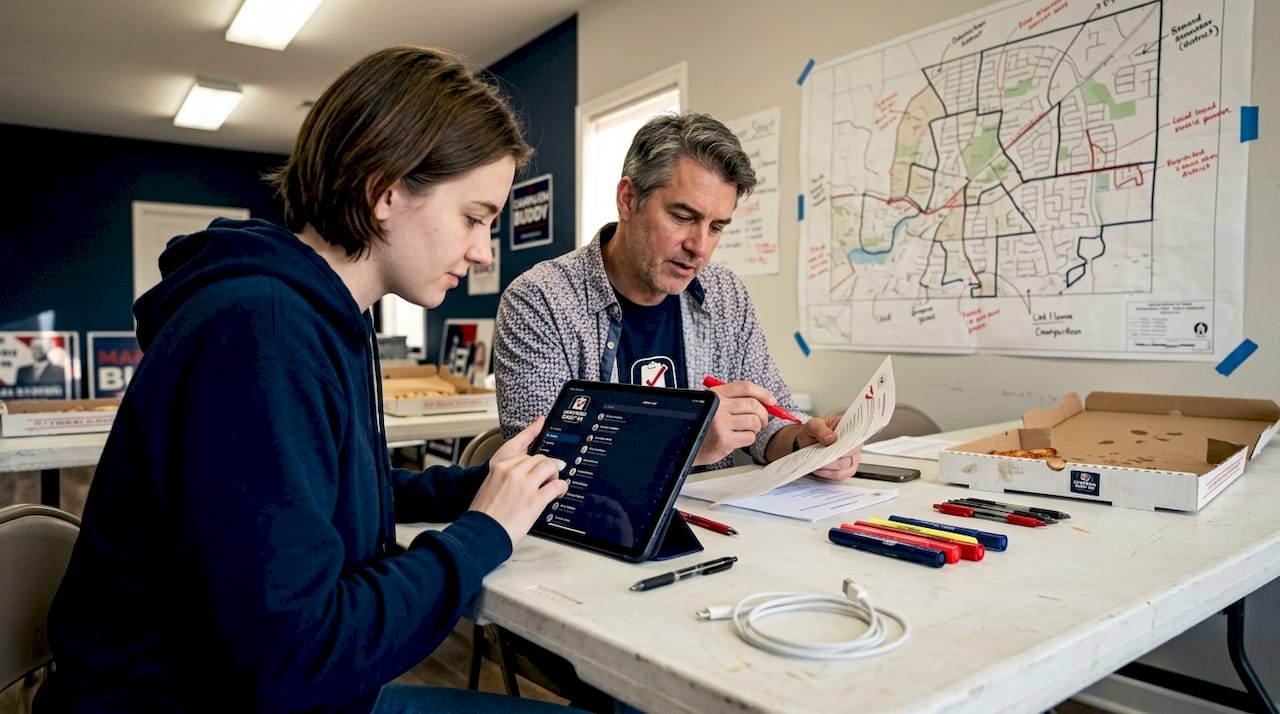
NGP VAN and Ecanvasser are the leading examples for progressive and cross-ideology campaigns respectively, with digital tools consistently producing higher outreach completion rates than paper alternatives.
Beyond the software itself, every campaign needs a set of core materials to support tracking:
- Updated contact lists segmented by turf, precinct, or phone bank batch
- A progress checklist that defines what "complete" means for each outreach type
- Role assignments that clarify who logs what and when
- Volunteer training guides that walk new team members through the logging process
- A weekly reconciliation process to catch errors before they compound
Good organizational planning tips always start with defining completion criteria before outreach begins, not after. If volunteers don't know what a "completed" door knock looks like in your system, you'll end up with inconsistent data that's nearly impossible to clean up later.
Pro Tip: Choose software that auto-updates completion percentages as volunteers log their work. Manual tallying is a full-time job that no campaign manager has time for, and it introduces errors every time someone recalculates a running total.
A reliable tracking checklist should include fields for contact type, outcome, volunteer ID, timestamp, and any follow-up flags. These six data points give you everything you need to reconcile, report, and re-target.
Step-by-step process to track campaign progress
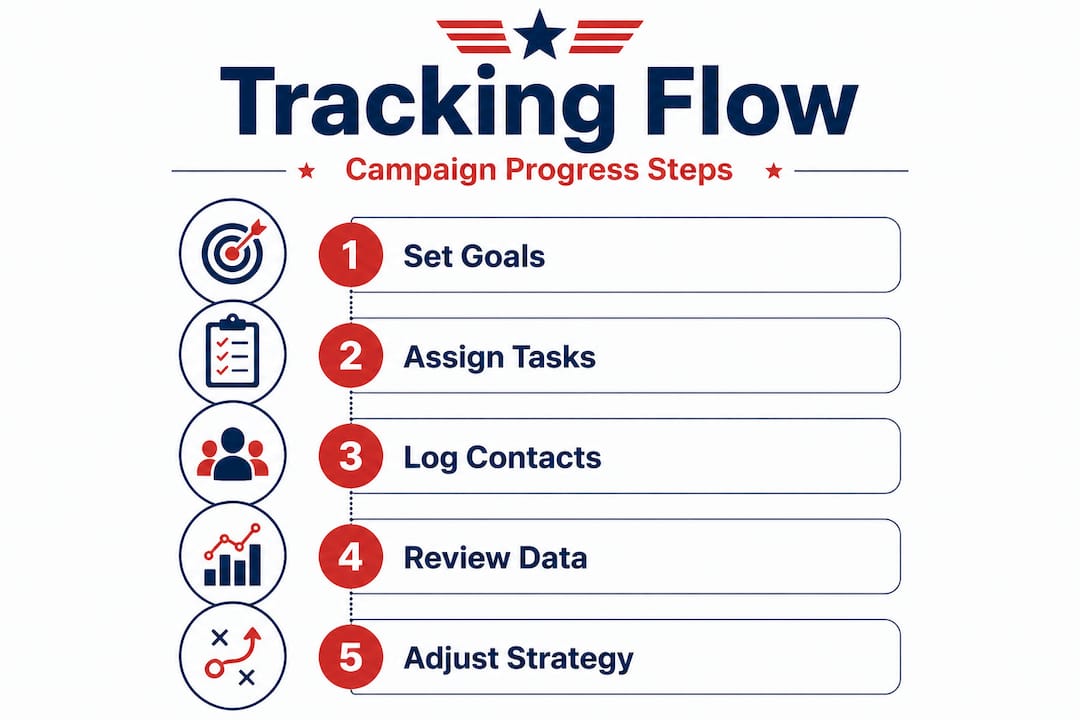
A tracking system only works if everyone follows the same process every single time. Here's the workflow that keeps campaigns organized from the first door knock to the final GOTV push.
- Build your outreach lists. Pull from your voter file and segment by geography, contact type, and priority tier. Define what "complete" means for each list before volunteers touch it.
- Assign volunteers, tools, and roles. Every volunteer should know which tool they're using, which list they're working, and who to contact if they hit a technical problem.
- Set daily and weekly targets. Break your total outreach goal into manageable daily chunks. If you need 10,000 door contacts in 30 days, that's roughly 333 per day. Track against that number every single day.
- Log contacts in real time. Whether you're using an app or a paper sheet, results should be logged during or immediately after each contact. Waiting until the end of a shift creates memory errors and incomplete records.
- Reconcile and verify data. At the end of each day or shift, a designated team member should review logs for missing fields, duplicate entries, or suspicious patterns.
- Adjust targets based on progress. If you're behind pace, you need to know by Wednesday, not the weekend before election day. Use your data to reallocate volunteer time and resources.
Apps have demonstrably higher completion rates than paper lists, which makes the case for digital tools even in low-resource campaigns where the learning curve feels like a barrier.
Here's a simple progress tracking table you can adapt for your own campaign:
| Outreach type | Weekly goal | Completed | % complete | Status |
|---|---|---|---|---|
| Door knocks | 1,500 | 1,120 | 75% | On pace |
| Phone calls | 2,000 | 1,340 | 67% | Needs attention |
| Text messages | 3,000 | 2,890 | 96% | Ahead of pace |
| Voter registrations | 200 | 145 | 73% | On pace |
Building this kind of visibility into your campaign tracking workflow gives leadership the information they need to make real decisions, not just gut-feel calls about where to focus resources.
Pro Tip: Schedule a 15-minute data audit every three days. Review your logs for incomplete entries, volunteers who haven't submitted results, and any turf that shows zero activity. Catching these gaps early prevents a data crisis in the final week of the campaign.
Detailed audit tracking steps typically include cross-referencing logged contacts against your original list, verifying that completion percentages match raw counts, and flagging any turf where results seem implausibly high or low.
Avoiding common tracking mistakes in grassroots campaigns
Even campaigns with good tools make avoidable mistakes. The most damaging ones tend to compound over time, turning a small data gap into a major operational problem by the time anyone notices.
The most common errors we see:
- Skipping list updates after each shift, leaving the next volunteer team with stale data
- Using multiple tools simultaneously without a clear hierarchy, which creates duplicate entries and conflicting completion numbers
- Failing to train volunteers on the specific logging process your campaign uses, resulting in partial records and missing outcome codes
- Treating tracking as optional rather than a non-negotiable part of every volunteer shift
- Relying on verbal reports from canvass captains instead of verified data from the system
Tracking mistakes like partial updates or inconsistent file use reduce the effectiveness of even the best tools. A platform is only as good as the data going into it.
"A campaign that logs 80% of its contacts accurately will outperform one that logs 100% sloppily. Precision beats volume when it comes to outreach data." — Campaign Buddy HQ
Optimizing attribution tracking for digital accuracy requires more than picking the right app. It requires building habits around consistent data entry, standardized outcome codes, and regular review cycles.
The solution to most of these mistakes is simpler than campaigns expect. Designate a single point of contact for all progress updates. This person owns the data, reviews it daily, and is the only one who makes corrections to the master record. Distributed ownership of tracking data is one of the leading causes of inconsistent records.
Pro Tip: Institute a "no log, no credit" rule for volunteer shifts. If a volunteer's contacts aren't logged in the system, those contacts don't count toward your progress totals. This creates immediate accountability without being punitive, and it reinforces that logging is part of the job, not an optional add-on.
Good tracking error solutions also include building a brief training module into every volunteer onboarding session. Five minutes on how to log a door knock correctly saves hours of data cleanup later.
How to measure campaign success and verify progress
Tracking data is only valuable if you're measuring the right things and reviewing them on a schedule that gives you time to respond. Here are the core metrics every progressive campaign should monitor:
- List completion percentage by turf, contact type, and volunteer team
- Total voter contacts broken down by door, phone, and text
- Volunteer engagement including shifts completed, contacts per hour, and no-show rates
- Persuasion and GOTV contact rates for your highest-priority voter segments
- Error and correction rates in your outreach logs, which reveal training gaps
Key statistic: Apps achieve 75-85% completion compared to 58-65% for paper lists. On a campaign targeting 10,000 voter contacts, that gap represents 1,000 to 2,700 additional completed contacts. In a close race, that's the margin.
Weekly reviews should include reconciling outreach logs against your original contact lists, identifying precincts that are behind pace, and updating your vote goal projections based on actual completion data. Tying your outreach progress directly to your measuring campaign outcomes framework keeps leadership focused on what actually moves the needle toward a win.
Strong campaign ROI methods connect outreach volume to vote projections, fundraising benchmarks, and volunteer capacity. When you can show your team that 500 additional door contacts this week puts you 3% closer to your vote goal, tracking stops feeling like administrative work and starts feeling like winning.
Our perspective: Why true progress tracking requires more than tools
Here's something most campaign tech vendors won't tell you: the tool is the easy part.
We've seen campaigns with access to the best software in the progressive space produce garbage data because no one built a culture of accountability around logging. And we've seen scrappy operations with basic apps run circles around better-funded campaigns because every single volunteer understood that their logged contacts were the lifeblood of the operation.
The uncomfortable truth is that most campaigns underinvest in training and oversight, and they overestimate how intuitive their tracking tools are for first-time volunteers. A 20-year-old knocking doors for the first time doesn't naturally think about outcome codes and contact dispositions. That behavior has to be taught, reinforced, and rewarded.
Transparency about errors matters more than most campaign managers realize. When a volunteer logs incorrect data and the campaign manager quietly fixes it without acknowledgment, the volunteer never learns. When errors are surfaced, discussed briefly, and corrected as a team, the whole operation gets sharper. Campaigns that treat data quality as a shared responsibility consistently outperform those where it's one person's silent burden.
Regular check-ins, even brief ones, do more for data quality than any feature upgrade. A two-minute end-of-shift debrief where volunteers confirm their logs are submitted and flag any issues they encountered is worth more than an expensive analytics dashboard that no one reviews.
The campaigns that win aren't necessarily the ones with the most sophisticated tools. They're the ones where tracking best practices are baked into the culture from day one, where every volunteer knows why accurate logging matters, and where leadership reviews the data with enough regularity to catch problems before they become crises.
Take your campaign tracking to the next level with Campaign Buddy HQ
Putting these tracking principles into practice is much easier when your tools are built specifically for the way progressive campaigns actually operate.
Campaign Buddy HQ gives campaign managers and organizers a purpose-built platform for logging doors, calls, texts, and voter registrations, with daily and weekly planning tools that keep your team on pace from kickoff to election day. The platform includes a vote goal calculator that connects your outreach targets directly to the number of votes you need to win, so your tracking data always has a clear strategic purpose. You can also use the how many voters to win tool to set realistic, data-driven goals before your first volunteer shift. Try it free for 7 days with no credit card required and see what organized, accountable tracking actually feels like.
Frequently asked questions
Which tools are best for tracking progress in progressive campaigns?
NGP VAN leads for Democratic voter files, while Ecanvasser and Campaign Buddy HQ offer strong integration options for progressive tech stacks and grassroots operations.
How much more effective are digital tools than paper lists?
Digital apps average 75-85% completion compared to 58-65% for paper lists, a gap that can represent thousands of additional voter contacts in a competitive race.
What metrics should campaigns use to measure outreach progress?
Key metrics include list completion percentage, total voter contacts by type, and volunteer engagement rates, all of which correlate directly to improved outcomes when tracked consistently.
What is the biggest mistake campaigns make when tracking progress?
Failing to update lists regularly and using multiple tools without a clear hierarchy are the most damaging tracking mistakes, as partial updates and inconsistent file use directly reduce outreach effectiveness.
How can progress tracking be optimized for digital accuracy?
Use integrated apps with auto-sync features, schedule data audits every few days, and train every volunteer on your specific logging process, following proven optimization methods for attribution accuracy.