

Managing field work, outreach, and voter data from separate tools creates extra steps and confusion for campaign teams. Most options require extra training, high monthly fees, or split core functions across different platforms. This comparison matches daily planning, data coverage, and integration options across five alternatives so a campaign team can pick software that fits their size and field needs.
Table of Contents
Campaign Buddy HQ
At a Glance
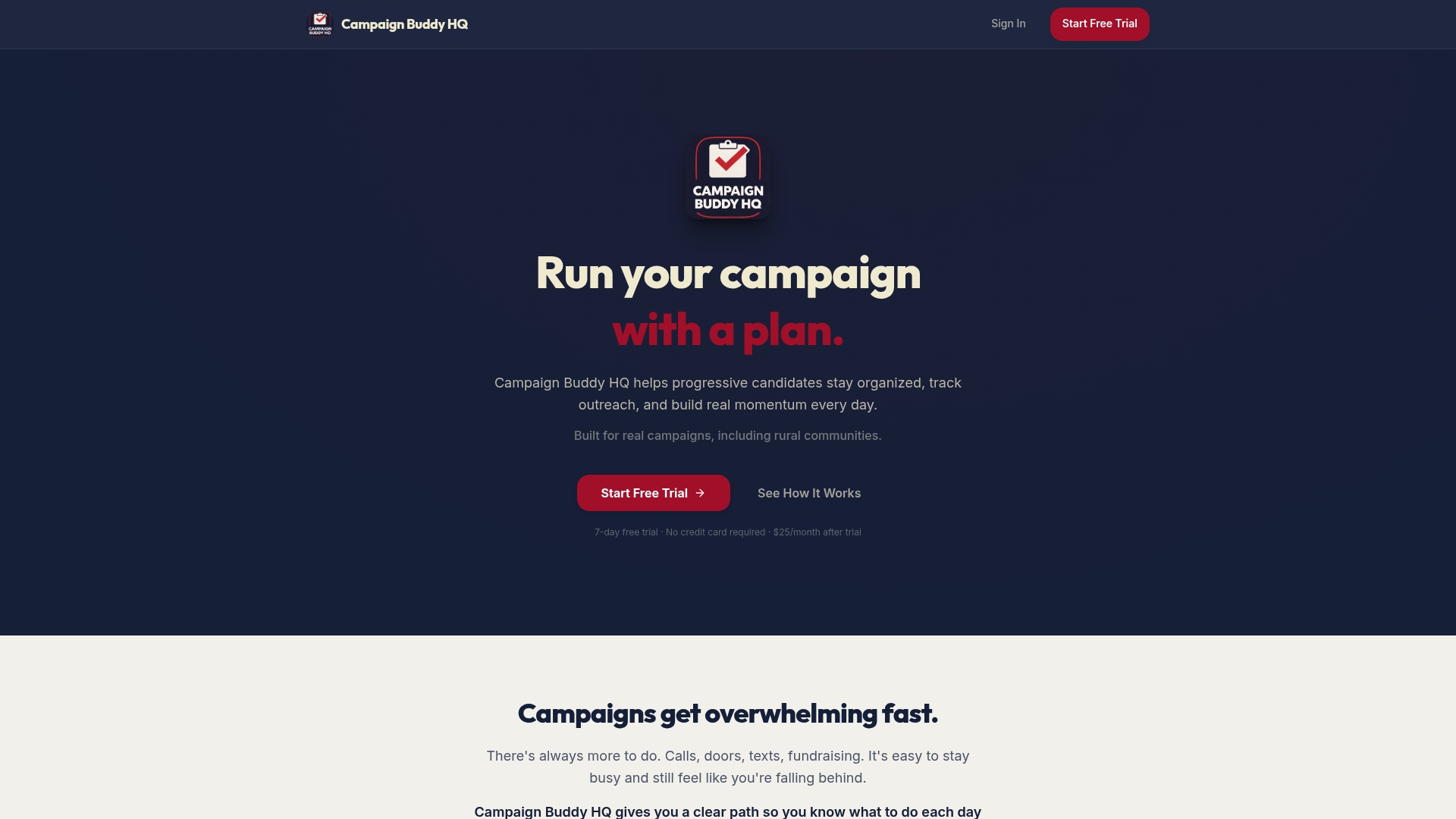
Costs $25/month after a free 7-day trial that requires no credit card. The service focuses on practical outreach tasks such as doors, calls, texts, and registrations. It also targets campaigns that operate in rural and low-density communities. The platform combines daily and weekly planning with phase tracking to keep activities consistent.
Core Features
The product centers on a Daily Plan that sets tailored priorities each day and a Weekly Plan to oversee pacing and adjustments. It includes Outreach Tracking to log doors, calls, texts, and registrations and a Supporter Progress tracker to measure goal achievement. People reached metrics let you see total outreach at a glance.
Key Differentiator
The feature that sets this tool apart is campaign phase management tied to outreach workflows. Phase templates let you shift daily priorities as a campaign moves from early organizing to voter contact. That phase linkage is tailored for rural campaign realities where travel and low density change outreach rhythms.
Pros
The interface organizes daily canvass and call work so your team follows a repeatable process. Outreach logging covers doors, calls, texts, and registrations, which makes field reports consistent and auditable. Phase-aware planning reduces time wasted on irrelevant tasks when your campaign changes focus. Pricing at $25/month plus a free 7-day trial lowers the cost barrier for small campaigns and volunteer-led efforts.
Cons
- Limited to outreach and planning tasks. It does not replace a full campaign platform for fundraising, advanced voter modeling, or volunteer payroll.
Who It's For
This tool fits progressive candidates and organizers who run grassroots, field-first campaigns. It works well for local campaigns that need daily task lists and simple outreach accountability. Campaigns operating in rural counties gain the most because the tool treats low-density outreach as a planning variable.
Unique Value Proposition
Daily and weekly plans link directly to logged outreach so each phase becomes measurable work, not just a checklist. That connection moves phase strategy into daily execution. For small staffs and volunteer teams this reduces ambiguity about who does what and when during each campaign phase.
Real World Use Case
A local candidate maps a canvass route for Monday and assigns two volunteers to calls. The team logs doors and texts during the day and updates supporter progress. At week end the campaign adjusts the weekly plan to focus on registration drives during the next phase.
Pricing
A single recurring plan at $25/month follows a no-credit-card 7-day free trial. The model makes short pilots feasible for volunteer-led campaigns and small committees. There are no pricing tiers publicly listed.
Website: https://campaignbuddyhq.com
NGP VAN
At a Glance
Many statewide and federal Democratic campaigns rely on NGP VAN for its voter data and canvassing capabilities. The platform combines fundraising, supporter management, and field tools to keep outreach centralized. Independent reviews regard it as a go to option for progressive organizations that need deep voter files and established field workflows.
Core Features
NGP VAN bundles fundraising and compliance tracking with mobile friendly forms, and it stores donor and supporter records alongside outreach activity. Voter targeting, universes, canvassing, phone banking, and texting tools connect the field and call room workflows. The system also supports petitions, pledges, online actions, and member data management for coordinated campaigning.
Key Differentiator
The standout attribute is the depth of voter data and the way that data ties directly into field tools and supporter records. That integration makes it straightforward to move contacts from a targeted universe into MiniVAN or phone programs. For progressive campaigns and labor groups this single data backbone reduces duplicate lists and lost outreach history.
Pros
The platform delivers very deep voter data and strong canvassing features that scale for large operations. Its fundraising and compliance tracking work alongside outreach records so your finance and field teams use a shared source of truth. Campaigns and unions trust the system for statewide and federal work because it already integrates with common field apps and event tools.
Cons
- The user interface and navigation are confusing for newcomers. New staff and volunteers may need extended training before they use the system effectively.
- The learning curve is steep. Smaller teams without a dedicated data manager can feel overloaded during onboarding.
- Reporting offers limited flexibility and customization. Teams that need bespoke visual reports will find the built in options restrictive.
- Some features feel dated and less intuitive than modern campaign tools. Expect slower adoption for volunteers used to consumer apps.
When It May Not Fit
If your campaign has a very small staff and limited training capacity, NGP VAN may add operational overhead. Teams that need highly customizable reports or visual dashboards could find the reporting functions too rigid. Organizations that prefer a minimal learning curve should evaluate lighter weight tools first.
Notable Integrations
NGP VAN connects directly to common field and event tools so data flows between systems. Key integrations include:
- VAN
- MiniVAN
- OpenVPB
- Mobilize
These integrations support canvass apps, phone banking imports, and event attendance syncing.
Who It's For
Democratic campaigns, progressive nonprofits, unions, and PACs that need advanced campaign management and voter outreach will find the platform appropriate. Large campaigns and statewide operations that require a shared voter file and coordinated field workflows benefit most. Small volunteer driven projects should weigh training costs before committing.
Real World Use Case
A statewide Democratic campaign uses NGP VAN to build targeted universes, deploy door lists to MiniVAN, and log canvass results back into the central file. Fundraising staff pull online donor records into compliance reports while field directors assign daily targets to volunteers. That configuration keeps contact history and finance records aligned across teams.
Pricing
Not applicable for this listing. The product information lists pricing as informational only. Contact NGP VAN sales for current packaging and rates.
Website: https://ngpvan.com
Campaign Nucleus
At a Glance
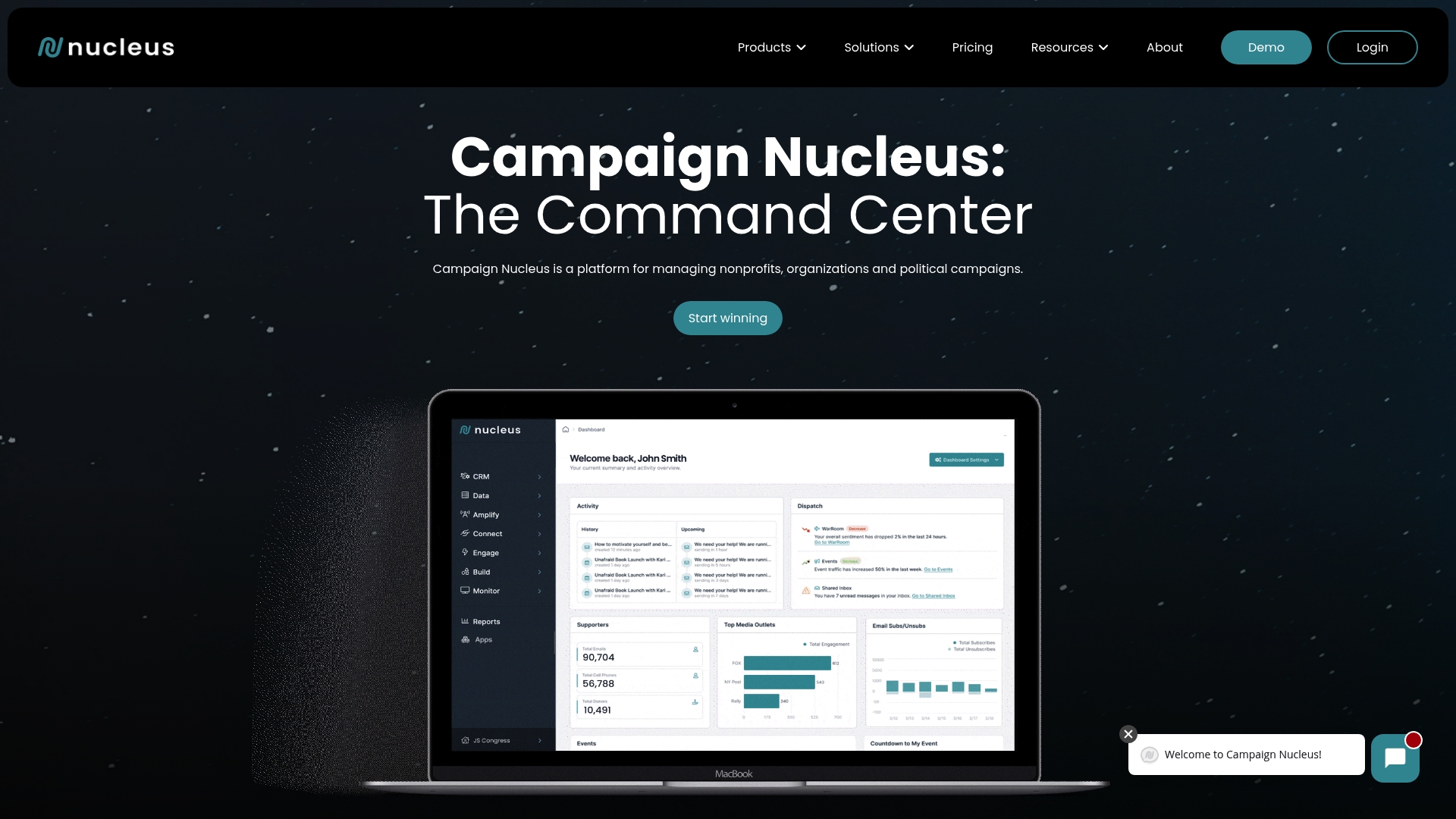
Includes an app store of supplementary campaign tools alongside War Room, a real-time audience sentiment feature. The platform combines CRM, email, event management, automations, and analytics in one environment. Plans range from Basic to Custom with published starting prices for Basic and Core.
Core Features
The CRM pairs voter records with AI-driven voter engagement to help prioritize outreach and follow ups. Email marketing supports batching and analytics while event management includes validation and AI fraud detection. The platform also offers consumer data platform integrations, automations for ground operations, and a unified dashboard for reporting.
Key Differentiator
Campaign Nucleus centers its offering on a single ecosystem that adds an app store for add ons, AI engagement, and live sentiment monitoring with War Room. That combination keeps contact management, outreach, and event tools inside one environment instead of forcing separate point tools. The result is fewer data imports for teams that run frequent field operations.
Pros
All core campaign functions live in one product, reducing the need to copy contact lists between systems. Users report responsive customer support, which speeds setup and troubleshooting during peak field periods. The interface reads as approachable for small teams while the vendor lists custom plans for larger organizations that need tailored integrations.
Cons
- Several feature pages on the vendor site are broken, which makes self guided exploration harder for new buyers.
- Public reviews do not list many specific drawbacks, so hidden limits may appear only after purchase.
- Custom pricing for large organizations may create uncertainty around total cost for scaled operations.
Who It's For
Teams running political campaigns, nonprofit organizers, and advocacy groups that want an all in one campaign platform. It fits groups that prefer consolidated contact lists, built in email and events, and an integrated analytics view. Larger shops that need bespoke integrations can request custom plans.
Real World Use Case
A mid sized campaign centralizes supporter contacts in the CRM, schedules segmented email batches, and validates field events with the platform's fraud detection. Staff monitor social tone in War Room during a debate night and adjust outreach priorities the next morning. The campaign keeps records and actions in one system for reporting.
Pricing
Basic starts at $150/month and Core starts at $500/month. Custom plans require contacting the vendor for a quote and scope. Pricing covers the listed feature set, with custom work appearing by request.
Website: https://campaignnucleus.com
Numinar
At a Glance
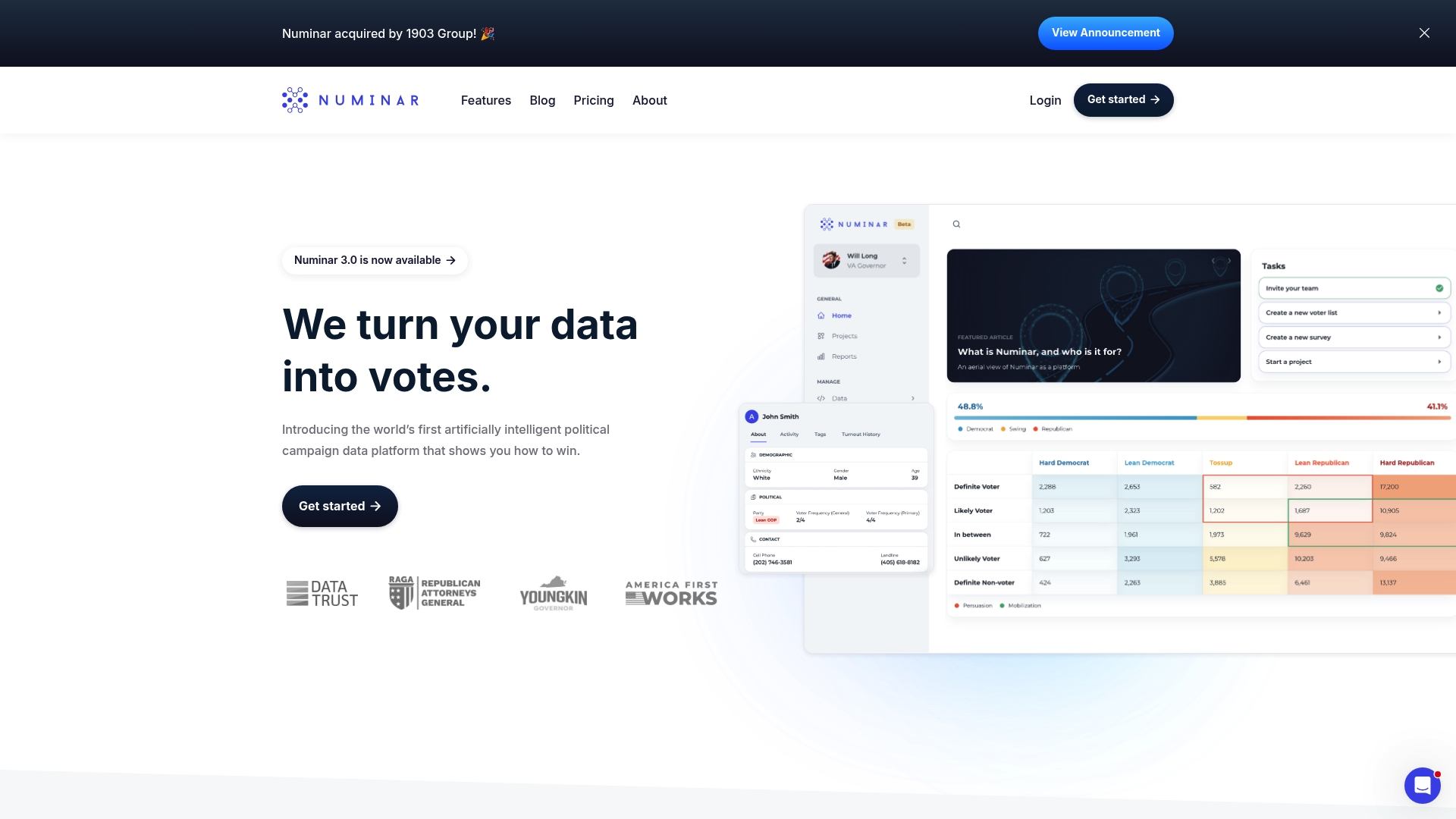
Numinar reports a voter database of 220M records with over 400 data points per voter. According to the company, it has been used by hundreds of campaigns and combines voter CRM, canvassing, calling, and texting tools. The vendor advertises polling that costs about ten times less than traditional methods for similar analysis.
Core Features
The package centers on a voter CRM that merges voter and consumer records into a single profile for canvassers and analysts. It includes a phone banking app with predictive dialing, a mobile canvassing app for volunteers, and peer to peer texting tools for rapid contact. It also offers scientific text and phone polling and machine learning models that score voters for targeting, with that figure referenced above.
Key Differentiator
Numinar blends a large voter database, machine learning predictions, and multi channel outreach inside one campaign focused interface. That combination keeps modeling, lists, and outreach workflows in one place for campaign strategists and operations teams. The vendor positions this as the first platform to assemble these pieces specifically for political campaigns.
Pros
Users praise the interface as intuitive and powerful, which reduces training time for volunteers and staff. Effective modeling tools help micro target resources, and reliable canvassing, calling, and texting features scale outreach without extra tools. That database above and the vendor reported campaign experience provide a unified data source for list creation and persuasion testing.
Cons
-
No substantive third party user reviews exist for independent validation.
-
Pricing requires a custom quote and uses a subscription plus a pay per contact model, which limits price transparency.
-
Some product pages return 404 errors, suggesting parts of the site are under revision and documentation may be incomplete.
Who It's For
Campaign teams, strategists, and outreach organizers who need a data driven platform for targeting and volunteer coordination will find this relevant. It suits teams that want modeling and contact tools together rather than separate vendors. Grassroots campaigns with limited tech staff will benefit from the simpler volunteer apps and integrated lists.
Real World Use Case
A local campaign loads voter files and consumer data into Numinar to build scored lists for persuasion and turnout. Managers assign volunteers through the mobile canvassing app and run phone banks with the predictive dialer. The team uses text and phone polling to test messages and shifts outreach based on model feedback.
Pricing
Pricing is by custom quote, combining subscription fees with a pay per contact component for outreach. The vendor provides tailored plans rather than public rate cards, so teams must request a proposal. That approach suits campaigns needing custom scope but reduces upfront price visibility for smaller campaigns.
Website: https://numinar.com
Vottiv
At a Glance
Vottiv's marketing materials state it serves campaigns from city council to U.S. Senate. The platform bundles voter data, website building, canvassing triggers, and creative tools into a single product. That integration aims to cut the number of vendors a campaign must manage.
Core Features
Vottiv provides Voter data and analysis tools alongside a campaign website builder with customizable templates. The platform includes automated canvassing triggers and multi channel outreach for calls, texts, and direct mail, and it offers a Design Studio for flyers and digital creative. Campaign teams can combine data, field work, and web presence inside one account.
Key Differentiator
The single biggest difference is that Vottiv attempts to host every common campaign function within one product. That means data, field operations, creative, and the campaign site all live under one admin panel. Campaigns that prefer fewer vendor handoffs will find that integrated model appealing.
Pros
Vottiv groups core campaign tasks so teams can move from list targeting to canvass follow up without exporting files. The platform's automated follow up triggers help close the loop on field contacts so volunteers see the next step. Flexible, district based pricing and a menu of add on services give campaigns choices about which services they buy and how they pay.
Cons
- Limited third party review coverage makes independent verification of user experience hard to find.
- Public pages provide little detail about customer support hours, onboarding processes, or SLA commitments.
- The product listing does not specify supported third party tools or open APIs, which may block workflows that depend on specific integrations.
When It May Not Fit
If your campaign already uses a suite of best of breed tools and requires specific integrations, Vottiv may force workflow changes. Teams that need documented third party reviews or extensive customer support detail may find public information thin. Organizations that track every vendor by API capability should verify integration support before committing.
Who It's For
This platform suits campaign managers, candidates, and political consultants who want a single account to handle voter data, field work, and the campaign website. It fits teams that prefer buying bundled services rather than assembling many vendors. It also matches campaigns that plan district level budgeting and want clear add on options.
Real World Use Case
A city council campaign imports a voter list into Vottiv, builds a simple campaign site from a template, and schedules canvass routes with automated follow up messages. Volunteers log knocks and the system triggers reminder texts to undecided voters. The campaign buys direct mail as an add on and tracks responses inside the same dashboard.
Pricing
Vottiv offers flexible, district based pricing with instant quotes and modular add ons. The vendor lists a Data Center plus optional services for canvassing, messaging, direct mail, and call services sold as bundles or pay per use rates. Campaigns must request a quote for exact figures.
Website: https://vottiv.com
Comparison of alternatives
For political campaigns, particularly grassroots and localized efforts, selecting the campaign management tool requires weighing cost-effectiveness against feature richness and operational simplicity. Here, Campaign Buddy HQ, alongside competitors such as NGP VAN, Campaign Nucleus, Numinar, and Vottiv, showcases a variety of functionalities.
Niche tailoring for specific campaign scales
Campaign Buddy HQ distinguishes itself by catering directly to grassroots campaigns with smaller budgets and more specific community organization needs, offering tools to streamline daily planning and outreach logging efficiently. Concurrently, NGP VAN, with its extensive voter data and integration capabilities, is particularly well-suited for expansive campaigns, such as statewide or federal operations. Where Campaign Buddy HQ emphasizes simplicity and fitting local campaign contexts, NGP VAN provides a breadth of data and utility requiring greater initial training and adaptation.
Unified versus modular systems
Campaign Nucleus and Vottiv excel in their approach of offering consolidated solutions all housed within a single platform. This reduces the need for managing multiple third-party integrations, appealing to organizations that highly value system unification. Campaign Buddy HQ, alternatively, optimizes efforts on campaign-specific micro-actions through its structured planning, important to tight-knit campaign teams operating on limited resources. For users needing detailed polling capabilities and predictive outreach targeting, Numinar’s integration of voter data and analytics would prove advantageous.
Best fit
- Campaigns conducted in rural or low-density communities requiring adaptability and focus in outreach will benefit most from Campaign Buddy HQ.
- Statewide or large-scale political operations needing extensive voter files and integration options may consider NGP VAN.
- Teams seeking an all-encompassing platform for contact management, event planning, and real-time feedback could turn to Campaign Nucleus.
- Campaigns emphasizing predictive analytics and score-based targeting should evaluate Numinar.
Our pick
Campaign Buddy HQ stands out with its tailored emphasis on rural and small-scale campaign operations, particularly its daily and weekly planning that reflects the dynamic needs of localized outreach. However, it may not perfectly fit campaigns requiring integrations or substantial voter data utilization, where platforms like NGP VAN excel. For grassroots-level efforts requiring a decisive, phase-structured, and cost-effective tool, Campaign Buddy HQ offers an excellent solution.
To assist campaign teams in selecting suitable management software, this table highlights key features and differences among popular platforms.
| Platform | Key Features | Best For | Pricing | Notable Limitation |
|---|---|---|---|---|
| Campaignbuddyhq | Daily and weekly planning, outreach logging, phase management | Grassroots campaigns in rural areas | $25/month, 7-day free trial | Limited to outreach and planning tasks |
| NGP VAN | Voter targeting, fundraising, compliance tracking | Large-scale Democratic campaigns | Price not published | Requires extended training for effective use |
| Campaign Nucleus | AI-driven CRM, event management, sentiment tracking | Unified platforms with custom integration needs | $150/month (Basic), $500/month (Core) | Broken feature pages on their website |
| Numinar | Voter CRM, predictive dialing, machine learning modeling | Data-driven campaigns | Price not published | Limited independent reviews to verify claims |
| Vottiv | Bundled voter data, website builder, automated outreach | Bundled all-in-one campaign solutions | Price not published | Lacks detailed integration and support documentation |
What Challenges Do Victoryguide.us Alternatives Present for Campaign Organizers?
Campaign teams often face difficulty maintaining daily outreach consistency while managing varied campaign phases, especially in low-density or rural areas. Many platforms offer broad features but lack focused tools to track doors, calls, texts, and registrations alongside clear progress toward campaign goals.
Campaignbuddyhq delivers tailored daily and weekly plans that keep outreach organized and measurable. It supports grassroots and traditional campaigns with an interface designed to reduce ambiguity and improve follow-through. This platform provides an affordable, no-credit-card trial and a low monthly fee that fits small staff and volunteer teams.
Learn more about Campaignbuddyhq and see how its outreach logging and phase-based planning can bring clarity and momentum to your campaign. Start tracking your daily priorities and supporter progress easily with Campaignbuddyhq’s focused approach.
FAQ
How does Campaignbuddyhq help with daily outreach tasks?
Campaignbuddyhq focuses on practical outreach tasks like doors, calls, and texts. Its Daily Plan feature sets tailored priorities each day to keep activities organized. Users can expect consistent tracking of outreach tasks.
What is the difference between Campaignbuddyhq and NGP VAN?
NGP VAN provides deep voter data and advanced campaign management tools. While it excels in complex voter outreach scenarios, Campaignbuddyhq is a better fit for grassroots campaigns that prioritize daily tasks and outreach accountability.
Which platform offers a low-cost entry point for political campaigns?
Campaignbuddyhq is available for $25/month after a free 7-day trial, making it accessible for small campaigns and volunteer-led efforts. This pricing structure reduces the cost barrier, allowing teams to start without upfront commitments.
Can I use Campaignbuddyhq if my campaign operates in a rural area?
Yes, Campaignbuddyhq is particularly effective for campaigns in rural and low-density communities due to its phase management linked to outreach workflows. Campaigns should consider it a tailored solution for their specific outreach challenges.
What features make Campaignbuddyhq easy to use for small teams?
Campaignbuddyhq organizes daily canvass and call work, ensuring that teams follow a repeatable process. This structure makes it easier for small teams to manage tasks and track outreach consistently during their campaigns.