

A campaign compliance checklist comes down to eight non-negotiable tasks: register with the FEC once aggregate contributions or expenditures cross the legally required threshold, designate a treasurer and open a dedicated campaign bank account, set up accrual-based bookkeeping before the first dollar moves, attach required disclaimers to every public communication, document your firewall against coordination if you're spending independently, file all required federal and state forms on time, establish a record-retention system from day one, and run a compliance audit at least quarterly. Miss any one of these and you're not just exposed to fines — you're handing opponents and regulators a story.
- Register when thresholds hit. Once aggregate contributions or expenditures exceed $5,000, you have 15 days to file Form 2 and designate a principal campaign committee. Independent spenders who raise or spend more than $1,000 in a calendar year must register as a political committee within 10 days.
- Name a treasurer. No committee can legally accept contributions or make expenditures without one.
- Open a campaign bank account. All funds must flow through a dedicated account — no personal accounts, no exceptions.
- Set up accrual bookkeeping. Record obligations when they are incurred, not when the check clears.
- Add required disclaimers. Every public communication needs compliant wording under 11 C.F.R. §109.11, with visibility standards that vary by medium.
- Lock down coordination rules. Shared strategy, staff, or information with a candidate converts independent spending into a contribution subject to limits.
- File on schedule. Quarterly reports, 24-hour and 48-hour independent-expenditure notices, and state-specific filings all have hard deadlines.
- Retain records. Federal rules require keeping financial records for at least three years after the report they appear in is filed.
Pro Tip: Treat compliance as a quarterly operating rhythm, not a pre-election scramble. Schedule a 90-minute compliance review at the end of every quarter — before the filing deadline, not the night before.
Key Takeaways
A campaign compliance checklist works only when it is treated as a recurring operational system, not a one-time pre-filing task — register at the right thresholds, document every obligation on an accrual basis, add required disclaimers to every public communication, and run a quarterly audit before each filing deadline.
| Point | Details |
|---|---|
| Register at the right threshold | File Form 2 within 15 days of exceeding $5,000 in aggregate activity; IE committees register within 10 days of exceeding $1,000. |
| Accrual basis from day one | Record every financial obligation when incurred, not when invoiced, to keep filings accurate and audit-ready. |
| Disclaimers on every communication | Federal rules under 11 C.F.R. §109.11 require medium-specific wording and visibility; state rules may be stricter. |
| Quarterly audits, not annual ones | Run a 15-question compliance review each quarter to catch errors before they appear in a filed report. |
| Campaignbuddyhq for operations | The platform's deadline reminders, transaction tagging, and exportable audit bundles support clean quarterly filings. |
Table of Contents
- What does a complete campaign compliance checklist look like?
- How do state requirements differ from federal rules?
- What are the key federal filing deadlines?
- How do you build internal controls that actually hold up?
- What compliance mistakes cost campaigns the most?
- Why repeatable processes beat last-minute legal reviews
- Campaignbuddyhq keeps your compliance operations organized
- Sources
What does a complete campaign compliance checklist look like?
Before launch
Before your campaign accepts a single dollar, three things must be in place: a designated treasurer, a dedicated bank account, and a written accounting policy. The treasurer is a legal requirement, not a title you fill later. Open the bank account in the committee's name, and document your chart of accounts so every transaction lands in the right category from the start.
Screen every vendor contract before signing. Confirm the vendor is not a federal contractor prohibited from making contributions, and capture the signed contract, scope of work, and payment schedule in your compliance archive at the moment of signing — not after the invoice arrives.
- Confirm committee name and address match across all filings
- Designate treasurer in writing before any financial activity
- Open a dedicated campaign depository account
- Establish accounting categories: contributions, in-kind contributions, loans, operating expenditures, independent expenditures
- Screen vendors for prohibited-source status
- Document conflict-of-interest disclosures for key staff
Daily and ongoing: contributions, in-kind, and prohibited sources
Every contribution requires four pieces of information: donor name, mailing address, occupation, and employer. For contributions over $200 in aggregate, itemization on FEC reports is mandatory. In-kind contributions — goods or services provided at below-market value — count as both a contribution and an expenditure and must be recorded at fair market value on the date received.
Loans from the candidate are contributions unless repaid. Loans from banks are permissible under specific conditions. Neither type is a free pass around contribution limits.
Donor-source screening is not optional. 52 U.S.C. § 30121 bars foreign nationals from contributing or spending in connection with any U.S. election — a prohibition that applies across all committee types and to independent expenditures. Screen every donor against that standard before depositing funds.
Required note fields to capture for every transaction:
- Date received or incurred
- Amount (cash value for in-kind)
- Donor or payee name, address, occupation, employer
- Purpose of expenditure (specific, not generic — "printing" not "services")
- Whether the transaction is itemized or aggregated below threshold
Pro Tip: Capture vendor contracts and access logs at the moment of contract signing. Accrual surprises — where an obligation was incurred months before the invoice — are one of the most common audit triggers.
Pre-election and time-sensitive filings
Quarterly reports cover most of the year, but the calendar tightens sharply before an election. Independent expenditures of $1,000 or more made within 20 days of an election trigger a 24-hour reporting requirement. The same threshold applies to contributions received within that window. Independent expenditures over a higher threshold outside the pre-election window require a 48-hour notice.
The MultiState compliance checklist consolidates these short-notice rules and stresses accrual-based reporting: record the expenditure when the contract is signed or the ad is placed, not when the vendor invoices.
Independent-expenditure-specific steps
Independent expenditures are only independent when there is zero coordination with a candidate. Under 11 C.F.R. §100.16, the FEC applies both a "magic words" test and an "only reasonable interpretation" test to determine whether a communication constitutes express advocacy. Coordination — sharing strategy, polling data, staff, or even a vendor with a candidate's committee — converts the expenditure into a contribution subject to limits and source prohibitions.
Per FEC guidance on independent expenditures, any shared information or staff interaction can invalidate independent status. Build a written firewall policy before spending begins.
Itemization for independent expenditures must include production costs, staff time allocated to the communication, and consulting fees — not just the media buy.
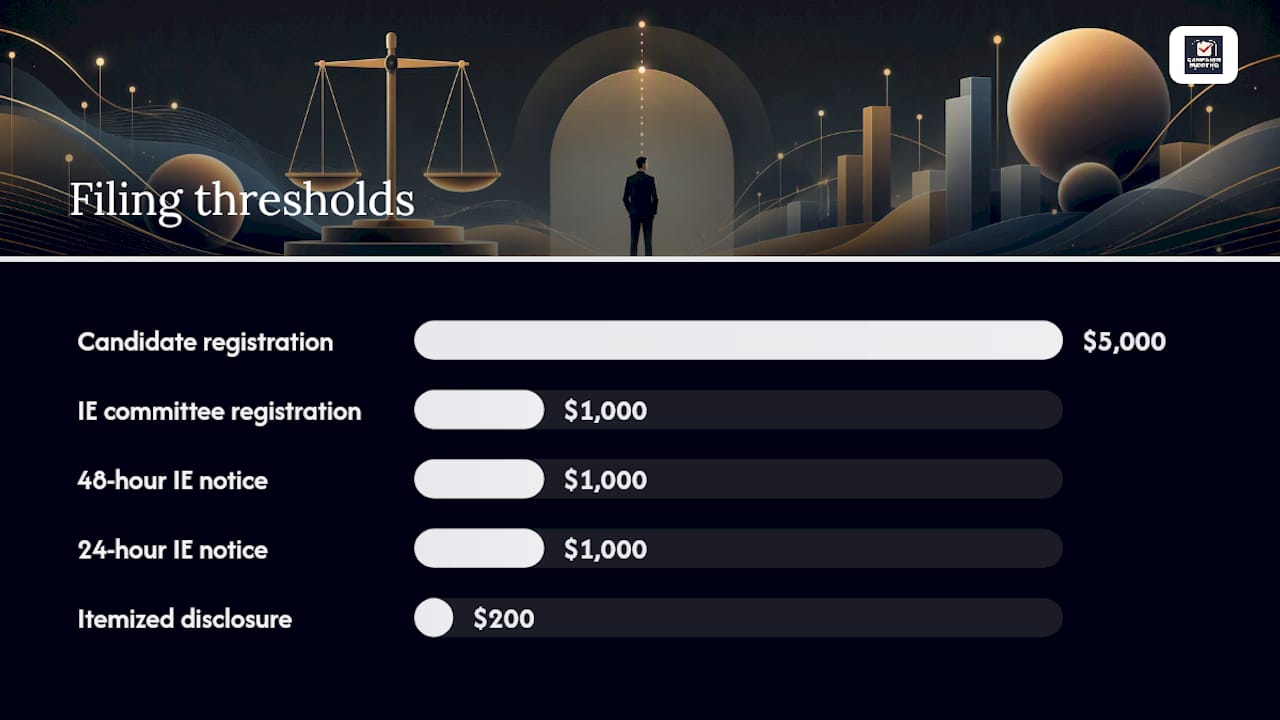
Key thresholds and forms at a glance:
| Trigger | Threshold | Form / Action | Deadline |
|---|---|---|---|
| Candidate registration | $5,000 aggregate | Form 2 (Statement of Candidacy) | 15 days after threshold |
| IE committee registration | $1,000 calendar year | Form 1 (Statement of Organization) | 10 days after threshold |
| 48-hour IE notice | $1,000+ outside 20-day window | FEC Form 5 | Within 48 hours |
| 24-hour IE notice | $1,000+ within 20 days of election | FEC Form 5 | Within 24 hours |
| Itemized contribution disclosure | Over $200 aggregate | Schedule A on quarterly report | Per filing deadline |
How do state requirements differ from federal rules?
Federal rules set the floor. States routinely set a lower ceiling — tighter contribution limits, faster filing windows, and stricter disclosure formats. California's Fair Political Practices Commission (FPPC) is a useful benchmark: its advertising disclosure requirements for online platform ads go beyond standard federal electronic media rules, requiring platform-specific disclosures that many campaigns miss.
The NCSL State Campaign Finance Disclosure Requirements Toolkit is the fastest way to locate your state's registration forms, filing calendars, and PDF checklists. Pull it before your campaign files anything at the state level.
Common axes of state variation:
- Registration thresholds (some states trigger at $500 or less)
- Contribution limits by source type (individual, PAC, party committee)
- Filing cadence (some states require monthly reports in election years)
- Ballot measure rules (separate registration and reporting tracks in many states)
- Ad-disclaimer format and font-size minimums for print and digital
- Electioneering communication windows (state definitions often differ from federal)
Steps to find your state's rules:
- Visit your state's ethics commission or campaign finance division website
- Download the current-year compliance calendar and registration packet
- Pull the state's independent-expenditure and electioneering communication rules separately — they are often in a different section than candidate committee rules
- Add every state filing deadline to the campaign calendar the same day you find it
- Keep a local copy of every downloaded PDF in your compliance archive
What are the key federal filing deadlines?
| Filing Type | Form | Trigger / Period | Standard Deadline |
|---|---|---|---|
| Statement of Organization | Form 1 | IE committee exceeds $1,000 | Within 10 days |
| Statement of Candidacy | Form 2 | Aggregate activity exceeds $5,000 | Within 15 days |
| Quarterly report | FEC Form 3/3X | Each calendar quarter | 15 days after quarter end |
| 48-hour IE notice | FEC Form 5 | $1,000+ IE outside 20-day window | Within 48 hours of obligation |
| 24-hour IE notice | FEC Form 5 | $1,000+ IE within 20 days of election | Within 24 hours of obligation |
| Year-end report | FEC Form 3/3X | Full calendar year | January |
For campaign reporting basics and a walkthrough of Form 2 filing requirements, the Campaignbuddyhq blog covers the registration-to-filing sequence in detail.
Immediate next steps for filing:
- Confirm who signs each form (treasurer signature is required on most FEC filings)
- Attach supporting documentation: bank statements, vendor contracts, donor records
- For special elections, check whether the FEC has issued a separate filing schedule — rolling deadlines apply
- If you discover an error after filing, amend the report promptly. File an amended version with a cover memo explaining what changed and why. Document the correction workflow in your compliance archive so auditors can trace the change.
Pro Tip: Set calendar reminders 10 days before every filing deadline, not the day before. That buffer is the difference between a clean amendment and a late filing.
How do you build internal controls that actually hold up?
Roles and separation of duties
Four roles must be clearly assigned and documented. The Treasurer signs filings and owns financial accuracy. The Custodian of Records maintains the compliance archive and is the named point of contact for any audit or inquiry — keeping this role separate from the Treasurer means staff turnover doesn't break the evidence trail. The Finance Admin handles day-to-day transaction entry and receipt collection. The Compliance Reviewer runs periodic audits and flags discrepancies before they become filings problems.

For a full breakdown of how these roles fit into a campaign structure, the campaign team roles guide maps ownership across every function.
Audit-readiness checklist
- Written financial policies (contribution acceptance, expenditure authorization, accrual policy) — reviewed annually
- Current org chart with named role holders and backup designees
- Training records for every staff member and volunteer with financial access
- Vendor files: signed contracts, W-9s, scope of work, payment records
- Access logs: who has login credentials to financial systems and when access was granted or revoked
- Incident log: any compliance question, near-miss, or corrective action taken
- Corrective-action tracker: open items, assigned owner, resolution date
Quarterly audits should cover the current quarter's transactions and filings. Annual audits should review the full year's records, update written policies, and confirm that all training is current. The Superdocu compliance audit template outlines the core evidence auditors expect and recommends assigning a named compliance owner for each checklist item.
Sample internal audit questions:
- Did every public communication include the correct disclaimer per 11 C.F.R. §109.11?
- Were all expenditures recorded on an accrual basis at the time the obligation was incurred?
- Are donor-screening logs current and documented for every contribution over $200?
- Has any staff member or volunteer had contact with a candidate's committee that could constitute coordination?
- Are all vendor contracts on file and matched to corresponding expenditure records?
Pro Tip: Maintain a separate, indexed compliance archive — digital and physical where needed — under the named Custodian of Records. When a staff member leaves, the archive stays intact and the next person can pick up without reconstructing months of records.
What compliance mistakes cost campaigns the most?
Most compliance failures are not dramatic. They are small, repeated process gaps that compound into significant exposure. Here are the ones that show up most often and what to do about them immediately.
- Accidental coordination. A shared consultant, a forwarded polling memo, a casual conversation with a candidate's scheduler — any of these can trigger coordination under 11 C.F.R. §100.16. Fix: Stop the activity, document what occurred, and consult legal counsel before resuming.
- Cash-basis accounting for independent expenditures. Recording when the invoice arrives rather than when the obligation is incurred creates mismatched filings. Fix: Switch to accrual accounting immediately and amend any affected reports.
- Missing 24/48-hour notices. These are the most time-sensitive filings in campaign finance. A missed 24-hour notice during the pre-election window is a clear violation. Fix: Assign one person to monitor independent expenditure activity daily during the 20-day pre-election period.
- Disclaimer visibility failures on digital ads. Federal rules under 11 C.F.R. §109.11 require specific wording and visibility standards; California's FPPC advertising rules add platform-specific requirements for online ads. Fix: Build a disclaimer template for each medium and require compliance review before any ad goes live.
- Inadequate donor-source screening. Accepting funds from a foreign national violates 52 U.S.C. § 30121 regardless of intent. Fix: Screen every donor before depositing funds; document the screening in the transaction record.
- Poor accrual tracking for production costs. Staff time and consulting fees on an independent expenditure must be itemized, not buried in a lump-sum media buy. Fix: Require a cost breakdown from every vendor at contract signing.
Pro Tip: When you find a filing error, amend quickly. File the corrected report, attach a brief explanatory statement, and log the correction in your corrective-action tracker. Regulators treat prompt self-correction very differently from errors discovered during an audit.
Why repeatable processes beat last-minute legal reviews
The conventional wisdom in campaign compliance is to hire a good lawyer and call them when something looks wrong. That's not wrong — it's just incomplete. The campaigns that stay out of trouble aren't the ones with the best attorneys on speed dial. They're the ones where the finance admin knows exactly what to do when a $250 check arrives with no employer listed, where the compliance reviewer runs the same 15-question checklist every quarter without being asked, and where the Custodian of Records can pull any document from the last three years in under five minutes.
Legal counsel is for contested questions and complex structures. Day-to-day compliance is an operations problem. The teams that treat it that way — building written policies, assigning clear ownership, running small frequent audits instead of one big pre-election scramble — are the ones that file clean reports and avoid the enforcement letters that derail campaigns at the worst possible moment.
This article is general information, not legal advice. For complex structures, contested coordination questions, or state-specific rules that may conflict with federal guidance, consult qualified campaign finance counsel.
Campaignbuddyhq keeps your compliance operations organized
Staying on top of filing deadlines, accrual records, and disclaimer audits is a full-time job layered on top of an already full-time campaign. Campaignbuddyhq gives campaign managers a single place to track outreach activity, log transactions, set deadline reminders, and maintain the kind of organized, exportable records that make quarterly compliance reviews fast instead of frantic.
The platform's deadline calendar flags upcoming filing windows before they become emergencies. Transaction tagging lets your finance admin categorize contributions and expenditures at the point of entry, so quarterly reports pull from clean data rather than a backlog of uncategorized receipts. Volunteer access controls create the access logs your Custodian of Records needs for audit readiness. And because everything is exportable, your compliance reviewer can pull an audit bundle without chasing down records across three different spreadsheets.
Campaignbuddyhq is not a substitute for legal counsel, but it is the operational backbone that keeps your campaign finance monitoring consistent between counsel reviews. Start a free 7-day trial at Campaignbuddyhq — no credit card required.
Sources
Every link below goes directly to the official form, regulation, or toolkit referenced in this article. Download and save a local copy of every document relevant to your committee type.
- Registering a candidate: FEC guidance
- 11 C.F.R. §100.16 — Definitions (express advocacy and coordination): eCFR
- 11 C.F.R. §109.11 — Disclaimer requirements: eCFR
- 52 U.S.C. § 30121 — Contributions and donations by foreign nationals (Cornell Law)
- State Campaign Finance Disclosure Requirements Toolkit — NCSL
Use the NCSL toolkit to locate your state's equivalent of each federal form above. Keep a printed and digital copy of every filed form in your compliance archive, indexed by filing date and report period.