

Most campaign managers assume they already know what their finance reports say. They glance at the top-line "raised" and "spent" figures, nod, and move on. That assumption is where compliance risk hides. Campaign reporting explained properly means understanding that those headline numbers are legal constructs, not plain-English summaries. "Raised" includes loans and in-kind items that never touched your bank account. "Spent" includes refunds. Miss those distinctions and your team is making strategic decisions based on a distorted picture, while your FEC filings quietly accumulate errors that become very expensive to fix later.
Table of Contents
- Understanding campaign finance reporting basics
- FEC reporting deadlines and filing requirements essentials
- Maintaining accurate and audit-ready reporting through schedules and reconciliation
- Optimizing campaign outreach reporting with automation and best practices
- Applying campaign reporting knowledge to drive better outreach and compliance
- Why most campaign reporting advice misses the mark
- Streamline your campaign reporting with Campaign Buddy HQ
- Frequently asked questions
Key Takeaways
| Point | Details |
|---|---|
| Understand key terms | Grasping ‘raised’ and ‘spent’ definitions and Form 3X schedules is essential for accurate campaign finance reporting. |
| Meet deadlines precisely | Check the FEC dates-and-deadlines calendar regularly and file reports timely to avoid penalties. |
| Reconcile thoroughly | Validate summary figures by tracing itemized contributions and expenditures before filing for audit readiness. |
| Automate reporting | Use saved report templates and scheduled bulk runs to improve accuracy and conserve resources. |
| Standardize data | Adopt consistent taxonomies and naming conventions to prevent confusion and enable effective outreach tracking. |
Understanding campaign finance reporting basics
Before you can build any useful reporting system, you need the vocabulary. In FEC filings, everything flows through two buckets. Receipts and disbursements are the legal terms the FEC uses, and they are not synonyms for "donations in" and "bills out." Receipts cover contributions, loans received, transfers from affiliated committees, and in-kind items. Disbursements cover vendor invoices, staff salaries, advertising buys, and refunds issued to donors.
The primary document for most campaign committees is the Form 3X. It carries a summary page at the top and then breaks everything into itemized schedules. Two schedules matter most:
- Schedule A (itemized receipts): Lists every receipt above the itemization threshold, including contributor name, address, occupation, employer, and date.
- Schedule B (itemized disbursements): Lists every payment above threshold, including payee, purpose, and date.
Understanding these campaign finance basics is what separates committees that file cleanly from those that file amended reports under pressure. Your cash-on-hand figure at any point is simply beginning cash plus total receipts minus total disbursements. Simple arithmetic, but only accurate if every line item is properly categorized.
FEC reporting deadlines and filing requirements essentials
Timing is not optional in campaign finance. Missing a deadline triggers automatic scrutiny and potential fines. Here is how the structure works:
Filing frequency options:
- Quarterly filing applies during non-election years. Reports cover January through March, April through June, July through September, and October through December.
- Monthly filing is available as an alternative. Committees that elect monthly filing must stick with it for the entire calendar year.
- During election years, both quarterly and monthly filers add pre-election and post-general reports on top of their regular schedule.
Key deadlines at a glance:
| Report type | Coverage period | Due date |
|---|---|---|
| Q1 Quarterly | Jan 1 to Mar 31 | April 15 |
| Q2 Quarterly | Apr 1 to Jun 30 | July 15 |
| Q3 Quarterly | Jul 1 to Sep 30 | October 15 |
| Year-End | Jul 1 to Dec 31 | January 31 |
| Pre-election | Varies by election | 12 days before election |
| Post-general | Day after general to 30 days post | 30 days after general |
FEC reporting deadlines are set by the FEC's dates-and-deadlines calendar, which is election-cycle specific. Always confirm the exact window for your specific report type before filing. Using last cycle's calendar is one of the most common avoidable mistakes.
Accelerated disclosure rules add another layer. Within 20 days of an election, contributions of $1,000 or more trigger a 48-hour notice. Independent expenditures of $10,000 or more trigger a 24-hour notice. These rules catch campaigns off guard constantly. Build them into your campaign reporting checklists from day one.
Committees that cross certain thresholds must also file electronically. Paper filing is not a workaround once your receipts exceed $50,000 in a calendar year.
Maintaining accurate and audit-ready reporting through schedules and reconciliation
Here is where most campaigns fall short. Generating a report is not the same as verifying it. Audit-ready reporting requires reconciliation, and reconciliation has a specific process.

Start with the Form 3X summary page. Confirm that beginning cash plus total receipts minus total disbursements equals ending cash on hand. If those numbers do not balance, nothing else matters until they do. Reconciliation work means validating that arithmetic first, then tracing every line into Schedule A and Schedule B to catch misclassified or missing entries before filing.
Common red flags to watch for during reconciliation:
- Unexplained loans: Loans from the candidate or other sources that appear in receipts but lack matching loan agreement documentation.
- Repeated inter-committee transfers: These are legal but frequently miscategorized, especially when a state party and federal committee share staff.
- Rapid cash depletion: A sudden drop in cash-on-hand that is not supported by disbursement detail usually signals missing entries.
- Missing itemizations: When your Schedule A subtotal does not match the itemized receipts summary line, you have uncategorized contributions sitting in a catch-all bucket.
In-kind contributions deserve special attention. A donor who pays your printing vendor directly has made an in-kind contribution. That transaction must appear in both Schedule A as a receipt and Schedule B as a disbursement, or your totals will be off and your audit trail will be incomplete.
Pro Tip: Reconcile your books before every filing deadline, not after. Discovering a discrepancy the morning a report is due forces rushed amendments and draws exactly the kind of attention you want to avoid. Schedule a reconciliation review at least one week before each deadline on your campaign reporting reconciliation calendar.
Optimizing campaign outreach reporting with automation and best practices
Finance reporting is one half of the picture. Outreach reporting, tracking doors knocked, calls made, texts sent, and registrations collected, is equally important for running a data-driven progressive campaign. The same discipline that makes financial reports reliable applies here.
"Scheduling reports for regular use and standardizing date ranges reduce the risk of incomplete data and conflicting numbers, whereas ad hoc reports waste resources and can produce inconsistent metrics." — Google Campaign Manager 360 reporting guidance
That principle holds whether you are pulling advertising analytics or canvassing numbers. A few practices make a measurable difference:
- Save report definitions: Build your standard outreach and finance reports once, save them as templates, and reuse them every cycle. This prevents the "different person ran the numbers differently" problem.
- Use relative date ranges: Pulling data with parameters like LAST_7_DAYS or LAST_30_DAYS eliminates manual date-entry errors and makes reports directly comparable week over week.
- Avoid ad hoc report generation: One-off reports created under pressure tend to miss data that has not yet fully processed. They also create version-control chaos when two staff members run slightly different queries and get different totals.
- Handle large data downloads carefully: For campaigns with high volume activity, break downloads into chunked requests rather than pulling everything at once. A failed download halfway through a large dataset leaves you with incomplete numbers that look complete.
Pro Tip: When your reporting system polls for report status, use exponential backoff, meaning wait a short time, then a longer time, then longer still, rather than hammering the system with constant checks. This is a technical concept, but it matters if you are using any API-connected campaign reporting automation tools.
Applying campaign reporting knowledge to drive better outreach and compliance
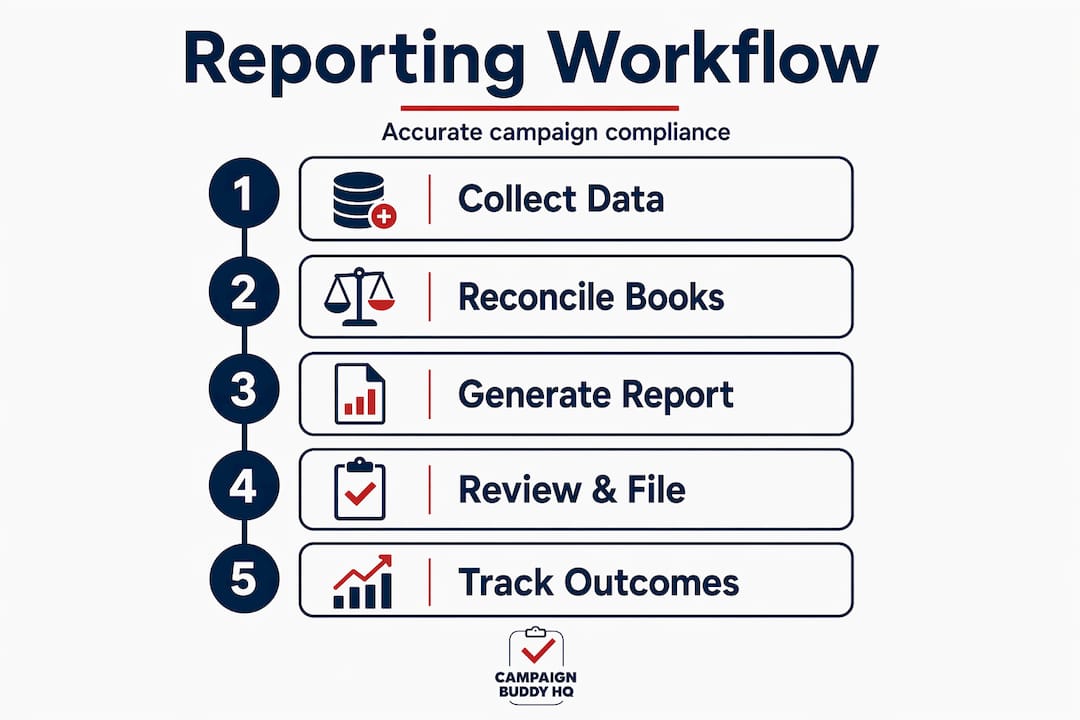
Knowledge without a system produces inconsistent results. Here is how to translate everything above into daily campaign operations:
Practical steps to implement now:
- Set your reporting cadence. Decide whether you file quarterly or monthly and build every internal deadline backward from the FEC due date by at least seven days.
- Standardize field names and categories. Every staff member logging outreach contacts or entering transactions should use identical naming conventions. "Phone bank" and "phonebank" are two different categories in most systems.
- Automate data pulls where possible. Manual data entry compounds errors. Connect your donor database, outreach tracking tool, and reporting platform wherever you can.
- Train every person who touches data. One undertrained volunteer entering disbursements incorrectly can create weeks of cleanup. A 30-minute onboarding session on data entry standards pays off immediately.
- Review legal deadlines at the start of every month. Put the FEC calendar on your team's shared workspace and assign deadline ownership explicitly.
Standardized taxonomies and saved report definitions prevent the conflicting numbers that derail team trust and create compliance exposure. When your finance director and field director are looking at the same numbers from the same source, decisions happen faster and errors surface sooner.
Manual vs. automated reporting:
| Approach | Pros | Cons |
|---|---|---|
| Manual reporting | Full control, low startup cost | Error-prone, time-intensive, version inconsistency |
| Automated reporting | Consistent, scalable, time-saving | Requires setup investment, depends on clean input data |
Organizing outreach data and campaign data impact are directly linked. Campaigns that report accurately on both finance and outreach in one unified view make better resource decisions throughout the cycle, not just at filing time.
Why most campaign reporting advice misses the mark
Most of what passes for campaign reporting advice stops at "check your dashboard regularly." That is not wrong. It is just not sufficient. The advice skips the part that actually separates campaigns with clean compliance records from campaigns scrambling to file amendments under FEC inquiry.
The real work is reconciliation discipline. Specifically, the habit of verifying that every headline number is supported by schedule-level detail. As the core issue with finance reports illustrates, "raised" and "spent" are defined terms with specific inclusions. The fix is not reading faster. It is verifying headline numbers with detailed schedule-level traceability every single time.
The second problem is the lack of standardized naming and taxonomy. When staff members use different terminology for the same activity, report outputs diverge. Your field director says you contacted 1,400 voters last week. Your data manager says 1,200. Neither is lying. They just pulled from different categories with different filters. That kind of disagreement does not get resolved by buying a better dashboard. It gets resolved by establishing shared definitions before anyone runs a report.
"Headline figures are only as trustworthy as the itemized schedules that support them. If you cannot trace a number to its source entries, you do not actually know if it is right."
Pro Tip: Build a short daily or weekly reconciliation routine into your campaign workflow before election season peaks. Catching a $500 miscategorized disbursement in April costs 20 minutes. Catching it in October costs three days and a possible amended filing.
The campaigns that win on data are not the ones with the most sophisticated tools. They are the ones with the most consistent habits.
Streamline your campaign reporting with Campaign Buddy HQ
Mastering campaign reporting clarifies your financial status, ensures compliance, and empowers smarter outreach decisions. Putting all of that into practice requires a system your whole team can use consistently.
Campaign Buddy HQ brings finance reporting discipline and outreach tracking together in one platform built for progressive campaigns. You can log doors, calls, texts, and registrations alongside your financial activity, set reporting cadences with saved templates, and keep your team working from a single source of truth. The platform supports FEC Form 3X workflow management and schedule reconciliation checks, so deadline management is built into your daily operations rather than bolted on at the last minute. Tracking campaign activities becomes automatic rather than manual. Start your free 7-day trial today, no credit card required, and see how much cleaner your next filing cycle can be.
Frequently asked questions
What do "raised" and "spent" mean in campaign finance reports?
"Raised" refers to all money a committee receives during the period, including contributions, loans, transfers, and in-kind donations, while "spent" refers to all money paid out such as vendor payments, salaries, and advertising. The FEC uses receipts and disbursements as the precise legal terms for these categories.
How often must PACs file their FEC reports?
PACs file reports quarterly during non-election years and either monthly or quarterly with additional pre- and post-election reports during election years. Exact windows are confirmed through the FEC's dates-and-deadlines calendar for each specific election cycle.
Why is reconciling schedules on Form 3X important?
Reconciliation ensures reported totals are accurate by validating cash balances and matching itemized receipts and disbursements, catching errors before filing. Reconciliation involves tracing Form 3X summary totals to itemized schedules, making reports genuinely audit-ready rather than just numerically plausible.
What are best practices for running campaign reports efficiently?
Save reusable report templates, schedule regular bulk runs with consistent relative date ranges, and avoid one-off ad hoc reports to ensure complete and reliable data. Scheduled reports reduce the risk of incomplete datasets and are far more resource-efficient than generating reports reactively.