

Most campaign managers assume that doing more automatically means winning more. It doesn't. Pouring hours into knocking doors, making calls, and sending texts without a clear tracking system is like driving without a map. You're moving, but not necessarily forward. Tracking campaign activities enables efficient resource allocation by targeting likely supporters, saving time, and increasing success rates. This article walks you through why tracking matters, what the evidence says, and exactly how to build a system that turns raw activity into real results.
Table of Contents
- Understanding the value of tracking campaign activities
- How analytics inform campaign strategy
- Quality over quantity: Targeting supporters wisely
- Practical steps to implement campaign activity tracking
- What most campaign managers miss about activity tracking
- Enhance your campaign tracking with proven tools
- Frequently asked questions
Key Takeaways
| Point | Details |
|---|---|
| Efficient resource allocation | Tracking lets you focus resources on likely supporters, maximizing campaign impact. |
| Personalized outreach | Analytics enable tailored messaging based on real voter interests and behavior. |
| Ethical targeting strategies | Smart activity tracking ensures campaigns reach supporters inclusively and efficiently. |
| Agile campaign response | Real-time tracking empowers campaigns to adjust to new data and changing voter needs. |
Understanding the value of tracking campaign activities
Campaign activity tracking is the practice of systematically recording, measuring, and reviewing every outreach action your team takes. Doors knocked. Calls completed. Texts sent. Voter registrations logged. Events attended. When you capture this data consistently, patterns emerge. Those patterns tell you where your team's energy is actually moving votes and where it's evaporating into thin air.
The difference between campaigns that win by a narrow margin and those that fall just short often comes down to how well they manage their time and attention. Efficient resource allocation is the single biggest advantage tracking gives you. Resource allocation, simply put, means deciding where to put your people, your calls, and your budget for maximum return. Without tracking, those decisions are guesswork.
Here's why this matters for progressive campaigns specifically. You're typically operating with limited staff, energetic but busy volunteers, and a tight budget. Every misallocated hour is a real cost.
Core benefits of systematic campaign activity tracking:
- Time savings: Know which precincts and outreach methods yield the fastest voter contact rates, so you stop repeating low-return activities.
- Higher success rates: When you track conversion from contact to commitment, you can model which approaches actually move supporters to action.
- Clear targeting: Data reveals which voter segments are responding, letting you concentrate outreach where it counts most.
- Team accountability: Visible progress logs help volunteers and staff stay motivated and on task.
- Better reporting: When your candidate or coalition partners ask for updates, you have real numbers, not estimates.
Using campaign tracking tools built specifically for political outreach makes this process far more manageable than building spreadsheets from scratch.
"Targeting likely supporters and tracking outreach activities are not administrative tasks. They are the strategic core of any campaign that wants to use its resources well." — Campaign analytics research, LSU Online
With this foundation in place, let's explore how analytics reshape the strategy layer of your campaign.
How analytics inform campaign strategy
Campaign analytics, the practice of using data to guide decisions, is not new. Barack Obama's 2008 presidential campaign is widely credited with bringing data-driven strategy into mainstream political organizing. His team built voter models that helped identify persuadable voters with remarkable precision, and they tracked field activity at a level that earlier campaigns simply had not attempted. The result was a ground game that exceeded nearly every expectation. The lesson isn't that you need Obama-level resources. The lesson is that the principle scales down. A county commission race can use the same logic with a spreadsheet and a clear process.
Campaign analytics inform strategy by identifying key voter issues, predicting turnout likelihood, and revealing which messages resonate with which segments. When you know that a specific neighborhood responds strongly to canvassing but ignores phone calls, you redirect your volunteers accordingly. That's not a small tweak. Over the course of a campaign, it's the difference between efficient momentum and exhausted stagnation.
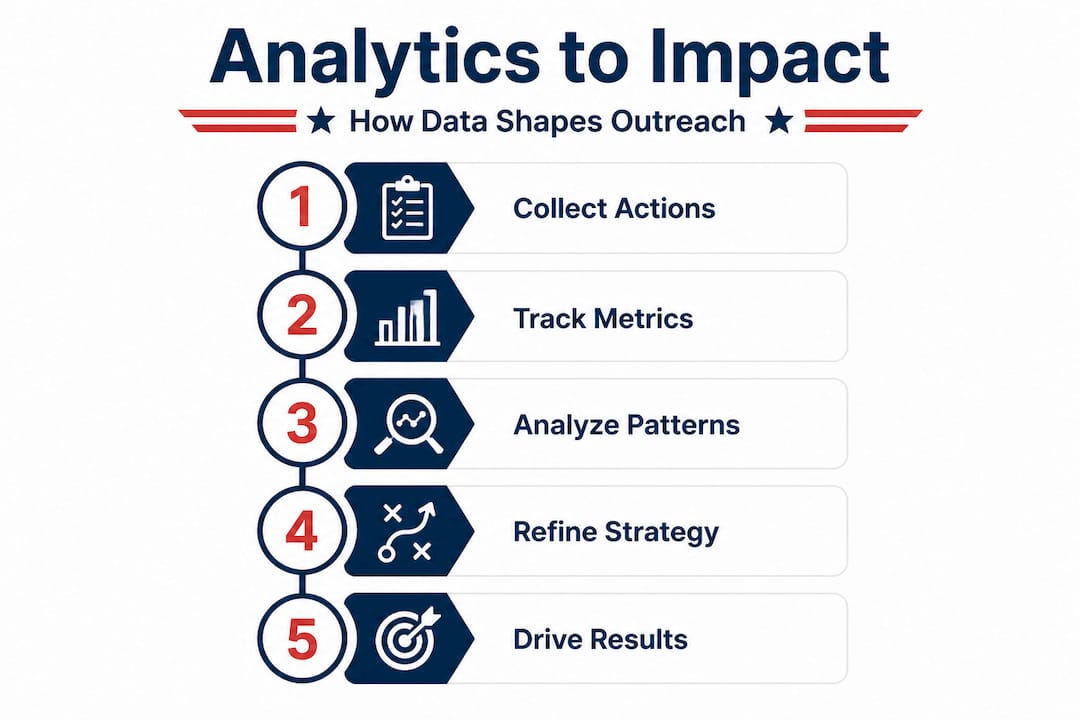
Here's a practical look at how different campaign activities map to measurable outcomes:
| Activity type | Primary metric tracked | What it tells you |
|---|---|---|
| Door knocking | Contact rate per hour | Volunteer productivity and neighborhood density |
| Phone banking | Call completion and pledge rate | Message effectiveness and supporter readiness |
| Text outreach | Response rate and opt-out rate | List quality and message resonance |
| Voter registration drives | New registrations per event | Community engagement and capacity |
| Social media engagement | Shares, comments, direct replies | Organic reach and issue salience |
| Event attendance | RSVPs vs. actual turnout | Supporter commitment levels |
Understanding how campaign data drives results in practice helps you move from recording numbers to actually acting on them. The numbers are only valuable if they change what you do next.
Pro Tip: Set up real-time tracking from day one of your field program. Campaigns that wait until the final weeks to analyze their data miss weeks of opportunities to course correct. Even a simple daily log shared across your team creates the feedback loop you need to stay agile.
Your outreach guide should specify not just what activities to run, but what data to capture for each one, so tracking becomes part of the habit, not an afterthought.
Quality over quantity: Targeting supporters wisely
Here's a counterintuitive truth that experienced organizers eventually learn: contacting 500 genuinely persuadable voters is worth far more than contacting 5,000 people who have no interest in your candidate. Volume alone is not a strategy. It's activity theater.
Ethical targeting avoids exclusion while prioritizing quality outreach over sheer quantity. This is both a practical and a values-based point. On the practical side, targeting supporters wisely saves your team hours of wasted effort. On the values side, fair targeting means you're not systematically ignoring or dismissing entire communities based on flawed assumptions. Progressive campaigns, in particular, have both an interest and a responsibility to get this right.
The numbers make the case clearly:
| Outreach approach | Contact success rate | Resource use | Volunteer burnout risk |
|---|---|---|---|
| Untargeted (all households) | 18-25% | Very high | High |
| Broadly targeted (registered voters) | 35-45% | Moderate to high | Moderate |
| Targeted (likely supporters, modeled) | 55-70% | Moderate | Low |
| Highly targeted (warm supporters) | 70-85% | Low to moderate | Very low |
The jump from untargeted to targeted outreach is not marginal. It's transformational. And the volunteer experience improves dramatically when people feel their time is producing real conversations, not door-slams and hang-ups.
Here are ethical targeting practices every campaign should follow:
- Use publicly available voter file data as your foundation. Don't rely on purchased commercial lists that may contain outdated or inaccurate information.
- Build voter models that include, not exclude. Design your targeting to identify who is persuadable or supportable, not just who is convenient to contact.
- Review your contact lists for demographic gaps. If your outreach is systematically missing renters, young voters, or non-English speakers in your district, that's a signal to adjust.
- Train volunteers on respectful contact practices. Good data means nothing if the person at the door feels dismissed or patronized.
- Track refusals and opt-outs carefully. These signals help you refine your lists and avoid repeating unwanted contacts, which damages your campaign's reputation.
Knowing how to organize outreach around these principles gives your team a real competitive edge and a more rewarding experience on the ground.
With sound principles for targeting in place, let's turn to practical ways to implement robust tracking.
Practical steps to implement campaign activity tracking
Knowing that tracking matters is step one. Building the system is where campaigns actually win or lose their discipline. Here's how to get it done without overwhelming your team.
Practical steps to set up your campaign activity tracking system:
- Choose the right tools early. Whether you're using a purpose-built platform or a well-structured spreadsheet, your tool needs to be accessible to volunteers in the field, not just to your data manager at headquarters. Mobile-friendly is not optional.
- Define your key metrics before you launch. Decide upfront which numbers matter: doors knocked per shift, contact rate, pledge rate, texts sent, registrations completed. Every team member should know what they're being asked to track and why.
- Establish a daily reporting rhythm. Brief daily check-ins or automated log submissions create a steady flow of data instead of a chaotic data dump at the end of a week. This is how you spot problems before they compound.
- Assign a data point of contact. Someone on your team needs to own the tracking system. Not just enter data, but review it, flag anomalies, and present insights at weekly team meetings.
- Use campaign checklists to standardize what gets recorded at each type of outreach event. Checklists reduce the chance of inconsistent data that makes comparisons meaningless.
- Review and act on the data weekly. Data that doesn't change decisions is just noise. Build a standing meeting slot to review outreach numbers, identify what's working, and redirect effort accordingly.
Tracking campaign activities helps allocate resources efficiently across all phases of a campaign, from early voter contact through GOTV (get out the vote). The discipline you build in the first weeks pays dividends in the final stretch.
Real-time processing increases agility in ways that end-of-week batch reporting simply cannot match. When a neighborhood is responding unusually well to a particular message, you want to know that today, not next Friday. Real-time tracking lets you double down on what's working while the momentum is live.

Understanding how to build campaign momentum with data is not complicated, but it does require consistency. The campaigns that sustain momentum are the ones where the tracking habit never breaks, even on the hardest days.
Pro Tip: Always review outreach quality, not just quantity. A week where your team knocked 800 doors but logged only a 15% contact rate is a week to investigate, not celebrate. Find out why. Were doors knocked at the wrong time? Is the neighborhood layout difficult? Was the volunteer script landing poorly? The numbers surface the questions; your team answers them.
What most campaign managers miss about activity tracking
Here's the uncomfortable reality: most campaigns treat tracking as a compliance task. Something you do because you're supposed to. Logs get filled out at the end of a shift from memory. Data sits in a spreadsheet that nobody opens until a donor asks for a report. The tracking exists, but it doesn't function.
This is a fundamental misunderstanding of what tracking is for. It's not a paper trail. It's a navigation system.
The campaigns we've seen struggle most are the ones that only turn to their data when something has already gone wrong. A volunteer rate that's tanked. A neighborhood that's showing no enthusiasm two weeks before Election Day. By then, you're reacting to a crisis instead of steering around it. Tracking done right is continuous. It's how you prevent the crisis in the first place.
Here's the angle most people miss: visible progress data changes how your team feels about the campaign. When volunteers can see that their Saturday shift helped the campaign hit a milestone, morale rises. When canvassers see their contact numbers climbing week over week, they come back. Campaign metrics mastery isn't just about strategy. It's about building a team that believes the work is adding up.
"When your team can see the scoreboard, they play harder. Tracking isn't bureaucracy. It's the momentum engine for every serious campaign."
The contrarian view we'd push back on is this: "We're a small campaign. Tracking is for the big races." Wrong. Small campaigns have even less margin for wasted effort. A 500-vote margin in a local race can turn on whether your volunteers spent their last weekend in the right precincts. Tracking is not a luxury. It's the discipline that separates campaigns that run efficiently from those that run on hope.
Enhance your campaign tracking with proven tools
Tracking your campaign activities effectively starts with having the right system behind your team.
Campaign Buddy HQ is built specifically for progressive campaigns, issue advocacy groups, and grassroots organizers who need a clear, practical way to log outreach, monitor progress, and plan daily and weekly activities without drowning in complexity. The platform covers door knocking, calls, texts, voter registrations, and supporter tracking, all in one place. Whether you're running a rural district canvass or a high-density urban phone bank, the tools scale to fit your reality. Try it free for seven days without entering a credit card, and see how much cleaner your campaign operation can run from day one.
Frequently asked questions
What metrics should campaigns track for maximum impact?
Campaigns should monitor supporter engagement, outreach contact rates, conversion rates from contact to pledge, and issue resonance across voter segments. Efficient resource allocation depends on tracking the right numbers consistently, not just tracking everything.
How can real-time tracking improve campaign strategy?
Real-time tracking allows your team to catch low-performing outreach efforts immediately and redirect volunteers or messaging before a full week of effort is wasted. Real-time agility is one of the most cited advantages of modern political analytics.
Is ethical targeting important in campaign analytics?
Absolutely. Ethical targeting avoids exclusion and ensures your outreach reflects the full community you're seeking to represent, not just the easiest or most convenient segment to contact.
Are there tools that help automate activity tracking?
Yes. Purpose-built platforms let campaigns log doors, calls, texts, and registrations in real time, removing the manual burden from volunteers. Tracking with digital tools streamlines reporting and makes it far easier to act on outreach data quickly.