
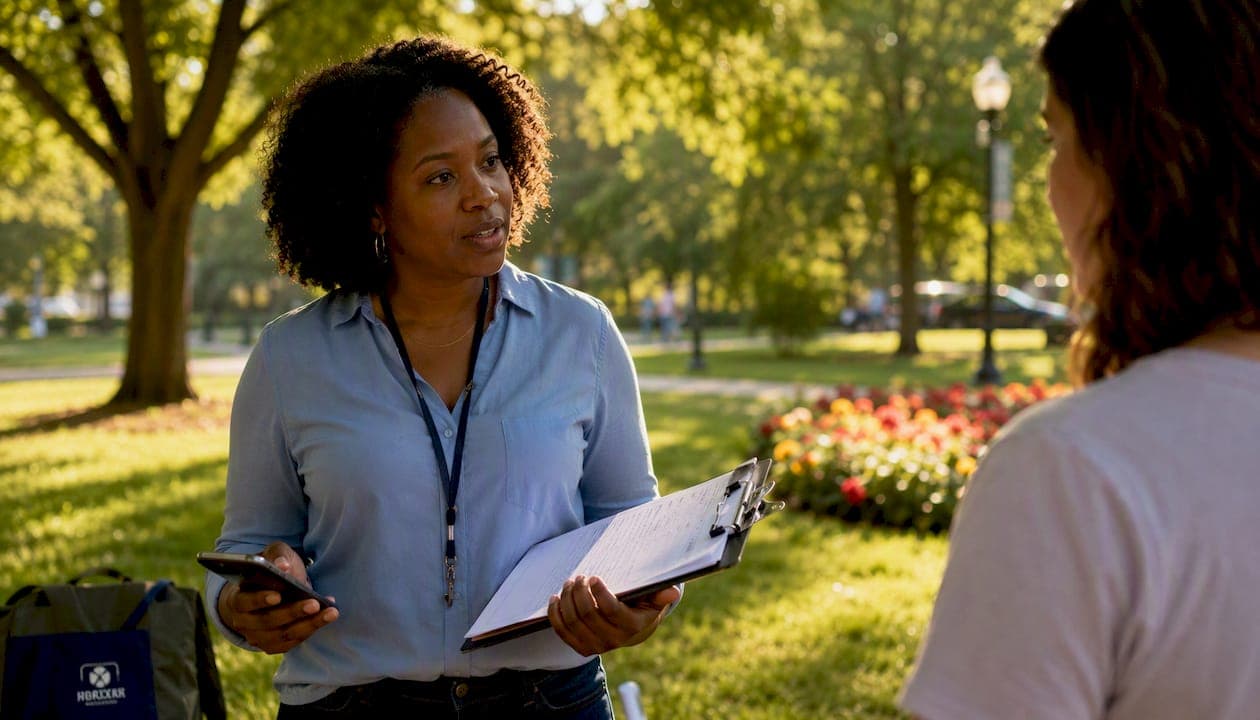
The single most effective approach to campaign visibility tactics is a layered, 3–5-touch sequence that puts direct voter contact first. Canvassing, phonebanking, and targeted mail are your primary tools. Texts and digital ads work best as follow-up reminders after initial contact, not as substitutes for it.
Start this week:
- Lock your target universe from the voter file (turnout history, registration recency, issue flags)
- Schedule your first phonebank session and assign a list manager
- Draft your 48-hour text follow-up sequence for no-answer calls
- Confirm your GOTV mail drop dates and print deadlines
Table of Contents
- 1. Why 3–5 coordinated touches is the rule you build everything around
- 2. Primary GOTV visibility tactics you must prioritize: canvassing, phonebanking, direct mail
- 3. Digital channels and last-mile texting: where they fit and where they don't
- 4. Yard signs, street teams, and events are icing, not cake
- 5. How to prioritize voters and build your target universe
- 6. What to track and how to measure outreach-to-turnout conversion
- 7. US compliance checklist for texts, calls, mail, and ads
- 8. A concrete 4-week outreach plan for urban and rural campaigns
- 9. Mobilizing volunteers: recruitment, training, and shift logistics
- Key Takeaways
- What winning campaigns actually do differently
- Campaignbuddyhq gives you the workflow to run this plan from day one
- Useful sources and next steps
1. Why 3–5 coordinated touches is the rule you build everything around
Experienced field organizers treat several coordinated touches per target voter as the foundational rule of any outreach program. Not because more contact is always better, but because a single touch rarely converts intention into action. The cumulative effect of layered contact is what moves voters.
A 3-touch sequence fits most down-ballot races: voter ID call in week 1, a door knock in week 3, and a GOTV text 48 hours before Election Day. A 5-touch sequence adds a persuasion mail piece and a second call or relational text in the final week. The sequencing matters as much as the count. Doors build commitment; calls reinforce it; texts remind.
Pro Tip: Flag opt-outs immediately and suppress them across every channel. A voter who asks to stop receiving contact and gets another call two days later is a lost vote, not a recovered one. Build suppression logic into your contact record before you scale.
2. Primary GOTV visibility tactics you must prioritize: canvassing, phonebanking, direct mail
Live conversation is the most reliable turnout driver. A review of field research found canvassing increased turnout in 44 of 51 studies, with tactic effects typically ranging from 0.2% to 3.0% depending on context and timing. That range sounds modest until you're in a race decided by 200 votes.
Canvassing works best when doors are prioritized by voter-file signals: low-propensity supporters and soft persuadables in competitive precincts. Don't knock every door on a block. Use your file to identify who needs the conversation, then send your best volunteers or paid staff to those addresses. A step-by-step canvassing guide can help you build the operational checklist before your first shift.
Phonebanking targets persuadables and low-propensity supporters who are harder to reach at the door. Contact rates vary with list quality and timing, higher when you're calling during evening hours with a well-trained volunteer team. Volunteer GOTV calls have been found to increase turnout in some studies, making phonebanks one of the highest-ROI activities in your program.

Direct mail earns its place when you need to reach voters who don't answer calls or doors, and when you want a physical reminder in hand during the GOTV window. Reminder postcards timed 5–7 days before Election Day outperform persuasion letters sent too early. Mail is slower and less flexible than digital, but it reaches older, lower-propensity voters who often decide elections.
| Tactic | Relative cost per contact | Typical turnout lift | Best campaign moment |
|---|---|---|---|
| Canvassing | Medium | 0.2–3.0% | Persuasion through GOTV |
| Phonebanking | Low | 0.2% to 3.0% | Voter ID, persuasion, GOTV |
| Direct mail | Medium-high | Varies by format | GOTV window (5–7 days out) |
Pro Tip: Mix volunteer and paid staff strategically. Paid interns or field staff handle the highest-priority doors and quality-control scripts; volunteers cover volume. A lean program built around one staffer and paid interns can deliver quality contacts for under $50K.
3. Digital channels and last-mile texting: where they fit and where they don't
Peer-to-peer texting scales your reach faster than any other channel, but it works best as a follow-up, not a first touch. A voter who has already spoken with a canvasser or volunteer caller is far more likely to respond to a text than someone receiving their first contact from your campaign.
The practical sequence: send an email to your supporter list and track opens and clicks. Contacts who engage get a follow-up call within 48 hours. Those who don't answer the call get a peer-to-peer text within 48 hours of that. Texts are often read within minutes of delivery, which makes them ideal for GOTV reminders, polling location confirmations, and vote-plan links in the final 72 hours.
Targeted digital ads serve a different function: they reinforce name recognition and messaging for voters you can't reach directly. Use them for persuasion and supporter cultivation in the middle weeks of your campaign, then shift budget toward direct contact as Election Day approaches.
Pro Tip: Send GOTV texts between 9 AM and 8 PM local time to stay within TCPA safe-harbor windows. Include a direct link to a vote plan or polling locator. Texts with a clear single action convert better than texts with multiple asks.
4. Yard signs, street teams, and events are icing, not cake
Visibility tactics like yard signs and street teams are valuable, but they're secondary to direct voter contact. Deploy them only after your canvass, phone, and mail programs are running at full capacity.
Where they actually move the needle: competitive precincts where name recognition is genuinely low, volunteer morale events that double as earned media opportunities, and neighborhoods where a visible street presence signals momentum to undecided voters. Yard signs don't vote, but a block saturated with your signs in a swing precinct can shift the social proof calculus for a persuadable neighbor.
Rules of thumb for spending on visibility:
- Concentrate signs in target precincts, not everywhere
- Use street teams to capture contact information, not just wave signs
- Measure volunteer hours spent on visibility against hours that could go to doors or phones
- Treat events as contact-capture opportunities, not rallies for the already-converted
Pro Tip: Every event and street team deployment should end with a sign-in sheet or QR code that feeds directly into your contact record. A voter who attends a rally and gives you their number is now a warm contact for your next touch sequence.
5. How to prioritize voters and build your target universe
Your voter file is the foundation. The flags that matter most: turnout history in comparable elections, registration recency, geography (precinct competitiveness), and any issue or demographic tags your data vendor provides. Layer in digital signals — email opens, event RSVPs, social engagement — to identify warm contacts who should move up your priority queue.
A simple three-tier priority matrix:
- High-value persuadables: Registered voters with moderate turnout history in competitive precincts. These get the full 5-touch sequence: mail, door, call, text, GOTV reminder.
- Low-propensity supporters: Identified supporters who rarely vote. These get a door knock, a call, and two GOTV texts. The goal is activation, not persuasion.
- Broad universe: Voters outside your top tiers. Reach them with mail and digital ads only. Don't spend volunteer hours here until tiers 1 and 2 are covered.
Keep lists in sync across channels. A voter who pledges to vote during a door conversation should be flagged in your contact record immediately so the phonebank doesn't call them again that week. Siloed lists create duplicate contacts and damage your caller ID reputation during the GOTV sprint when you can least afford it.
Pro Tip: Review your voter contact field guide before finalizing your universe. The difference between a 40,000-voter universe and a 12,000-voter priority list is often the difference between a scattered program and a winning one.
6. What to track and how to measure outreach-to-turnout conversion
Every outreach log needs these fields at minimum:
| Field | What it captures | Who owns it |
|---|---|---|
| Contact date and channel | When and how the voter was reached | Volunteer or caller |
| Call/door disposition | Answered, no answer, refused, moved | Volunteer or caller |
| Last touch | Most recent contact type and date | System auto-update |
| Opt-out status | Do-not-contact flag | System auto-update |
| Vote plan | Confirmed voting plan (yes/no/maybe) | Volunteer or caller |
| Pledge-to-vote | Explicit commitment | Volunteer or caller |
The KPIs that matter: total contacts, conversations (not just attempts), pledge-to-vote rate, vote-plan conversion, and ultimately turnout conversion for your identified supporters. Contact rate — conversations divided by total attempts — tells you whether your lists are clean and your timing is right.
One contact record per voter, updated in real time. Multi-channel outreach breaks down when channels run in silos; a voter who doesn't answer a call should be queued for a follow-up text within 48 hours, automatically. That workflow only works if the call result is logged immediately.
7. US compliance checklist for texts, calls, mail, and ads
Before you scale any outreach channel, confirm these controls are in place:
- TCPA compliance: Peer-to-peer texts sent by a human agent are generally lower-risk than automated blast SMS. Consult counsel before deploying any auto-dialer or pre-recorded message to cell phones.
- State-level rules: Several states have stricter calling and texting windows than federal TCPA minimums. Check your state's specific rules before your first phonebank.
- Paid communication disclaimers: All paid ads, mail, and digital content must carry the required "paid for by" disclaimer under FEC rules and applicable state law.
- Opt-out handling: Honor opt-outs within 24 hours across all channels. Maintain a suppression list that syncs across your dialer, text platform, and email system.
- Vendor contracts: Confirm your text and call vendors carry their own TCPA compliance representations and indemnification clauses.
Pro Tip: Robocalls to cell phones without prior express consent are high-risk under TCPA. Peer-to-peer platforms that require a human to send each message individually are the safer path for most campaigns. When in doubt, get a 30-minute call with a campaign attorney before launch.
8. A concrete 4-week outreach plan for urban and rural campaigns
| Week | Urban focus | Rural focus | Touch targets | Staffing |
|---|---|---|---|---|
| Week 1 | Voter ID calls, email launch | Voter ID calls, mail drop 1 | — | 2 staff, 8 volunteers |
| Week 2 | Canvass priority precincts, P2P texts to openers | Canvass county seats, phonebank | — | 2 staff, 12 volunteers |
| Week 3 | Persuasion mail, second canvass pass | Mail drop 2, relational texts | — | 3 staff, 15 volunteers |
| Week 4 (GOTV) | GOTV calls, 48-hr texts, E-day lit drop | GOTV calls, E-day ride-to-polls | — | Full team |
Contingency checklist:
- Weather delay: shift door shifts to phonebank hours; pre-schedule makeup canvass days
- Legal hold on a channel: pause that channel, redistribute volunteer hours to doors or calls
- Opposition rapid response: designate one staffer as rapid-response lead; prepare three pre-approved response messages for the most likely attack lines; do not pull field staff off voter contact to manage comms
9. Mobilizing volunteers: recruitment, training, and shift logistics
Recruit from your email list, event sign-ins, and social media first. For small-budget races, the paid intern model, one or two paid part-time organizers managing a volunteer corps, delivers more consistent quality than relying entirely on unpaid staff.
Training essentials before any shift: a two-page script with common objections, a 15-minute role-play with a supervisor, and a clear explanation of how to log results in your contact system. Quality matters more than volume. A volunteer who logs accurate dispositions is worth three who don't.
Shift logistics that reduce dropout: keep shifts to two hours for doors, three for phones. Assign territories before volunteers arrive. Arrange transportation for canvassers in areas without transit. Small incentives, pizza, a thank-you text from the candidate, a leaderboard for top contactors, improve retention meaningfully over a multi-week program.
Pro Tip: Use a real-time supervisor dashboard during phonebank shifts so a staff member can monitor contact rates and coach struggling callers live. A caller hitting 5% contact rate on a clean list needs a script adjustment, not more dials. Catching that in hour one saves the whole shift.
Key Takeaways
Winning campaigns layer direct voter contact across several coordinated touches per target voter, treating canvassing, phonebanking, and mail as the core program and digital channels as last-mile reinforcement.
| Point | Details |
|---|---|
| 3–5 touches is the rule | Plan every target voter for 3–5 coordinated contacts across doors, calls, mail, and texts. |
| Direct contact first | Canvassing lifted turnout in 44 of 51 reviewed studies; prioritize it before any visibility spend. |
| Digital is last-mile | Use texts and targeted ads to reinforce and remind, not to replace live conversation. |
| One contact record | Sync all channels to a single voter record and trigger follow-ups from the last logged action. |
| Campaignbuddyhq | Campaignbuddyhq maps daily/weekly planning, outreach logging, and phase workflows to the 3–5-touch model with a 7-day free trial. |
What winning campaigns actually do differently
The campaigns that consistently outperform their resource level share one habit: they treat sequencing as a discipline, not a preference. Most campaigns run their channels in parallel and call it a multi-channel program. Winning campaigns run them in sequence, with each touch triggered by the result of the last one. A no-answer call becomes a text. A text click becomes a call-back. A door pledge becomes a suppressed record that frees up capacity for the next persuadable.
The other thing they do: they measure vote-plan conversions, not just contact totals. A campaign that made 10,000 calls but can't tell you how many resulted in a confirmed vote plan doesn't know if it's winning. The campaigns that know their pledge-to-vote rate by precinct, by channel, and by week are the ones that can make smart resource calls in the final 10 days.
Layering relational organizing, peer-to-peer texting, door conversations, and calls into one sequenced workflow is what separates a program that generates activity from one that generates votes. The tactics themselves aren't secret. The discipline to sequence them and measure the results is what most campaigns skip.
Campaignbuddyhq gives you the workflow to run this plan from day one
Running a layered 3–5-touch program without a system to track it is how campaigns lose control of their own data. Campaignbuddyhq is built specifically for this: daily and weekly planning tools, outreach logging for doors, calls, texts, and registrations, a single contact record per voter, and phase-based workflows that map directly to the voter ID, persuasion, and GOTV sequences described in this article.
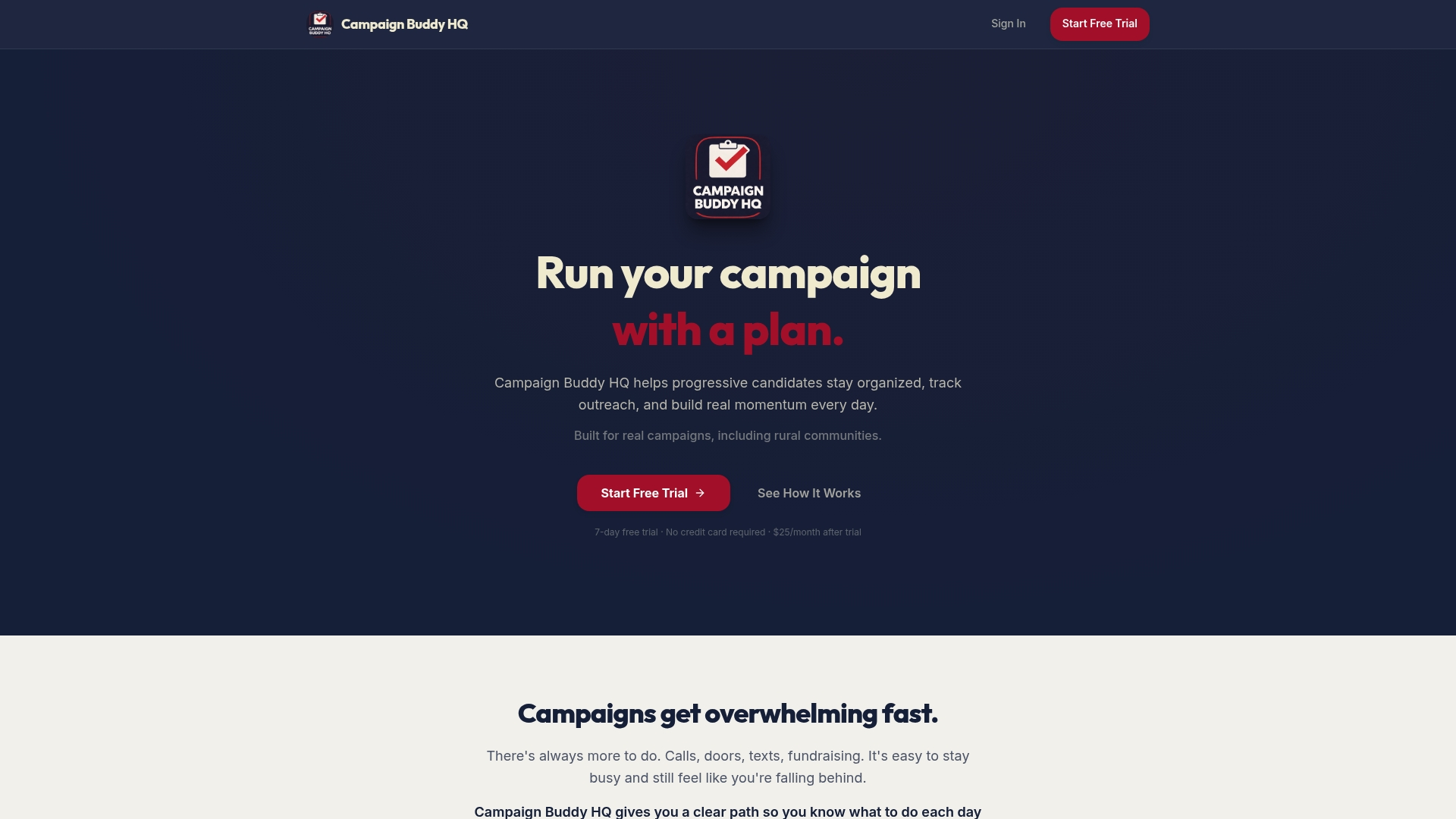
It handles rural and low-density campaign contexts as well as urban ones, which matters when your canvass territory spans 40 miles instead of 40 blocks. The AI-assisted content tools can generate stump speech drafts and social posts so your staff spends time on voter contact, not copy.
Start your 7-day free trial at Campaignbuddyhq with no credit card required. Import your target list, set up week 1 of your outreach plan, and see your contact progress in real time before you commit to a subscription.
Useful sources and next steps
- Tools for Building a Winning Program — The Campaign Workshop's GOTV operational guide
- Field Research Overview — StatesWin review of canvassing and tactic effect sizes
- Campaign Field Plan — Good Party's field planning guide including the 3–5-touch rule
- Layering Every Direct Voter Contact Tactic — Lisa Schneegans on sequenced, layered organizing
- Step-by-Step Campaign Outreach Guide — Campaignbuddyhq's outreach foundation and logging guide
- Campaign Buddy HQ — Platform landing page, free trial signup