

Running a political campaign without a solid management plan is like canvassing without a map. You move fast, burn energy, and cover the wrong ground. The most effective campaign management tips aren't about doing more. They're about doing the right things in the right order, with the right people accountable for each piece. Whether you're a first-time candidate or a seasoned campaign manager, the difference between winning and losing often comes down to process, not passion. Here's what actually works.
Table of Contents
- Key takeaways
- 1. Start with clear, measurable campaign objectives
- 2. Segment your voter audience with precision
- 3. Build a realistic budget with overhead built in
- 4. Map your campaign calendar with intelligence
- 5. Use agile planning instead of a rigid one-time plan
- 6. Centralize your team's workflow and information
- 7. Prioritize consistent messaging across every channel
- 8. Track meaningful KPIs, not vanity metrics
- 9. Establish a clear approval workflow for all communications
- 10. Schedule regular team syncs with clear agendas
- 11. Build buffer time and contingency plans into your schedule
- 12. Train your team on tools and processes before launch
- My honest take on what makes or breaks campaigns
- How Campaignbuddyhq helps you put these tips into practice
- FAQ
Key takeaways
| Point | Details |
|---|---|
| Set measurable goals first | Vague objectives waste budget and confuse your team before outreach even begins. |
| Use agile, not rigid, planning | Campaigns require real-time adaptation and built-in buffer time to survive unexpected events. |
| Centralize your systems | A single source of truth for tasks, assets, and data prevents coordination breakdowns. |
| Focus on outcomes, not vanity metrics | Track conversion and mobilization rates, not likes or impressions. |
| Consistent messaging wins trust | Repetition across all channels with clear calls to action drives voter mobilization. |
1. Start with clear, measurable campaign objectives
Before you assign a single task or send a single text, define what winning actually looks like. Not "increase awareness." Something specific: register 500 new voters in District 4 by October 15, or knock 2,000 doors in the first 30 days.
Most campaigns fail early because goals are fuzzy at the start. Fuzzy goals produce fuzzy plans. And fuzzy plans mean your team is constantly improvising rather than executing. When your objectives are measurable, you can build every activity planning step backward from that target.
Pro Tip: Apply the "Rule of One" to each campaign phase: one primary objective per phase keeps your message sharp and your budget focused instead of scattered across competing priorities.
2. Segment your voter audience with precision
Not every voter in your district responds to the same message. A 28-year-old renter in an urban precinct and a 55-year-old homeowner in a rural township have different priorities. The campaigns that ground targeting in historical data consistently outperform those relying on gut instinct.

Use past election results, census data, and prior canvassing records to build voter segments. Then tailor your outreach method: doors for high-priority persuadable voters, texts for low-propensity supporters who need a nudge, and calls for your most engaged base. This isn't just campaign planning theory. It's how you stretch a limited budget into maximum contact.
3. Build a realistic budget with overhead built in
The number you think you need for field operations is rarely the full number. Best-practice budget allocation suggests reserving 20% of your total campaign budget for strategy, management, and overhead. That covers the coordinator who manages your volunteer schedules, the software that tracks your outreach, and the unexpected mailer you'll need after a news cycle shifts.
Many candidate campaign checklists skip this step entirely. They list the cost of yard signs and phone banking hours but forget that coordination itself has a cost. If you don't plan for it, you either underfund your operations or raid your field budget to cover it.
4. Map your campaign calendar with intelligence
Launch timing matters more than most candidates realize. Start your planning phase at least four weeks before launch to map competitor activity, identify voter attention windows, and spot "green zones" where your outreach will face less noise. In a competitive primary, running a big door-knock weekend the same week as a rival's major event is a coordination failure you could have avoided.
Your campaign calendar should integrate external intelligence alongside internal deadlines. Know when school is out, when local events draw your volunteers away, and when news cycles tend to dominate voter attention. Build the calendar around voter behavior, not just campaign convenience.
5. Use agile planning instead of a rigid one-time plan
The biggest trap in campaign activity planning is treating the initial plan as final. Agile methodologies produce 252% higher success rates than traditional rigid planning approaches, and the principle applies directly to political campaigns.
That means running your plan in sprints: two-week cycles where the team reviews what worked, adjusts targets, and reallocates effort based on real data. Did last week's canvass in Precinct 7 generate 40% fewer door contacts than projected? Shift resources before you lose another weekend. Staying flexible is not a sign of disorganization. It's how disciplined campaigns adapt without losing momentum.
Pro Tip: Build a 48-hour review window after every major push. Pre-plan two or three tactical responses based on likely performance scenarios so your team isn't starting from zero when adjustments are needed.
6. Centralize your team's workflow and information
74% of campaign teams prefer using a consistent set of collaboration tools to avoid losing information across platforms. When your field director is updating one spreadsheet, your communications director is working from a different one, and your volunteer coordinator is texting updates nobody sees, things fall apart fast.
A centralized campaign outreach system gives every team member one place to check task status, log contact totals, and see campaign progress. This matters most during crunch periods when there's no time to chase down updates. One source of truth cuts wasted coordination time and keeps everyone accountable to the same numbers.
7. Prioritize consistent messaging across every channel
Voters don't make decisions after one contact. They need repeated exposure to your core message before it registers. Consistent messaging with urgent calls to action across all platforms is what drives mobilization, not a single brilliant ad.
That means your door script, your text messages, your social media posts, and your mail pieces should all reinforce the same two or three core themes. Not word for word, but in tone and direction. Building message consistency across channels requires discipline. It means resisting the temptation to run a clever side message that pulls attention away from your main ask.
8. Track meaningful KPIs, not vanity metrics
Impressions and "likes" feel good. They do not tell you whether you're winning. Winning campaigns focus on outcomes like doors knocked per volunteer hour, phone contacts per shift, voter registration rates, and early vote returns from targeted precincts.
Set your KPIs before the campaign starts, not after you see what numbers look good. A practical candidate campaign checklist should include weekly targets for doors, calls, texts, and registrations. Then compare actuals to targets every week. If you're consistently under, that's a planning problem. If you're over, that's an opportunity to raise your targets.
9. Establish a clear approval workflow for all communications
Nothing stalls a campaign faster than unclear approval chains. Who signs off on the mail piece? Who approves the press release before it goes out at 7 a.m.? When those questions don't have answers before the campaign starts, you get bottlenecks at the worst possible moments.
Standardizing your approval workflow with a single integrated platform prevents asset delays and keeps your brand consistent. Assign one approver per communication type and set a 24-hour turnaround standard. For time-sensitive items, designate a backup approver so nothing sits in a queue waiting for someone who's unavailable.
10. Schedule regular team syncs with clear agendas
Weekly check-ins without a structure are a waste of everyone's time. Structure yours around three questions: What did we accomplish this week? What are we behind on? What do we need to solve before next week's push?
This format keeps meetings under 30 minutes and produces clear action items. Accountability loops like this are where campaign organizing essentials move from theory into practice. When every team member knows they'll be reporting their numbers weekly, the numbers improve because people track what gets measured.
11. Build buffer time and contingency plans into your schedule
Most campaign managers underestimate the disruption caused by a single bad news cycle, a key staffer getting sick, or a major weather event during a canvassing weekend. Building one to two weeks of buffer time into your campaign schedule is not padding. It's insurance.
Your contingency plan doesn't need to be elaborate. It needs to answer two questions: if we lose a week of field work, what gets cut and what gets protected? If a major story shifts voter attention, do we have a rapid-response message ready? Campaign planning frameworks that skip contingency planning are frameworks that fall apart under pressure.
12. Train your team on tools and processes before launch
The best campaign management software in the world does nothing if your volunteers don't know how to log contacts and your field organizers are still tracking doors on paper. Technology adoption requires intentional training, not just a tutorial video sent in a Slack message.
Schedule a two-hour onboarding session before your first major outreach push. Walk through how contacts get logged, how progress gets reported, and how team members escalate problems. Training upfront cuts confusion downstream and ensures your data is actually usable when you need to make decisions. A well-trained team using simple tools outperforms a confused team using expensive ones every time.
My honest take on what makes or breaks campaigns
I've watched campaigns with real resources and real talent fall apart because the management side was treated as an afterthought. The candidate was compelling, the message was solid, and the staff was motivated. But nobody owned the system. Tasks overlapped, data went unlogged, and decisions happened based on instinct rather than numbers.
What I've learned is that campaign management is a living system, not a document you create in January and revisit in October. The campaigns I've seen succeed treat their weekly numbers as seriously as any voter contact script. They build in real buffer time. They assign clear ownership to every piece of the operation. And they communicate the same core message so many times it feels almost boring internally, which is usually the moment it starts landing with voters.
The counter-intuitive truth I'd pass along: the most creative campaign isn't the one that wins. The most disciplined one does. Creative moments matter, but they land on a foundation of structure. If your team doesn't know who owns which task, your brilliant ad still doesn't get out on time. Consistent execution beats inspired improvisation, almost without exception.
— Billy
How Campaignbuddyhq helps you put these tips into practice
Managing a political campaign means tracking dozens of moving parts while keeping your team pointed at the same goal. That's exactly what Campaignbuddyhq is built to do.
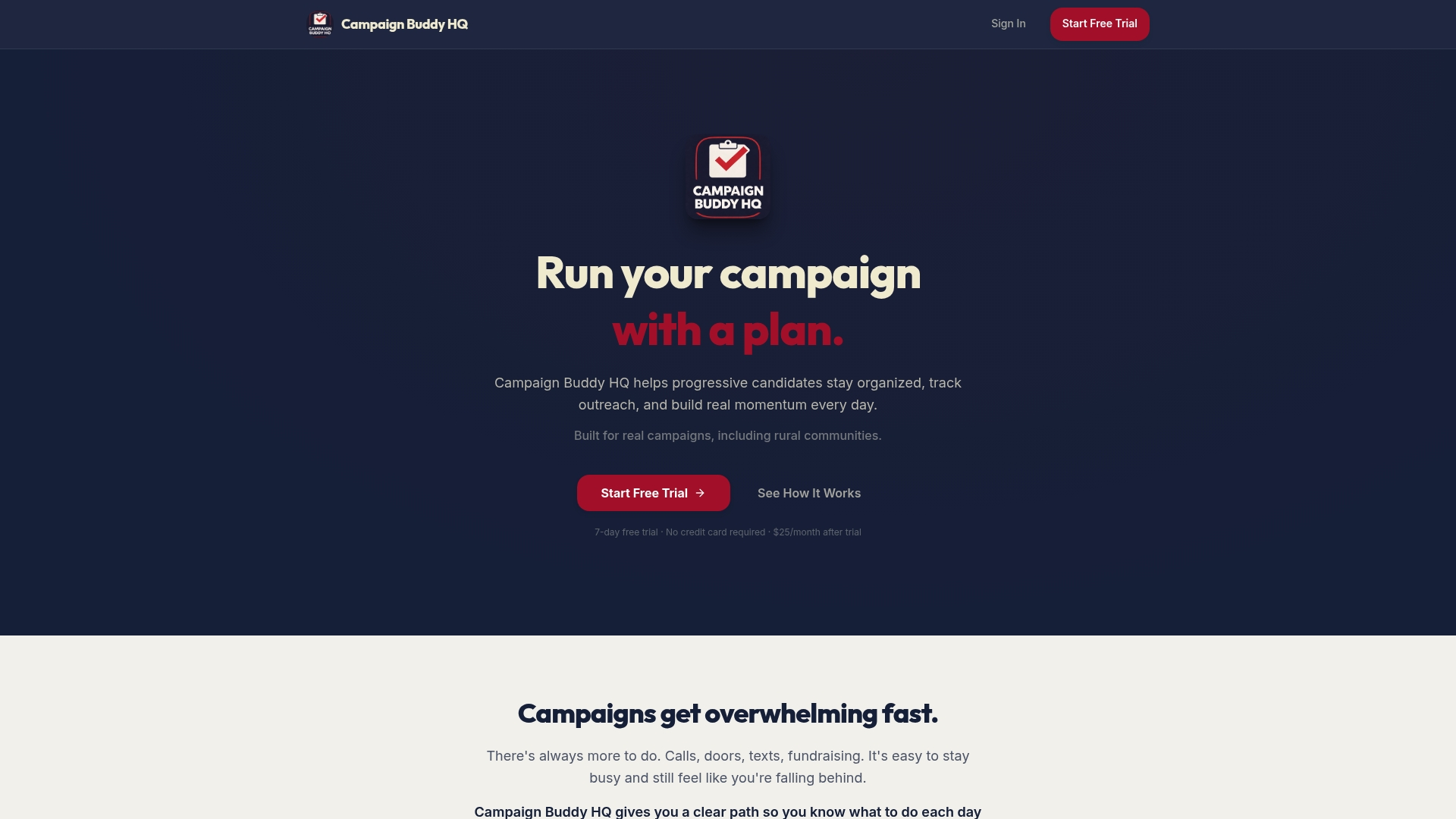
Campaignbuddyhq gives political candidates and campaign managers a centralized platform for planning outreach, logging door knocks and calls, tracking supporter data, and monitoring progress toward weekly and phase goals. It supports daily and weekly planning workflows that reflect the campaign management tips covered throughout this article, without requiring a technical background to use. Whether you're running a rural canvass or coordinating a multi-precinct phone bank, Campaignbuddyhq keeps your operation organized from day one. Try it free for 7 days, no credit card required, and see how much easier consistent execution becomes when your whole team works from one place.
FAQ
What are the most important campaign management tips for beginners?
Start with a clear, measurable objective and build your calendar backward from it. Centralize your team's information in one system before your first outreach push so nothing gets lost.
How do agile methods apply to political campaign planning?
Agile planning means running your campaign in short cycles, reviewing results every one to two weeks, and adjusting tactics based on real contact data rather than sticking to a plan that isn't working.
What KPIs should a political campaign track?
Track doors knocked, calls completed, texts sent, voter registrations, and early vote returns from targeted precincts. Avoid measuring impressions or social media likes as primary success indicators.
Why does consistent messaging matter so much in political campaigns?
Voters typically need multiple contacts before a message registers. Repeating the same core themes across doors, texts, mail, and social media reinforces your message and drives mobilization more effectively than varied messaging.
How much buffer time should a political campaign schedule include?
Build one to two weeks of buffer time into your overall campaign schedule. This protects your field operation from disruptions like weather, staffing gaps, or news cycles that shift voter attention unexpectedly.