

Most campaign managers pour their best energy into the final three weeks before election day, treating everything before as a warm-up act. That's a costly mistake. The campaigns that consistently outperform their opponents don't win because of a last-minute surge. They win because they built something durable across every phase of the election cycle. This guide breaks down each campaign phase in detail, from early planning all the way through post-election analysis, so you can stop leaving votes on the table and start treating the full lifecycle as your competitive advantage.
Table of Contents
- The essential campaign phases: A lifecycle overview
- Phase 1: Laying the foundation — Planning and prep
- Phase 2: Building momentum — Outreach & engagement
- Phase 3: The final stretch — GOTV tactics and election day
- After election day: Measuring, analyzing, and iterating
- Perspective: Why real campaign strength comes from what happens between phases
- Execute every campaign phase with Campaign Buddy HQ
- Frequently asked questions
Key Takeaways
| Point | Details |
|---|---|
| Map every phase | Understanding and mapping each campaign phase gives you the structure needed for efficient outreach. |
| Prep drives success | Solid early planning, clear goals, and team alignment set the campaign up for later momentum. |
| Segment for engagement | Targeted outreach and volunteer mobilization result in higher voter contact and engagement. |
| Track and adapt | Measuring and reflecting on your progress lets you improve results in real time and future campaigns. |
The essential campaign phases: A lifecycle overview
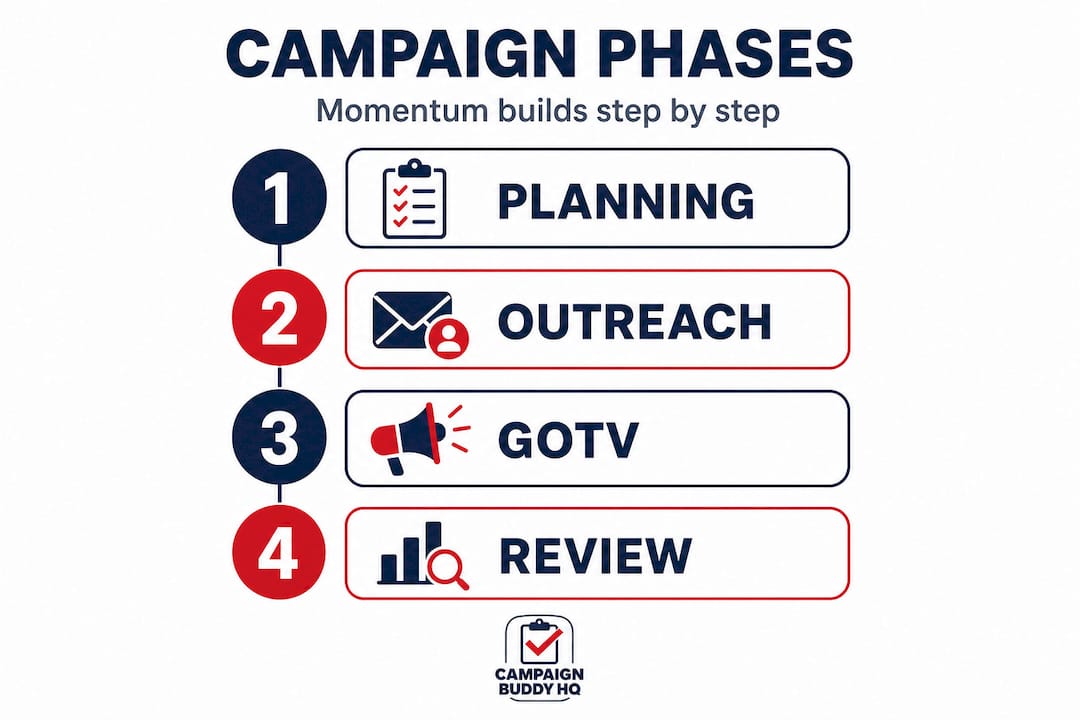
Before you can optimize anything, you need to see the full picture. A political campaign is not a single event. It's a sequence of connected phases, each with its own purpose, focus, and set of tactics. Skipping or shortchanging any one phase creates gaps that compound over time.
Here's the big picture. Organized campaign phases increase outreach efficiency by giving your team a clear structure to operate within. Without that structure, you get duplicated efforts, missed contacts, and wasted resources.
The core phases of a well-run campaign look like this:
- Planning and prep: Define objectives, build your data infrastructure, and assign team roles before a single door is knocked.
- Build-up and early outreach: Introduce the candidate, collect supporter information, and start building relationships with potential voters.
- Mid-campaign outreach and engagement: Scale up field operations, digital outreach, and media strategy to maximize voter contact.
- Get Out The Vote (GOTV): Execute last-mile tactics to make sure your identified supporters actually cast their ballots.
- Post-election analysis: Review what worked and what didn't to strengthen your infrastructure for the next cycle.
| Phase | Primary focus | Common failure point |
|---|---|---|
| Planning and prep | Goal setting, data, team roles | Skipping voter file analysis |
| Build-up and outreach | Relationship building, ID-ing supporters | Messaging inconsistency |
| Mid-campaign engagement | Scaling contact rates, volunteer management | Poor data capture |
| GOTV | Turnout maximization | Insufficient follow-up |
| Post-election | Reflection, documentation | Ignoring lessons learned |
Each phase hands off to the next. When those hand-offs are clean, momentum compounds. When they're messy, you rebuild from scratch every time, and that kills campaigns.
Phase 1: Laying the foundation — Planning and prep
Now that you see the journey ahead, let's start with what makes or breaks a campaign: the foundation. Most campaigns rush this phase because it doesn't feel like "real" campaign work. There are no rallies, no canvassers knocking doors, no vote tallies. But the decisions made here determine how efficiently you can execute everything that follows.
Here's what strong planning actually looks like in practice:
- Define your target universe. Pull your voter file and segment it into tiers: strong supporters, persuadables, and opposition leaners. Your outreach resources should be concentrated on the first two groups, not wasted on unlikely converts.
- Set measurable goals per phase. Don't just say "talk to more voters." Set specific targets: 500 door contacts per week during the build-up phase, or 80% re-contact of identified supporters during GOTV. Concrete numbers keep your team accountable.
- Select your data and workflow tools. You need a voter file, a way to organize outreach activities, and an event calendar that keeps your team coordinated. Pre-launch organization directly improves the likelihood of timely, targeted contact once outreach begins.
- Assign clear roles and responsibilities. Who owns field operations? Who manages digital? Who handles volunteer recruitment and scheduling? Ambiguity here leads to duplicated work and dropped tasks.
- Build your communication templates. Door scripts, phone banking scripts, text message templates, and social media messaging should all be drafted and tested before your outreach officially launches.
Pro Tip: Track your campaign progress tips from week one, even before major outreach begins. Establishing your baseline data habits early makes it much easier to spot trends when the pace picks up.
One detail many campaign managers overlook during planning is geographic prioritization. If you're running in a district with a mix of urban and rural precincts, your outreach model for a high-density neighborhood is completely different from what works in a rural township with dispersed households. Map this out during planning so your volunteers aren't walking into the wrong environment with the wrong approach.
Phase 2: Building momentum — Outreach & engagement
With the groundwork set, it's time to look at how outreach is best activated and optimized for impact. This is the phase where campaigns either accelerate or stall. Outreach volume matters, but quality and targeting matter more.

Campaigns with segmented outreach and strong volunteer mobilization consistently achieve higher voter contact rates than those relying on broad, untargeted communication. Segmentation means breaking your voter universe into groups based on geography, issue priorities, voting history, and contact preferences, then customizing your message and channel for each group.
Here's how effective segmentation works across outreach channels:
| Outreach channel | Best segment to target | Key metric to track |
|---|---|---|
| Door-to-door canvassing | High-density precincts, low-turnout households | Doors knocked, contacts made |
| Phone banking | Rural or spread-out precincts, older voters | Calls completed, live contacts |
| Text messaging | Young voters, first-time voters | Response rate, opt-outs |
| Social media | Persuadable voters, first-time donors | Engagement rate, click-throughs |
| Community events | High-priority neighborhoods, volunteers | Attendance, sign-ups |
Volunteer management is the engine behind all of this. Your paid staff sets the strategy, but your volunteers do the actual work of reaching voters. Strong campaigns treat their volunteers like assets, not just warm bodies.
- Schedule volunteers in consistent shifts so they build familiarity with their turf.
- Pair new volunteers with experienced canvassers for the first week.
- Celebrate small wins publicly within your team to maintain morale.
- Use tracking outreach impact tools to show each volunteer their individual contribution toward the team goal.
Pro Tip: The most common reason campaigns lose volunteer power tips during the engagement phase is not asking volunteers to return. After every shift, personally confirm the next commitment before they leave. Retention is far cheaper than recruitment.
Watch your metrics weekly during this phase. If your door contact rate drops below 35% of doors knocked, your turf isn't right or your script needs adjustment. If your text response rate falls below 5%, your message needs testing. These numbers are signals, and ignoring them means entering the GOTV phase with a weaker voter ID list than you think.
Phase 3: The final stretch — GOTV tactics and election day
Once outreach is at full speed, the focus must intensify as election day approaches. GOTV is not just about doing more outreach. It's about doing the right outreach to the right people at exactly the right moment. The goal is simple: make sure every person who said they'd vote for your candidate actually does.
GOTV initiatives with daily check-ins and targeted reminders can lift turnout by 5 to 8 percent among identified supporters. That's not a small number. In a tight race, 5 to 8 percent is the margin of victory.
Here's a seven-day countdown plan that works:
- 7 days out: Send the first personalized reminder to all identified supporters. Include polling place information and hours. Confirm your volunteer shifts are locked in for the full week.
- 5 days out: Launch your second contact wave. Focus on low-propensity supporters who need extra encouragement. Use phone calls for maximum personal impact.
- 3 days out: Deploy texting volunteers for rapid follow-up with non-responders. Keep messages short and specific: "Polls are open from 7 a.m. to 8 p.m. at [location]. We're counting on you."
- Day before election: Knock on doors for all high-priority households who haven't confirmed a plan to vote. This is your last chance for a real conversation.
- Election day morning: Activate your full volunteer team for phone and text contact. Prioritize anyone who hasn't voted by midday according to your poll checker data.
- Election day afternoon: Surge resources to precincts where turnout is running behind historical averages. Redirect volunteers in real time.
- Final hours: Chase every remaining identified supporter who hasn't voted. Door knocking and phone calls should run until polls close.
"The campaigns that win GOTV aren't louder. They're more organized. They know exactly who to call, what to say, and when to follow up — and they stick to that plan even when it's exhausting."
Building momentum with data during GOTV means updating your lists daily. Every vote cast should be removed from your contact list. Every non-contact should be flagged for a different channel. Use the data your outreach team collects to sharpen your targeting with every passing hour.
After election day: Measuring, analyzing, and iterating
Campaigns don't end with votes cast. What you do immediately after determines your growth and readiness for the next run. This phase is consistently underinvested, and it's one of the biggest reasons campaigns struggle to build durable infrastructure over multiple cycles.
Campaigns that track and reflect on activities post-election improve their efficiency and targeting accuracy for future cycles. That improvement compounds. A campaign that runs a strong post-election review in 2026 enters the next cycle with a head start that rivals cannot replicate from scratch.
Here's what a solid post-election review actually covers:
- Outreach performance by channel: Which channel delivered the highest voter contact rate? Which had the worst return on volunteer time?
- Voter ID accuracy: What percentage of your identified supporters actually voted? A gap here signals problems with your ID process, not just your GOTV.
- Volunteer retention: How many of your volunteers are willing to come back for the next campaign? Ask within two weeks while the experience is still fresh.
- Phase transitions: Where did momentum stall? Often it's the shift from mid-campaign outreach to GOTV, where data isn't fully transferred between teams.
- Message resonance: Which scripts, social posts, or talking points generated the most positive responses? Save the best-performing language for future use.
- Resource allocation: Where were you overstaffed or understaffed? A precinct-by-precinct breakdown usually reveals patterns that are invisible at the district level.
When you document these takeaways immediately after the election, you build a living playbook. The teams that do this work consistently stop reinventing the wheel every cycle and start building on what actually works in their specific communities.
Perspective: Why real campaign strength comes from what happens between phases
Here's the thing most campaign strategy guides won't tell you: the individual phases matter less than the transitions between them. Every campaign plans their field program. Every campaign talks about GOTV. But the campaigns that actually outperform expectations are the ones that treat the hand-off from one phase to the next as a strategic moment worth planning explicitly.
Most campaigns lose momentum precisely at those transitions. The volunteer energy built during mid-campaign outreach dissipates because no one does the work of converting engaged canvassers into a committed GOTV force. The voter ID data collected in the field doesn't make it into the phone banking lists in time because no one owns that transfer. These aren't big dramatic failures. They're small organizational breakdowns that silently erode results.
The fix isn't perfection within each phase. It's building feedback loops between them. What did you learn from early outreach that should reshape your messaging for the final stretch? Which precincts underperformed your contact goals in mid-campaign, and how does that affect where you concentrate GOTV resources? The campaigns that ask these questions and actually adjust based on the answers are the ones that get better every cycle.
Strong essential daily planning habits are what make this possible in practice. When your team logs activities consistently, reviews numbers daily, and communicates across departments, you create the conditions for those feedback loops to actually function. It's not glamorous work. But it's what separates campaigns that grind to the finish line from those that accelerate into it.
Execute every campaign phase with Campaign Buddy HQ
You've just walked through the full campaign lifecycle from foundation to post-election review. Putting all of this into practice takes more than a good plan. It takes the right tools to keep your team coordinated, your data clean, and your progress visible at every stage.
Campaign Buddy HQ is built specifically for this kind of organized, phase-by-phase campaign management. The platform gives campaign managers tools for daily and weekly planning, outreach logging across doors, calls, and texts, supporter tracking, and progress monitoring toward phase-specific goals. Whether you're running a grassroots canvassing operation in a rural district or managing a multi-channel outreach program in a dense urban precinct, Campaign Buddy HQ provides the structure to keep every phase on track and every transition clean. Start your free 7-day trial today, no credit card required, and see how a purpose-built platform changes the way your team executes.
Frequently asked questions
What are the key phases of a political campaign?
The key phases are planning and prep, building momentum through outreach, Get Out The Vote (GOTV), and post-election analysis. Organized campaign phases increase outreach efficiency and create a connected structure that compounds results across the full cycle.
How do you keep a campaign organized across phases?
Use checklists, assign clear team roles for each phase, and track progress with dedicated management tools. Pre-launch organization and goal setting directly improve the likelihood that outreach stays timely and well-targeted throughout the campaign.
What is the most common mistake during campaign transitions?
The most common mistake is losing momentum due to unclear handoffs between phases and no system for carrying lessons and data from one stage to the next. Without intentional feedback loops, teams start each new phase from a weaker position than necessary.
Why is GOTV important in campaign phases?
GOTV maximizes turnout and can lift turnout by 5 to 8% among identified supporters when campaigns use daily check-ins, personalized reminders, and real-time data updates. In close races, that margin is everything.