

The 2026 electoral cycle is forcing progressive campaigns to make a hard choice: adapt or fall behind. The old playbook of raw volume, disconnected departments, and metric-only thinking isn't cutting it anymore. With relationship-building and unified operations now at the center of the DNC's new organizing framework, campaigns that stick to yesterday's tactics will be fighting an uphill battle they didn't have to climb. This article lays out what's actually working, what the data says, and how to build a 2026 campaign operation that's built to win.
Table of Contents
- Rethinking the campaign plan: The 2026 organizing revolution
- Mastering campaign data and metrics: What matters in 2026
- Targeting, voter universe, and voter turnout: Evidence-driven outreach
- Grassroots outreach and fundraising: Tools, timing, and volunteer motivation
- Our take: What 2026 campaign planners must prioritize for true impact
- Ready to transform your campaign planning?
- Frequently asked questions
Key Takeaways
| Point | Details |
|---|---|
| Relationship-driven organizing | Building real connections is the cornerstone of modern campaign success in 2026. |
| Unified operations and data | Integrating departments and metrics improves outreach impact and adaptability. |
| Evidence-based targeting | Smart targeting avoids costly mistakes and maximizes turnout by focusing efforts on the right voters. |
| Grassroots volunteer motivation | Clear leadership, local focus, and authentic messaging are key to sustaining a powerful volunteer force. |
| Early, personal fundraising | Starting early and leveraging personal stories and digital tools ensures fundraising momentum. |
Rethinking the campaign plan: The 2026 organizing revolution
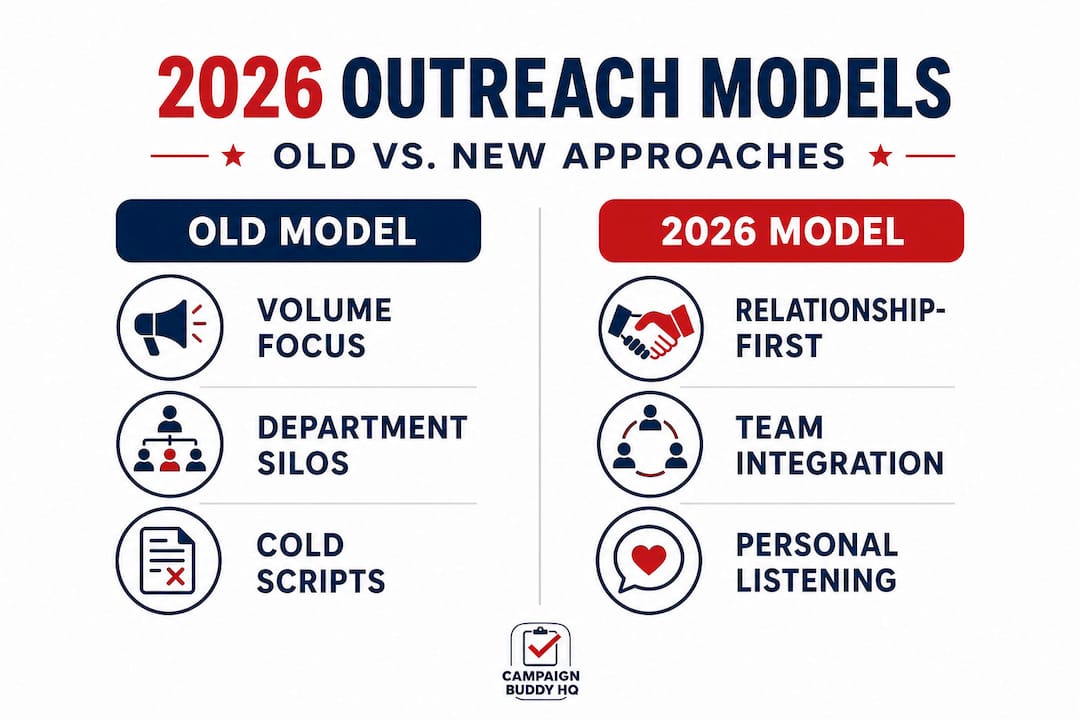
For years, campaign managers measured success by volume. How many doors knocked? How many calls made? Those numbers still matter, but they've been dethroned. The DNC's new organizing approach for 2026 centers on what they call "Organizing Re-Model," which deprioritizes raw outreach counts in favor of lasting relationships, community integration, and human connection.
This is not a soft pivot. It's a structural rethinking of how campaigns organize people.
One of the most significant changes is the breakdown of departmental silos. In the old model, digital, coalitions, field, and communications teams operated in separate lanes. In the new model, these functions are unified. Digital teams share data with field organizers. Coalition partners co-create voter contact scripts. The result is a more coherent operation where every touchpoint reinforces the next. You'll also want to incorporate organized outreach checklists that align every department around shared goals and daily priorities.
The DNC also introduces non-traditional tactics like high-traffic canvassing, relational outreach, and "layering" follow-ups, meaning you don't just knock once and move on. You return. You follow up by text. A volunteer who knows a voter personally follows up with a phone call. This layered approach dramatically increases persuasion and commitment rates.
Here's how the old and new models compare side by side:
| Element | Old model | New 2026 model |
|---|---|---|
| Success metric | Doors knocked, calls made | Relationships built, commitments secured |
| Department structure | Siloed (digital vs. field) | Unified and cross-functional |
| Volunteer role | Script-reader | Community connector |
| Voter contact | Single-touch outreach | Layered, multi-channel follow-up |
| Messaging focus | Candidate-first | Community needs first |
| Data flow | Internal only | Shared across departments |
The "Listen First, ID After" conversation model from the DNC's framework is especially worth internalizing. Instead of opening a voter conversation by asking who they support, organizers are trained to listen to community concerns before introducing the candidate. This builds trust faster. Voters who feel heard are far more likely to commit, volunteer, and turn out.
The practical takeaway here is that modern organizing isn't just about changing tactics. It's about changing the culture of your operation.
Mastering campaign data and metrics: What matters in 2026
Once the team structure is locked in, the next essential step is knowing which data signals to trust and act on.
Here's a number that should change how you plan your field schedule: door answer rates dropped to around 5% in 2024. That means for every 100 doors your volunteers knock, roughly 95 result in no real contact. The volume-first mentality becomes even less defensible when you see that number. Timing and targeting are now more important than raw contact attempts.
Campaigns that are winning in 2026 are solving this by testing outreach windows. Morning canvassing on weekends outperforms weekday evenings in many working-class precincts. Texting before a canvass visit increases open-door rates. Short video messages sent ahead of a volunteer's visit create familiarity and reduce skepticism. These are all data-driven tactics that should be tested, measured, and refined throughout the cycle.
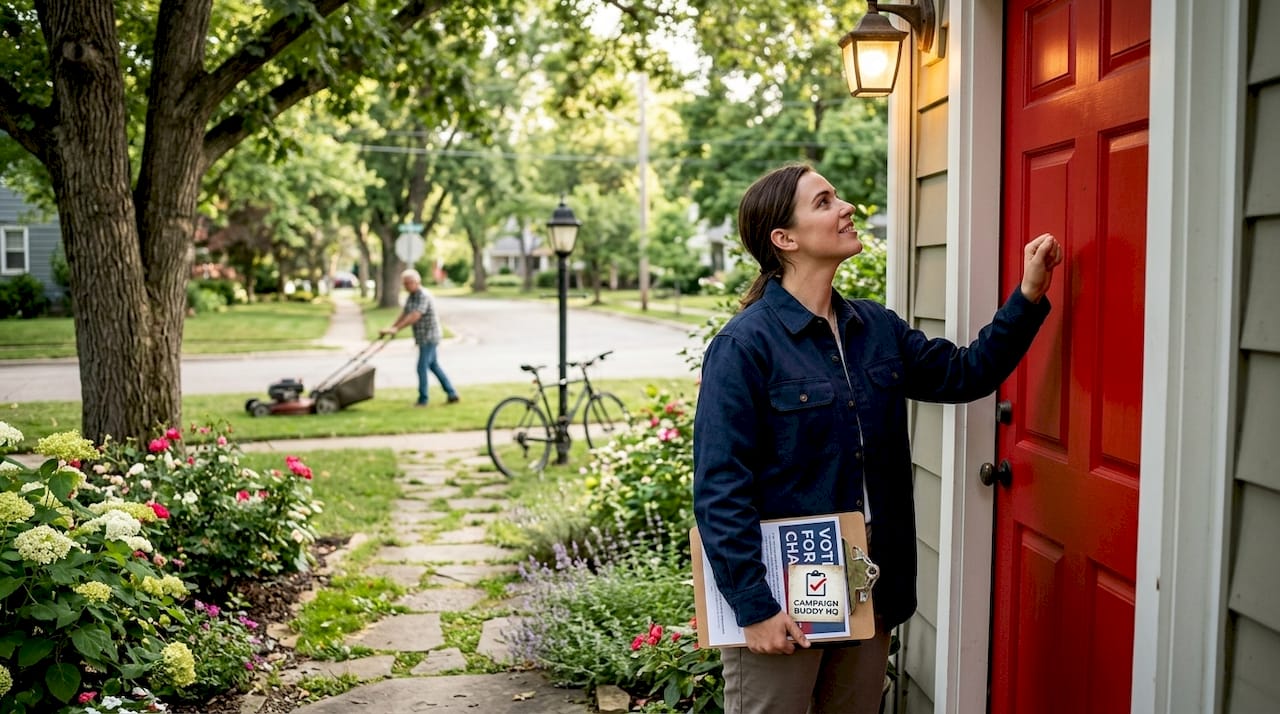
Here's a practical snapshot of what optimized data use looks like across different outreach types:
| Outreach type | Optimal timing | Expected engagement rate | Notes |
|---|---|---|---|
| Door-to-door canvassing | Weekends, 10am to 1pm | 5 to 8% answer | Preannounce via text |
| Phone banking | Weekdays, 5pm to 8pm | 8 to 12% contact | Avoid robocalls |
| SMS texting | Weekdays, midday | 20 to 35% open rate | Personalized beats mass |
| Email outreach | Tuesdays and Thursdays | 15 to 25% open rate | Subject line is everything |
| Social video content | Evenings and weekends | Varies by platform | Short-form performs best |
To track impactful campaign metrics that actually move the needle, build your dashboard around commitment quality, not just contact volume. A voter who agrees to volunteer is worth more than 50 unanswered doors. Your data system should track these distinctions.
Here's a simple four-step process for smarter data integration:
- Unify your data sources. Field contact reports, digital ad results, and donor records should feed into one shared dashboard, not three separate spreadsheets.
- Segment your voter universe by engagement history. Voters who've responded in past cycles are your highest-value contacts. Prioritize them.
- Track commitment depth, not just contact. Record whether a voter pledged to vote, agreed to volunteer, or requested a yard sign. These are actionable signals.
- Review weekly and adjust. Real-time feedback loops allow you to shift resources toward what's working before you've burned through your volunteer hours.
Also, understand that campaign data drives results not because of the data itself, but because of the decisions you make from it.
Pro Tip: Layer your outreach engagements. A voter who receives a text, then a door knock, then a personal follow-up call from someone they know is three times more likely to turn out than a voter who received one cold contact. Build sequences, not just single-touch events.
Targeting, voter universe, and voter turnout: Evidence-driven outreach
Armed with stronger data infrastructure, the next strategic question is: who do you actually talk to, and what do you say?
Under-targeting your voter universe is one of the most common and costly mistakes a campaign can make. Many progressive campaigns in competitive districts try to persuade too many low-propensity or unfavorable voters and end up neglecting their base. That's a resource drain with a weak return.
The evidence here is direct and a little uncomfortable. Progressive nominees underperform moderates by 2 to 4 percentage points in swing districts rated D+3 or lower. That's not a small gap in a close race. At the same time, there is no statistically meaningful general election penalty for progressive nominees running in safe Democratic districts. They can and do win those seats while running on bold economic platforms.
This points to a targeting strategy that is genuinely different depending on where your district sits on the partisan spectrum. Here's what that looks like in practice:
- Swing districts: Prioritize persuasion of soft Republicans and true independents. Avoid heavy ideological framing. Lead with economic kitchen-table issues and local concerns.
- Safe Democratic districts: Go deep into your base. Drive turnout among infrequent voters. Use bold economic and healthcare messaging to generate enthusiasm.
- Mixed precincts: Layer your messaging. Start with shared local values, then build toward broader policy themes once a relationship is established.
Turnout projections for 2026 are also worth anchoring your planning around. Midterm turnout is forecast at 47 to 52%, with a central projection of 49%. If conditions hold, this could match or approach the exceptional 2018 midterm levels. That kind of turnout environment rewards campaigns that have built genuine organizing infrastructure well before election season.
"Progressives succeed in safe seats and can push bold economic policies to drive turnout. The strategy changes entirely based on district context. One-size-fits-all messaging is a recipe for underperformance."
Your campaign outreach guide should map voter universe segments to specific outreach channels and message themes. A high-propensity base voter should get a very different communication than a low-propensity persuadable. The targeting infrastructure you build now determines whether your GOTV push in October actually lands.
Clear messaging on wallet issues, healthcare costs, and local control consistently outperforms abstract policy arguments in driving both persuasion and turnout. Voters in 2026, regardless of ideology, are responding to tangible, personal stakes.
Grassroots outreach and fundraising: Tools, timing, and volunteer motivation
With targeting locked and turnout drivers mapped, the next question is capacity. Who's doing the work, and how do you fund it?
Volunteer conditions in 2026 are well-documented. Progressive volunteers are motivated but they have requirements: operational clarity, data that is respected and not misused, a campaign that genuinely focuses on local community needs, and leadership that stays humble and listens. Campaigns that project arrogance or disorganization will hemorrhage volunteers at exactly the wrong moment.
On the fundraising side, the tactics have shifted significantly. Early investment is critical. AI tools are now being deployed to reengage lapsed donors with personalized messages. SMS outperforms email for small-dollar fundraising. And personal candidate stories, not policy talking points, generate the highest conversion rates in digital fundraising.
Here's a sequential grassroots outreach and fundraising timeline that has been shown to work:
- Winter 2025 to spring 2026: Launch your donor reengage campaign. Use AI-driven personalization to reconnect with past donors. Set up your CRM and data infrastructure before the busy season.
- Spring 2026: Begin door-to-door canvassing in your highest-priority precincts. Host community listening events. Establish your volunteer base with clear onboarding and training.
- Summer 2026: Layer in digital outreach and SMS fundraising campaigns. Run A/B tests on message themes and donation ask amounts.
- Early fall 2026: Shift into GOTV mode. Increase canvassing frequency, focus exclusively on high-propensity and committed voters, and intensify volunteer recognition efforts.
- Final four weeks: Execute your full layered contact plan. Every committed voter gets at least three touches across different channels.
Campaign planning resources recommend budgeting for a 10 to 20% spend increase each cycle, with early investment in field infrastructure rather than late-cycle advertising blitzes. The campaigns that wait until October to start spending heavily are competing for attention in the noisiest, most expensive media environment of the cycle.
Here are the key volunteer motivation levers you should build into your operation:
- Clarity over inspiration. Volunteers want to know exactly what to do on any given day. Clear shifts, clear goals, and clear feedback matter more than rousing speeches.
- Data transparency. Share progress metrics openly with volunteers. When they can see the impact they're making, they show up more consistently.
- Local relevance. Connect every outreach task to a local issue your volunteers personally care about.
- Humble leadership. Volunteers disengage fast when they feel like just a body in a system. Leadership that listens and adjusts builds lasting commitment.
Pro Tip: Prioritize early investment over last-minute surges. A volunteer who has been through your training program and run three shifts by August is infinitely more valuable in October than a new recruit who shows up the week before the election. Build your volunteer motivation strategies around consistency and long-term engagement, not recruitment spikes.
Effective goal setting for grassroots campaigns also means building in milestone checkpoints. Weekly goals for donor contacts, volunteer hours logged, and community events hosted keep the campaign's momentum visible and trackable.
Our take: What 2026 campaign planners must prioritize for true impact
Here's the uncomfortable truth most campaign strategy articles skip: operational competence is a more powerful differentiator than any single tactic or message.
The campaigns that win in 2026 won't necessarily have the flashiest digital ads or the most aggressive canvassing numbers. They'll be the ones where the field director knows exactly what data the digital team is seeing, and vice versa. Where volunteers receive a clear assignment on Monday and an honest debrief by Friday. Where community members actually trust the organizers knocking their doors because those organizers are from the neighborhood, not parachuted in from a different city.
Silo-breaking is the real competitive advantage. Not just adopting new digital tools or upgrading your CRM. The structural change of having your digital, field, and coalition teams share data and decision-making authority is what separates a functioning operation from a fragmented one.
Most campaigns also make the mistake of doubling down on outrage or ideological purity as a primary mobilization strategy. That might work for small-dollar fundraising emails. It rarely builds the kind of deep volunteer commitment you need to sustain a six-month organizing operation. Community-driven, layered outreach, where people feel genuinely heard and locally connected, is what actually powers volunteer retention.
The hard-won lesson from the last several cycles is that relationships create lasting organizing networks. Election-day turnout is the output. The relationship infrastructure you build between now and November is the input. Track campaign metric insights throughout the cycle, but always remember that the metrics are downstream of the relationships. Get those right first.
Ready to transform your campaign planning?
Applying these strategies at scale requires more than good intentions. You need systems that keep your team organized, your data unified, and your outreach consistent day after day.
Campaign Buddy HQ was built for exactly this kind of work. Whether you're running a state legislative race or a county-level GOTV campaign, the platform gives your team the tools to plan daily outreach, log every door knock, call, and text, and track progress toward real campaign goals. You can start with campaign planning checklists that reflect the 2026 organizing framework, then build your full operation inside the Campaign Buddy HQ platform without needing a technical background or a large staff. Try it free for seven days with no credit card required.
Frequently asked questions
What is the biggest change in campaign planning for 2026?
The DNC's new framework shifts the focus from raw outreach volume to relationship-driven organizing, breaking down departmental silos and integrating digital, field, and coalition teams into one unified operation with layered personal outreach at its core.
How should progressive campaigns target voters in swing vs. safe districts?
Progressive nominees underperform moderates by 2 to 4 points in swing districts, so persuasion messaging and moderate framing work better there. In safe Democratic districts, progressives can drive turnout aggressively with bold economic and healthcare policies without a general election penalty.
What are effective grassroots fundraising strategies for 2026?
The most effective approach is to invest early, reengage inactive donors using AI-driven personalization, lead with personal candidate stories over policy, and prioritize SMS as your highest-converting fundraising channel.
How can campaigns motivate and retain volunteers in 2026?
Progressive volunteers require clear operational structure, data transparency, local relevance in their assignments, and humble leadership that listens and adapts. Retention follows from consistency, not just recruitment.