

Running a progressive campaign is equal parts passion and precision. You might have a compelling vision, strong values, and real community support, but without a structured plan, even the most dedicated teams stall out, burn through resources, and fail to reach the voters who matter most. The gap between a great candidate and a winning campaign almost always comes down to execution. This guide walks you through every major planning step, from mapping your voter universe to executing a Get-Out-The-Vote (GOTV) push, with concrete examples and data to help your campaign move from inspiration to victory.
Table of Contents
- Understand your campaign universe and set goals
- Build your team and organize resources
- Craft your messaging and choose outreach channels
- Execute your outreach: Field, digital, and GOTV strategies
- Why personalization beats volume, and what most campaigns miss
- Take your campaign plan to the next level
- Frequently asked questions
Key Takeaways
| Point | Details |
|---|---|
| Map your voter universe | Identify base, persuadable, and low-propensity segments to target outreaches efficiently. |
| Invest in onboarding | Quality team onboarding drives stronger retention and more impactful outreach results. |
| Personalize your message | Relational, authentic conversations yield higher conversions and voter engagement than scripted messaging. |
| Use data to adapt | Monitor outcomes and adjust strategies using turnout data to maximize ROI. |
| Local teams outperform | Neighborhood-based organizing achieves higher contact rates and better engagement than mass approaches. |
Understand your campaign universe and set goals
To lay the foundation for an impactful campaign, start with precise goals and a clear understanding of your voter landscape.
Before you knock a single door or send one text, you need to know exactly who you're trying to reach and what you need from them. This is your voter universe. It breaks down into three key groups: base voters who already support progressive causes, persuadable voters who are movable on specific issues, and low-propensity voters who lean your way but rarely show up on Election Day.
Effective campaign goal setting starts with knowing which universe demands your attention at each point in the race. A Campaign Plan Example from Everytown illustrates how smart campaigns prioritize voter universes by starting with base turnout, then shifting to persuadables based on issue-specific targeting, and finally treating low-propensity voters as a genuine goldmine, especially when pivoting from persuasion to GOTV near Election Day.
Once you've defined your universe, set hard numerical targets. Vague goals like "talk to more voters" don't hold your team accountable. Instead, set targets like these:
| Outreach method | Goal | Estimated conversations |
|---|---|---|
| Door knocking | 10,000 doors | 2,500 conversations |
| Phone banking | 20,000 calls | 3,000 conversations |
| Text banking | 50,000 texts | 500 direct responses |
| Relational outreach | 1,000 personal contacts | 800 conversations |
Breaking goals into weekly milestones also helps you stay on track across different campaign phases, from early organizing through the final GOTV sprint.
Key outreach targets to define upfront:
- Total number of voters in your target universe
- Weekly and monthly door, call, and text goals
- Conversion rate benchmarks (conversations per contact attempt)
- Voter registration targets if your district has low registration rates
- Volunteer hours needed to meet those outreach totals
Pro Tip: Data-driven targeting isn't just efficient, it prevents your team from spending time on voters who were never going to move. Run a simple precinct-level analysis before you start. Knowing where persuadables and low-propensity voters cluster helps you prioritize turf and schedule your canvassing resources weeks in advance.
Build your team and organize resources
Once your goals and target universe are defined, assembling the right team ensures your outreach is effective and sustainable.
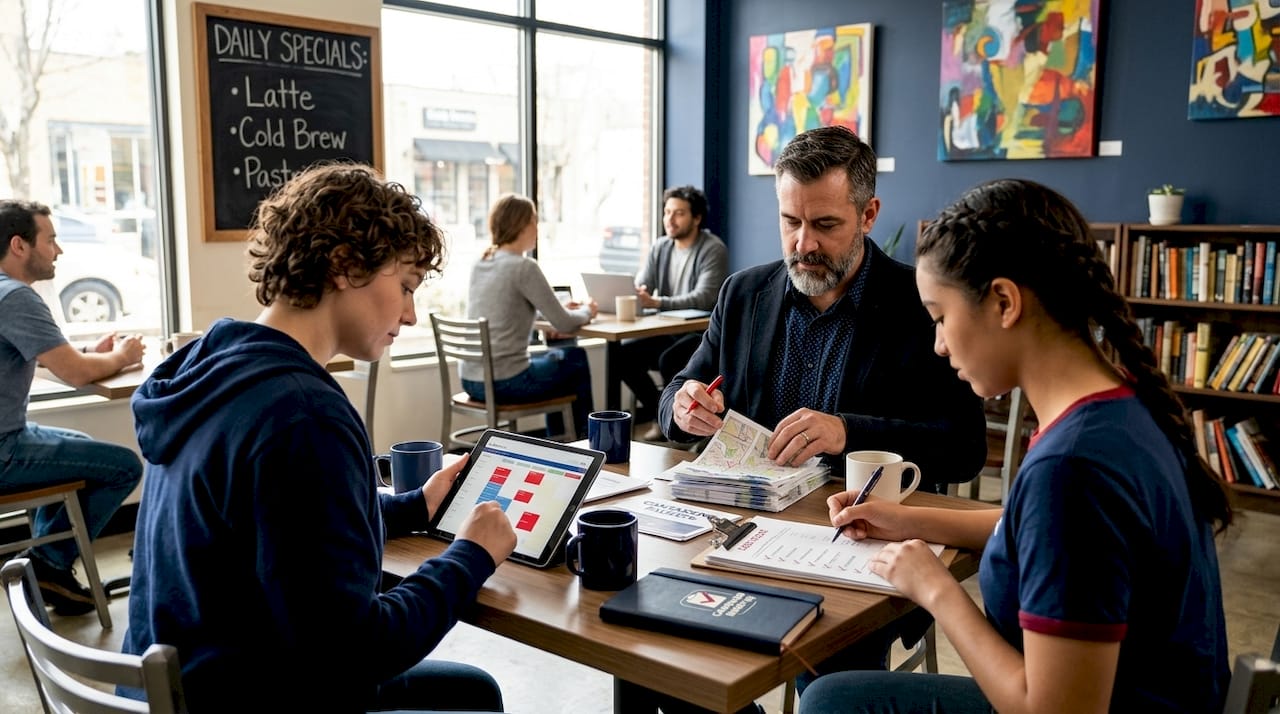
People power wins campaigns. But not all people power is created equal. There's a real difference between a paid organizer who owns a turf, a local volunteer who knows every neighbor on the block, and a digital organizer who runs your texting and email programs. Each plays a critical role, and knowing how to staff and structure your team affects everything that follows.
| Role | Strengths | Best use |
|---|---|---|
| Local volunteers | High trust, strong contact rates | Door knocking, relational outreach |
| Paid field staff | Consistency, accountability, scale | Managing turf, training volunteers |
| Digital organizers | Reach, speed, data tracking | Texts, email, online mobilization |
The DNC 2026 Organizing Playbook puts a sharp focus on what it calls an "Organizing Re-Model," a shift toward listen-first conversations, dismantling silos between digital and coalition teams, and prioritizing staff onboarding. Critically, 60% of staffers rated their 2024 onboarding as poor. That's not a minor issue. Poor onboarding leads to staff who don't know the tools, don't follow the message, and burn out faster. It kills momentum before it starts.
The Obama 2008 ground game remains one of the best-documented case studies in American political history. With 700 paid organizers and 2.2 million volunteers organized into neighborhood teams, the campaign achieved 2.2 million new voter registrations with high follow-through on turnout. Local organizers achieved 30 to 40 percent higher contact rates than mass phone efforts, and counties with physical campaign offices saw approximately 1 percent higher vote share. That adds up to a lot of votes.
Here's how to build your team from scratch:
- Map your roles first. Identify which positions you need before you hire or recruit. At minimum, you need a field director, a data manager, and lead volunteers in each priority precinct.
- Recruit from your base. Reach out to allied organizations, local unions, community groups, and past campaign volunteers before posting externally.
- Run a structured onboarding session. Cover the campaign's core message, target universes, outreach tools, and weekly reporting expectations. Don't assume people know this.
- Assign neighborhood captains. Matching volunteers to their own streets increases contact rates dramatically. People open the door for their neighbors.
- Create a weekly check-in rhythm. Short, consistent team calls or meetings keep people accountable and prevent drift. Celebrate wins publicly.
- Recognize and retain. Volunteer strategies that include personal thank-yous, milestone tracking, and team competitions dramatically reduce turnover.
Good campaign daily planning also keeps your team productive between big events. When volunteers know what they're doing each morning, fewer hours are wasted waiting for direction.
Pro Tip: Create neighborhood-based teams where volunteers canvass their own blocks and call their own contacts. The data consistently shows local organizers outperform strangers. It's also easier to retain volunteers who feel personal ownership over their turf.
Craft your messaging and choose outreach channels
With your team in place, it's time to fine-tune your campaign message and choose the most effective ways to reach voters.
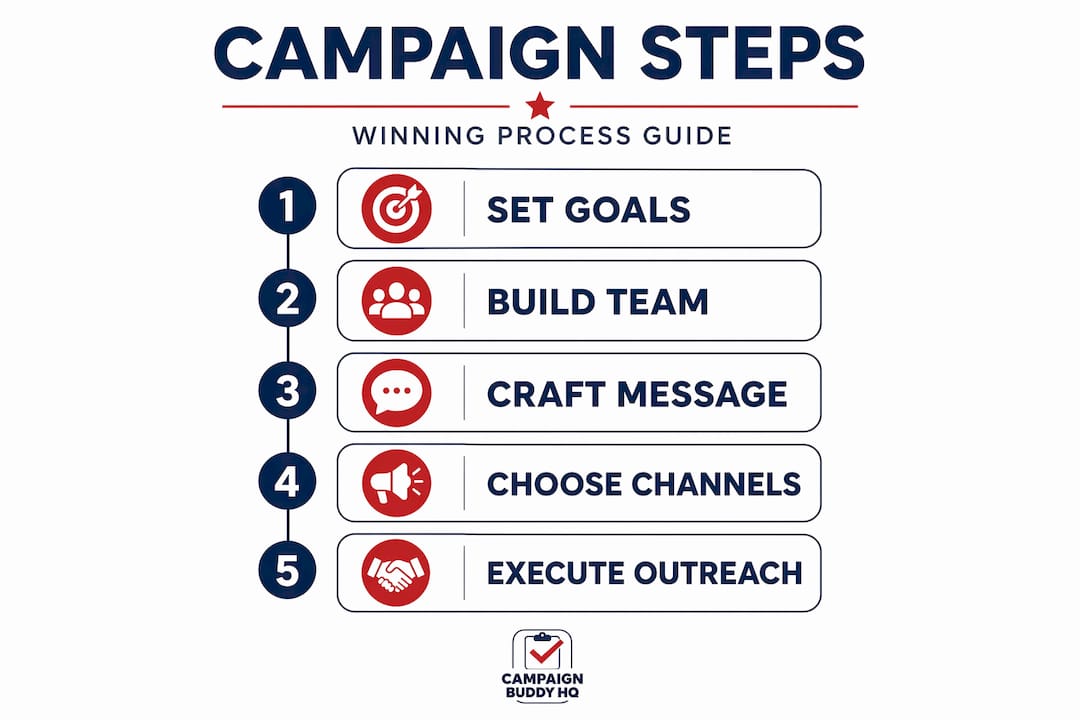
Messaging is where many progressive campaigns go off track. A common mistake is leading with policy details and hoping voters connect the dots. Strong campaign messaging works in reverse: start with values and lived experience, then connect those to the specific change you're fighting for. Voters don't respond to platforms; they respond to people and stories.
A solid messaging frame includes three elements. First, a clear statement of what's broken in your community. Second, a personal or local story that makes the problem real. Third, a specific, believable solution tied to your candidate or initiative.
Once your message is sharp, you need to choose which channels carry it. A Campaign Plan Example outlines how a structured field strategy with goals of 10,000 doors, 20,000 calls, and 50,000 texts can generate roughly 4,000 quality voter conversations when combined with persuasion targeting before shifting to GOTV outreach four weeks before Election Day.
Effective outreach channels to build into your plan:
- Field canvassing: The highest-impact method for both persuasion and turnout. Nothing replaces a face-to-face conversation.
- Phone banking: Efficient for volume, though contact rates are falling. Best used for soft supporters who need one more push.
- Text banking: Great for rapid mobilization, event reminders, and GOTV. Keep messages short and human.
- Direct mail: Still effective for older voters and high-information pieces. Use it strategically, not broadly.
- Relational organizing: Personal outreach from friends to friends. This is where the biggest returns live right now.
- Digital and social media: Essential for earned media, volunteer recruitment, and reinforcing your field message.
"Campaigns that modernize beyond traditional scripts, and integrate volunteer-led conversations with digital tools, see dramatically better results. Callbacks alone can triple contact rates compared to single-touch outreach efforts." — DNC 2026 Organizing Playbook
Use your campaign outreach guide to assign each channel a role in your plan and set weekly benchmarks. Your campaign checklists should reflect the specific tasks tied to each channel so nothing slips through.
Pro Tip: Train your volunteers to always follow up. One contact rarely moves a voter. Callbacks, second doors, and personal follow-up texts can triple your effective contact rate without adding people to your team.
Execute your outreach: Field, digital, and GOTV strategies
Every campaign's plan comes to life during outreach. Here's how to execute it effectively and measure your results.
Knowing your channels is one thing. Deploying them in the right sequence with the right targets is what actually drives turnout. Here's how the major outreach methods stack up based on what the research actually shows.
Door-to-door canvassing remains the gold standard for GOTV, generating 2.5 to 3.5 turnout points per low-propensity contact. Phone banking delivers 0.75 to 1.5 points. Text banking adds 0.5 to 1.5 points per contact. Mail contributes 0.2 to 0.5 points. Relational outreach, meaning a neighbor or friend reaching out personally, delivers 1.5 to 2 points. These are not small differences at scale.
What makes relational organizing especially powerful is how it outperforms all forms of impersonal digital contact. A relational organizing field test found that personal texts from known contacts increased voter turnout by 8.6 percentage points compared to a control group, outperforming peer-to-peer texting campaigns by a wide margin and delivering results across different demographic segments.
Use campaign data results to track which methods are converting in your specific district. What works in a dense urban precinct may differ from a rural or suburban turf.
Here's a sequential GOTV ramp-up plan for the final four weeks:
- Week 4 before Election Day: Shift all persuasion contacts to soft GOTV. Identify your confirmed supporters and flag unreached targets.
- Week 3 before Election Day: Launch relational texting program. Assign every campaign supporter a short list of personal contacts to reach out to directly.
- Week 2 before Election Day: Double canvassing shifts. Focus turf on low-propensity supporters who've been contacted at least once. Add mail drop for confirmed supporters.
- Final week: All hands on doors and phones. Text your entire supporter list twice. Prioritize any supporter who hasn't confirmed a voting plan.
- Election Day: Run a full door and phone operation from morning until polls close. Confirm rides, polling locations, and hours for any flagged supporter.
Managing a solid supporter database through this ramp-up phase is essential. Without accurate, up-to-date records, your team will waste contact attempts on already-confirmed voters or miss the unreached persuadables who could have moved.
Pro Tip: Track the conversion rate for every outreach method in your campaign, not just total contacts. Knowing that your neighborhood team converts 1 in 4 doors while your phone bank converts 1 in 12 calls tells you exactly where to put your resources in the final stretch.
Why personalization beats volume, and what most campaigns miss
Here's a take most campaign playbooks won't give you: the single biggest mistake progressive campaigns make isn't underinvesting in digital. It's overvaluing volume and undervaluing depth.
There's a persistent belief that the team with the most contacts wins. More texts. More doors. More calls. And yes, volume matters. But the Obama ground game data is instructive in a way that runs counter to modern instincts. Local organizers in neighborhood teams consistently outperformed mass phone operations, sometimes by 30 to 40 percent in contact rates. That wasn't because they worked harder. It was because voters actually picked up the phone and opened the door for someone they recognized.
The DNC's post-2024 review found that voter contact rates had dropped to a historical nadir of around 5 percent in some programs. That's not a staffing problem. That's a quality problem. When outreach is scripted, impersonal, and volume-driven, voters disengage.
The shift the most effective campaigns are making right now is toward listening-first conversations. Instead of delivering a message, organizers are being trained to ask questions and reflect back what they hear. This approach takes longer per contact. But the campaign momentum with data these conversations build is qualitatively different from what a mass text blast generates.
For progressive campaigns specifically, this matters more than it might for transactional politics. The voters you most need, those low-propensity, community-embedded, often skeptical voters, respond to trust. Trust is built through consistency, presence, and genuine listening. You can't automate that. What you can do is build a team structure that prioritizes it, train your volunteers to practice it, and track whether it's working.
The campaigns that win in 2026 won't be the ones that sent the most texts. They'll be the ones that built the deepest relationships in the precincts that mattered most.
Take your campaign plan to the next level
Now that you understand how to plan and execute an impactful campaign, the right tools make all the difference between a plan that stays on paper and one that delivers results on Election Day.
Campaign Buddy HQ is built specifically for progressive candidates and campaign managers who need to organize outreach, track voter contacts, and keep their team moving toward measurable goals. The platform supports daily and weekly planning, outreach logging across doors, calls, and texts, supporter tracking, and campaign phase management. Whether you're running a competitive statehouse race or a local ballot initiative, Campaign Buddy HQ gives you the structure to translate your plan into consistent daily action. Start your free 7-day trial today, no credit card required, and see how organized your campaign can actually be.
Frequently asked questions
What are the most effective campaign outreach methods for turnout?
Door-to-door canvassing and relational organizing are the top methods, with canvassing delivering 2.5 to 3.5 turnout points per low-propensity contact and relational outreach adding 1.5 to 2 points.
How soon should a campaign shift focus from persuasion to GOTV?
Four weeks before Election Day is the ideal point for transitioning from persuasion to Get-Out-The-Vote activities to maximize the impact of both phases.
Why is team onboarding so crucial for campaign success?
Poor onboarding leads directly to higher volunteer turnover and lower field performance. The DNC's 2024 survey found 60% of staff rated their onboarding as poor, signaling a major area for improvement in 2026.
How can campaign managers measure the impact of their outreach?
Track conversion rates and turnout changes for each method separately. Comparing contact-to-conversation rates by channel tells you exactly where to concentrate resources as Election Day approaches.
What's the benefit of local teams versus mass outreach?
Local neighborhood teams achieve 30 to 40 percent higher contact rates than impersonal mass outreach, and counties with active campaign offices have historically seen about 1 percent higher vote share.