

Most campaign managers assume that loading up a massive list of contacts automatically sets their outreach up for success. It doesn't. A bloated, poorly organized database is actually a liability, pulling your team toward noise instead of neighbors who can move the needle. The real edge comes from understanding exactly what data you have, what it means, and how to act on it systematically. This guide breaks down the essential structure of a campaign supporter database, explains what enriched data looks like in practice, and gives you a repeatable workflow to build and maintain a system that actually delivers results.
Table of Contents
- What is a campaign supporter database?
- Core data and enrichment: What matters most
- Quality vs. quantity: Nuances for progressive campaigns
- Practical workflow: Building and updating your database
- Our take: What most campaigns miss in supporter database strategy
- Connect with Campaign Buddy HQ for smarter outreach
- Frequently asked questions
Key Takeaways
| Point | Details |
|---|---|
| Focus on quality data | Prioritize merging and enrichment of supporter information rather than collecting more fields. |
| Leverage predictive scores | Use support scoring to target persuadable voters and improve outreach efficiency. |
| Match tools to needs | Choose a database that fits your campaign's workflow and avoid CRM overload. |
| Maintain regular updates | Update your database consistently to keep outreach data accurate and relevant. |
| Intentional strategy is key | Databases enable results only when paired with ongoing staff education and smart processes. |
What is a campaign supporter database?
A campaign supporter database is the central record-keeping system where your campaign stores, organizes, and accesses information about voters, volunteers, donors, and potential supporters. Think of it as the operational backbone of every door knock, phone call, and text message your team sends out.
At its most basic level, a supporter database holds contact information: names, phone numbers, addresses, and email addresses. But that's just the starting point. The real value comes when that basic contact list is layered with context. Who voted in the last three elections? Who donated to a similar candidate two cycles ago? Who lives in a rural precinct that requires a different outreach approach than a dense city block?
Voter registration records include name, address, date of birth, party affiliation where applicable, and voting history. Those records become truly useful when campaigns enrich them with demographics, consumer data, propensity scores, and interaction records like surveys, donations, and activist codes. That enrichment is what separates a raw list from an actionable database.
Here's a quick overview of the core fields most campaign databases include:
| Field type | Examples | Why it matters |
|---|---|---|
| Contact info | Name, phone, email, address | Basic outreach identification |
| Voting history | Election participation records | Indicates reliability and engagement level |
| Demographics | Age, income, education level | Helps with message targeting |
| Party and registration | Party affiliation, reg. status | Shapes persuasion vs. mobilization strategy |
| Campaign interactions | Survey responses, donation history | Shows level of engagement with your campaign |
| Propensity scores | Support, turnout, volunteer likelihood | Predicts future behavior for smarter targeting |
When your team is out tracking campaign activities, every interaction logged updates the database in real time. That constant feedback loop is what keeps the system relevant and actionable.
The key benefit of an organized supporter database is that it makes your team's decisions faster and more confident. Rather than asking "who should we call today?" you can ask "who are the 50 persuadable voters in this zip code who haven't heard from us yet?" That's a fundamentally different, and far more productive, question.
"A supporter database isn't just storage. It's the mechanism that connects your team's daily work to your campaign's big-picture goals." Real outreach is driving campaign results only when the data behind it is organized, actionable, and consistently maintained.
Core data and enrichment: What matters most
After grasping the basics, it's crucial to differentiate between standard and enriched supporter data. Standard data is what you receive when you pull a voter file from your state or county. Enriched data is what you build on top of it through additional sources, campaign interactions, and predictive modeling.
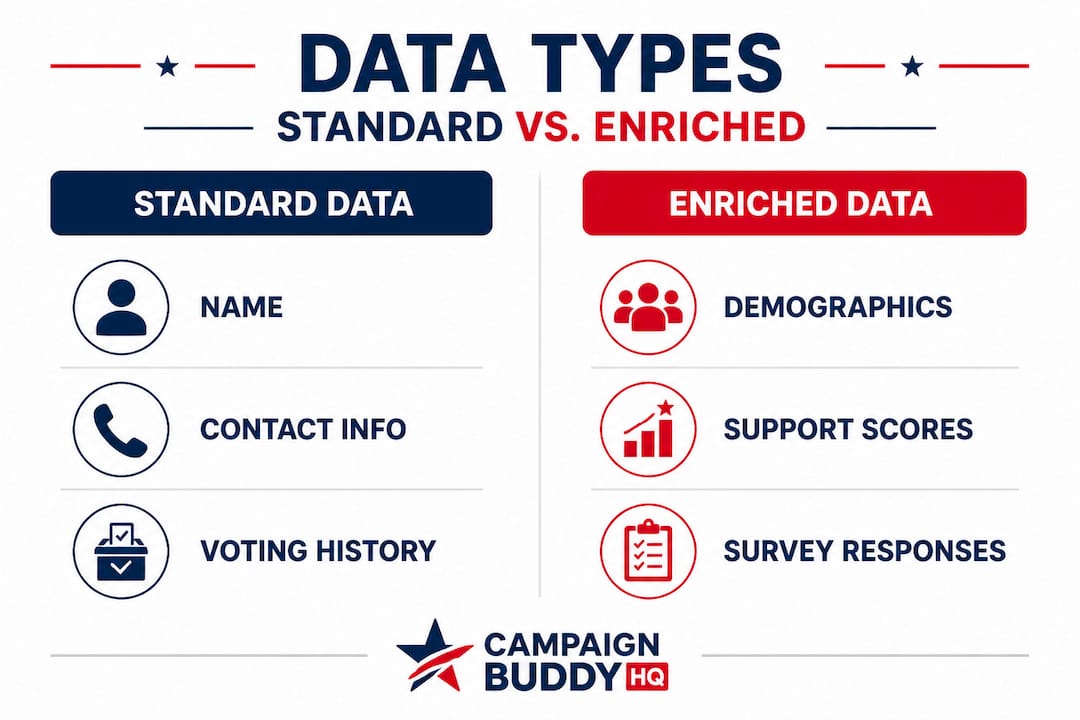
Standard voter file data gives you the "who." Enriched data gives you the "why" and the "what next." For example, knowing that a voter is registered as a Democrat tells you something. Knowing that the same voter has a high propensity score for environmental issues, donates to progressive causes, and opened your last two email newsletters tells you a lot more.
According to Political Analytics Data Structure, core data includes voter registration details like name, address, date of birth, party where applicable, and voting history. When enriched with demographics, consumer data, propensity scores, and campaign interactions such as surveys, donations, and activist codes, that raw data becomes a targeting engine.
Here's how standard and enriched data compare in terms of practical value:
| Data type | What you get | Outreach impact |
|---|---|---|
| Standard voter file | Name, address, party, voting history | Baseline contact list |
| Consumer data overlay | Purchase behavior, household income | More precise message matching |
| Demographic enrichment | Age range, education, household size | Segment outreach by life context |
| Propensity scores | Support likelihood, turnout probability | Prioritize who gets contacted first |
| Campaign interactions | Donations, surveys, volunteer sign-ups | Identify committed supporters and activists |
The fields that actually make targeting and outreach possible include:
- Voting history: Frequent voters are mobilization targets; infrequent voters may need extra persuasion and activation.
- Support score: Typically rated on a scale from 0 to 100, this tells your team how likely someone is to support your candidate.
- Issue flags: Tags based on survey responses or consumer data that signal which issues a voter cares most about.
- Geographic segment: Precinct or district-level grouping that allows for localized messaging.
- Contact preferences: Whether a voter is more responsive to doors, calls, or texts based on prior interactions.
Pro Tip: Don't chase every data enrichment option available. Start with voting history, support scores, and one or two issue-based segments. Build outward as your team learns to use the data you already have. More fields without more staff capacity to use them is just clutter.
Tracking campaign metrics for wins means knowing which enriched fields are actually informing your decisions and which are just taking up space. Regularly audit your fields to confirm your team is using them. If a column in your database never drives a decision, it's not an asset, it's overhead. Pairing good data hygiene with a strategy for building campaign momentum is what separates organized campaigns from reactive ones.
Quality vs. quantity: Nuances for progressive campaigns
With enriched fields in place, campaign success relies not just on the volume of data, but on using it wisely. This is where many progressive campaigns make a critical mistake. They accumulate massive databases, spend thousands on voter file access and data tools, and then struggle to act on any of it because the quality is inconsistent and the team doesn't know where to start.

Data quality over quantity is the expert consensus: focus on merging data sources effectively, enabling real-time sync, and using predictive scores to target persuadable supporters, those with a support score in the 40 to 70 range. Avoid CRM decision paralysis by matching your organization's specific needs to a platform's actual capabilities.
That 40 to 70 support score range is worth understanding in detail. Voters below 40 are likely to oppose your candidate regardless of outreach. Voters above 70 are already likely supporters and are better targets for mobilization and volunteer recruitment. The persuadable middle is where your outreach resources have the most impact. Spending time on confirmed opponents or certain supporters dilutes the effect of your field program.
Here's a practical approach to managing data quality over time:
- Start with a clean voter file: Pull your base from a verified state or county source. Check for duplicates, missing fields, and obviously outdated addresses before you begin any outreach.
- Establish a merge protocol: When you layer in consumer data or campaign interactions, define clear rules for which source takes priority when fields conflict.
- Flag unverified records: Use a simple tag or field to mark records that haven't been validated through direct contact. Treat unverified records as lower-confidence until confirmed.
- Run regular deduplication: Duplicate records are a common problem, especially when volunteers enter new contacts manually. Schedule a deduplication pass at least once per campaign phase.
- Sync in real time when possible: If your field team uses a canvassing app and your database doesn't update until someone manually exports a file, you're working with stale information.
Pro Tip: Real-time data synchronization doesn't require expensive enterprise software. Even a shared spreadsheet with version control and clear ownership rules can approximate live sync for small teams. The key is making sure that the person canvassing on Saturday isn't duplicating work someone else did on Thursday.
Campaign progress tracking tools help you spot gaps before they become problems. When you can see which precincts have low contact rates or which volunteers haven't logged any doors in a week, you can adjust strategy before it costs you the race. Maintaining campaign consistency across your field team starts with everyone working from the same clean data.
Practical workflow: Building and updating your database
Next, let's translate these principles into a clear, actionable workflow for your campaign team. Building a supporter database isn't a one-time setup task. It's an ongoing operational process that evolves with your campaign.
Here's a step-by-step framework to follow:
- Pull your base voter file: Request your voter file from the appropriate state or county authority. In most states, political campaigns have access to this data at low or no cost.
- Import into your campaign management system: Whether you're using a dedicated CRM or a spreadsheet-based system, get the voter file into a central location your entire team can access.
- Layer in enrichment data: Add demographic overlays, consumer data, or propensity scores from a data vendor. Map these fields carefully to ensure they align correctly with your existing records.
- Segment your database: Create initial segments based on support scores, geography, and voting history. Build separate lists for mobilization targets, persuasion targets, and volunteer prospects.
- Train your team on data entry standards: Every volunteer or staffer who enters data needs to follow the same format. Inconsistent data entry is one of the fastest ways to degrade database quality.
- Log every outreach interaction: Use your campaign outreach guide practices to record results after every door knock, call, or text. Update support scores and contact notes in real time.
- Run weekly data hygiene checks: Flag outdated addresses, merge duplicates, and review unverified records at least once a week during an active campaign.
Good database hygiene practices also include:
- Archiving records for supporters who have moved out of your district rather than deleting them, so you maintain a clean active list without losing historical data.
- Logging every survey response and attaching it to the individual record so future volunteers have context before making contact.
- Keeping a change log that records who updated a record and when, reducing errors and accountability gaps on large teams.
- Using campaign outreach checklists to ensure your team completes all data tasks before closing out a canvassing shift.
- Building a clear volunteer data entry protocol that you can review with volunteer strategies training sessions so new team members are productive from day one.
Core voter file fields include name, address, date of birth, party affiliation, and voting history, enriched by demographics, consumer data, propensity scores, and campaign interaction records like surveys, donations, and activist codes. Knowing exactly which fields your system tracks keeps your workflow focused and prevents data sprawl.
Our take: What most campaigns miss in supporter database strategy
Having mapped out daily workflows, it's worth considering a broader perspective on what really drives results with supporter databases. And it's not the technology. It's the people using it.
Most campaign managers we talk to are excited about finding the right CRM or the perfect data vendor. That enthusiasm makes sense. Good tools matter. But a sophisticated database running on a platform your field director barely understands is less valuable than a simpler system your whole team uses consistently every single day.
Over-engineered databases are actually a common failure mode for progressive campaigns. A field director who spends three hours a week trying to pull the right report is not spending those three hours having conversations with voters. The database is supposed to reduce friction, not create it. If your system requires a technical expert to extract basic contact lists, you've built a tool for analysts, not organizers.
The campaigns that see real data-driven wins share a common trait: their staff have internalized why the data matters, not just how to enter it. When a canvasser understands that logging a "lean support" response is what moves that voter into a follow-up call queue, they're not just doing data entry, they're participating in the campaign strategy. That understanding doesn't come from a training manual. It comes from campaign leadership explaining the logic behind the process.
The other thing campaigns consistently underestimate is the cost of skipping the review cycle. You don't build a great database once. You build it in weekly iterations, catching errors, adjusting segments, and retiring stale records. The campaigns that win aren't necessarily the ones with the best data on day one. They're the ones whose data is most accurate on election week.
Connect with Campaign Buddy HQ for smarter outreach
If you're ready to simplify and scale your supporter outreach, here's your next step.
Managing a campaign supporter database doesn't have to mean wrestling with spreadsheets or paying for software that requires a consultant to operate. Campaign Buddy HQ is built specifically for progressive campaigns and issue advocacy organizers who need an intuitive, practical system for tracking outreach, managing supporter records, and monitoring progress toward their goals.
With Campaign Buddy HQ, your team can log doors, calls, texts, and registrations in one place, access supporter records with clear interaction histories, and plan daily and weekly outreach with built-in workflows designed for real campaign conditions. Whether you're managing a city council race or a statewide issue campaign, the tools scale to your needs. Start organizing outreach efficiently with a free 7-day trial, no credit card required.
Frequently asked questions
What are the most important fields in a campaign supporter database?
Key fields include name, contact information, voting history, party affiliation, demographic details, survey responses, and donation history. Core voter data also includes date of birth, propensity scores, and activist codes that track campaign engagement over time.
How often should campaign databases be updated?
It's best practice to update supporter databases at least weekly during active campaign periods to maintain accuracy and responsiveness. During high-intensity phases like the final four weeks before Election Day, daily updates after each canvassing shift are strongly recommended.
Why is predictive scoring valuable in supporter databases?
Predictive scores help campaigns focus outreach on persuadable supporters, boosting efficiency and impact. Targeting persuadables with a 40 to 70 support score ensures your limited staff hours go toward voters who can actually move your numbers.
How can campaigns avoid decision paralysis when choosing a CRM?
Match the CRM's features to your organization's specific outreach needs and prioritize usability and integration with existing workflows. The best CRM choice is the one your team will actually use consistently, not the one with the longest feature list.