
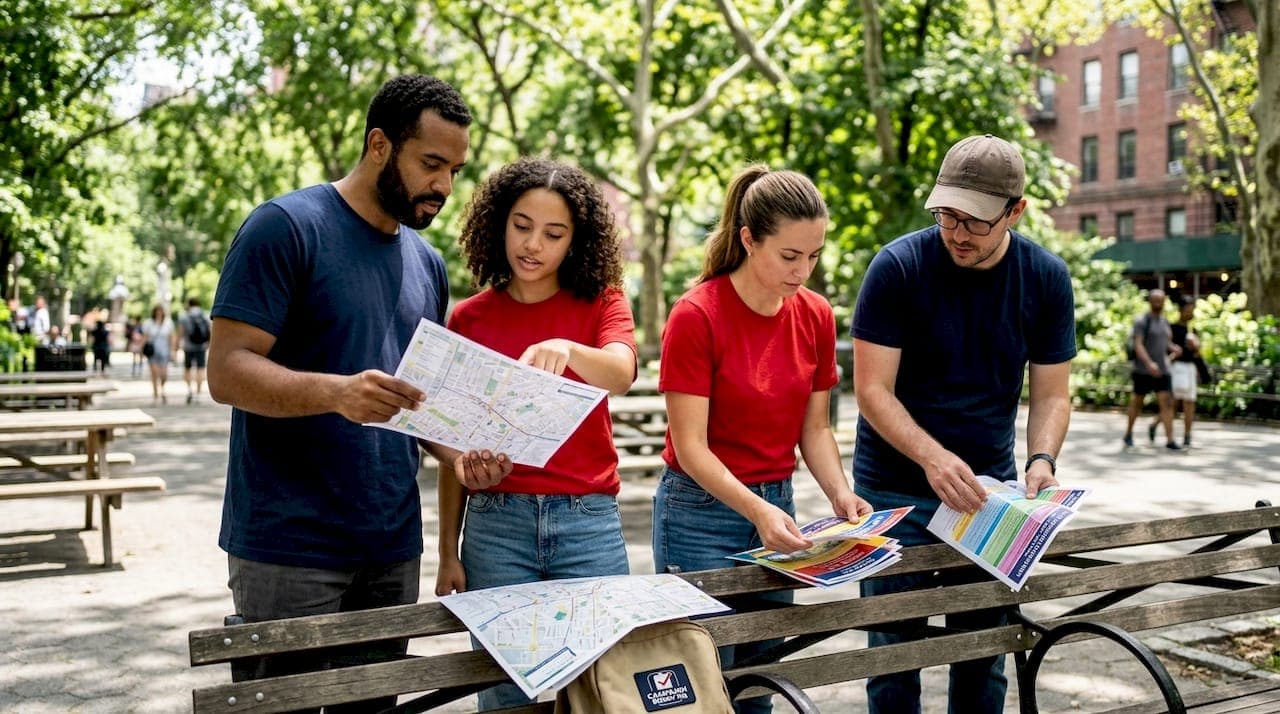
Door-to-door canvassing is defined as the structured practice of sending trained volunteers to targeted households to identify supporters, persuade undecided voters, and drive turnout through direct, face-to-face conversation. This step by step canvassing guide covers every phase of that process, from territory mapping to follow-up workflows, so your team wastes zero time and maximizes every door. Face-to-face canvassing lifts voter turnout by 7 to 10 percentage points compared to phone or digital outreach. That gap is not marginal. It is the difference between winning and losing a close race.
What does a step by step canvassing guide actually cover?
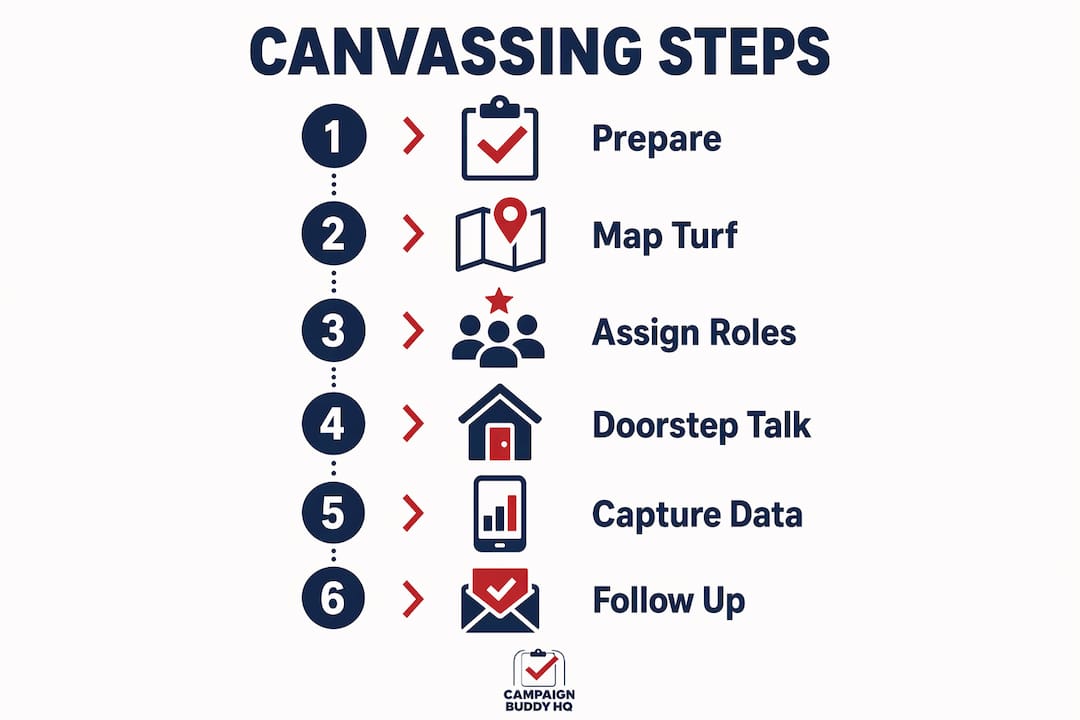
Canvassing, in the political context, is also called "blockwalking" or "door-to-door outreach," and the industry standard term for the full process is voter contact canvassing. A structured canvassing workflow has four distinct phases: preparation, doorstep execution, data capture, and follow-up. Most campaigns fail not at the door but in the phases before and after it. Skipping territory prep means your volunteers walk streets full of non-targets. Skipping data capture means every conversation disappears the moment the canvasser moves on.
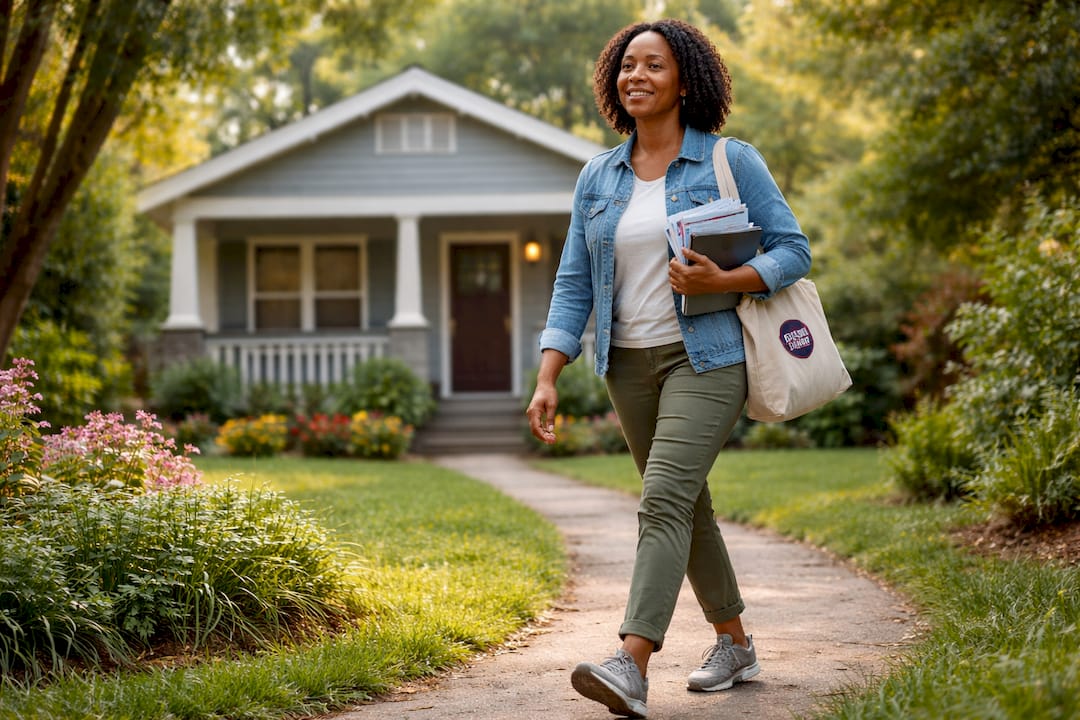
Two distinct canvassing approaches define the field: blockwalking, which prioritizes maximum coverage and initial voter identification, and deep canvassing, which uses longer empathetic conversations to persuade and build trust. Knowing which approach fits your current campaign phase is the first strategic decision you make. Early in a campaign, blockwalking builds your voter file. Closer to election day, deep canvassing converts soft supporters into confirmed votes.
How to prepare your canvassing plan before hitting the doors
Preparation separates campaigns that hit 80 doors per volunteer per day from those that hit 30. The work you do before a single knock determines your contact rate, your data quality, and your volunteers' confidence.
Mapping and segmenting your turf
Start with your voter file. Filter by party registration, voting history, and geography to create targeted lists. Prioritize low-propensity voters in your coalition who have voted in at least two of the last four elections. These are persuadable and reachable. Avoid spending time on strong opposition households or non-voters with no registration history.
Divide your territory into manageable "turfs," each covering roughly 50 to 80 doors per volunteer per shift. Use a campaign outreach guide to structure your turf assignments around natural geographic boundaries like blocks, apartment complexes, or subdivisions. Compact turfs reduce walking time and increase doors knocked.
| Preparation Task | Why It Matters |
|---|---|
| Filter voter file by target profile | Focuses effort on persuadable and low-propensity supporters |
| Assign compact turf boundaries | Reduces transit time and increases doors per hour |
| Set team roles before launch | Prevents confusion and keeps coverage consistent |
| Brief volunteers on local issues | Improves conversation quality and voter trust |
Setting roles, timing, and dress code
Assign a team lead for every group of three to five canvassers. That person handles real-time troubleshooting, collects data at the end of the shift, and communicates back to HQ. The best canvassing windows are weekday evenings from 5:30 to 8:00 p.m. and Saturday mornings from 10:00 a.m. to 1:00 p.m. These windows catch residents at home without interrupting dinner or weekend plans.
Dress matters more than most campaigns admit. Wear your campaign t-shirt or a clean, neutral outfit. Avoid anything that reads as aggressive or overly formal. Voters open doors faster when the person on the other side looks approachable and non-threatening.
Pro Tip: Print a one-page neighborhood brief for each turf that includes the top two local issues, the candidate's position on each, and three common objections with short responses. Volunteers who walk in knowing the neighborhood talk like neighbors, not strangers.
How to run effective doorstep conversations
The doorstep is where campaigns are won or lost in real time. The first 10 seconds at the door determine about 70% of outcomes. Stepping back two feet after knocking increases door-open rates by 10 to 15%. That single physical adjustment signals respect for personal space and dramatically changes how voters perceive you before you say a word.
Opening lines that work
Skip the formal introduction. Lead with the voter's name and a local reference. "Hi, Maria, I'm with the campaign to elect [Candidate Name] and I wanted to talk with neighbors in this area about the school funding vote in November" outperforms "Hi, I'm a volunteer and I'm here to talk about the election" every time. Specificity signals that you are not reading from a generic script.
Scripts should function as adaptable conversation frameworks, not lines to recite. Train your volunteers to listen for cues and respond naturally. If a voter mentions their property taxes in the first sentence, pivot to your candidate's tax position immediately. Rigid scripts make canvassers sound robotic and voters disengage within 30 seconds.
Qualifying early to protect your time
Good qualifying questions early in conversations save time and target effort where it matters, reducing wasted pitches to household members who cannot vote or who are firmly opposed. A simple "Are you the registered voter at this address?" takes five seconds and tells you whether to continue the full conversation or leave a door hanger and move on.
Here is a proven five-step doorstep sequence:
- Knock and step back. Give the voter physical space before the door opens.
- Open with name and local reference. Personalize the first sentence immediately.
- State your purpose in one sentence. Be direct about why you are there.
- Ask one qualifying question. Confirm you are speaking with the right person.
- Listen before you pitch. Ask what issues matter most to them before delivering your message.
Pro Tip: If a voter says "I'm not interested," respond with "Totally understand. Can I just leave you this one-pager?" You stay non-confrontational, leave a touchpoint, and log the interaction as a soft contact for follow-up.
How to capture data and follow up after every door
Data capture is the most neglected part of the door-to-door canvassing workflow. Campaigns that log every interaction, including no-answer visits, build a living voter file that gets sharper with every shift. Campaigns that skip logging are running the same blind outreach every week.
Digital canvassing apps with route planning, real-time data capture, and dashboards improve team coordination and performance tracking significantly. Tools like these let canvassers log support levels, issue priorities, and follow-up flags from their phones while standing at the door. That data feeds directly into your targeting model for the next round of outreach.
A structured 3-pass system that works every door, including no-answer doors, leaves leaflets, logs visits, and schedules follow-ups for missed contacts improves engagement dramatically. On the first pass, you knock and attempt a conversation. On the second pass, you leave a targeted door hanger if there is no answer. On the third pass, you attempt a call or text follow-up within 48 hours.
Building a follow-up workflow that converts
Personalized follow-up that references voter concerns raised at the door is far more effective than generic outreach for converting support into action. If a voter mentioned childcare costs, your follow-up text should reference childcare costs, not a generic "vote on November 5th" message.
Your follow-up plan should include:
- Day 1 after contact: Log support level and issue flags in your voter file.
- Day 3: Send a personalized text or email referencing the conversation topic.
- Day 7: Attempt a second door visit or phone call for undecided voters.
- Two weeks before election day: Final GOTV contact targeting all soft supporters.
Every interaction, including a slammed door, is usable data that guides future strategy and prevents wasted resources. A slammed door tells you to deprioritize that household. A long conversation with an undecided voter tells you to invest more contact attempts there.
Common canvassing challenges and how to solve them
Even the best-prepared canvassers hit walls. The difference between a productive shift and a demoralizing one is knowing how to handle the predictable obstacles before they happen.
Non-responsive doors are the most common challenge. Expect 40 to 60% of doors to go unanswered on any given shift. The solution is systematic: leave a targeted door hanger, log the visit with a timestamp, and flag the address for a follow-up attempt at a different time of day. Never skip logging a no-answer. It is still a data point.
Hostile voters require a calm, short exit. Train volunteers to say "I appreciate your time" and disengage within 10 seconds. Arguing never converts a hostile voter and wastes time that could go to three more doors. Check out these volunteer management strategies for training your team to handle difficult interactions without losing confidence.
Safety protocols include canvassing in pairs, sharing plans with HQ, training on defusing difficult interactions, and only carrying essentials to stay mobile. Pair newer volunteers with experienced ones for the first two shifts. Morale drops fast when someone feels unsafe or unprepared.
Pro Tip: Run a 15-minute debrief at the end of every shift. Ask volunteers what objections they heard most often. That feedback updates your script in real time and keeps the team feeling heard and invested in the outcome.
Key takeaways
Effective voter contact canvassing requires preparation, structured doorstep execution, real-time data capture, and personalized follow-up working together as one continuous workflow.
| Point | Details |
|---|---|
| Preparation drives contact rates | Map turf, filter voter files, and assign roles before any doors are knocked. |
| First 10 seconds decide outcomes | Step back after knocking and open with the voter's name and a local reference. |
| Qualify early to protect time | Confirm you are speaking with the registered voter before delivering your full message. |
| Log every door, including no-answers | Systematic data capture turns every shift into a sharper targeting tool for the next one. |
| Personalize all follow-up | Reference specific voter concerns from the doorstep conversation to maximize conversion rates. |
What I've learned after watching hundreds of canvassing shifts
The campaigns I've seen struggle most are not the ones with the smallest budgets. They are the ones that treat canvassing as a volume game and ignore the quality side entirely. Knocking 200 doors with a rigid script and zero data capture is less effective than knocking 80 doors with a conversational framework, real-time logging, and a follow-up plan ready to go.
The other lesson that took me a while to fully absorb: volunteer morale is a canvassing metric. A burned-out volunteer who dreads the next shift knocks fewer doors, has shorter conversations, and logs data sloppily. Investing 15 minutes in a pre-shift briefing and a post-shift debrief pays back in better performance and lower dropout rates. The 2026 outreach trends confirm that campaigns prioritizing volunteer experience alongside voter contact see measurably better results.
The most underrated canvassing technique is also the simplest: silence. After you ask a voter what issues matter most to them, stop talking. Let them fill the space. The information you get in those 10 seconds shapes the entire conversation and makes your follow-up far more targeted than any generic script ever could.
— Billy
How Campaignbuddyhq supports your canvassing workflow
Campaignbuddyhq is built specifically for campaigns running the kind of structured, data-driven canvassing this guide describes. The platform handles territory mapping, daily outreach planning, and real-time door logging in one place, so your team spends time at doors instead of managing spreadsheets. Volunteer coordinators can assign turfs, track progress by shift, and flag follow-up priorities without chasing down paper walk sheets. If you are running a grassroots advocacy campaign or a local electoral effort, the free 7-day trial at Campaign Buddy HQ requires no credit card and gives your team a full look at what organized canvassing actually feels like.
FAQ
What is the most effective canvassing method for voter turnout?
Face-to-face door-to-door canvassing is the most effective method, lifting voter turnout by 7 to 10 percentage points compared to phone or digital outreach. No other single tactic produces a comparable per-contact impact.
How many doors should one canvasser cover per shift?
A well-prepared canvasser working a compact turf can cover 50 to 80 doors in a three to four hour shift. Tight turf boundaries and a filtered voter list are the two biggest factors that determine that number.
What should canvassers do when no one answers the door?
Leave a targeted door hanger, log the visit with a timestamp and "no answer" status, and schedule a follow-up attempt at a different time of day. A 3-pass system that works every door systematically improves overall engagement rates.
How do you handle voter objections at the door?
Treat objections as conversation cues, not obstacles. Acknowledge the concern, connect it to your candidate's position in one sentence, and ask a follow-up question. Volunteers who listen and respond naturally convert far more undecided voters than those reciting scripted rebuttals.
What data should canvassers log after each door?
Log support level (strong support, soft support, undecided, soft opposition), the top issue the voter mentioned, whether the voter was home, and any follow-up flags. Every data point, including a no-answer, sharpens your targeting for the next round of outreach.