

Launching a political or issue-advocacy campaign comes down to five moves: build a written plan, set a vote goal and backward timeline, staff your core team, lock in finance and tech, and start field operations. Start the 9 to 12 month planning window recommended by the National Democratic Institute, aim for an effective benchmark of doors knocked per volunteer per shift, and run daily operations through a hub like Campaign Buddy HQ.
In the next 72 hours, do two things:
- Write a one-page vision memo covering your win number, message, and top three priorities.
- Open a campaign bank account and set up a shared workspace so nothing lives only in your head.
Key Takeaways
Campaigns succeed when a written, backward-planned timeline gets paired with daily outreach logging and weekly KPI reviews, not when the plan exists only as a memory.
| Point | Details |
|---|---|
| Start 9 to 12 months out | Work backward from Election Day and assign owners to every milestone. |
| Build seven plan elements | Vote goal, universe, message, timeline, budget, communications, and voter contact all need owners and KPIs. |
| Finish 30-day setup fast | Register the campaign, hire core staff, and run a test shift within the first month. |
| Log every contact the same way | Capture date, method, result, and next action for every door, call, and text. |
| Use Campaign Buddy HQ as your hub | Run daily planning and outreach logging in one workspace, starting with a 7-day free trial. |
Table of Contents
- What Is the Right Timeline for Launching a Campaign?
- What Are the Core Elements of a Campaign Plan?
- What Should You Do in Your First 30 Days?
- How Do You Track Doors, Calls, Texts, and Registrations?
- What Tools Do You Need to Launch and Track Outreach?
- What Compliance Checks Matter Before You Launch?
- Why Documentation Beats Memory in a Campaign
- Get Your Campaign Running in Campaign Buddy HQ
- Frequently Asked Questions
- Sources
What Is the Right Timeline for Launching a Campaign?
Work backward from Election Day. Pick your vote goal, then map every fundraising push, volunteer recruitment wave, and door-knocking surge as a countdown plan instead of an ad hoc list. The Campaign Skills Handbook frames this as starting from the finish line by assigning owners and resources to each milestone before you assign a date.
A backward-planned timeline usually breaks into six stretches:
| Timeframe | Objective | Key activities |
|---|---|---|
| 9 to 12 months out | Foundation | Vote goal set, universe build, treasurer named, core team hired |
| 9 to 12 months out | Message testing | Draft narrative, test with small groups, build digital presence |
| — | Volunteer recruitment | Recruit team leads, run first training shifts, open a volunteer ladder |
| 2 to 4 months out | Field launch | Daily door and phone shifts begin, texting program starts |
| — | GOTV ramp | Increase shift frequency, layer in mail and digital ads |
| Election week | Final push | Super Saturday shifts, poll coverage, last data pull |
Each stretch should tie to a specific number: how many doors, how many dollars, how many volunteers on the roster. Vague milestones ("build momentum") are how timelines quietly fall apart.
Pro Tip: Protect the candidate's calendar early. Block fundraising call time and door shifts on a weekly sprint board before anything else claims those hours. Once a week fills with reactive scheduling, it never gets that structure back.
What Are the Core Elements of a Campaign Plan?
A campaign plan is a written roadmap, not a slide deck you show once and shelve. The NDI handbook lists seven components: vote goal, universe segmentation, message and narrative, timeline with owners, budget and fundraising, communications plan, and voter contact strategy. Every one of them needs an owner, a deadline, and a number attached, or it stays aspirational.
A simple ownership matrix keeps this honest:
| Plan element | Owner | Backup | KPI |
|---|---|---|---|
| Vote goal & universe | Manager | Candidate | Contacts needed vs. logged |
| Message & narrative | Comms lead | Candidate | Message test results |
| Budget & fundraising | Treasurer | Manager | Cash on hand weekly |
| Voter contact plan | Field director | Deputy | Doors/calls/texts per week |
Conversion math, in plain terms: if your vote goal is 5,000 votes and you expect roughly one in three contacted voters to commit, you need around 15,000 solid contacts before Election Day. That single number should drive your weekly door and call targets, not the other way around.
Maintain three living documents: the vision memo, a weekly sprint board, and a budget tracker. If those three exist and get updated every week, most of the plan takes care of itself.
What Should You Do in Your First 30 Days?
The first month is about converting intention into a working operation. Break it into three stretches.
- Week 1: Write your one-page vision, open a campaign bank account, designate a treasurer, and register the campaign as your local election law requires. Set up a shared workspace, whether that is Campaign Buddy HQ or a comparable system, so the plan lives somewhere everyone can see it.
- Weeks 2 to 3: Recruit your core staff (field director, treasurer, comms lead at minimum), pull voter file access or build a target list, launch a basic website and social presence, and set up your first fundraising ask with a working receipts flow.
- By day 30: Lock in a 90-day timeline, set daily and weekly KPIs, run a volunteer onboarding session, and put on a test shift, either phone or door, to see what actually breaks.
Tech-wise, you need four things running by day 30: a CRM or supporter tracker, a dialer or texting tool, an outreach logging system, and one place where the plan itself lives. Skipping the logging piece is the most common early mistake. Teams knock doors for weeks with no consistent way to record who answered, and by month two nobody can say what the contact rate actually is.
How Do You Track Doors, Calls, Texts, and Registrations?
Every contact your team makes needs the same nine fields logged, every time: date, contact method, staff or volunteer name, voter ID, contact result (support, undecided, or opposed), follow-up ask, next action, vote intent, and registration status. Skip any of these and your weekly numbers stop meaning anything.

Productivity benchmarks give you something concrete to plan shifts around. Field organizing data from Huxley Strategies puts average door-knocking at 10 to 20 doors per volunteer-hour, while phone shifts run 50 to 70 dial attempts per hour with roughly one contact per 10 attempts. If your volunteers are knocking fewer than 10 doors an hour, that's usually a turf-mapping problem, not a motivation problem.
Weekly KPIs worth putting on a dashboard:
- Doors knocked per volunteer per shift
- Contact rate (people reached versus attempts made)
- Conversion to pledged support
- New voter registrations logged
- Follow-up completions from the prior week's undecideds
A basic shift structure runs briefing, shift, debrief, and data entry, in that order. Skipping debrief is how bad turf assignments and script problems go unnoticed for weeks. Review the dashboard every week, not just before big pushes, and adjust the next sprint's targets based on what the numbers actually show. Field work runs in phases, starting with identification and moving toward persuasion and GOTV, and your KPIs should shift with each phase rather than staying static all cycle.
What Tools Do You Need to Launch and Track Outreach?
Keep the stack small at launch. You need a campaign workspace and plan repository, an outreach logging tool that handles doors, calls, texts, and registrations in one place, a basic donor and payment system, a shared calendar, and a reporting dashboard. More tools than that usually means more login screens, not more organized volunteers.
Campaign Buddy HQ is built specifically to be that organizing hub. Daily and weekly planning, outreach logging, supporter tracking, and campaign phase management all live in one workspace designed with rural and low-density outreach in mind, not just dense urban turf.
Onboarding takes four steps:
- Create your campaign workspace.
- Import your supporter or target list.
- Set your vote goal and phase.
- Schedule your first volunteer shift.
Pro Tip: Give your treasurer read access to the reporting dashboard from day one, not just after the first compliance headache. Financial data and field data belong in the same weekly review.
What Compliance Checks Matter Before You Launch?
Check filing and financial reporting deadlines for your jurisdiction before you accept a single dollar, and register the campaign and treasurer where required. Four operational red flags derail launches more often than any legal technicality: undocumented expenditures, nobody owning fundraising compliance, weak data security on the voter file, and volunteer protocols that exist only verbally.
The fix for each is almost always ownership, not more paperwork. Assign one person to compliance, restrict voter file access to logged-in staff, and centralize receipts the same week you open your bank account.
Store compliance documents and outreach logs in the same shared workspace you use for daily planning. A campaign that can produce its receipts and its contact logs in the same afternoon is a campaign that survives an audit or a reporter's question without panic.
Why Documentation Beats Memory in a Campaign
A plan that lives only in the candidate's head falls apart the first time that person gets sick or a crisis eats a week. Documented timelines, budgets, and role assignments give volunteers and donors something to trust, and they let a team catch a slipping KPI before it becomes a slipping poll number. Planning never really finishes. It gets revisited every week, in the same sprint meeting, against the same dashboard.
Get Your Campaign Running in Campaign Buddy HQ
Once your plan exists on paper, the harder problem is keeping doors, calls, texts, and registrations logged consistently across a team that's mostly volunteers working different shifts. Campaign Buddy HQ solves that specific gap: daily and weekly planning, outreach logging, supporter tracking, and campaign phase management. It is built with rural and low-density turf in mind rather than assuming a dense urban canvass.
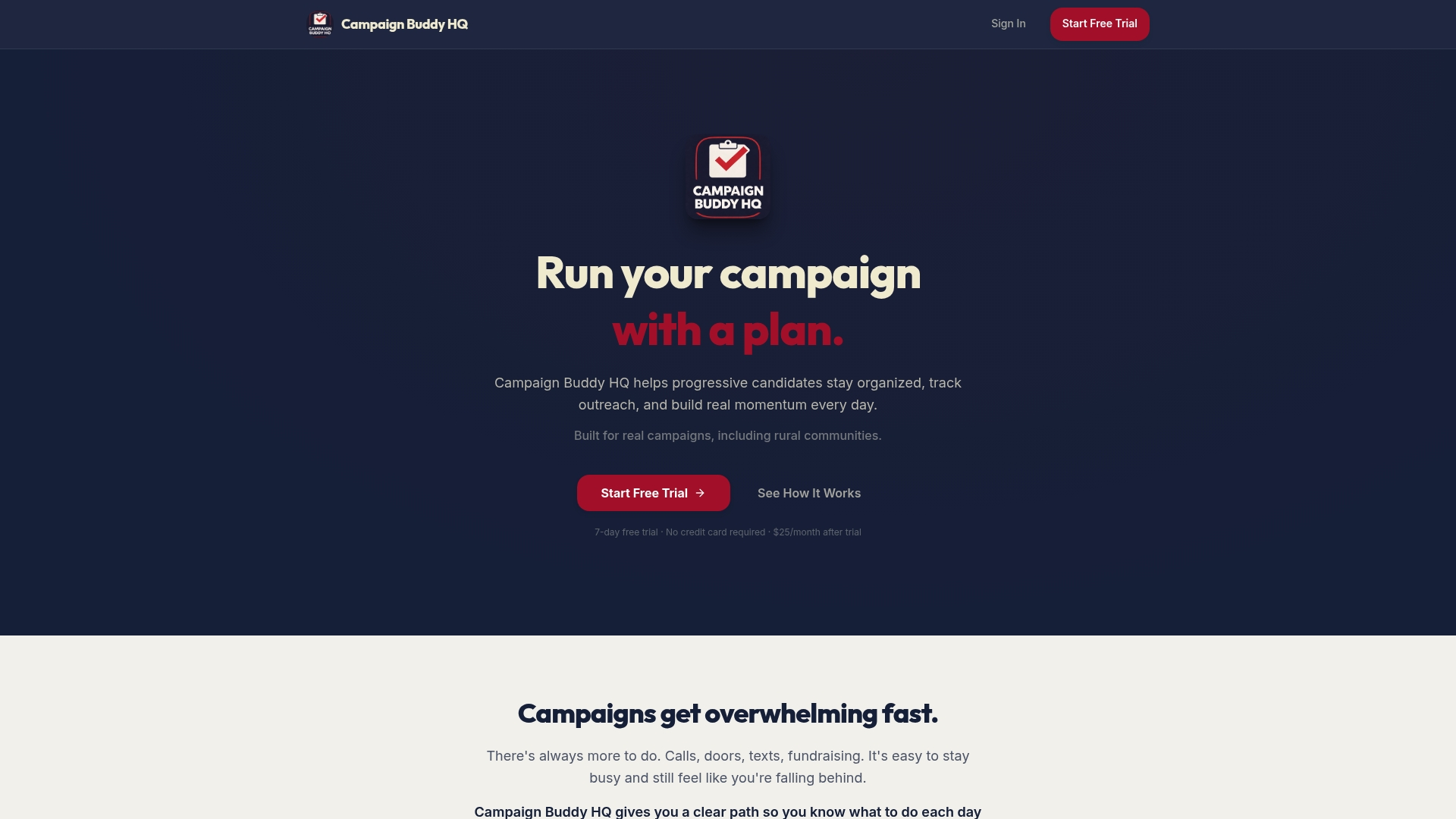
Getting started takes four steps: create your workspace, import your supporter list, set your vote goal, and schedule your first volunteer shift. The 7-day free trial requires no credit card, and after that it runs on a straightforward monthly subscription. If your first 30 days are still ahead of you, start your free trial and get your outreach logging running before your first shift goes out.
Frequently Asked Questions
What are the first steps for launching campaigns? Write a one-page vision memo, open a campaign bank account, name a treasurer, and set up a shared workspace, all within the first week after deciding to run.
How far in advance should you start planning a campaign? Most experienced organizers recommend starting 9 to 12 months before Election Day, then working backward to set milestones for fundraising, message testing, and field launch.
What should a campaign launch checklist include? A solid checklist covers vision and vote goal, resource audit, backward timeline, budget, message testing, field plan, media strategy, volunteer recruitment, and a weekly monitoring rhythm.
How do you track doors, calls, and texts consistently? Log the same fields for every contact: date, method, staff name, voter ID, result, follow-up ask, and next action, then review the totals weekly against your KPI targets.
What tools do campaigns need to launch outreach operations? A shared workspace, an outreach logging tool, a donor and payment system, a calendar, and a reporting dashboard cover the minimum. Campaign Buddy HQ bundles most of that into one hub built for daily and weekly planning.
Sources
- 10 Political Campaign Strategies: Step by Step Guide + Timeline — MFStrategies
- Field Organizing for Political Campaigns: Complete Guide to Volunteers, Doors & GOTV — Huxley Strategies
Workspace starter kits and plan templates are available inside Campaign Buddy HQ for paying users, and during the free trial.