

Momentum is not something that appears on launch day. It is built weeks before anyone sees a press release, and it depends on decisions made in planning rooms, not on social media. Here is the complete building campaign momentum checklist your team can copy into any project tool today:
- Step 1: Complete a readiness and feasibility assessment
- Step 2: Define SMART goals, KPIs, and a gift-range chart
- Step 3: Recruit and activate campaign leadership (chair, co-chairs, committee)
- Step 4: Develop your case for support and core messaging
- Step 5: Secure lead gifts during the quiet/leadership phase
- Step 6: Execute a structured public launch with a follow-up plan over the subsequent days
- Step 7: Deploy volunteer toolkits and peer-to-peer amplification
- Step 8: Run a consistent content drumbeat across all channels
- Step 9: Track KPIs regularly, test frequently, and review strategy consistently
- Step 10: Celebrate wins, steward donors, and plan your post-campaign transition
For a deeper organized outreach checklist you can print and share with your team, the linked resource covers role-by-role task breakdowns.
Pro Tip: Treat launch day as a reporting event, not a starting gun. Campaigns that rely on public launch for their initial energy are already behind. Momentum is a product of the planning phase.
Key Takeaways
Building and sustaining campaign momentum requires a phase-ordered operational system, not a single launch event, and every phase needs clear owners, measurable KPIs, and a consistent content cadence to hold its gains.
| Point | Details |
|---|---|
| Start momentum in planning | Secure leadership buy-in and lead gifts before any public launch activity begins. |
| Gift-range math is non-negotiable | Build a gift-range chart before outreach starts so your prospect pool matches your goal. |
| Volunteer toolkits drive amplification | Equip every volunteer with email templates, social posts, and an ask script before they make contact. |
| Track KPIs daily, not monthly | Review outreach velocity and conversion rates every day to catch bottlenecks before they become lulls. |
| Campaignbuddyhq operationalizes the checklist | Daily planning, outreach logging, and phase management keep every checklist item assigned, tracked, and visible in real time. |
Table of Contents
- Is your campaign actually ready to build momentum?
- Who do you need to sustain campaign activity week after week?
- What makes your message worth sharing?
- How do you turn launch day into 14 days of measurable traction?
- How do you keep the content drumbeat going for weeks?
- What does operational discipline actually look like day to day?
- How do you recognize wins without losing focus on what's next?
- Your phase-by-phase checklist and sample 6–12 month timeline
- How does a campaign workflow tool make this checklist repeatable?
- How do you keep donors engaged when the campaign hits a lull?
- What do you do when something goes wrong mid-campaign?
- How do you use social proof to build trust and keep momentum going?
- Why operational discipline beats one-off creativity every time
- Campaignbuddyhq puts this checklist to work for you
- Sources
Is your campaign actually ready to build momentum?
Building momentum starts during the planning stage: secure leadership, board, and key donor buy-in before public launch, then celebrate early wins to fuel what comes next. That sequence matters because campaigns that skip the readiness check often launch into a vacuum.
Readiness checklist (complete before any public activity)
- Staff capacity confirmed: development lead and campaign manager have dedicated time blocked
- Board has reviewed and endorsed the campaign goal
- A feasibility study or informal leadership interviews have been completed
- A draft case for support exists and has been reviewed by at least two stakeholders
- A preliminary prospect list (top 20 donors) has been pulled and wealth-screened
- Legal and compliance requirements have been reviewed for your campaign type
Setting goals and KPIs that actually hold up
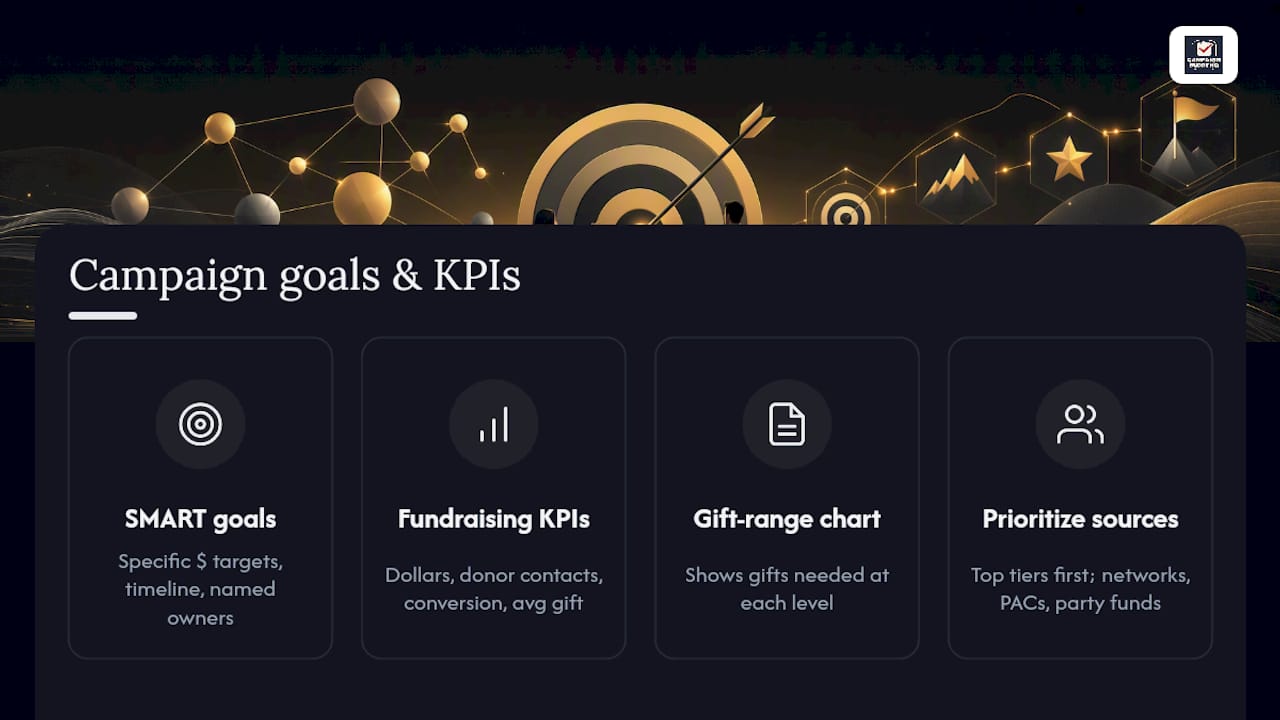
Clear goals and measurable KPIs are what separate campaigns that finish strong from those that drift. Write SMART goals: specific dollar or vote targets, a defined timeline, and named owners for each metric. For fundraising campaigns, KPIs worth tracking from day one include total dollars raised, number of donor contacts made, conversion rate from prospect to gift, and average gift size by segment.
A gift-range chart is the planning artifact most teams skip and later regret. It shows how many gifts at each level you need to reach your goal, and it forces an honest conversation about whether your prospect pool is deep enough. Feasibility studies, gift-range charts, and phased campaign structure are among the ten essentials for a successful capital campaign, and the gift-range math is where most shortfalls are first visible.
Prioritize prospects for the top tiers first.
For new political campaigns, prioritize funds that can be collected with the least effort early to build the cash flow you need for the rest of the race. That means personal networks, PAC relationships, and party committee support before broad public fundraising.
Pro Tip: Senior leaders should commit significant time to a campaign during the months leading up to solicitation and during the active solicitation period. Block the CEO's and chief development officer's calendars before the campaign plan is finalized, not after.
Who do you need to sustain campaign activity week after week?
People sustain momentum. Systems preserve it. You need both, and the people come first.
Campaign leadership roles and expectations
| Role | Primary Activity | Measurable Outcome |
|---|---|---|
| Campaign Chair | Peer-to-peer major gift asks, public credibility | Lead gifts closed, key endorsements secured |
| Co-Chairs (2–4) | Segment-specific outreach (board, community, alumni) | Contacts made per week, gifts per segment |
| Campaign Committee | Volunteer recruitment, event hosting, social amplification | Volunteers activated, events hosted |
| Major-Gift Volunteers | Personal asks top-tier prospects | Gifts closed at target level |
| Field Organizers | Door knocking, phone banking, text outreach | Doors knocked, contacts logged, supporters registered |
Volunteer toolkit: what every volunteer needs before they make a single ask
Practical volunteer toolkits dramatically increase amplification when paired with regular guidance on what to use and when. A complete toolkit includes:
- A one-page case for support (print and digital versions)
- Three pre-written email templates (personal ask, follow-up, thank-you)
- Five to seven social media posts with approved images and hashtags
- A two-minute verbal ask script with common objections and responses
- A FAQ sheet covering the campaign goal, timeline, and donor recognition
For volunteer recruitment and activation tactics that map directly to these roles, the linked resource covers how to move people from interested to active in under a week.
Pro Tip: Convert your feasibility interviewees into your first leadership volunteers. They already know the case, they gave you candid feedback, and they have a stake in seeing the campaign succeed. Ask them directly at the close of the feasibility process.
What makes your message worth sharing?
A case for support is not a brochure. It is the argument your volunteers make when they are sitting across from a donor who has not decided yet. It needs to be short enough to say out loud and specific enough to be believed.
Case-for-support template
- Headline impact: One sentence stating what changes if the campaign succeeds (lives served, votes won, program launched)
- Why now: The specific reason this campaign cannot wait another year
- What success looks like: A concrete, measurable outcome tied to the goal
- Donor recognition: How donors will be acknowledged at each gift level
Message hierarchy by audience
| Audience | Core Message | Emphasis |
|---|---|---|
| Major donors | Your lead gift makes the campaign viable | Impact, legacy, naming opportunity |
| Volunteers | Your network is the campaign's reach | Community, personal influence, belonging |
| General public | This campaign solves a problem you care about | Urgency, accessibility, social proof |
Brand assets to deploy across every touchpoint
- Email header and footer with campaign logo and tagline
- Landing-page hero image and campaign-specific URL
- Social media tile set (square, story, cover photo)
- Event signage and printed materials
- Donor acknowledgment templates (letter, email, social shout-out)
Consistent branding across every touchpoint is not a design preference. It signals organizational credibility, and credibility is what converts a curious prospect into a committed donor. Implementing campaign branding across all touchpoints is one of the clearest signals that a campaign is organized and worth backing.
Pro Tip: Build your brand asset library before the launch event, not during it. Design bottlenecks in the first week after launch are one of the most common reasons early momentum stalls.
How do you turn launch day into 14 days of measurable traction?
Launch day is a milestone, not a mechanism. The mechanism is what you do in the 14 days that follow.
Launch and first-14-day checklist
- Launch day: Send the campaign announcement email to your full list; post across all social channels; issue a press release if applicable
- Days 1–3: Gift officers make personal calls to top-20 prospects; campaign chair sends personal notes to peer-level donors
- Days 4–7: Deploy volunteer toolkit; send a "momentum update" email showing early progress (dollars raised, supporters joined)
- Days 8–10: Host a launch event or virtual kickoff; capture testimonials and photos for content use
- Days 11–14: Send a second email to non-openers with a different subject line; post a mid-launch progress update on social; schedule one-on-one meetings with any major prospects who have not yet responded
Quick-use templates
Email subject line options:
- "We launched. Here's what happened in 48 hours."
- "[First name], your community needs you this week."
Social post template: "We're [X] days into our campaign and [Y] supporters have already joined. Here's why that matters: [one sentence on impact]. Add your name: [link]."
Publicly celebrating early wins builds social proof without jeopardizing major-gift cultivation, as long as you keep dollar amounts general until a donor has given permission to be named. Plan communications for the days immediately after launch and treat that window as its own mini-campaign.
Pro Tip: Do not announce a major gift publicly until the donor has signed off on the announcement. A premature disclosure can damage the relationship and set a precedent that discourages other major donors from coming forward.
How do you keep the content drumbeat going for weeks?
The campaigns that sustain momentum past the launch spike are the ones with a content calendar that runs on a schedule, not on inspiration.
Build a timeline, set checkpoints, and convert launch interest into broader awareness with coordinated media and content. Here is a sample 8-week framework:
| Week | Social | Earned Media | Event/Outreach | |
|---|---|---|---|---|
| 1 | Launch announcement | Campaign launch posts | Press release | Launch event |
| 2 | Momentum update | Volunteer spotlight | Local media pitch | Volunteer onboarding |
| 3 | Donor story | Impact stat graphic | Op-ed submission | Major donor meetings |
| 4 | Mid-campaign progress | Peer-to-peer ask | Radio/podcast pitch | Community event |
| 5 | Urgency update | Countdown post | Follow-up media | Board outreach |
| 6 | Testimonial feature | Supporter shout-out | Feature story | Appreciation event |
| 7 | Final push | Deadline countdown | Final media push | Closing calls |
| 8 | Thank-you and results | Campaign wrap post | Results announcement | Stewardship event |
Channel rules and quick A/B test ideas
- Email: Send twice per week at peak; test subject lines first (open rate is your signal), then hero image, then CTA copy
- Social: Post daily during launch and closing phases; short video outperforms static by a measurable margin on most platforms
- Peer-to-peer: Give volunteers a specific ask ("send this to three people you know") rather than a general "spread the word"
For progressive campaign activity ideas that fill your content calendar with events worth posting about, the linked resource covers formats that generate genuine engagement rather than passive likes.
For grassroots amplification, peer-to-peer fundraising tactics that pair with your volunteer toolkit can extend your reach into networks your campaign cannot access directly.
What does operational discipline actually look like day to day?
Momentum dies in the gaps between strategy and execution. The fix is not more creativity. It is a repeatable daily workflow.
KPIs to track in real time
- Donor leads in pipeline (by gift tier)
- Contacts made this week vs. weekly target
- Conversion rate: prospects contacted to gifts received
- Velocity: dollars raised per week vs. pace needed to hit goal
- Volunteer activity: toolkit downloads, peer asks sent, events attended
Centralized visibility, automated workflows, and real-time dashboards prevent execution breakdowns and let teams pivot quickly. A dashboard does not need to be complex. It needs to answer three questions at a glance: Are we on pace? Where are the bottlenecks? What needs a decision today?
Daily and weekly workflow template
Daily (15 minutes):
- Review outreach log from the previous day
- Flag any prospects who have gone 7+ days without contact
- Confirm today's scheduled calls and meetings
Weekly (60 minutes):
- Review KPI dashboard against weekly targets
- Identify one tactic to test or adjust based on data
- Send a brief progress update to campaign leadership
Accurate judgment of campaign tactics requires a period of data collection, so resist the urge to pivot after two or three days of slow results. Set a minimum testing window of 7–10 days before drawing conclusions.
Standardize workflows, map dependencies, add intake gates, and run short retrospectives after each major phase. A 15-minute retrospective that captures what broke and what worked is worth more than any post-campaign report written three months later.
Pro Tip: Implement an intake gate: no campaign task starts without an approved brief, a confirmed budget, and defined success metrics. This single rule prevents the ad-hoc work that quietly drains momentum.
How do you recognize wins without losing focus on what's next?
Stewardship is not a post-campaign activity. It starts the moment a gift is received, and it is one of the clearest predictors of whether a donor gives again.
Stewardship checklist by gift level
- All gifts: Personal thank-you within 48 hours (phone call for gifts above your threshold, email for smaller gifts)
- Mid-level gifts: 30-day impact update showing how the gift is being used
- Major gifts: Named recognition in campaign materials (with donor approval), invitation to a recognition event, personal update from campaign leadership at 90 days
- Lead gifts: Dedicated stewardship plan with quarterly touchpoints and a legacy conversation at campaign close
Closing-phase tactics
- Set a firm close date and communicate it publicly at least 30 days in advance
- Send a "final week" email series (three emails over seven days) with a clear deadline
- Make personal calls to any mid-level prospects who have not yet given
- Host a closing celebration that doubles as a stewardship event for early donors
- Transition major donors into a legacy or planned-giving conversation within 60 days of campaign close
Using social proof and testimonials
Publish donor testimonials with explicit permission. For donors who prefer anonymity, use a format like "A longtime supporter said..." and focus on the impact, not the gift amount. Timing matters: release testimonials during the mid-campaign lull (weeks 4–6) when energy tends to dip, not only at launch when enthusiasm is already high.
Your phase-by-phase checklist and sample 6–12 month timeline
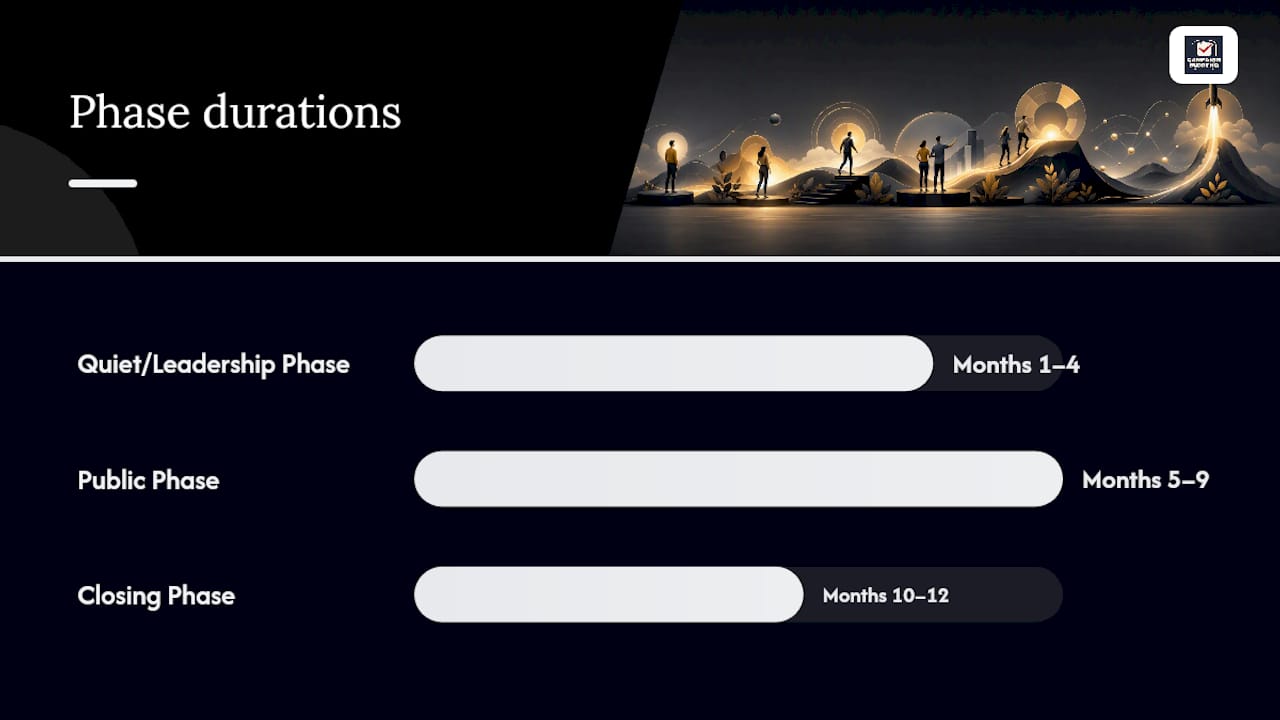
Every campaign is different, but the phase structure is consistent: quiet/leadership phase, public phase, closing phase. Here is how to map your checklist to each.
Phase-based checklist
Quiet/Leadership Phase (Months 1–4)
- Feasibility study complete
- Campaign goal and gift-range chart approved
- Campaign chair and co-chairs confirmed
- Lead gifts (top 10–20% of goal) secured or in active cultivation
- Case for support finalized and reviewed
- Volunteer toolkit built and distributed to leadership team
- Owner: Campaign Director | Minimum success criteria: a substantial portion of the goal secured before public launch
Public Phase (Months 5–9)
- Public launch event executed
- Launch email and social campaign deployed
- Content calendar running on schedule
- Weekly KPI reviews in place
- Mid-campaign donor event hosted
- Owner: Campaign Manager + Communications Lead | Minimum success criteria: most of the goal reached by end of public phase
Closing Phase (Months 10–12)
- Final push communications sent
- All major prospects have received a personal ask
- Close date announced publicly
- Stewardship plan activated for all donors
- Post-campaign transition plan drafted
- Owner: Campaign Director + Development Lead | Minimum success criteria: full goal reached; all donors thanked promptly
Approval delays are the most common cause of phase slippage, and they are almost always predictable in advance.*
For a step-by-step outreach guide that maps to these phases, the linked resource covers sequencing and scripting for field, phone, and digital outreach.
A campaign plan should include goals, KPIs, target audiences, budget, tactics, timeline, and roles laid out in an actionable template. If any of those elements is missing from your plan before the quiet phase ends, the gap will show up as a bottleneck during the public phase.
How does a campaign workflow tool make this checklist repeatable?
A checklist on paper is a starting point. A checklist inside a workflow tool is a system. The difference is accountability: who did what, when, and what happened next.
Campaignbuddyhq is built specifically for this. It maps directly to the operational steps in this checklist:
- Daily and weekly planning: Teams log outreach activity (doors, calls, texts, registrations) and see progress toward weekly targets in real time
- Supporter tracking: Move contacts through defined stages (prospect, contacted, committed, closed) so nothing falls through the gaps between team members
- Campaign phase management: Organize tasks by phase (quiet, public, closing) so the right work happens at the right time
- Outreach logging: Every contact is recorded, timestamped, and visible to the full team, which prevents duplicate outreach and missed follow-ups
- AI-assisted content: Generate stump speeches and social posts directly inside the platform, so volunteers always have fresh, on-message material
Using data to build and maintain campaign momentum is where most campaigns leave the most performance on the table. Campaignbuddyhq makes that data visible without requiring a data analyst.
Pro Tip: When setting up Campaignbuddyhq, configure your campaign phases and KPI targets before you add any contacts. Starting with structure means every piece of data you enter from day one is immediately useful for reporting.
A connected operational approach with centralized visibility and real-time dashboards prevents the execution breakdowns that quietly kill momentum between phases.
How do you keep donors engaged when the campaign hits a lull?
Every campaign has a mid-run energy dip, usually around weeks 4–6 of the public phase. The mistake most teams make is treating it as a communications problem and sending more emails. The real fix is structural.
Maintain a consistent content drumbeat rather than extending deadlines or flooding inboxes. Share anonymized examples of early participation: "More than 200 supporters have already joined. Here's what they're saying." That kind of social proof signals that the campaign is moving, even when the pace feels slower internally.
Segment your donor list and personalize outreach by giving history and engagement level. A lapsed donor who gave two years ago needs a different message than a first-time prospect. Building and segmenting your supporter list before the lull hits means you have the right message ready for the right person when energy dips.
For community-based campaigns, in-person engagement during lulls can reset energy in ways that digital outreach cannot. Organizations like CVPSD demonstrate how community space and in-person gathering can anchor ongoing engagement between major campaign moments.
What do you do when something goes wrong mid-campaign?
Setbacks are not exceptional. A key volunteer drops out, a major donor pulls back, a news cycle drowns your message, or a fundraising event falls short of its goal. The campaigns that recover fastest are the ones with a contingency plan already written.
Build a simple risk register before your public launch. List your top five risks, assign a probability and impact score to each, and write a one-paragraph response plan for each scenario. The act of writing it forces your team to think through dependencies they would otherwise discover under pressure.
When a setback hits, the first 24 hours matter most. Convene your campaign leadership, assess the actual impact on your goal and timeline, and communicate clearly with your team before rumors fill the gap. Silence from leadership during a setback is interpreted as panic, even when it is not.
Adjust tactics, not goals. If a fundraising event underperforms, increase personal outreach in the following week rather than lowering the campaign target. Lowering the goal mid-campaign signals to donors that the campaign is in trouble, which makes the problem worse.
How do you use social proof to build trust and keep momentum going?
Social proof is not a marketing tactic. It is evidence that other people have already made the decision you are asking your prospect to make. Used well, it removes the risk of being first.
The most effective forms of social proof for campaigns are donor testimonials, participation numbers, and named endorsements from credible community figures. Each works differently. Testimonials address the "why" question. Participation numbers address the "is this real" question. Named endorsements address the "who else" question.
Collect testimonials continuously, not just at campaign close. Ask donors within 48 hours of their gift, when the decision is fresh and the emotion is still present. A two-sentence response collected by text or email is more useful than a polished paragraph collected six weeks later.
Publish social proof during the mid-campaign lull, not only at launch. A donor story released in week 5 can reset energy more effectively than any promotional email, because it shifts the frame from "please give" to "here is what giving looks like."
For political campaigns, voter testimonials and community leader endorsements serve the same function. A named local figure saying "I'm with this campaign because..." carries more weight with undecided voters than any paid ad.
Why operational discipline beats one-off creativity every time
The campaigns I have seen stall mid-run share a common pattern: they launched with strong creative energy and no repeatable system underneath it. The first two weeks looked great. By week five, the content calendar had gaps, the volunteer toolkit had not been updated, and the KPI dashboard was being checked monthly instead of daily.
Creativity gets campaigns noticed. Operational discipline is what keeps them moving. A 15-minute daily outreach review, a weekly KPI check-in, and a phase-gated task list are not glamorous. They are the difference between a campaign that finishes and one that fades.
The checklist orientation in this guide is intentional. Momentum is an operational outcome, not a marketing event. When you treat it that way, you stop asking "how do we create excitement?" and start asking "what did we do today, and did it move the number?" That shift in framing is where campaigns find their second gear.
Campaignbuddyhq puts this checklist to work for you
Running this checklist manually across spreadsheets, email threads, and shared docs works until it doesn't. The moment your team grows past three people or your campaign enters the public phase, the coordination cost starts eating into the time you should be spending on outreach.
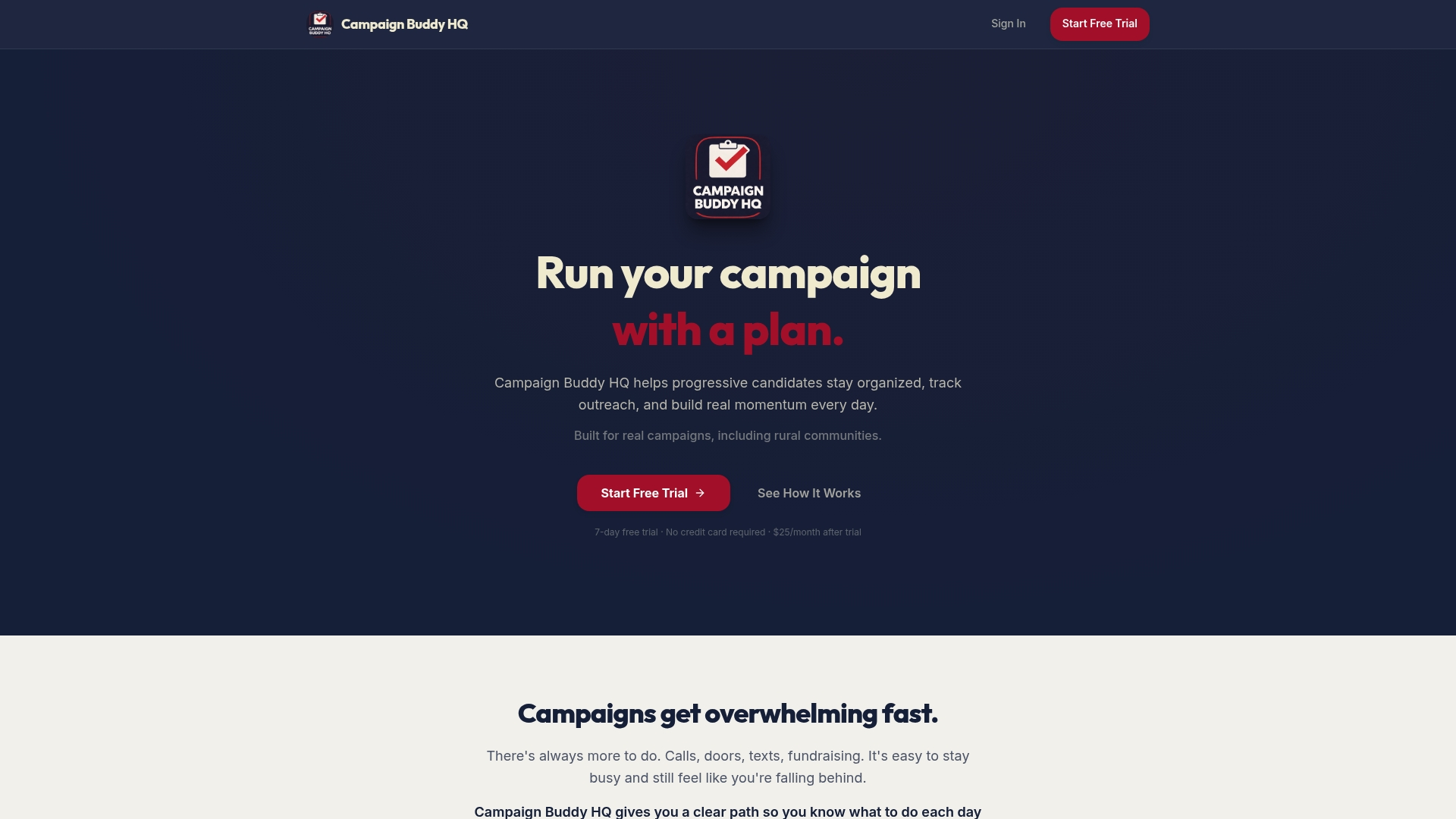
Campaignbuddyhq is built for exactly this workflow. Daily planning keeps your team focused on the right activities each morning. Outreach logging captures every door, call, text, and registration so nothing gets lost between shifts. Supporter tracking moves contacts through campaign stages automatically, and campaign phase management keeps the right tasks visible at the right time. AI-assisted content means your volunteers always have fresh talking points and social posts without waiting on a communications team.
The free 7-day trial requires no credit card. Start your trial at Campaignbuddyhq and have your first campaign phase set up before the end of the week.
Sources
- Optimizing the Planning Stage of a Campaign to Build Early Momentum - BWF
- The Campaign Manager's Checklist - Campaigns & Elections
- Building momentum: 10 essentials for a successful capital campaign - Champion Project Consulting
- How to Create a Successful Marketing Campaign - HubSpot
- How to create campaigns that deliver results - Mailchimp