

Every progressive campaign that wins does the same ten things: research the race, register and file compliance paperwork, build a core team, develop a tested message platform, create a fundraising plan, execute a field plan, run a digital strategy, track data and KPIs, produce materials and events, and follow a launch timeline. That is the complete checklist for progressive campaigns in one sentence. Everything below unpacks each item into a working plan you can use today.
The 10-item launch checklist:
- Research the race: Confirm election calendar, ballot access rules, and voter file access.
- Register and comply: File with the FEC, get an EIN from the IRS, appoint a treasurer, open a campaign bank account.
- Build your team: Hire or recruit a campaign manager, finance lead, field director, communications lead, and data manager.
- Develop your platform and message: Draft a message map, test it qualitatively, and finalize a stump speech.
- Create a fundraising plan: Set 30/60/90-day goals, segment donors, and launch small-dollar outreach.
- Build a field plan: Schedule canvasses, phonebanks, and textbanks; recruit and train volunteers.
- Launch a digital strategy: Set up email, SMS, and social channels; build a content calendar.
- Set up data and targeting: Access the enhanced voter file, define target universes, and build a tracking dashboard.
- Produce materials and events: Order signs and literature; plan a launch event.
- Follow a launch timeline: Use 30/60/90-day milestones and a day-by-day launch-week checklist.
Download the essential campaign checklists and outreach templates to get a ready-to-use version of this plan.
Pro Tip: File your committee registration and get your EIN before you spend or raise a single dollar. Compliance errors in the first week follow a campaign for months.
Key Takeaways
A well-executed checklist for progressive campaigns starts with compliance and team-building in the first week, then scales field and digital operations through 30/60/90-day milestones, with data-driven adjustments at every phase.
| Point | Details |
|---|---|
| File compliance first | Register your committee, get an EIN, and appoint a treasurer before spending or raising any money. |
| Own your data | Keep donor and volunteer records on platforms you control; use social media for reach, not as your primary database. |
| Test messages qualitatively | Run three to five voter interviews before finalizing your message platform; qualitative research is faster and cheaper than polling at the early stage. |
| Use threshold-based triggers | If contact rate or fundraising drops more than 20–30% below target for two consecutive weeks, convene a review immediately. |
| Campaignbuddyhq centralizes the plan | The platform maps outreach logging, daily planning, supporter tracking, and campaign phases to the same ten-item checklist structure in this article. |
Table of Contents
- How do you turn this checklist into an operational campaign plan?
- How do you research the race before you spend a dollar?
- How do you register your campaign and stay legally compliant?
- Who should be on your campaign team, and what does each person own?
- How do you build a message platform that actually moves voters?
- How do you build a fundraising plan that works from day one?
- What does a strong field plan look like for a progressive campaign?
- What does a digital strategy look like for a progressive campaign?
- How do you track data and know when to adjust your campaign plan?
- What campaign materials and events does a progressive campaign need?
- What does a 30/60/90-day launch timeline look like?
- How do you monitor progress and run a post-election review?
- How does Campaignbuddyhq map the checklist to daily workflows?
- Legal compliance nuances specific to progressive campaigns
- How do you build an opposition research and rapid response plan?
- How do you build coalitions with local organizations and labor unions?
- How do you keep volunteers engaged beyond the first shift?
- How do you manage a campaign crisis before it becomes a disaster?
- How do you build a media relations strategy that generates earned coverage?
- What most campaign guides get wrong about limited resources
- Campaignbuddyhq gives your campaign one place to run the whole checklist
- Sources
How do you turn this checklist into an operational campaign plan?
A checklist is only useful if someone owns each item and knows when it is due. The four campaign phases below give you that structure.
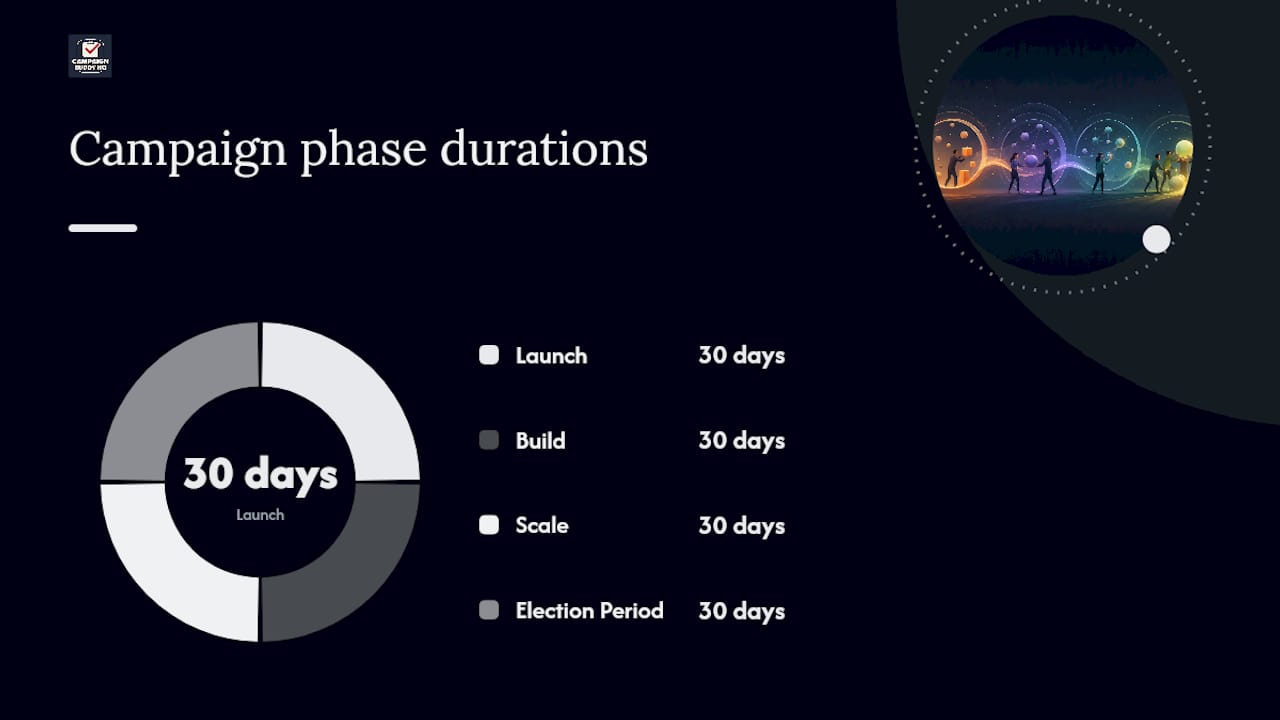
Phase 1: Launch (Days 1–30). Register, build the core team, finalize the message, and open the fundraising engine. Everything in this phase is about legal standing and foundational infrastructure.
Phase 2: Build (Days 31–60). Ramp field operations, grow the volunteer roster, launch digital channels, and start tracking weekly KPIs. The goal is consistent activity, not peak activity.
Phase 3: Scale (Days 61–90). Increase contact volume, deepen coalition relationships, and begin paid advertising. Decisions in this phase should be driven by data from Phase 2.
Phase 4: Election Period (Final 30 days). Shift almost all resources to GOTV. Every contact should be a persuasion or pledge-to-vote conversation.
| Checklist Item | Phase | Primary Owner | Secondary Owner |
|---|---|---|---|
| Research and landscape | Launch | Campaign Manager | Data Manager |
| Registration and compliance | Launch | Finance Lead | Campaign Manager |
| Team building and onboarding | Launch | Campaign Manager | All |
| Platform and messaging | Launch | Communications Lead | Campaign Manager |
| Fundraising plan and budget | Launch | Finance Lead | Campaign Manager |
| Field plan and volunteer recruitment | Build | Field Director | Campaign Manager |
| Digital strategy and content | Build | Communications Lead | Data Manager |
| Data, targeting, and KPIs | Build | Data Manager | Field Director |
| Materials, branding, and events | Build | Communications Lead | Field Director |
| Launch timeline and milestones | Scale | Campaign Manager | All |
| Monitoring and evaluation | Scale/Election | Campaign Manager | Data Manager |
Pro Tip: Block a 30-minute weekly planning meeting for the full leadership team. Review the prior week's KPIs and set the top three priorities for the coming week. Small teams that skip this meeting drift; teams that hold it stay coordinated.
How do you research the race before you spend a dollar?
Research is not optional prep work. It is the foundation that determines which voters you target, what you say to them, and whether you can even get on the ballot.
Step 1: Calendar the election. Confirm the exact election date, primary date (if applicable), and all filing deadlines. Check your state election office directly; deadlines vary by state and office type.
Step 2: Confirm ballot access rules. Some jurisdictions require petition signatures, filing fees, or party affiliation. Missing a ballot access deadline ends the campaign before it starts.
Step 3: Map the electorate. The Progressive Technology Project Voter TechKit recommends starting with political context analysis, targeting, and infrastructure capacity before scaling voter engagement. Request access to your state's enhanced voter file through your state party or a voter file vendor. Pull turnout data from the last three comparable elections to understand who actually votes in your race.
Step 4: Identify key jurisdictions and turnout factors. Which precincts are high-turnout? Which are low-turnout but persuadable? Where does your opponent perform well? These answers shape your field plan before you recruit a single volunteer.
Step 5: Research the opposition. Pull public financial disclosures, voting records, and public statements. Identify your opponent's vulnerabilities and their likely attack lines against you.
Step 6: Assess voter sentiment. Conduct at least three to five qualitative interviews or focus groups with likely voters before you finalize your message. Polling is useful but expensive; qualitative research is faster and often more revealing at the early stage.
Research checklist:
- Election date and all filing deadlines confirmed
- Ballot access requirements reviewed and calendared
- Enhanced voter file access requested
- Last three comparable election turnout reports pulled
- Key precincts mapped by turnout and partisanship
- Opposition financial disclosures reviewed
- At least three qualitative voter interviews completed
Pro Tip: Ask focus group participants to describe the problem they want solved, not to rate your candidate. The language they use to describe the problem is often the most persuasive language for your message.
How do you register your campaign and stay legally compliant?
Compliance is the least glamorous part of a campaign and the most consequential. A missed filing or an improperly documented contribution can result in FEC fines, public disclosure of errors, and press coverage you do not want.
Immediate filing steps:
- Register your committee with the Federal Election Commission using the correct FEC forms. Federal candidate committees must file a Statement of Organization (FEC Form 1) within 15 days of crossing the $5,000 threshold in contributions or expenditures.
- Appoint a treasurer. Federal rules require every candidate committee to have a legally responsible treasurer who signs reports and maintains records. This person is personally liable for accurate reporting.
- Get an EIN. The IRS requires campaign committees to obtain an Employer Identification Number for bank account opening and tax reporting. Political organizations have specific EIN classification rules; review the IRS guidance for political organizations to confirm your entity type before filing.
- Open a dedicated campaign bank account. Never commingle personal and campaign funds. The bank account must be in the committee's name.
- Register with your state election office. Federal registration does not replace state-level requirements. Most states have their own committee registration, treasurer appointment, and reporting rules.
Contribution limits and recordkeeping:
The FEC sets contribution limits for federal races and requires campaigns to track every donor's name, address, employer, and occupation for contributions over $200. State races follow state law; check your state election office for applicable limits.
Pro Tip: Set up your recordkeeping system the day you open the bank account, not after the first fundraiser. Retroactive data entry is where compliance errors multiply.
Who should be on your campaign team, and what does each person own?
A progressive campaign with five core roles and clear ownership runs better than one with ten people and no accountability. Start lean and add capacity as fundraising allows.
Core roles and responsibilities:
- Campaign Manager: Owns the overall strategy, daily schedule, and decision-making. The hub that connects all other roles.
- Finance Lead / Treasurer: Manages fundraising goals, donor records, compliance filings, and budget tracking. Must be named before any money moves.
- Field Director: Owns the volunteer program, canvass and phonebank schedules, and GOTV execution.
- Communications Lead: Manages the message platform, press relationships, social media, email, and all public-facing content.
- Data Manager: Maintains the voter file, tracks outreach metrics, builds dashboards, and manages data hygiene.
Volunteer leadership pipeline:
High-performing campaigns convert their best volunteers into shift leads and neighborhood captains within the first 30 days. A volunteer who knocks 50 doors becomes a shift lead who coordinates five other volunteers. That multiplier is how small campaigns scale. For a detailed framework on campaign organizing and volunteer leadership, the step-by-step guide covers the full progression.

Onboarding checklist for new staff and volunteers:
| Onboarding Item | Timing | Owner |
|---|---|---|
| Review compliance rules and contribution limits | Day 1 | Finance Lead |
| Complete data entry standards training | Day 1 | Data Manager |
| Review safety protocols for canvassing | Day 1 | Field Director |
| Shadow an experienced volunteer for one shift | Days 1–3 | Field Director |
| Complete message training and stump speech review | Days 1–3 | Communications Lead |
| First independent shift with check-in debrief | Days 3–7 | Field Director |
Use the volunteer onboarding checklist to give every new team member a consistent first week.
How do you build a message platform that actually moves voters?
A message is not a slogan. It is a structured argument that connects your candidate's values to a voter's lived experience and gives them a reason to act. The MAP Research communications best practices guide identifies four questions every campaign must answer before finalizing a message: What is the goal? Are you changing opinion or communicating a position? How long is the campaign? And have you done research-based message testing?
Message map template:
- Core issue: The single problem your campaign exists to solve (one sentence).
- Values frame: The moral or civic value that makes your position right, not just popular.
- Proof points: Two or three specific, verifiable facts or local examples that support the core issue.
- Call to action: What you want the voter to do (vote, volunteer, donate, sign).
Message testing process:
- Draft two or three distinct message approaches, not variations on the same theme.
- Test qualitatively first: read each message to five to ten likely voters and ask them to describe what they heard in their own words.
- Identify which message generates the strongest emotional response and the clearest comprehension.
- Validate with a small quantitative poll or digital A/B test once budget allows.
The key trade-off in progressive messaging is education versus persuasion. A message that explains a complex policy position may educate voters but fail to move them. A message that connects the policy to a concrete local impact moves voters but may oversimplify. The right balance depends on your target universe; persuadable voters need the concrete local impact, while base voters often respond to the values frame.
For a deeper look at progressive campaign principles and messaging priorities, the 2026 guide covers the full framework.
How do you build a fundraising plan that works from day one?
Fundraising is not a single event. It is a system with daily inputs, weekly reviews, and monthly targets. Build the system before you make the first ask.
Fundraising checklist:
- Set a 30/60/90-day dollar goal and break it into weekly targets.
- Segment your donor universe: small-dollar online, mid-dollar personal outreach, high-dollar events, and recurring monthly donors.
- Open a merchant account for online donations (ActBlue is the standard for progressive federal and state campaigns).
- Set up a receipt and acknowledgment system for every contribution.
- Establish a recordkeeping protocol that captures name, address, employer, and occupation for all contributions over $200, per FEC contribution limits and reporting rules.
- Schedule at least two peer-to-peer fundraising asks in the first 30 days.
- Plan one house party or small-dollar event in the first 60 days.
90-day budget template:
| Budget Category | Days 1–30 | Days 31–60 | Days 61–90 |
|---|---|---|---|
| Staff and stipends | Primary cost | Primary cost | Primary cost |
| Voter file and data tools | Setup cost | Ongoing | Ongoing |
| Printing and materials | Minimal | Ramp up | Peak |
| Digital advertising | Minimal | Moderate | Increase |
| Events and venue | Launch event | House parties | Fundraiser |
| Contingency (10%) | Reserve | Reserve | Reserve |
For small-dollar tactics and peer-to-peer strategies, the grassroots fundraising guide covers the full playbook.
Pro Tip: Launch a recurring monthly donation option on day one. A $10/month recurring donor is worth more than a $50 one-time donor over a six-month campaign, and recurring donors are far easier to retain.
What does a strong field plan look like for a progressive campaign?
Field operations are where campaigns win or lose. A candidate who out-knocks their opponent by a significant margin in the final 30 days almost always wins close races. The field plan is the engine.
Core field activities and timing:
- Doors (canvassing): Start in Phase 2 (Days 31–60) with persuasion conversations. Shift to GOTV pledge-to-vote conversations in the final 30 days.
- Phones (phonebanking): Run alongside canvassing for voters who are not home. Phones are faster per contact but lower quality than a door conversation.
- Texts (textbanking): Use for event reminders, volunteer recruitment, and GOTV. Texts have high open rates but low response rates for persuasion.
- Literature drops: Use for high-density areas where door conversations are not practical.
Volunteer recruitment and retention:
Recruit volunteers through personal asks first, then social media, then email. A personal ask from a friend converts at a much higher rate than a mass email. Train every volunteer before their first shift; untrained volunteers make data entry errors and deliver inconsistent messages. For detailed outreach execution steps covering phonebanks, canvasses, and texts, the step-by-step guide is the reference.
Field metrics table:
| KPI | Target per Shift | Tracking Method |
|---|---|---|
| Doors knocked | 15–20 per volunteer | Outreach log |
| Contacts made (home) | 8 per volunteer | Outreach log |
| Persuasion conversations | 3–5 per volunteer | Outreach log |
| Pledge-to-vote commitments | 2–4 per volunteer (GOTV phase) | Voter file tag |
| Volunteer retention rate | 60%+ return for second shift | Volunteer tracker |
Volunteer training checklist:
- Campaign message and stump speech overview (30 minutes).
- Script review and role-play for persuasion and GOTV conversations (20 minutes).
- Data entry standards: how to log contacts correctly (15 minutes).
- Safety protocols: what to do if a voter is hostile or a situation feels unsafe (10 minutes).
- First shift debrief: what went well, what was hard, what questions came up.
What does a digital strategy look like for a progressive campaign?
Digital strategy for a progressive campaign is not about going viral. It is about building owned assets, converting engagement into action, and keeping the cost per volunteer and cost per donor as low as possible.
Owned assets checklist:
- Email list with a double opt-in confirmation flow.
- SMS list with explicit consent documentation.
- CRM or supporter database that you control (not a platform you rent).
- Campaign website with a clear donation and volunteer signup form.
- Social media accounts on the platforms where your target voters actually spend time.
Owned platforms give you control over conversion pathways. Social media is for reach; email and SMS are for action. Digital advocacy best practices consistently show that easy-to-use forms, integrated media approaches, and ongoing testing produce higher conversion and retention rates than any single tactic alone.
Content calendar sample (weekly cadence):
- Monday: Share a local story or constituent testimonial tied to your core issue.
- Wednesday: Post a policy explainer or candidate update (video performs better than text).
- Friday: Volunteer recruitment ask or event promotion.
- Weekend: Behind-the-scenes content from a canvass or event (builds authenticity).
Ad-to-conversion flow:
Run a social ad to a landing page with a single action (sign up to volunteer, donate $5, or attend an event). Never send ad traffic to your homepage. A single-action landing page converts at a much higher rate than a general page with multiple options.
Pro Tip: Test two versions of every ad creative before scaling spend. Change one variable at a time (headline, image, or call to action) and run each version for at least 72 hours before declaring a winner. Small tests save significant money at scale.
How do you track data and know when to adjust your campaign plan?
Data without a decision framework is just noise. The goal is a simple dashboard that tells your campaign manager, in under five minutes, whether the campaign is on track.
KPIs by campaign phase:
| Phase | KPI | What It Tells You |
|---|---|---|
| Launch (Days 1–30) | Donor acquisition rate | Is the fundraising engine working? |
| Build (Days 31–60) | Contact rate per shift | Is the field program efficient? |
| Build (Days 31–60) | Email open and click rate | Is the message resonating? |
| Scale (Days 61–90) | Persuasion lift (pre/post) | Are conversations moving voters? |
| Election Period | Pledge-to-vote rate | Are GOTV contacts converting? |
| Election Period | Turnout yield (Election Day) | Did pledges translate to votes? |
Data hygiene and security steps:
- Deduplicate the voter file weekly to avoid double-counting contacts.
- Use strong passwords and two-factor authentication on all campaign accounts.
- Limit data access to staff who need it; volunteers should not have access to full voter records.
- Back up the supporter database weekly to a secure, off-platform location.
For tools and steps to build your campaign progress tracking dashboard, the tracking guide covers the full setup.
Do not wait for the monthly review to address a field problem.*
What campaign materials and events does a progressive campaign need?
Materials and events are where your brand becomes visible. Inconsistency here signals disorganization to voters and press alike.
Essential materials inventory:
- Yard signs (standard 18"x24" and large 4'x8" for high-visibility locations).
- Door hangers and palm cards for canvassers.
- Lit drops (one-page campaign overview for non-contact visits).
- Digital asset kit: candidate headshot, logo, social media templates, and banner ads.
- Media kit: candidate bio, platform summary, and high-resolution photos for press.
- Donation envelopes and thank-you cards for events.
Production lead times: Order printed materials at least three weeks before you need them. Rush printing is expensive and often lower quality. For campaign consistency tactics that keep branding uniform across volunteers and vendors, the consistency guide is the reference.
Launch event checklist:
- Confirm venue, date, and time at least three weeks out.
- Verify ADA accessibility: ramp access, accessible restrooms, and seating.
- Arrange language access if your district has significant non-English-speaking populations.
- Prepare a run-of-show document with timing for each segment.
- Assign a volunteer to manage the sign-in table and collect contact information.
- Brief the candidate on the stump speech and Q&A format.
- Arrange media notification and press credentials.
- Set up a donation station or QR code for on-site giving.
Branding quick rules:
- Use the same logo, color palette, and font on every piece of collateral.
- Require all partner organizations to use the approved logo file, not a screenshot.
- Review all volunteer-produced social content before it is posted publicly.
What does a 30/60/90-day launch timeline look like?
A timeline without milestones is just a calendar. Every milestone below has a clear owner and a decision point: if the milestone is not met, the team reviews why and adjusts the plan.
30/60/90-day milestone table:
| Milestone | Target Date | Owner | Decision Point |
|---|---|---|---|
| Committee registered, EIN obtained | Day 5 | Finance Lead | No fundraising until complete |
| Core team hired or recruited | Day 15 | Campaign Manager | Pause hiring if budget is short |
| Message platform finalized | Day 30 | Communications Lead | No public launch until approved |
| Fundraising goal set, bank account open | Day 7 | Finance Lead | No spending until account is open |
| First 30-day fundraising target hit | Day 30 | Finance Lead | Review budget if missed |
| Voter file access confirmed | Day 15 | Data Manager | No field plan without file |
| First canvass shift completed | Day 31–60 | Field Director | Adjust script if contact rate is low |
| Email list at 500+ subscribers | Day 31–60 | Communications Lead | Increase list-building if behind |
| Digital ads launched | Day 50 | Communications Lead | Pause if cost per click is too high |
| 60-day fundraising target hit | Day 60 | Finance Lead | Reassess budget allocation |
| GOTV plan finalized | Day 61–90 | Field Director | Confirm volunteer commitments |
| All materials ordered | Day 61–90 | Communications Lead | Rush order if behind |
| Election Day GOTV shifts fully staffed | Day 61–90 | Field Director | Recruit more volunteers if gaps |
Launch-week day-by-day checklist:
- Day 1: File committee registration, apply for EIN, open bank account.
- Day 2: Confirm treasurer, brief core team on compliance rules.
- Day 3: Request voter file access, set up campaign email and website.
- Day 4: Draft message platform, schedule first qualitative message test.
- Day 5: Send first fundraising email to personal network.
- Day 6: Post first social media content, confirm launch event date.
- Day 7: Review week one KPIs, set week two priorities.
Pro Tip: Do not announce the campaign publicly until the committee is registered and the bank account is open. Press coverage before you can legally accept donations is a missed opportunity.
How do you monitor progress and run a post-election review?
Monitoring is not a once-a-month activity. The campaigns that catch problems early are the ones that build a weekly review rhythm from the start.
Periodic evaluation checklist:
- Weekly health check (every Monday): Review prior week's contact numbers, fundraising totals, and volunteer retention rate against targets.
- Monthly deep dive (first Monday of each month): Review message performance, donor acquisition trends, and field efficiency. Adjust the plan if any metric is more than 20% below target.
- Threshold-based triggers: If volunteer retention drops below 50% for two consecutive weeks, convene a retention review. If fundraising falls more than 30% below monthly target, convene a finance review.
Post-election review template:
- What worked: Which tactics produced the highest contact rates and conversion rates?
- What failed: Which investments produced the lowest return? What would you cut next time?
- Resource gaps: Where did the team run short on staff, budget, or tools?
- Supporter relationships: Which donors and volunteers should be re-engaged for the next cycle?
- Next-cycle recommendations: Three specific changes to make if the campaign runs again.
Pro Tip: Hold the post-election review within two weeks of Election Day, while the details are fresh. Assign one person to write up the findings and store them in a shared folder. Institutional memory is the most undervalued asset in progressive politics.
How does Campaignbuddyhq map the checklist to daily workflows?
Campaignbuddyhq is built around the same ten-item checklist structure described above. Each feature maps directly to a checklist item, which means your team does not need to build a separate tracking system on top of the tool.
Feature-to-checklist mapping:
- Daily and weekly planning: The planning dashboard prompts campaign managers to set daily priorities and review prior-day performance, which directly supports the launch timeline and monitoring checklist items.
- Outreach logging: Volunteers log doors, calls, texts, and registrations in real time. The data flows directly into the contact rate and persuasion KPIs in the tracking dashboard.
- Supporter tracking: Every contact is tagged by status (supporter, persuadable, opposed), which feeds the targeting and GOTV planning steps.
- Campaign phase management: The platform organizes tasks by campaign phase (launch, build, scale, election), matching the four-phase structure in this checklist.
- AI-assisted content: Campaignbuddyhq generates draft stump speeches and social posts, which reduces the time the communications lead spends on first drafts and frees capacity for message testing.
7-day use case example:
A field director uses Campaignbuddyhq to schedule three volunteer shifts in the first week. Each volunteer logs their contacts at the end of the shift. By Day 7, the field director has a real-time contact rate, a list of supporters tagged for follow-up, and a clear picture of which precincts are under-contacted. That data feeds directly into the week-two field plan without a separate spreadsheet.
Pro Tip: Use the campaign phase feature to lock checklist items to specific phases. When a task is marked complete, the platform moves it to the next phase automatically, which keeps the whole team aligned without a daily status meeting.
Legal compliance nuances specific to progressive campaigns
Progressive campaigns often work alongside activist organizations, labor unions, and issue advocacy groups. Each of those relationships carries specific legal rules that differ from standard campaign finance compliance.
Coordination rules: A campaign cannot coordinate expenditures with outside groups, including allied nonprofits and PACs, without those expenditures counting as in-kind contributions subject to limits. The line between coordination and independent activity is fact-specific; consult a campaign finance attorney before sharing strategy documents or ad creative with allied organizations.
In-kind contributions from activist organizations: If an allied organization provides staff time, office space, or materials to the campaign, those items are likely in-kind contributions subject to FEC reporting and contribution limits. Document every non-monetary benefit the campaign receives from outside organizations.
Labor union contributions: Federal law prohibits labor unions from making direct contributions to federal candidate committees from their general treasury funds. Unions may operate separate PACs funded by voluntary member contributions. State rules vary; check your state election office for applicable rules in state and local races.
501(c)(3) organizations: Charities classified as 501(c)(3) organizations are prohibited from participating in or intervening in political campaigns. If your campaign has relationships with community organizations, confirm their tax status before accepting any support that could be construed as campaign activity.
Activist-related contributions: Contributions from individuals who are also active in allied organizations are generally permissible, subject to standard contribution limits. The key compliance question is whether the contribution is from the individual personally or from the organization's funds.
How do you build an opposition research and rapid response plan?
Opposition research is not about finding dirt. It is about knowing what your opponent will say about you before they say it, and having a response ready.
Opposition research checklist:
- Pull all public financial disclosures and campaign finance reports for your opponent.
- Review voting records, public statements, and press coverage for the last five years.
- Identify your opponent's top donors and any potential conflicts of interest.
- Map your opponent's likely attack lines against your candidate based on their past messaging.
- Identify your own candidate's vulnerabilities and prepare factual responses.
Rapid response plan:
Assign one person (usually the communications lead) as the rapid response coordinator. When an attack or negative story breaks, the response process should follow a clear sequence: confirm the facts, draft a response, get approval from the campaign manager, and release within two hours. A response that takes 24 hours is a response that arrives after the news cycle has moved on.
Prepare holding statements in advance for the three or four most likely attack scenarios. A holding statement is a one-paragraph factual response that can be released immediately while the full response is being drafted. It buys time without leaving the campaign silent.
How do you build coalitions with local organizations and labor unions?
Coalition relationships are not transactional. The organizations that show up for your campaign on Election Day are the ones you built a real relationship with six months earlier.
Coalition building checklist:
- Map all relevant local organizations: labor unions, faith communities, neighborhood associations, environmental groups, and immigrant rights organizations.
- Request a meeting with each organization's leadership before asking for an endorsement or support.
- Ask what the organization needs from the campaign, not just what the campaign needs from them.
- Offer concrete reciprocity: speaking at their events, amplifying their issues in your platform, or providing volunteer support for their programs.
- Formalize the relationship with a written MOU or letter of support that defines what each party is committing to.
The Networked Change report, based on 47 campaigns, identifies "opening to grassroots power" as one of four operational principles that distinguish high-performing progressive campaigns from average ones. Coalitions are not a nice addition to the field plan; they are a force multiplier that extends your reach into communities where your campaign has no existing relationships.
Labor union relationships: Unions bring three things: endorsements, member volunteer lists, and independent expenditure capacity. Earn the endorsement through a formal interview process with the union's political committee. Do not assume an endorsement because the union is ideologically aligned; they evaluate candidates on electability and responsiveness to their members' issues.
How do you keep volunteers engaged beyond the first shift?
Recruitment is the easy part. Retention is where most campaigns fail. A volunteer who comes once and never returns is a missed opportunity; a volunteer who returns for five shifts becomes a neighborhood captain.
Retention tactics:
- Call every volunteer within 24 hours of their first shift to thank them personally. A phone call from the candidate or campaign manager converts at a much higher rate than a form email.
- Assign returning volunteers to a specific team or precinct so they feel ownership over a geography.
- Create a visible progression path: shift volunteer, shift lead, neighborhood captain, precinct captain. People stay when they can see where they are going.
- Host monthly volunteer appreciation events (even a pizza night at the campaign office) to build community among the volunteer corps.
- Share weekly progress updates with volunteers so they can see the impact of their work. A volunteer who knows the campaign knocked 2,000 doors last week feels part of something real.
Engagement beyond canvassing:
Not every volunteer wants to knock doors. Offer alternative roles: phone banking from home, data entry, social media posting, event setup, and translation support. A volunteer who cannot canvass but can translate your lit into Spanish is enormously valuable in a multilingual district.
For progressive campaign activity ideas that keep volunteers engaged across the full campaign cycle, the activity guide covers the full range of options.
How do you manage a campaign crisis before it becomes a disaster?
Every campaign faces at least one crisis: a negative story, a staff conflict, a candidate gaffe, or an external event that disrupts the plan. The campaigns that survive crises are the ones that have a plan before the crisis hits.
Crisis communication plan:
- Designate a single spokesperson for all external communications during a crisis. No one else speaks to press.
- Establish a crisis response team: campaign manager, communications lead, and legal counsel (or a trusted advisor with campaign finance experience).
- Define what constitutes a crisis: a negative story with named sources, a social media post going viral, a staff complaint, or a legal notice.
- Prepare a crisis communication protocol: who is notified first, who approves the response, and what the response timeline is.
Dispute management:
Internal disputes (staff conflicts, volunteer complaints, candidate disagreements) should be resolved through a clear escalation path: direct conversation first, then the campaign manager, then a designated neutral party. Document every formal complaint and its resolution. Unresolved internal disputes leak to the press; resolved ones stay internal.
Crisis communication checklist:
- Confirm the facts before responding publicly.
- Draft a response that is factual, brief, and does not repeat the attack.
- Release the response within two hours of the story breaking.
- Follow up with key stakeholders (major donors, coalition partners, endorsers) directly and personally.
- Debrief the crisis response within 48 hours and update the protocol based on what you learned.
How do you build a media relations strategy that generates earned coverage?
Earned media is the most credible and cost-effective form of campaign communication. A story in the local paper reaches voters who will never see your ads.
Press list and outreach:
Build a press list that includes every local newspaper, TV station, radio station, and political newsletter that covers your district. Assign the communications lead to maintain relationships with at least three reporters who cover local politics. A relationship built before you need coverage is worth ten cold pitches.
Press release checklist:
- Lead with the news, not the candidate's name.
- Keep the release to one page (400–500 words).
- Include a quote from the candidate that sounds like a person, not a press release.
- Send at 9:00 AM on a Tuesday, Wednesday, or Thursday for best open rates.
- Follow up by phone within two hours of sending.
Earned media opportunities:
- Candidate announcement event (generates initial coverage).
- Endorsement announcements (especially labor unions and elected officials).
- Policy proposals tied to a local news hook.
- Op-eds in local papers (the candidate's byline builds credibility).
- Letters to the editor from supporters (builds the impression of broad community support).
Debate preparation:
Prepare for every debate with at least three full mock sessions. Assign a staff member to play the opponent and use the opponent's actual public statements as attack material. Prepare a 30-second answer for every likely question. The goal is not to win the debate on points; it is to deliver two or three memorable lines that reporters will quote.
What most campaign guides get wrong about limited resources
The conventional wisdom says that small campaigns should do everything the big campaigns do, just with less money. That is the wrong frame. A small campaign that tries to run a scaled-down version of a large campaign will always lose to a large campaign. The campaigns that win with limited resources do something different: they pick one or two high-leverage activities and do them better than anyone else.
The Networked Change research makes this point precisely. The directed-network model does not ask small campaigns to do everything. It asks them to open to grassroots power, identify network hubs (the people who already have relationships in the community), and maintain focus and discipline on a small number of strategic priorities. A campaign that knocks every door in a 500-voter precinct three times will outperform a campaign that knocks every door in a 5,000-voter precinct once.
The other thing most guides miss is the cost of complexity. Every additional tool, tactic, or channel you add to a small campaign adds coordination overhead. A two-person campaign running five social media platforms, a weekly newsletter, a podcast, and a canvass program is not doing any of them well. Pick the two or three activities that reach your target voters most efficiently and execute them with discipline.
For grassroots organizers running their first campaign, the most important investment is not a tool or a tactic. It is a clear decision about which voters you need to move and how many of them you need to reach. Everything else follows from that decision.
Campaignbuddyhq gives your campaign one place to run the whole checklist
Running a progressive campaign from a spreadsheet and a group chat means your field data, your donor records, and your daily plan live in three different places. Campaignbuddyhq puts all of it in one place, built specifically for the way progressive campaigns actually operate.
The platform maps directly to the ten-item checklist in this article. Your field director logs doors and calls in real time. Your campaign manager reviews a daily dashboard that shows contact rates, fundraising progress, and volunteer retention without pulling data from five sources. The AI content tools generate draft stump speeches and social posts so your communications lead spends time on message testing, not first drafts. And the campaign phase feature keeps the whole team aligned on what phase you are in and what needs to happen next.
For rural and low-density campaigns, Campaignbuddyhq includes tailored workflows that account for the longer travel times and lower door-density that make standard field metrics misleading. You set the targets that match your geography, not a template built for a dense urban district.
Start a free 7-day trial at Campaignbuddyhq with no credit card required. It takes less than ten minutes to set up your first campaign phase and start logging outreach.
Sources
Every link below is a primary source or a vetted resource. Use them to verify compliance requirements, deepen your research, and access ready-made templates.
Legal and compliance sources:
- Employer ID Numbers (EINs) | Internal Revenue Service
- Federal Election Commission
- Forms for candidates and committees | Federal Election Commission
- Employer Identification Number — Political organizations | Internal Revenue Service
- Get a treasurer | Federal Election Commission
- Contribution limits | Federal Election Commission
- Networked Change: How progressive campaigns are won in the 21st century | Commons Library
- Communications campaign best practices | MAP Research
- Campaign Planning - Progressive Technology Project Voter TechKit
- 14 ways to help create successful digital advocacy campaigns | Engaging Networks
Strategy and planning resources:
Templates and operational tools: