
Most campaigns pour money into ads and social media, then wonder why their numbers fall flat on election day. The uncomfortable truth is that advertising moves persuadable voters in very limited ways, while the organized, relational work of talking to real people in real communities is what actually shifts outcomes. Campaign organizing is a structured methodology for building relational power through grassroots efforts to achieve specific political or social change goals, particularly in electoral contexts for progressive candidates. This article breaks down what that means in practice, what tools and frameworks drive results, and how your team can build the kind of organizing infrastructure that wins.
Table of Contents
- Defining campaign organizing and its purpose
- Core mechanics: The Ganz framework and leadership tools
- Methods and benchmarks: Ladder of engagement and outreach impact
- Nuanced challenges: Decay effects, quality, and hybrid strategies
- A fresh perspective: Beyond reactive mobilizing for sustained wins
- Explore campaign organizing tools and support
- Frequently asked questions
Key Takeaways
| Point | Details |
|---|---|
| Relational power matters | Campaign organizing builds lasting influence through grassroots relationships, not just digital ads. |
| Frameworks drive results | Ganz methodology and structured leadership teams deliver higher outreach and turnout rates. |
| Data-based benchmarks | Door-to-door and neighborhood teams consistently lift turnout and identify top leaders. |
| Avoid common pitfalls | Managing timing, canvasser quality, and hybrid strategies prevents campaign boom-and-bust cycles. |
| Long-term wins | Deep organizing creates sustainable victories for progressive campaigns, not just quick organizational gains. |
Defining campaign organizing and its purpose
Campaign organizing is not the same as running ads, sending mailers, or blasting emails to a purchased list. Those are transactional approaches, meaning you push a message out and hope someone responds. Organizing, by contrast, builds relationships over time, develops local leadership, and creates structures that can generate sustained political power across multiple election cycles.
According to research on grassroots power building, campaign organizing operates as a structured methodology specifically designed to build relational power from the ground up. The goal is not just to win one race but to grow a network of engaged, capable people who keep showing up.
"Organizing is fundamentally about building the capacity of people to act collectively, not just getting them to act once."
This matters enormously for progressive campaigns, which typically face resource gaps compared to well-funded opponents. When you cannot outspend your opponent on TV, you need to out-organize them. The NJ-11 congressional race is a frequently cited example, where deep relational organizing over months produced a win that polling and advertising models had largely missed. Volunteers who had been recruited, trained, and developed as local leaders did the work that moved voters.
Here is what effective campaign organizing actually delivers:
- Relational voter contact that moves low-propensity voters traditional outreach misses
- Local leadership development that multiplies your team's capacity without multiplying costs
- Accountability structures that keep your volunteer power strategies consistent across the full arc of a campaign
- Data on supporter engagement, not just voter files, so you know who is actually with you
- Phase-based momentum aligned with campaign phases for voter impact
The contrast with pure advertising campaigns is stark. Advertising changes minds in the short term, maybe. Organizing changes communities over time, reliably.
Core mechanics: The Ganz framework and leadership tools
Understanding the purpose brings us to the heart of effective organizing: the framework and practical tools that drive outcomes.
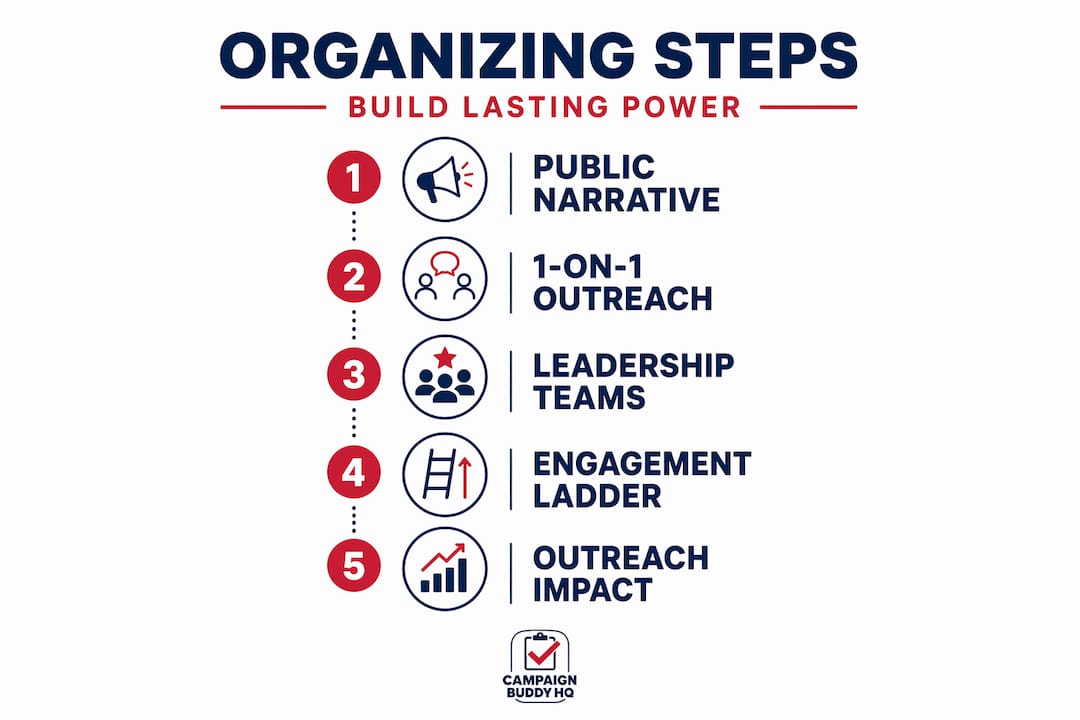
Harvard professor Marshall Ganz developed one of the most widely used frameworks for campaign organizing, built on five core practices that form the backbone of any serious progressive campaign:
- Public Narrative (storytelling): Train leaders and volunteers to tell the Story of Self, Story of Us, and Story of Now. This connects personal motivation to shared values and urgent action.
- Building Relationships (one-on-ones): Structured, intentional conversations that identify values, motivations, and leadership potential in supporters.
- Structuring Leadership Teams: Building a clear hierarchy of trained local leaders, each responsible for a defined group of volunteers or supporters.
- Strategizing (power analysis and targeting): Identifying who has power, what they want, and how to apply pressure effectively toward campaign goals.
- Action (tactics and evaluation): Executing specific tactics, then evaluating what worked and adjusting quickly.
You can learn more about the Marshall Ganz methodology directly, but the practical takeaway is that these five practices work together as a system. Skipping narrative training means your volunteers cannot tell a compelling story at the door. Skipping relational one-on-ones means you miss your best potential leaders. Each element depends on the others.
A major distinction worth understanding is the difference between organizing and mobilizing. Organizers often conflate the two, but they are fundamentally different in scope and purpose:
| Dimension | Organizing | Mobilizing |
|---|---|---|
| Time horizon | Long-term, multi-cycle | Short-term, single event |
| Leadership focus | Developing new leaders | Activating existing supporters |
| Goal | Build relational power | Drive turnout or attendance |
| Typical tools | One-on-ones, structure tests, narrative training | Phone banks, text blasts, event invites |
| Resource intensity | High upfront, lower ongoing | Lower upfront, high ongoing |
| Sustainability | Builds lasting infrastructure | Fades after the event |
Both are needed, but campaigns that rely entirely on mobilizing burn out their staff and supporters without creating anything durable. Getting fluent with campaign terminology helps your team speak the same language across these two distinct modes.
Here is how to structure your leadership team using the Ganz approach:
- Identify five to ten potential leaders in each geographic area through one-on-one conversations.
- Assess each person's commitment level, relational network, and willingness to take on responsibility.
- Assign each leader a small team of five to ten supporters they personally recruit and manage.
- Provide narrative training so leaders can run their own volunteer conversations, not just attend yours.
- Run weekly accountability check-ins tied to clear goal setting for grassroots targets.
- Use structure tests (see below) to assess whether your leadership structure is real or just on paper.
Connecting outreach tracking efficiency to this leadership structure is what turns a theoretical framework into operational results.
Pro Tip: When you assess new leaders, prioritize relational reach over enthusiasm. A volunteer who already has 200 trusted relationships in a neighborhood is far more valuable than a passionate newcomer who does not. Use your one-on-one notes to map who knows whom before you assign leadership roles.
Methods and benchmarks: Ladder of engagement and outreach impact
The mechanics are only part of the story. Let's see how methodology and outreach efforts deliver measurable results for progressive campaigns.
Methodologies grounded in movement organizing emphasize a key tool called the ladder of engagement. This is a way of thinking about supporter development that moves people from initial contact through increasingly committed levels of involvement, ultimately to local leadership.
The stages look roughly like this:
- Aware: The person knows about your campaign.
- Interested: They have signed up, attended an event, or responded to outreach.
- Involved: They have taken a meaningful action, like volunteering for a shift.
- Invested: They are consistently showing up and taking responsibility.
- Leading: They are recruiting and managing others.
Most campaigns focus their energy at the bottom of this ladder, trying to make more people aware. The real leverage is in moving people up the ladder, from interested to leading. That is what structure tests reveal: you assign a specific task to a potential leader (ask them to bring three friends to an event, for example), and you see whether they actually do it. If they do, they are real. If they do not, they may be enthusiastic but not yet committed.
The data on grassroots outreach impact is compelling. Empirical benchmarks from political analytics show that door-to-door canvassing generates a turnout lift of 2.5 to 3.5 percentage points per contact, and the Obama 2008 campaign's use of neighborhood teams produced 30 to 40 percent higher contact rates compared to traditional centralized phone banking. That same campaign registered 2.2 million new voters through organized neighborhood team structures. Successful state-level organizations typically develop between 200 and 700 committed leaders to achieve durable wins.
Grassroots outreach benchmarks:
| Method | Metric | Outcome |
|---|---|---|
| Door-to-door canvassing | Turnout lift per contact | +2.5 to 3.5% |
| Neighborhood team model | Contact rate improvement | +30 to 40% |
| Neighborhood team model | Voter registrations | 2.2M (Obama 2008) |
| Statewide organizing | Committed leaders needed | 200 to 700 |
These are not soft numbers. They come from rigorous field experiments and large-scale campaign analyses. The implication is direct: organizing structures that develop local leaders produce significantly more voter contact per dollar spent than centralized, staff-driven outreach.
Key features of high-performing organizing methodologies include:
- Relational accountability at every level, not just top-down directives
- Clear leader assessments tied to concrete deliverables
- Structure tests built into every phase of the campaign
- Regular evaluation loops that adjust tactics based on what the data shows
You can make these methods much easier to execute consistently with strong outreach checklists and a clear campaign outreach steps process your whole team follows.
Nuanced challenges: Decay effects, quality, and hybrid strategies
Once methods and benchmarks are clear, it's crucial to examine the nuanced challenges and expert-recommended solutions to ensure real campaign impact.
Not every canvassing contact is equal, and not every organizing effort translates to votes. Research on edge cases in political contact reveals several critical nuances that most campaign guides skip over.
The first is contact decay. Early voter contact that happens far from election day tends to have a weaker effect on actual turnout than contact in the final weeks. This does not mean you should only organize late. It means you need to build persistent relational structures that reinforce contact over time, not rely on a single early touch to carry someone all the way to voting.
The second is canvasser quality. This is uncomfortable but important:
"Low canvasser quality reduces the intent-to-treat (ITT) effect from 3.9% to 2.1%, cutting effectiveness nearly in half. Who goes to the door matters as much as whether someone goes at all."
Training, preparation, and selection of your canvassers is not a nice-to-have. It is a core driver of whether your field program actually moves voters. A poorly trained canvasser can actively harm your numbers by creating negative impressions or misrepresenting the candidate's positions.
The third challenge is the boom-and-bust cycle. Expert analysis on organizing sustainability draws a sharp distinction between organizing that builds long-term brick-and-mortar structures versus mobilizing surges that disappear after election day. Many progressive campaigns fall into the boom-and-bust trap: they surge in October, burn out everyone involved, lose or win narrowly, and then the structure evaporates. The next cycle starts from scratch.
Here is a numbered approach to building hybrid strategies that avoid this pattern:
- Start organizing at least six to twelve months before election day, not six weeks.
- Identify and train your initial cohort of local leaders before you start large-scale canvassing.
- Use mobilizing tactics (phone banks, text programs) only after your organizing foundation is in place, so you are activating a real structure rather than building one.
- Design your leader development program to continue after the election, anchoring people in ongoing civic structures.
- Track volunteer retention rates across cycles as a core campaign health metric, not just new volunteer acquisition.
For campaigns in smaller or less dense communities, rural campaign tactics require even more emphasis on the relational side, because broadcast tactics simply do not reach enough people per dollar spent. And keeping your organizers disciplined and consistent over a long campaign requires strong daily planning for organizers habits that prevent burnout and drift.
Pro Tip: Before your next canvassing program launch, run a half-day canvasser training that includes role-play scenarios and narrative practice. Campaigns that invest four hours in pre-launch training consistently outperform those that send volunteers out after a 20-minute briefing. Quality beats quantity at the door every time.
A fresh perspective: Beyond reactive mobilizing for sustained wins
Here is the perspective that most campaign consultants will not give you, because it challenges the model they are paid for.
Digital-only and advertising-heavy campaigns have a structural ceiling. They can generate awareness, they can sometimes persuade persuadable voters, and they can activate people who were already going to vote. What they cannot do is create genuine political power in communities that have been ignored, underserved, or deliberately demobilized. That requires showing up, building trust, and staying present across time, not just across a six-week ad buy.
Deep organizing and long-term base-building consistently outperform reactive mobilization for sustained progressive victories. The NJ-11 win is a specific, documented example of this dynamic. The campaign did not win because it out-advertised its opponent. It won because it built a real network of local leaders who had authentic relationships with voters that no ad could replicate.
The uncomfortable implication is that campaigns need to start treating organizing budget as infrastructure investment, not as a line item to cut when ad buys get expensive. A dollar spent on developing a committed local leader who will recruit and motivate ten other people over six months generates far more return than a dollar spent on a digital impression that most voters scroll past.
Campaigns that develop strong volunteer power strategies and invest in them early do not just win more often. They build something that outlasts any single election, which is the real definition of political success for progressive movements.
"The question is not whether organizing works. The evidence is overwhelming that it does. The question is whether campaigns are willing to start early enough, invest deeply enough, and trust local leaders enough to let it work."
Explore campaign organizing tools and support
Campaign organizing is demanding, detailed work, and the difference between campaigns that sustain momentum and those that collapse mid-cycle often comes down to whether the team has the right operational tools.
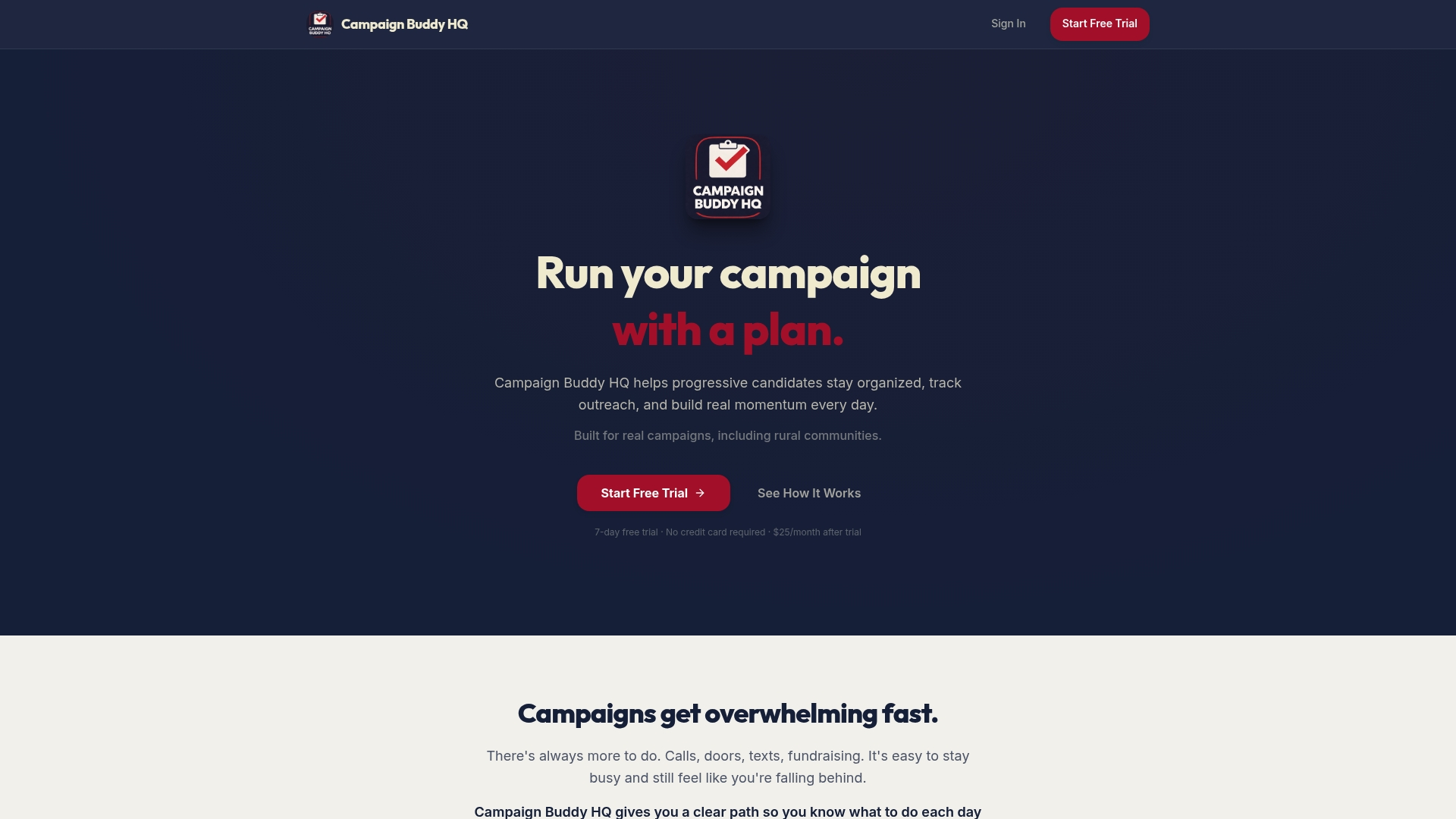
Campaign Buddy HQ is built specifically for progressive campaigns and grassroots organizing teams who need to plan daily outreach, track doors, calls, texts, and registrations, and monitor progress toward campaign goals across every phase of the cycle. Whether you are managing neighborhood teams in a dense urban ward or coordinating volunteers across a rural multi-county district, the platform gives you the workflow structure that keeps your organizing effort on track. You can try it free for seven days with no credit card required.
Frequently asked questions
What is the difference between campaign organizing and mobilizing?
Organizing builds long-term leaders and persistent structures over multiple cycles, while mobilizing drives turnout for a specific event or election day. Both are necessary, but campaigns that skip organizing in favor of pure mobilization tend to burn out without building lasting political power.
How much does grassroots organizing increase voter turnout?
Door-to-door canvassing increases turnout by 2.5 to 3.5 percentage points per contact, and structured neighborhood teams can boost contact rates by 30 to 40 percent compared to centralized phone banking models.
What are the essential steps to start campaign organizing?
Begin with the Ganz five practices: public narrative training, structured one-on-one relationship building, leadership team development, power analysis and strategy, and action with evaluation. Use structure tests early to identify who your actual committed leaders are.
What is a ladder of engagement, and why is it important?
The ladder of engagement is a framework for moving supporters from initial awareness through increasing levels of commitment and responsibility, all the way to local leadership. It is important because it focuses your team on developing leaders, not just accumulating names on a list.