

Fundraising can feel like the most draining part of running a campaign. You're asking people for money, tracking spreadsheets, and hoping the totals add up before the next deadline. But there's a bigger opportunity hiding inside every ask you make. As progressive organizing frameworks suggest, fundraising should be treated as organizing, not just a series of transactions. When you shift that mindset, every donor becomes a potential volunteer, every event becomes a leadership moment, and every dollar raised builds something far more durable than a campaign account balance.
Table of Contents
- Laying the foundation: Why grassroots fundraising matters
- Preparing your campaign: Tools, roles, and readiness
- Executing your grassroots fundraising strategy: Step-by-step
- Tracking success and troubleshooting common pitfalls
- Our perspective: Rethinking fundraising as movement building
- Ready to turn grassroots fundraising into community power?
- Frequently asked questions
Key Takeaways
| Point | Details |
|---|---|
| Fundraising as organizing | Treat fundraising as an opportunity to build leadership and community, not just raise money. |
| Strong foundations matter | Set up the right tools, roles, and protocols before launching fundraising to ensure engagement and success. |
| Participatory strategies win | Direct involvement and storytelling drive deeper supporter commitment and better results. |
| Track and adapt | Regularly measure both engagement and giving, and use lessons learned to refine your approach. |
Laying the foundation: Why grassroots fundraising matters
Grassroots fundraising is fundamentally different from big-dollar donor cultivation. It's not about landing one check that covers your mailer budget. It's about hundreds of people choosing to invest in your cause, and in doing so, becoming more deeply connected to your campaign's mission.
The distinction matters because the way you raise money shapes what your campaign becomes. A campaign built on large, transactional donations creates dependency. A campaign built on small-dollar grassroots giving creates a community. That community votes, volunteers, recruits neighbors, and sticks around after election day.
Good campaign goal setting starts here: define what you want fundraising to accomplish beyond hitting a dollar target. Do you want 200 first-time donors? Fifty new volunteers who came in through a fundraising event? Ten neighbors who now host house parties? Each of these is a measurable community outcome.
The messaging shift is equally important. Rather than framing donations as a financial need ("help us reach our goal!"), frame them as belonging and participation ("join the 150 people from your neighborhood who are already part of this movement"). Here's a framing principle worth keeping close:
"The goal is not only to extract donations but to grow supporter leadership and organizational capacity—so messaging and tactics should explicitly tie giving to participation and community-building."
Key principles to anchor your foundation:
- Participation over extraction. Every ask should invite people deeper into the campaign, not just out of their wallets.
- Transparency builds trust. Show donors exactly how their contribution connects to a specific action or outcome.
- Leadership development is a fundraising goal. Track how many donors convert to volunteers or event hosts.
- Small amounts matter. A $10 donation from someone who has never given before is worth more to your community infrastructure than a $500 donation from someone who will never engage again.
When you build fundraising on these principles, you're not just raising money. You're building the organizational muscle that wins races and sustains movements.
Preparing your campaign: Tools, roles, and readiness
With your motivation set, it's time to assemble the pieces you'll need to run an effective, community-centered program. Preparation isn't glamorous, but campaigns that skip it spend their energy managing chaos instead of building community.
Essential tools you need in place before you launch:
| Tool category | Purpose | Example use |
|---|---|---|
| Donor management (CRM) | Track giving history, engagement, follow-up | Segment donors by amount, region, or engagement level |
| Communication platform | Email, text, and phone outreach | Send personalized ask sequences and thank-you messages |
| Donation processing | Accept online and in-person gifts | Track real-time totals and issue automatic receipts |
| Outreach tracker | Log volunteer and staff activity | Monitor doors knocked, calls made, and events hosted |
| Scheduling tool | Coordinate events and volunteer shifts | Prevent gaps in activity during high-stakes periods |
Each tool should feed information back to a central location so your team isn't working in silos. When your volunteer coordinator doesn't know who your top donors are, you miss easy conversion opportunities. When your fundraising lead doesn't know which doors got knocked last week, you miss the chance to ask warm contacts for support.
Volunteer roles in fundraising:
Your volunteer strategies need to include fundraising-specific assignments. Most campaigns think volunteers are for canvassing. The best campaigns use volunteers at every stage of fundraising, including outreach, event hosting, donor follow-up, and phone banking for small-dollar asks.
Assign clear roles before launch. A "fundraising captain" for each geographic zone, a follow-up caller who calls donors 48 hours after events, and a "thank you team" who writes personal notes to first-time donors. These roles signal to volunteers that fundraising is a serious part of the movement, not an afterthought.

Use your campaign checklists to ensure every team member knows their role and has completed the right prep steps before outreach begins.
Readiness checklist before your first ask:
- Clean, segmented donor and supporter list loaded into your CRM
- Fundraising message tested with 5 to 10 current supporters for clarity and resonance
- Staff and volunteers briefed on campaign goals and what each dollar enables
- Thank-you sequence automated and ready to fire after each donation
- Event dates confirmed with locations and hosts secured
- Follow-up schedule assigned to specific team members
As the organizing-based approach to fundraising argues, campaign fundraising tactics should reinforce community-building and leadership capacity. That means your readiness work isn't just logistical. It's relational. Every person who joins your volunteer fundraising team should understand they're building something together, not just completing tasks.
Pro Tip: Schedule a shared onboarding session for all fundraising volunteers before launch. Walk them through the campaign's values, the specific goals, and the stories behind your candidate or cause. Volunteers who understand the "why" convert more donors and stay engaged longer than those who only know the "what."
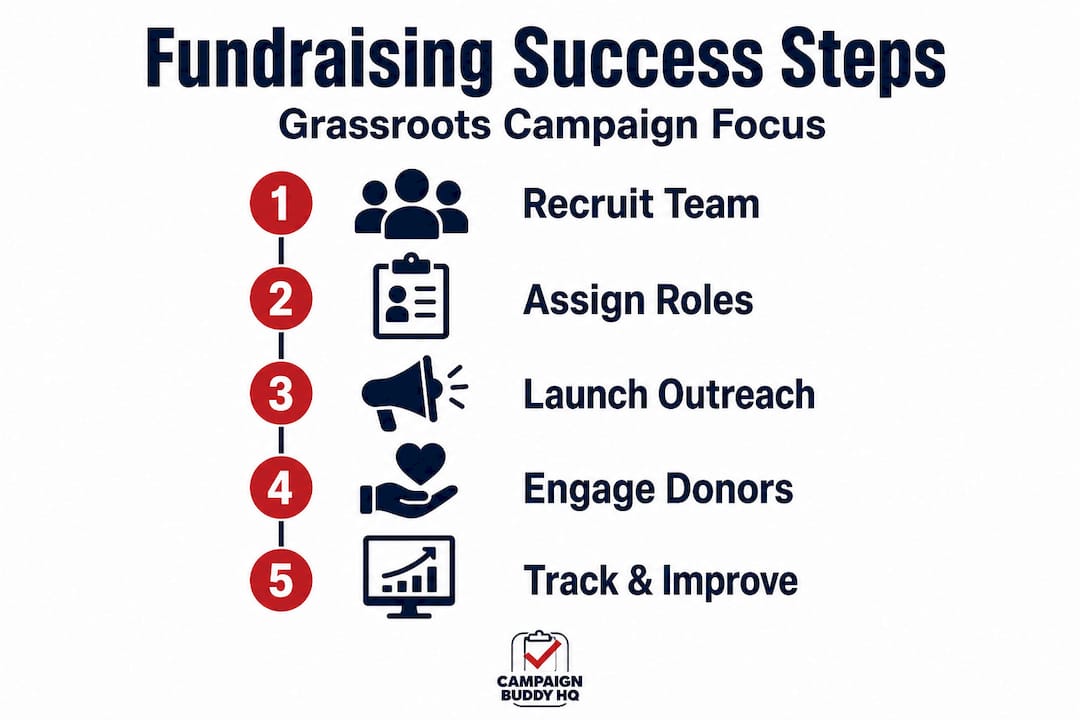
Executing your grassroots fundraising strategy: Step-by-step
After prepping your team and tools, it's time to put the grassroots fundraising plan into action. Execution is where most campaigns either build momentum or stall out. A clear sequence keeps everyone moving in the right direction.
Step-by-step execution guide:
-
Build your tiered outreach list. Segment contacts by relationship level: warm (previous donors or volunteers), cool (past attendees or signers), and cold (new community contacts). Start with warm contacts first. Conversion rates are dramatically higher, and early wins build team confidence.
-
Craft personalized asks. Generic asks get ignored. Reference something specific: the supporter's neighborhood, a past event they attended, or a local issue that matters to them. A message that says "You signed our petition about housing last spring, and now we're asking you to invest in the campaign that will make it happen" performs far better than a mass appeal.
-
Use storytelling throughout the ask. Every outreach piece should include at least one story about a real person affected by the issue. Numbers inform; stories move people to act. Your outreach guide can help shape this content strategy for each channel.
-
Make the ask clear and specific. "Can you give $25 today to help us knock 500 more doors before the primary?" is far more effective than "Please donate whatever you can." Specificity creates confidence. People want to know their gift matters in a tangible way.
-
Follow up without apology. Most donations happen on the second or third ask. Build a three-touch follow-up sequence for every ask: an initial message, a reminder at 48 hours, and a final message with a deadline. Don't guilt people. Reinforce the opportunity.
-
Connect every gift to an ongoing action. When someone donates, immediately invite them to a next step: attend an event, recruit a neighbor, or sign up to volunteer. This is the heart of treating fundraising as organizing, not transactions. Use your ability to track outreach activity to confirm these follow-up steps actually happen.
Comparing direct asks versus event-based strategies:
| Approach | Strengths | Best use case |
|---|---|---|
| Direct ask (email/text/phone) | Scalable, low cost, easy to track | Warm or previous donors, urgent deadlines |
| House party / small event | Builds personal connection, high conversion | New communities, volunteer recruitment |
| Crowdfunding push | Creates public momentum, good for visibility | Launch periods, matching gift drives |
| Door-to-door canvass ask | High-touch, relationship-building | Neighborhood organizing, first-time asks |
Pro Tip: Every time you ask for a donation, connect it explicitly to a campaign action or milestone. "We just hit 1,000 doors this week. Your gift of $20 helps us hit 2,000 next week." This transforms the donation from a financial favor into participation in something real and measurable.
Tracking success and troubleshooting common pitfalls
Running your campaign is only half the battle. Measuring and refining your approach ensures long-term grassroots growth and prevents your team from repeating avoidable mistakes.
Metrics worth tracking beyond dollar totals:
- Number of first-time donors acquired each month
- Conversion rate from donor to volunteer or event attendee
- Repeat donation rate within a 90-day window
- Average donation size by outreach channel
- Number of volunteers actively participating in fundraising activities
- Qualitative feedback from donor conversations at events
Campaigns that only track total dollars raised miss the deeper health indicators. A campaign that raised $10,000 from five donors is far more fragile than one that raised $8,000 from 400 people. More donors means more relationships, more resilience, and more capacity to build campaign momentum with data.
Common pitfalls to watch for:
- Transactional messaging. Asks that focus only on financial urgency ("we need to hit our goal!") with no community context drain goodwill and produce one-time donors who never re-engage.
- Missing the follow-up. Most campaigns thank donors once and move on. Donors who don't hear back after giving are unlikely to give again. Build a structured follow-up cadence into your workflow.
- No clear next step. After someone donates, they should immediately know what they can do next. A dead end after a donation wastes a warm relationship.
- Volunteer burnout. When fundraising volunteers are asked to "just make calls" without understanding the larger mission, they burn out fast. Tie every task back to purpose.
- Ignoring small donors. A $10 donor who attends three events, recruits a neighbor, and knocks 50 doors is worth more to your campaign than a $500 donor who does nothing else. Your campaign consistency tactics should include regular recognition and engagement for small-dollar supporters.
The importance of relational metrics:
Research on organizing-based campaigns consistently shows that fundraising reinforcing community-building and leadership capacity is the distinguishing factor between campaigns that fade and movements that last. Track qualitative outcomes: how many donors can name your candidate's top three priorities? How many have introduced a friend to the campaign? These signals tell you whether your fundraising is building power or just collecting money.
Pro Tip: After every major fundraising event or campaign push, hold a team debrief within 48 hours. What worked? What messaging fell flat? Which follow-ups are outstanding? This habit turns each effort into a learning cycle and keeps your team aligned on organizing principles, not just revenue targets.
Our perspective: Rethinking fundraising as movement building
Here's something most fundraising guides won't tell you: the campaigns that struggle most with donor retention and volunteer engagement usually have the same problem. They've accidentally taught supporters that the only thing they're needed for is money.
It sounds harsh, but it happens easily. You send an email when there's a deadline. You call when the monthly total is short. You text when there's a match drive. What you're training donors to expect is that you'll only contact them when you need something. That pattern destroys the sense of belonging that turns a supporter into a movement participant.
The more powerful insight, backed by organizing-based fundraising thinking, is that every fundraising interaction is a chance to make someone feel like a leader. Not a customer. Not a source of revenue. A leader. That means your outreach should include updates, wins, behind-the-scenes stories, and invitations to take new roles, not just asks.
When you treat your donor list as your leadership pipeline, a few things shift. Donors start referring friends without being asked. They show up to events because they want to, not because you sent a reminder. They give again because they feel invested in an outcome, not just obligated to a campaign. Growing your campaign volunteer power is inseparable from this kind of donor cultivation.
Progressive campaigns have a built-in advantage here. The issues we fight for, housing, healthcare, climate, democracy, are inherently about community and collective action. Fundraising that reflects those values doesn't just raise more money. It builds the kind of resilient base that sustains a movement through losses, pivots, and the slow grind of long-term change.
Ready to turn grassroots fundraising into community power?
The strategies in this guide work best when your team has the infrastructure to track, organize, and act on every interaction. Knowing who donated, who followed up, who attended an event, and who still needs a personal call makes the difference between a campaign that scrambles and one that scales.
Campaign Buddy HQ is built specifically for progressive campaigns that want to run outreach and fundraising as true organizing. With tools for tracking donor and volunteer activity, planning daily and weekly outreach, and monitoring progress toward campaign goals, you can keep your whole team aligned and accountable without managing a dozen separate spreadsheets. Start your free 7-day trial, no credit card required, and see how structured support makes the community-building work easier to sustain.
Frequently asked questions
What is grassroots fundraising in political campaigns?
Grassroots fundraising focuses on raising small-dollar donations from many supporters, emphasizing community-building and participation rather than transactional giving. As organizing frameworks make clear, it treats every donor as a potential leader rather than a one-time source of revenue.
How can I motivate volunteers to help with fundraising?
Connect fundraising roles to leadership development and show each volunteer how their specific work grows the movement's capacity. When volunteers understand that fundraising reinforces community-building and not just the campaign account, their engagement and retention improve significantly.
What's the best way to personalize fundraising asks?
Use supporter data to reference specific actions they've already taken and link their donation directly to a local issue or upcoming campaign milestone. This approach reflects the principle that fundraising as organizing means every interaction should deepen connection, not just request a transaction.
What metrics should I track to evaluate grassroots fundraising?
Measure new supporters, repeat donors, volunteer conversions, and qualitative engagement alongside total dollars raised. Campaigns that track community-building and leadership capacity as outcomes, not just revenue, build far more durable and effective bases for long-term impact.