
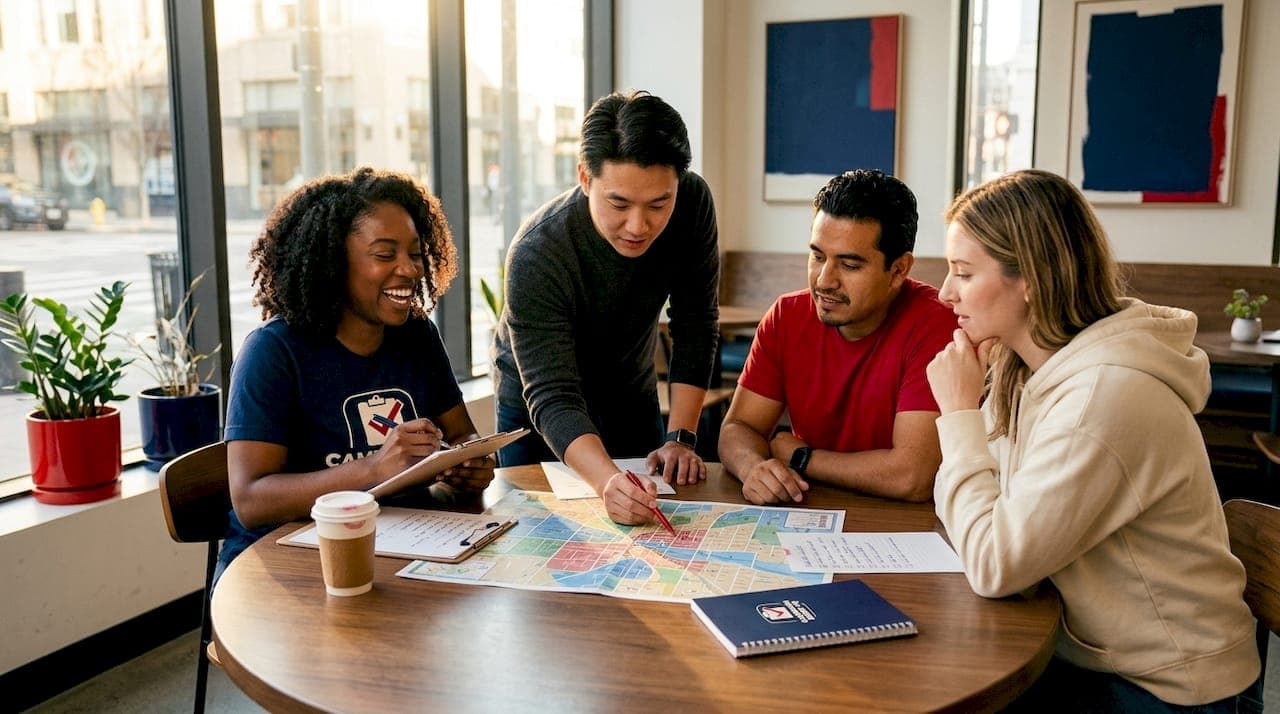
Progressive organizers in 2026 face a tougher challenge than ever. Voters are distracted, budgets are tight, and the gap between a clever tactic and a genuinely effective one is wider than most campaign playbooks admit. Picking the right progressive campaign activity ideas is not about doing everything. It is about doing the right things, in the right order, for the right people. This article gives you a curated set of tactics, from hyperlocal grassroots events to precision digital outreach, with the criteria to choose between them and the data to back each one up.
Table of Contents
- Key takeaways
- How to choose the right progressive campaign activities
- 1. Multi-stage progressive celebration campaigns
- 2. Community listening sessions on affordability
- 3. Narrative-driven neighborhood canvassing
- 4. Peer-to-peer text and phone outreach
- 5. Creative small-dollar fundraising events
- 6. AI-assisted content ideation and targeting
- 7. Political SMS marketing for GOTV and fundraising
- 8. Authentic short-form video content
- 9. Segmented email and social media campaigns
- Comparing progressive campaign activities by impact and cost
- Situational recommendations for different campaign contexts
- My honest take on where progressive campaigns go wrong
- Put your campaign activities to work with Campaignbuddyhq
- FAQ
Key takeaways
| Point | Details |
|---|---|
| Segment before you act | Tailoring activities to specific voter groups dramatically outperforms generic outreach in both response and conversion rates. |
| Grassroots and digital work together | The strongest campaigns pair in-person canvassing and community events with SMS, video, and email for maximum reach. |
| Phase your rollout | Starting with a small test group lets you fix problems before scaling, protecting your budget and volunteer time. |
| Authentic storytelling wins | Content grounded in real personal experience outperforms polished slogans on every measurable engagement metric. |
| Follow-up is where conversions happen | Warm follow-up nudges to non-responders consistently yield the highest donation and volunteer conversion rates. |
How to choose the right progressive campaign activities
Before you plan a single event or send a single text, you need a framework for choosing which activities belong in your campaign at all. Not every idea that sounds good on paper will work for your community, your budget, or your timeline.
Start with issue alignment. Progressive affordability policies on housing and prescription drugs draw up to 65% support across party lines, including significant Republican backing. That kind of broad appeal means your activities should create space for voters who are not already in your corner to find common ground. Community listening sessions centered on housing costs or healthcare will land differently, and better, than a rally that preaches to the converted.
Next, honestly assess your resources:
- Budget: Small-dollar fundraising events require a realistic anchor. A first fundraising milestone of $2,500 to $5,000 in the first week gives local campaigns early momentum without overextending.
- Volunteers: Know how many hours you can realistically commit before choosing labor-intensive tactics like door-to-door canvassing.
- Technology: If your team cannot manage a CRM, do not build your strategy around one yet.
Segment your audience before you do anything else. Generic message blasts consistently reduce campaign effectiveness. Split your supporter list by neighborhood, voting history, or issue priority, then design activities that speak directly to each group.
Pro Tip: Think of your campaign activities as the start of a relationship, not a transaction. Every door knock, text, or event should be designed with a follow-up in mind, whether that is a phone call, a volunteer ask, or a donation request two weeks later.
1. Multi-stage progressive celebration campaigns
One-time events create a spike in energy and then nothing. Multi-stage celebration campaigns that include a countdown, a main event, and follow-up stories build the kind of sustained supporter loyalty that one-off rallies cannot touch.
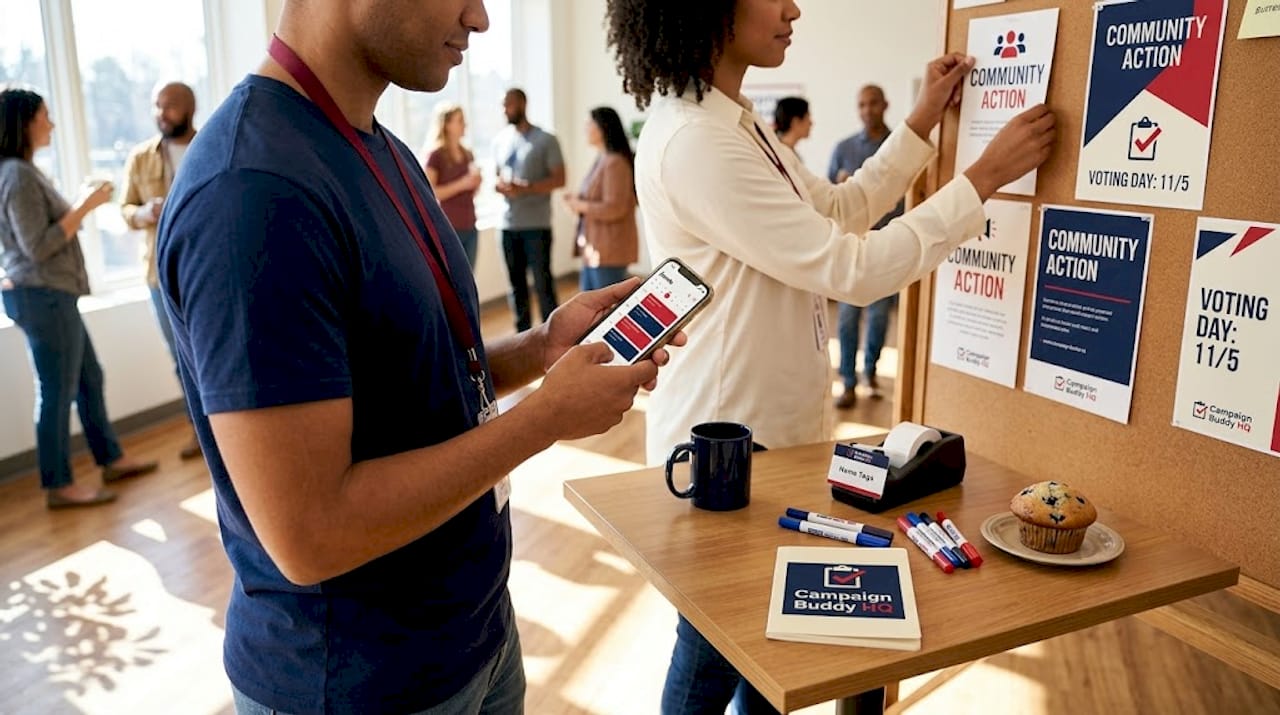
In practice, this means announcing a milestone, such as 500 doors knocked or a fundraising goal reached, building anticipation with social posts and texts in the days before, hosting the actual celebration event, and then sharing photos, quotes, and results in the week after. Each stage adds another touchpoint without requiring a full new event.
2. Community listening sessions on affordability
Forget the town hall format where the candidate talks for 45 minutes. A real listening session puts voters in small groups of eight to twelve people and asks them to describe what housing costs, healthcare bills, or childcare access looks like in their own lives.
This format works for two reasons. You get genuine intelligence about what voters actually care about, not what you assume they care about. And the people in the room feel heard, which is the foundation of long-term supporter engagement. Pair these sessions with progressive campaign messaging tips that connect local stories to broader policy solutions.
3. Narrative-driven neighborhood canvassing
Generic scripts kill canvassing. The moment a voter hears a canned pitch, they check out. Train your canvassers to open with a personal story, a real one, about how the campaign's core issue has affected someone they know or themselves.
This approach does two things. It makes the conversation human rather than transactional. And it gives your canvassers something they actually believe in, which keeps volunteer energy higher across a long campaign season. See campaign volunteer strategies for more on keeping your field team motivated.
4. Peer-to-peer text and phone outreach
Peer-to-peer texting is not cold outreach. It is a volunteer sending a personal message to a real person on a targeted list, with a real name attached. The difference in response rates compared to broadcast SMS is significant.
Segment your outreach by voter type: likely progressive voters get a mobilization message, soft supporters get a persuasion message, and lapsed donors get a re-engagement message. Each group gets a different conversation, not a different version of the same script.
Pro Tip: Give your peer-to-peer texters two or three approved conversation paths rather than a single script. Real conversations go in real directions, and a rigid script makes volunteers freeze when someone asks a question that is not on the page.
5. Creative small-dollar fundraising events
A wine-and-cheese reception targets one slice of your donor base. A trivia night at a local bar, a progressive movie screening, a community mural painting session, these events attract people who would never come to a traditional fundraiser and often convert them into recurring donors.
The key is connecting the event format to a local cultural identity rather than a generic political brand. When an event feels like it belongs to the community, people who attend feel ownership over the campaign, not just obligation to it.
6. AI-assisted content ideation and targeting
67% of high-performing campaign professionals now use AI tools in content creation and targeting strategies. For progressive organizers, that means using AI to generate email subject line variations, social post drafts, and audience segment descriptions, not to replace your message, but to produce it faster and test it smarter.
Use AI to generate five versions of a fundraising email subject line, then A/B test two of them before your full send. The data will tell you what works before you commit your full list to a message that might underperform.
7. Political SMS marketing for GOTV and fundraising
SMS open rates exceed 90%, and most messages get read within minutes. No other channel gives you that kind of reach with that kind of speed. For get-out-the-vote drives and time-sensitive fundraising asks, SMS is your most direct tool.
Broadcast SMS works for announcements. Peer-to-peer texting works for persuasion and personal asks. Use both, but never confuse them. Personalized merge fields in SMS messages consistently outperform generic blasts in response rates. Adding a first name and a specific local reference costs almost nothing and meaningfully changes results.
8. Authentic short-form video content
Effective progressive video content sparks emotion through core truths rather than slogans and captures attention within the first three seconds on TikTok and Instagram Reels. That is a narrow window, and polished production values do not help you hit it.
What does help: a real person, a real problem, a real thirty-second story. A volunteer describing why they knock doors every Saturday. A local teacher explaining what the school funding fight means to her classroom. Authentic smartphone-shot updates from campaign leadership routinely outperform expensive studio productions because they feel real. That is the currency that drives sharing.
9. Segmented email and social media campaigns
Your email list is not one audience. It is a dozen audiences at different stages of commitment. Treat it that way. Sort supporters by engagement level, donation history, and issue interest, then write emails that address each group's specific position in their relationship with your campaign.
The same logic applies to social media. A Facebook group for local neighborhood captains gets different content than your public Instagram feed. A LinkedIn post about campaign policy positions reaches a different slice than a TikTok video. Use the right format for the right platform and the right audience. For a deeper look at 2026 outreach trends, the data strongly favors multi-channel campaigns that optimize continuously.
Comparing progressive campaign activities by impact and cost
| Activity | Estimated cost | Volunteer hours | Voter engagement | Fundraising potential |
|---|---|---|---|---|
| Neighborhood canvassing | Low | High | Very high | Low |
| Community listening sessions | Low | Medium | High | Low |
| Peer-to-peer texting | Low | Medium | High | Medium |
| SMS broadcast campaigns | Low to medium | Low | High | High |
| Short-form video (organic) | Very low | Low | Medium to high | Low |
| Small-dollar fundraising events | Medium | Medium | Medium | High |
| Multi-stage celebration campaigns | Low to medium | Medium | High | Medium |
| AI-assisted content and email | Low | Low | Medium | High |
Phased rollout best practice means you start any new tactic with a small test group before committing your full list or volunteer pool. That protects your budget and gives you real data before you scale. A canvassing program tested in two precincts before expanding to ten will perform measurably better than one launched everywhere at once.
Budget-friendly options like peer-to-peer texting and short-form video require time but almost no money, which makes them ideal entry points for campaigns in their first phase. Resource-intensive options like large events and broadcast SMS need infrastructure in place before you commit to them.
Situational recommendations for different campaign contexts
The right mix of activities shifts significantly depending on your campaign's size, geography, and stage.
- Small-budget hyperlocal campaigns: Prioritize listening sessions, narrative canvassing, and peer-to-peer texting. These require people, not money, and they build the most durable community relationships.
- Urban campaigns: Short-form video and segmented social media campaigns scale well and reach voters who are harder to contact at the door. Partner with local organizations to extend your reach without adding staff.
- Rural and low-density campaigns: Canvassing and phone outreach still dominate. Community events tied to local culture, a county fair presence, a church parking lot voter registration drive, outperform digital-first tactics in lower-density areas.
- Mobilization-focused campaigns: Concentrate on SMS GOTV, peer-to-peer texting, and multi-stage events that build toward Election Day with clear momentum markers.
- Fundraising-focused campaigns: Email segmentation, small-dollar events, and warm follow-up nudges to non-responders yield the highest conversion rates. Most organizers underestimate how much the follow-up nudge matters.
Pro Tip: Build feedback loops into every activity. After each canvassing session, listening event, or text campaign, hold a fifteen-minute debrief with your team. What surprised people? What objections came up? That information reshapes your next round of messaging faster than any analytics platform can.
My honest take on where progressive campaigns go wrong
I have watched a lot of progressive campaigns make the same mistake. They invest in a splashy launch event, see a bump in social media followers, and then mistake that attention for momentum. It is not. Real momentum is built in the quieter work that follows: the follow-up call three days later, the text to the person who almost donated, the second conversation with a soft supporter at the door.
The other pattern I see constantly is over-reliance on polish. Campaigns spend real money on a professionally produced video that gets ignored, while a thirty-second phone-camera clip of a volunteer talking about why she canvasses every weekend gets shared five hundred times. Authentic content beats slick content in almost every measurable way, and most organizers still do not fully believe that.
AI tools are genuinely useful for content ideation and A/B testing, but they cannot replace the human judgment that knows which neighborhood needs a listening session versus which one needs a phone bank. Use AI to work faster. Use your organizers to work smarter.
The campaigns I have seen sustain volunteer enthusiasm longest are the ones that treat volunteers as stakeholders, sharing results, celebrating milestones, and asking for input on strategy. People burn out when they feel like cogs. They stay when they feel like co-owners.
— Billy
Put your campaign activities to work with Campaignbuddyhq
Choosing the right activities is only half the equation. Executing them consistently, tracking what works, and adjusting in real time is where most campaigns lose ground.
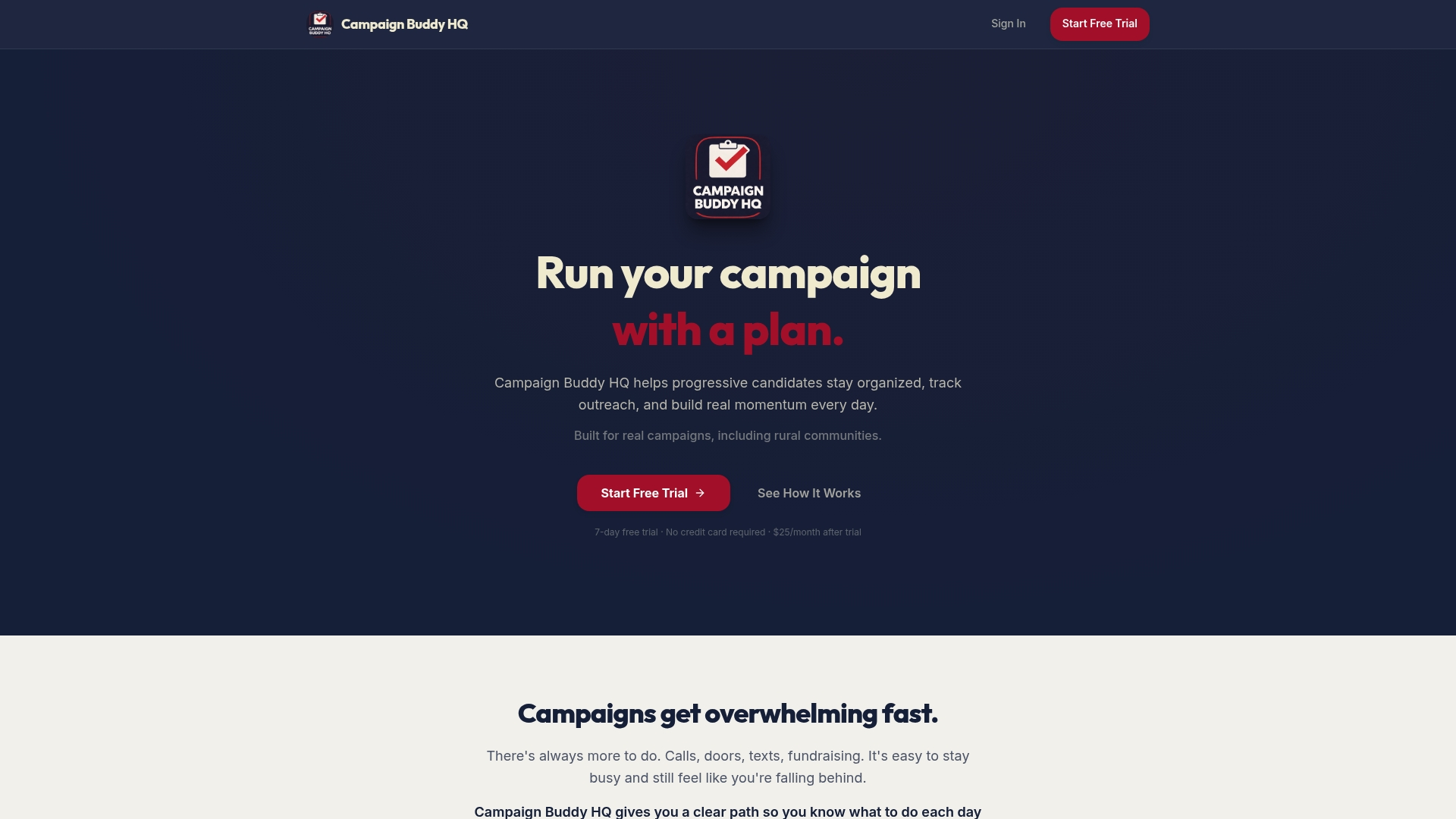
Campaignbuddyhq gives progressive organizers a single platform to plan daily outreach, log doors, calls, and texts, track supporter engagement, and monitor progress toward campaign goals. Whether you are running a hyperlocal race or scaling a multi-county operation, the platform is built for real campaign workflows, including rural and low-density communities that other tools overlook. You can explore Campaignbuddyhq with a free seven-day trial, no credit card required. Your activities are only as effective as the system tracking them.
FAQ
What are the most cost-effective progressive campaign activities?
Peer-to-peer texting, narrative-driven canvassing, and short-form video are the lowest-cost, highest-engagement options for most campaigns. They require volunteer time rather than budget.
How do I choose between digital and in-person activities?
Urban and younger-voter-heavy campaigns benefit more from digital tactics like SMS and social video, while rural and older-voter campaigns typically see stronger results from in-person canvassing and phone outreach. Most campaigns should use both.
How important is audience segmentation for campaign outreach?
Generic message blasts reduce effectiveness significantly. Segmenting supporters by issue interest, engagement level, or voting history and tailoring messages accordingly is one of the highest-return improvements any campaign can make.
What makes short-form video effective for progressive campaigns?
Video that leads with a real personal story and captures attention in the first three seconds consistently outperforms polished, slogan-driven content on platforms like TikTok and Instagram Reels.
How should I structure my first 30 days of campaign activity?
Focus the first week on setting a concrete fundraising milestone, building your supporter list, and testing one or two outreach channels with a small group before scaling. Phased rollout reduces risk and generates real data early.