

Campaign messaging is one of those terms that sounds self-explanatory but gets misunderstood constantly. Most people assume it means clever slogans or punchy ad copy. It's not. What is campaign messaging, really? It's the full architecture of how your candidate communicates values, vision, and priorities to voters in a way that moves them to act. Crafting effective campaign messages means connecting with voters at every touchpoint and guiding them toward specific actions, whether that's showing up to vote, knocking doors, or donating. This guide breaks down exactly how that works for progressive campaigns.
Table of Contents
- What is political campaign messaging?
- Building blocks of an effective campaign message
- Knowing your audience and crafting your core message
- Implementing campaign messaging across outreach channels
- Common pitfalls and expert tips for progressive campaigns
- Why most campaign messaging advice misses the mark
- How Campaign Buddy HQ can streamline your messaging and outreach
- Frequently asked questions
Key Takeaways
| Point | Details |
|---|---|
| Campaign messaging role | Campaign messaging defines your candidate’s core values and directs voter and volunteer actions. |
| Message fundamentals | Clarity, consistency, relevance, and clear calls to action are essential for effective messaging. |
| Audience insights | Deep understanding of demographics and motivations shapes persuasive, targeted messages. |
| Multi-channel operation | Implement messaging across digital, SMS, and in-person outreach using coordinated strategies. |
| Avoid jargon pitfalls | Focus on emotional, relatable outcomes over technical policy details to connect with voters. |
What is political campaign messaging?
Political campaign messaging is the system your campaign uses to tell its story. Not just once, and not just in one place. It covers every speech, every door knock script, every text blast, and every social media post your campaign puts into the world.
Political campaign messaging involves strategies and techniques used to convey a campaign's core message across speeches, ads, and social media formats. That core message is the single throughline that gives all of those different formats their meaning and coherence.
Think of campaign messaging as the candidate's public identity translated into language. It answers three questions voters are always asking:
- Who is this person?
- What do they stand for?
- Why should I care?
When your messaging is sharp, those questions get answered fast and consistently, no matter where a voter encounters your campaign. When messaging is loose or inconsistent, voters fill in the blanks themselves, and rarely in your favor.
"A campaign without a clear message is a campaign that asks voters to do your job for you."
Messaging also directs behavior. It's not enough for voters to feel warm toward your candidate. Good messaging drives specific actions: registering, showing up at a rally, signing a petition, or volunteering. This is where your campaign outreach strategies and your message have to work together as one unit, not as separate operations.
Building blocks of an effective campaign message
Understanding the campaign messaging definition is step one. Knowing what makes a message actually work is where campaigns separate themselves.
Key building blocks for an effective campaign message are clarity, consistency, relevance, and a clear call to action telling supporters what to do next. Each one pulls real weight.
- Clarity means a voter reads your message once and knows what you stand for. No five-point policy summaries, no academic language. Plain, direct communication.
- Consistency means the same core message shows up in every format. A door knock script, a fundraising email, and an Instagram caption should all feel like they come from the same campaign.
- Relevance means your message meets voters where they are. A rural voter worried about hospital closures needs different framing than a suburban parent focused on school funding, even if your underlying position is the same.
- A strong call to action closes the loop. "Learn more" is weak. "Knock three doors this Saturday" is specific and motivating.
"Voters don't need to agree with every position your candidate holds. They need to believe your candidate understands their life and will fight for it."
Pro Tip: Write your core message in one sentence and test it on someone outside politics. If they can immediately explain it back to you, it works. If they ask follow-up questions, it needs more work.
One thing that separates campaigns that maintain campaign consistency from those that don't is a written message guide. Not a brand deck. A practical document that tells every volunteer, staffer, and surrogate exactly what words to use and which framing to avoid.
Knowing your audience and crafting your core message
A strong message that reaches the wrong audience is wasted. Before you write a single word of copy, you need a clear picture of who you're talking to.
Developing a core message starts with understanding the target audience's demographics, psychographics, pain points, and motivations, then translating this into a value proposition. Here's a practical process for doing that:
- Map demographics first. Age, location, income level, and education shape how people receive information and which issues feel most urgent to them.
- Go deeper with psychographics. What do your voters value? What makes them anxious? What does fairness mean to them? These answers shape emotional resonance more than any policy position.
- Identify the pain point your candidate solves. Voters back candidates who feel like solutions. What specific problem is your candidate positioned to fix, and for whom?
- Build a value proposition. This is the sentence that says: "Vote for [candidate] because [specific reason that matters to you]." It connects your candidate's strength to the voter's need.
- Set SMART goals for your messaging. What does success look like? More volunteer sign-ups? Higher voter contact rates? Effective campaign goal setting turns abstract message priorities into measurable outcomes.
Pro Tip: Don't write your core message in a conference room with campaign staff. Go have ten real conversations with likely voters first. The phrases they use to describe their own concerns are often far more powerful than anything a strategist will invent.
Inclusive campaign messaging ideas come directly from this research phase. When you understand who feels left out of political conversations in your district, you can build a message that deliberately makes space for them. That's not just good ethics. It's good organizing.
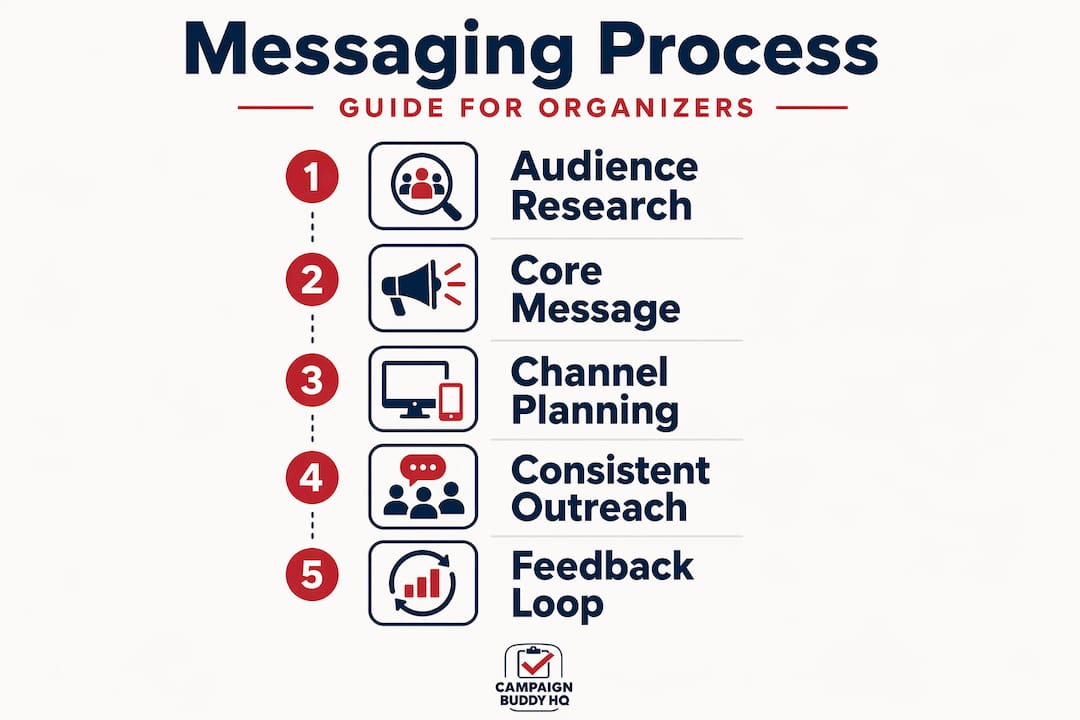
Your guide to campaign outreach should reflect this audience work. If your message is built around the right value proposition, outreach becomes a process of amplification rather than persuasion from scratch.
Implementing campaign messaging across outreach channels
Knowing how to create campaign messages is only part of the job. The harder work is executing them consistently across every channel your campaign uses.
Political SMS marketing uses broadcast and peer-to-peer texts for fundraising, GOTV, volunteer recruitment, surveys, and voter conversations. These are two different tools with different jobs:
| SMS type | Best use | Tone |
|---|---|---|
| Broadcast SMS | Mass announcements, GOTV pushes, event reminders | Direct, urgent, brief |
| Peer-to-peer SMS | Personal outreach, volunteer recruitment, persuasion | Conversational, relational |
Digital political advertising requires speed and audience segmentation to deliver timely messages post-events, with different messaging per segment. That means your digital team needs to be able to turn around new creative within hours when a news event creates an opening, and they need audience lists already segmented so the right version hits the right people.
Beyond SMS and digital ads, here is what channel implementation actually looks like in practice:
- Canvassing scripts should mirror the exact language of your core message, not a staffer's rewrite of it.
- Phone bank scripts need shorter sentences because of how people hear versus read.
- Email sequences should build over time, starting with story and moving toward action.
- Social media amplifies message to people who are not yet in your voter contact universe.
Pro Tip: Layer your outreach. A voter who receives a text, sees a door knock, and gets a phone call in the same week is dramatically more likely to act than someone who gets a single touchpoint. Design your contact cadence intentionally around your message timing.
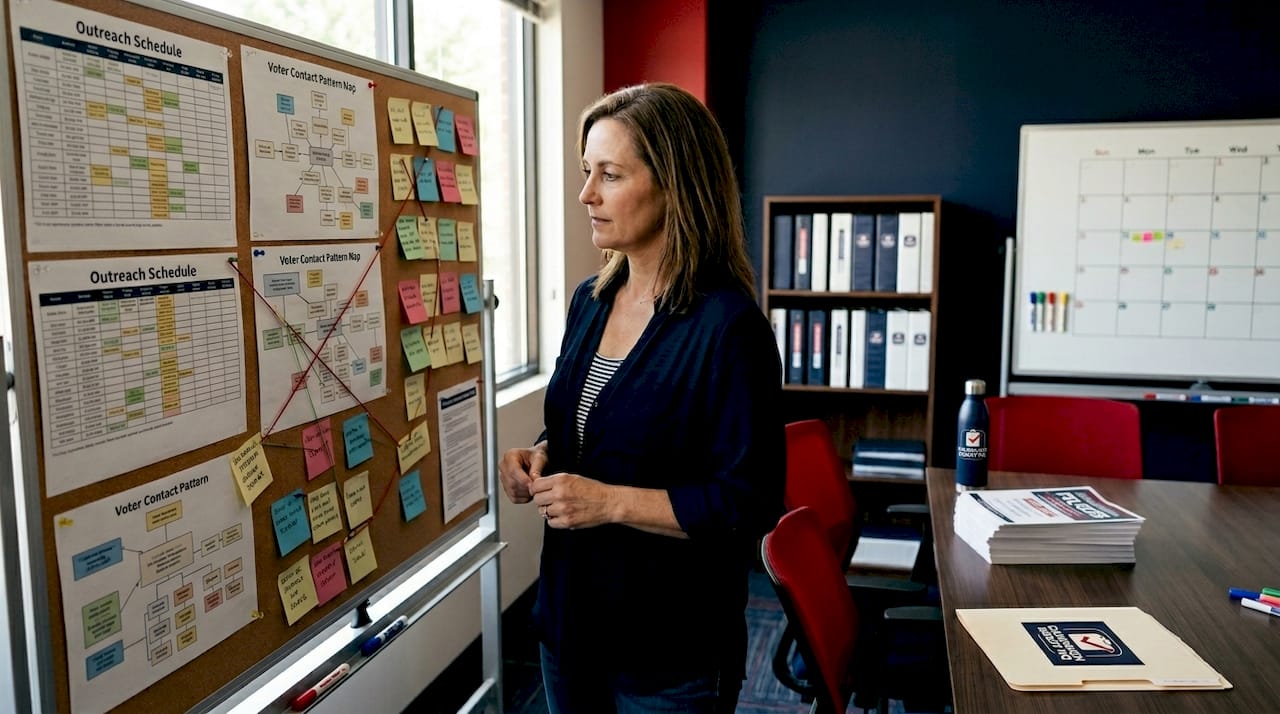
Keeping all of this organized outreach success requires more than enthusiasm. It requires systems that track what went out, who received it, and what response it generated.
Common pitfalls and expert tips for progressive campaigns
Even well-resourced progressive campaigns make the same messaging mistakes repeatedly. Knowing what those are lets you avoid them before they cost you voters.
Over-policying and jargon reduce voter persuasion. Progressive campaigns succeed by translating policies into relatable benefits tied to trust, safety, and fairness. Voters do not want a white paper. They want to know: will this make my life better?
Messaging as an organizational system requires unifying voice and coordinated layering across outreach to build cumulative engagement. That means the mistake is not just messaging that sounds wrong. It's messaging that sounds different depending on who delivers it.
Common pitfalls to watch for:
- Jargon-heavy framing. "Systemic equity investment" means nothing to most voters. "Making sure every kid in this county has a fully funded school" means everything.
- Candidate-centered copy. Voters care about themselves, not your candidate's resume. Flip the frame.
- One-size messaging. Sending the same message to a union member and a first-time voter in a college town is a missed opportunity.
- Weak or missing calls to action. Awareness without action is just advertising.
- No feedback loop. If you never test which messages perform, you are guessing instead of learning.
"The campaigns that win are not always the ones with the best candidate. They are the ones who know what their voters are afraid of, and offer hope in their specific language."
Pro Tip: Build an emotional check into your message review process. Before you approve any piece of copy, ask: what does this make a voter feel? If the answer is "informed," it's not ready. If the answer is "seen" or "hopeful" or "angry in the right direction," you're close.
Your campaign volunteer strategies also depend on this. Volunteers who understand the emotional core of a campaign message deliver it more convincingly than volunteers reading from a script they don't believe.
Why most campaign messaging advice misses the mark
Here's the uncomfortable truth most guides won't tell you. Campaign messaging is not primarily a creative problem. It's an operational one.
Campaign messaging functions as an operational constraint requiring shared voice, tone, and structure to prevent conflicting supporter frames. Read that again. It is a constraint. That means its job is partly to stop people from going off-script, not just to inspire them.
Most messaging advice focuses on how to write a compelling message. That part is actually the easier part. The harder part is ensuring that 47 volunteers, 3 paid staff members, and a candidate's spouse are all saying the same thing in the same spirit. When they aren't, voters receive conflicting signals. They stop trusting the campaign without knowing why.
Campaign consistency tactics are not a nice-to-have. They are the infrastructure that makes everything else work.
The other thing most advice gets wrong is the role of emotion. Progressive campaigns in particular often default to policy depth as a form of credibility. But voters do not evaluate credibility by counting policy positions. They evaluate it through gut-level trust. Does this person understand my world? Do they share my values? Policy details can reinforce that trust once it exists. They cannot create it.
The campaigns that consistently punch above their weight are the ones that treat their message as a living, operational discipline. They run message training with volunteers the same way they run canvassing training. They track which language drives more doors answered. They iterate. That discipline, not just a well-crafted tagline, is what the importance of campaign messaging actually comes down to.
How Campaign Buddy HQ can streamline your messaging and outreach
If you've made it this far, you already know that executing campaign messaging well requires coordination across people, channels, and time. That's where the right tools make a real difference.
Campaign Buddy HQ is built for exactly this kind of organized, layered outreach. The platform helps progressive campaign managers plan daily and weekly activities, log every door knock, call, and text, and track progress toward goals. That means your message doesn't just exist on paper. It gets delivered consistently, by real people, and you can see whether it's working. You can also use the calculate voters to win tool to set precise outreach targets that align with your messaging goals. Try it free for 7 days, no credit card required.
Frequently asked questions
What is campaign messaging in politics?
Campaign messaging is how a campaign communicates its candidate's values, vision, and priorities to voters to inspire actions like voting and volunteering. It covers every channel and touchpoint the campaign uses.
Why is audience understanding crucial for crafting an effective campaign message?
Understanding your audience's demographics, values, and pain points helps tailor messages that resonate deeply and position your candidate as the solution to what voters care about most.
How does political SMS support campaign messaging?
Political SMS marketing enables direct communication with voters and volunteers for fundraising, GOTV efforts, surveys, and personalized outreach at scale, using both broadcast and peer-to-peer formats.
What common messaging mistake should progressive campaigns avoid?
Progressive campaigns should avoid jargon and over-policying, and instead focus on relatable benefits tied to trust, safety, and fairness so voters feel understood rather than educated at.
Why is consistency important in campaign messaging?
Consistency across channels builds voter recognition and trust, and ensures that everyone delivering your message, from paid staff to first-time volunteers, is reinforcing the same core identity rather than creating noise.