

The 2026 midterms are shaping up to be the most expensive and competitive in U.S. history, forcing campaign managers to make every outreach dollar count. Voters are buried under ads, texts, and mailers, and the campaigns that cut through won't be the loudest ones. They'll be the most thoughtful. Whether you're managing a congressional race or a state legislative run, understanding which 2026 campaign outreach trends actually move voters — and which are just noise — is the difference between a victory speech and a concession call.
Table of Contents
- How to choose effective outreach trends: key criteria for 2026 campaigns
- Direct mail remains powerful: strategies to cut through voter fatigue
- Texting and peer-to-peer outreach: driving response and fundraising growth
- CTV and streaming audio: maximizing new digital ad opportunities
- Innovative organizing: listening-first and AI-driven canvassing
- Comparing top 2026 outreach trends: strengths, challenges, and best uses
- Choosing the right outreach mix for your progressive 2026 campaign
- Why listening-first organizing and data-driven integration will define 2026 wins
- Power your 2026 outreach with Campaign Buddy HQ
- Frequently asked questions
Key Takeaways
| Point | Details |
|---|---|
| Start early | Launching outreach programs early locks in lower costs and stronger engagement before the campaign heats up. |
| Segment and personalize | Tailoring messages by voter behavior and concerns increases fundraising and voter connection. |
| Use diverse channels | Combining direct mail, texting, digital ads, and organizing maximizes reach and impact. |
| Integrate data and listening | Real-time voter feedback and data integration build durable relationships and smarter targeting. |
| Leverage technology | AI tools improve outreach efficiency but should enhance human-centered voter dialogue. |
How to choose effective outreach trends: key criteria for 2026 campaigns
Before you chase the next shiny channel, you need a framework for evaluating what actually works. Not every trend fits every campaign, and spreading your budget too thin is one of the most common and costly mistakes progressive campaigns make.
Here are the five criteria that should guide every outreach decision heading into 2026:
- Start early. Campaigns that begin early and use segmentation raise significantly more money and build stronger name recognition before the costly final push.
- Segment audiences. Group voters by behavior, geography, issue priority, and donor history. Generic messaging is expensive and ineffective.
- Prioritize depth over volume. In a saturated media environment, channels that create genuine two-way connections outperform high-volume, low-engagement blasts.
- Use data and AI tools. AI-powered targeting now lets even smaller campaigns identify persuadable voters and optimize message timing with precision that used to require six-figure consultants.
- Listen before you talk. Campaigns that lead with voter frustrations before pitching their candidate build trust faster and sustain support longer.
Strong campaign planning for 2026 starts with these criteria locked in. With that foundation set, let's explore the top outreach methods campaigns are using this cycle.
Direct mail remains powerful: strategies to cut through voter fatigue
Here's something that surprises most first-time campaign managers: in an era of TikTok and streaming, physical mail is still one of the most effective voter contact tools available. And the data backs it up.
92% of political consultants say direct mail is effective for making voter connections, and 50% of voters report feeling more engaged by political mail than by digital ads. That's not nostalgia. That's neurological reality. Physical objects engage memory and emotional processing in ways that digital screens simply don't replicate.
To make your mail program work in 2026, focus on these four moves:
- Lead with bold visuals. A striking image or bold headline on the outer envelope determines whether the piece gets opened or recycled.
- Personalize to the issue, not just the name. Using voter file data to reference a specific local concern (a school closure, a transit cut, a water quality issue) makes mail feel personal, not mass-produced.
- Use heavy paper stock. Pieces printed on quality cardstock signal credibility and get held longer before being discarded.
- Time your drops strategically. Mailers arriving Tuesday through Thursday consistently outperform weekend drops in response testing.
Pro Tip: For organized outreach checklists that coordinate your mail schedule with canvassing and digital touchpoints, build your timeline backwards from Election Day so each channel reinforces the others.
Direct mail is a cornerstone, but digital channels also show real promise for dynamic engagement.
Texting and peer-to-peer outreach: driving response and fundraising growth
If your campaign is still treating texting as a secondary channel, you're leaving significant money and mobilization on the table. The numbers are stark.
P2P texting drives 8-12% response rates on fundraising asks compared to just 1.5-3% for email, and text donors give 20% higher average gifts than their email counterparts. Those aren't marginal differences. They're structural advantages that compound over a full campaign cycle.
Here's how smart campaigns are building their texting programs:
- Launch P2P programs early. Volunteers who begin texting in the spring build a warm list by fall. Cold fundraising texts in October underperform by a wide margin.
- Use SMS for crisis moments. When breaking news creates a fundraising opportunity (a controversial vote, a candidate attack, a policy win), text is the only channel fast enough to capture the emotional moment in real time.
- Segment your text lists. New donors and repeat donors need different asks. Treat your text list with the same segmentation logic you'd apply to email.
- Train volunteers on tone. P2P only works when it actually feels peer-to-peer. Scripted, corporate-sounding texts kill response rates.
Pro Tip: Integrate your P2P program with volunteer outreach coordination from the start so your volunteer-texters have context on the voter they're reaching, not just a phone number.
In addition to personal outreach, digital advertising plays a crucial role in 2026.
CTV and streaming audio: maximizing new digital ad opportunities
Connected television (CTV, meaning streaming content watched on a TV set through devices like Roku, Apple TV, or smart TVs) is now the second-largest political advertising channel in the country. And it's getting expensive fast.
Political ad spending hits $10.8 billion in 2026, with CTV accounting for $2.48 billion of that total while streaming audio continues a rapid growth curve. Campaigns that lock in premium inventory early will pay significantly less than those that wait until the fall sprint.
Key advantages of CTV and streaming audio for progressive campaigns:
- Household-level targeting. Smart TV data allows campaigns to serve ads based on actual viewing behavior, geography down to the zip code, and voter file matches, a level of precision that broadcast TV never offered.
- Unskippable format. Most CTV ads run as non-skippable 15- or 30-second spots, guaranteeing your message is delivered in a way that digital pre-roll rarely achieves.
- Streaming audio reaches the unreachable. Commuters, gym-goers, and remote workers who've largely abandoned broadcast radio are now reachable through Spotify and podcast platforms at relatively low CPMs (cost per thousand impressions).
- Mixed buying strategies lower costs. Combining programmatic buys (automated, lower-cost) with direct publisher buys (higher cost but premium placement) balances reach and value.
| Channel | Est. 2026 spend | Targeting precision | Format | Best use |
|---|---|---|---|---|
| CTV | $2.48 billion | Household-level | Non-skippable video | Persuasion, late-cycle ID |
| Streaming audio | Growing rapidly | Behavioral + geo | Audio :15/:30 | Awareness, commuter reach |
| Broadcast TV | Largest channel | Broad demographic | Skippable/non-skip | Mass reach, name ID |
| Digital display | Moderate | Cookie/IP-based | Banner/video | Retargeting, low cost |
For tracking and coordinating outreach across these channels, you need a system that prevents budget overlap and ensures messaging stays consistent. CTV and audio add new layers to the outreach mix; meanwhile, new organizing methods are transforming voter contact on the ground.
Innovative organizing: listening-first and AI-driven canvassing
The most underrated shift in 2026 campaign outreach strategies has nothing to do with technology. It's about what canvassers do in the first 30 seconds at the door. Specifically, whether they listen or pitch.
Swing Left's Ground Truth program uses AI voice-to-text tools at every door to transcribe conversations in real time, capturing voter concerns, language patterns, and issue priorities as they actually emerge. That data feeds directly back into the campaign's messaging, mail, and digital targeting — creating a feedback loop that traditional canvassing never had.
The DNC has built on this approach with broad-engagement programs that train canvassers to have longer, issue-driven conversations rather than quick script reads. DNC organizing innovations now formally prioritize listening as a core field skill, not just persuasion.
What this looks like in practice:
- Open with a question, not a pitch. "What's the biggest issue affecting your family right now?" opens a door that "Candidate X supports your values" closes.
- Use AI transcription to spot trends. When 40% of your doors mention the same local infrastructure concern, that's a mail piece, a digital ad, and a debate answer waiting to happen.
- Train for extended conversations. The 90-second door-knock is a relic. Programs that train for five-minute conversations report significantly stronger voter commitment rates.
- Go broad, not just targeted. Limiting canvassing to high-propensity voters misses the persuadable universe that increasingly determines outcomes.
"Organizing everywhere with a listening-first approach is key to winning anywhere — you can't only organize where it's comfortable."
For a step-by-step canvassing framework that builds this approach into your field plan, the listening-first model needs to be baked in from day one, not added as an afterthought.
Comparing top 2026 outreach trends: strengths, challenges, and best uses
With so many channels competing for your attention and budget, side-by-side comparison is the fastest way to see where each approach fits.
| Method | Strengths | Challenges | Best for |
|---|---|---|---|
| Direct mail | High engagement, neurological impact, trusted | Slower, higher cost per piece | Persuasion, voter ID, late GOTV |
| P2P texting | High response rates, fast, personal feel | Requires volunteer training, list management | Fundraising, volunteer mobilization |
| CTV ads | Precise targeting, non-skippable, large reach | Premium inventory costs rise sharply in fall | Mass persuasion, late-cycle push |
| Streaming audio | Reaches mobile/remote audiences, lower CPM | No visual component, creative limitations | Awareness, commuter audiences |
| AI-driven canvassing | Deep voter relationships, real-time data | Training intensive, resource-heavy | Persuasion, rural outreach, GOTV |
Use this comparison table alongside campaign metrics and evaluation to prioritize channels based on your specific race, budget, and timeline. No single method wins alone. The campaigns that win in 2026 will be the ones that combine methods intentionally.
Choosing the right outreach mix for your progressive 2026 campaign
With the full landscape mapped, here's the sequencing that gives progressive campaigns the best shot at maximizing impact across every phase.
- Start digital acquisition now. Digital fundraising costs spike sharply after Labor Day. Building your donor and supporter lists in spring cuts cost per acquisition by 30-50%.
- Launch direct mail for emotional storytelling. Use early mail to introduce your candidate's story and connect with voters on the issues they identified in your canvassing data.
- Build your P2P texting program in summer. Train volunteers, load your lists, and warm up your donor base before the fall fundraising sprint.
- Reserve CTV and audio buys for the persuasion window. October CTV ads reaching identified persuadable voters in your district deliver some of the highest ROI of any late-cycle investment.
- Embed listening-first canvassing throughout. Campaigns that organize early and integrate listening generate more sustainable support and better fundraising results across the entire cycle.
Pro Tip: For campaigns operating in rural outreach environments, direct mail and in-person listening programs often outperform digital channels significantly. Don't let urban campaign playbooks dictate your rural strategy.
Why listening-first organizing and data-driven integration will define 2026 wins
Here's the uncomfortable truth most campaign consultants won't say out loud: the biggest threat to progressive campaigns in 2026 isn't a strong opponent or a weak candidate. It's the assumption that more spending equals better results.
At $10.8 billion in total political advertising, the noise floor in 2026 is so high that raw volume is no longer a winning strategy. What breaks through is resonance, and resonance only comes from actually knowing what your voters care about before you spend a dollar on messaging.
The future of political outreach isn't about finding the next shiny channel. It's about building a data ecosystem where every canvassing conversation informs your mail program, every mail response refines your digital targeting, and every text exchange tells you something new about your donor base. DNC Chair Ken Martin has said that organizing everywhere with listening-first approaches is essential to winning anywhere. That's not a platitude. That's a structural shift in how campaigns should be built.
The campaigns that will win in 2026 aren't the ones with the biggest budgets. They're the ones with the tightest feedback loops between their field program, their data, and their messaging. AI tools and smart platforms support that integration, but they don't replace the human judgment required to act on it.
Smart campaign planning means treating outreach not as a series of isolated tactics but as an interconnected system where every touchpoint feeds the next one. That's the organizing model that sustains support between elections and converts it into votes when it counts.
Power your 2026 outreach with Campaign Buddy HQ
Knowing which trends to pursue is only half the battle. The harder part is executing them consistently, tracking what's working, and keeping your team coordinated across channels without losing momentum.
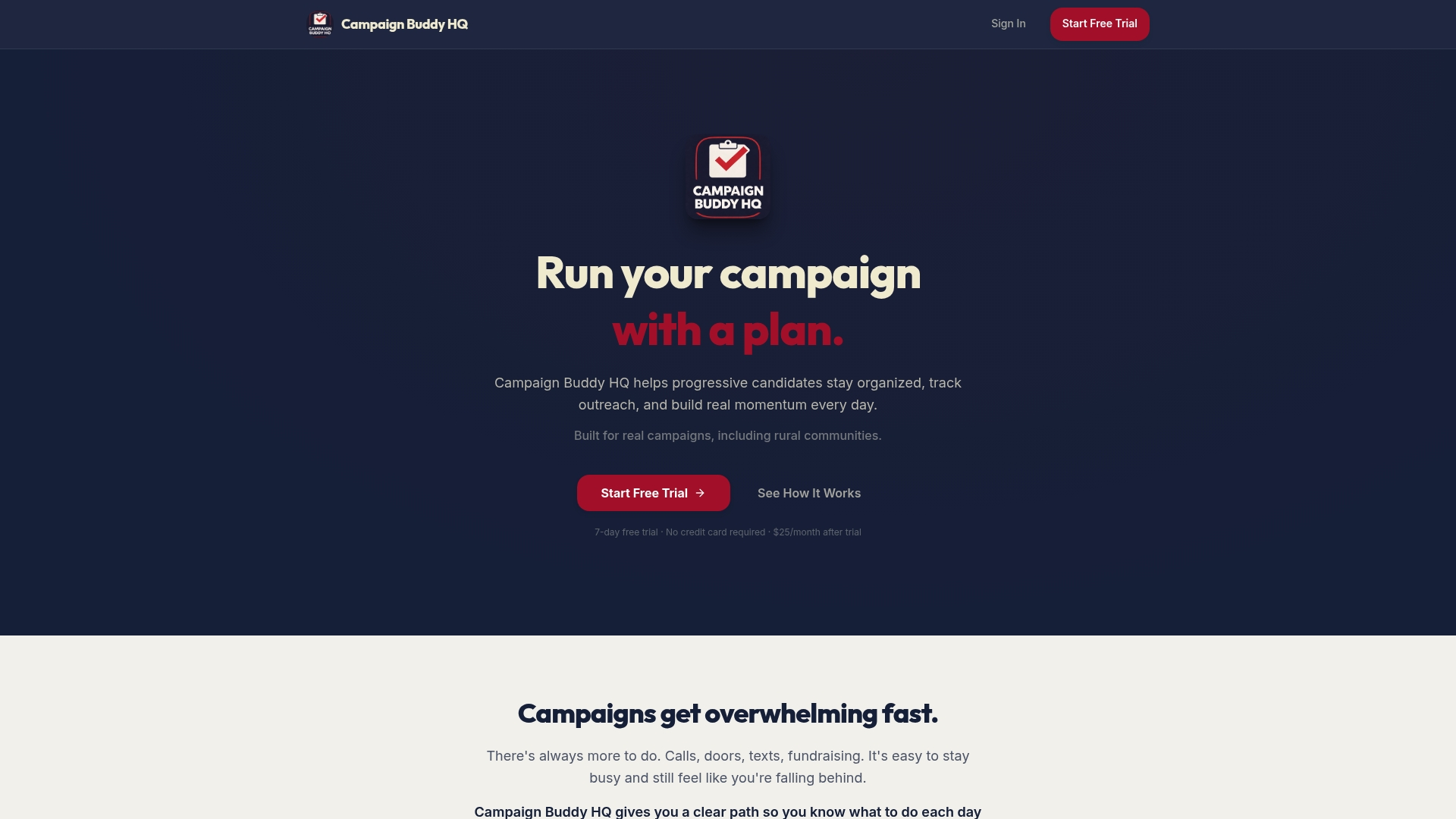
Campaign Buddy HQ is built specifically for progressive campaigns that need to manage direct mail schedules, volunteer texting programs, canvassing logs, and fundraising outreach from a single dashboard. You can track every door knocked, call made, and text sent, and measure progress against your actual voter contact goals. Use the built-in voter mobilization calculator to set targets based on your district and timeline. Try it free for 7 days with no credit card required, and see how much easier coordinated outreach becomes when everything lives in one place.
Frequently asked questions
Why is direct mail still effective in 2026 when digital outreach dominates?
Direct mail engages voters neurologically with personalized visuals and physical interaction, which overcomes digital ad fatigue in ways screens simply cannot replicate. 92% of political consultants say it's effective, and 50% of voters report feeling more engaged by political mail than by digital ads.
How much more effective is peer-to-peer texting compared to email for fundraising?
P2P texting achieves 8-12% response rates on fundraising asks versus 1.5-3% for email, and text donors give an average of 20% larger gifts, making it the highest-yield digital fundraising channel available to campaigns.
What makes connected TV advertising a key channel in 2026?
CTV delivers non-skippable ads to verified household audiences using smart TV data, giving campaigns the targeting precision of digital with the reach and credibility of television, at a projected $2.48 billion in political spend for the cycle.
How is AI changing canvassing and organizing in 2026 campaigns?
AI voice-to-text tools transcribe every door conversation in real time, feeding voter concerns directly back into campaign messaging and targeting. Swing Left's Ground Truth program pioneered this approach, allowing campaigns to act on listening data across every channel simultaneously.