

Building a supporter list is the process of gathering, organizing, and engaging individuals who are willing to back your campaign with their time, money, or voice. In political campaigns, this list functions as your most valuable operational asset. Campaigns that treat their supporter database as a living tool rather than a static spreadsheet consistently outperform those that don't. Whether you're a first-time candidate or a seasoned organizer, knowing how to build a supporter list from scratch, and grow it systematically, determines how much ground you can cover before election day.
How to build a supporter list starting with warm contacts
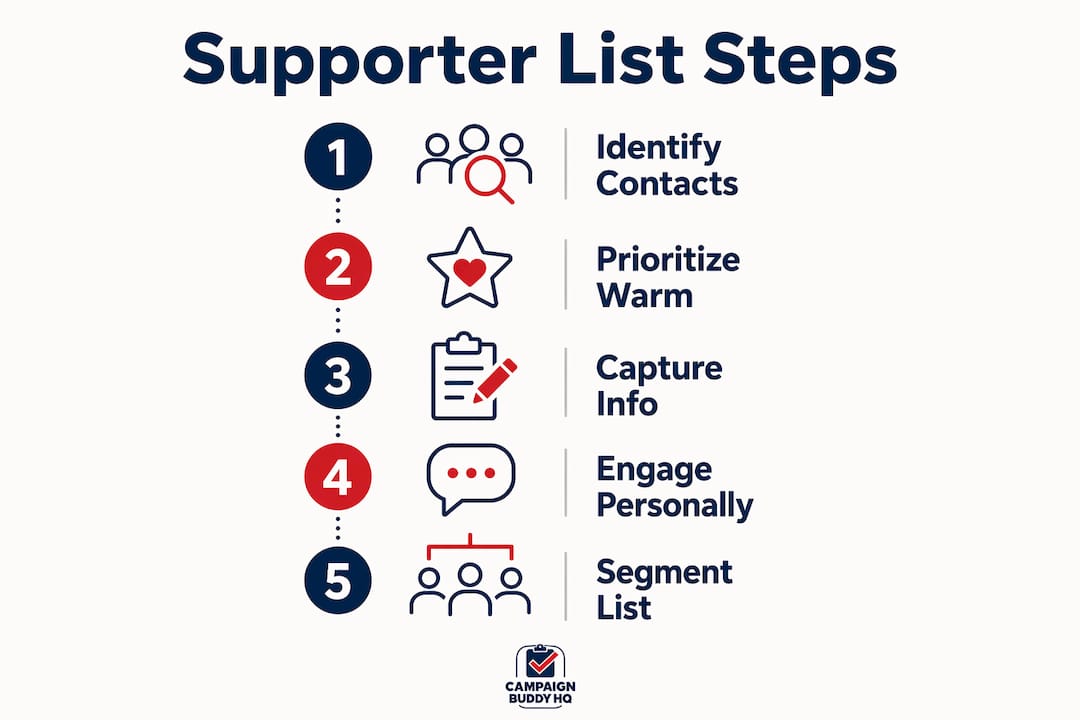
Every strong campaign list starts with people who already know you. The fastest way to generate your first 50 to 100 names is through what organizers call the 50-name exercise: a structured one-hour session where you write down every person you know across six categories.
Those six categories are:
- Board members or community leaders you've worked with directly
- Volunteers from past campaigns, civic groups, or community projects
- Past donors to causes you've supported or led
- Event attendees from town halls, fundraisers, or neighborhood meetings
- Service recipients who have benefited from your advocacy or work
- Community connections including neighbors, colleagues, and faith community members
Once you have your raw list, prioritize by connectivity. The people most likely to say yes and most likely to bring five more people with them belong at the top. A retired teacher who runs the local PTA and a union shop steward who knows 200 workers are worth more than ten passive acquaintances.
After you've ranked your initial list, reach out personally. A phone call or direct message converts far better than a mass email blast. Your goal at this stage is not volume. It's quality. Getting 50 committed supporters who open every email and show up to events beats having 500 names who ignore you.

Pro Tip: When doing the 50-name exercise, set a timer and don't edit yourself. Write every name that comes to mind first, then filter. Campaigns that skip the filtering step end up with bloated lists full of people who never engage.
What tools and tactics capture supporter information effectively
Once you've exhausted your warm network, you need capture systems that work around the clock. The most effective approach combines online and offline methods, each feeding into a central database like a CRM platform such as NationBuilder or a tool like Campaignbuddyhq.
Online capture points that convert:
- Digital petitions and action alerts are the lowest-friction entry point. Someone signs a petition on a local issue and becomes a supporter with a single click.
- Newsletter signups on your campaign website with a clear value statement ("Get weekly updates on housing policy in your district") attract motivated subscribers.
- Social media lead forms on Facebook and Instagram capture contact details without requiring users to leave the platform.
- Event registration pages through tools like Eventbrite or a simple Google Form collect names and emails before anyone walks through the door.
Offline capture methods:
- Clipboards at street stalls, canvassing events, and town halls remain effective, but only if the data moves immediately into your digital system.
- QR codes on printed materials let supporters sign up on their phones in real time, bypassing paper entirely.
The single biggest mistake campaigns make at signup is asking for too much information. Asking only for an email address at the point of entry maximizes conversion rates. A zip code is the only optional addition worth considering. Every extra field you add reduces the number of people who complete the form. Collect detailed data later through automated follow-up sequences.
For offline data, the clock starts the moment someone signs that clipboard. Offline data must be digitized within 24 to 48 hours to preserve engagement momentum. A supporter who signed up at Saturday's farmers market and receives a welcome email by Sunday night is far more likely to stay engaged than one who waits two weeks to hear from you.
| Capture method | Best use case | Conversion strength |
|---|---|---|
| Digital petition | Issue-based campaigns | High |
| Newsletter signup | Ongoing engagement | Medium to high |
| Event registration | Local and community events | High |
| Street stall clipboard | Door-to-door canvassing | Medium |
| Social media lead form | Paid ad campaigns | Medium to high |
Pro Tip: Use segmentation at the point of entry. Ask supporters to select their top issue (housing, education, public safety) during signup. This single data point lets you send targeted messages from day one instead of blasting everyone with the same content.
How to grow your supporter list with digital and organic strategies
Once your capture systems are live, you need traffic. The most cost-effective paid channel for political campaigns in 2026 is social media advertising. A $5 to $10 daily social ad budget generates 5 to 15 new subscribers per day, which means a campaign spending $10 daily can realistically add around 200 supporters per month. That's a meaningful list in 90 days without a massive budget.
Organic growth compounds over time through three primary channels:
- Newsletter cross-promotions: Partner with aligned organizations, local advocacy groups, or community newsletters to swap mentions. Each cross-promotion adds 20 to 50 new subscribers with zero ad spend.
- Referral programs: Ask existing supporters to share your signup link with three people they know. Tiered rewards, such as a personal thank-you call from the candidate for the top referrer each month, create compounding growth.
- Event follow-ups: Every public appearance is a list-building opportunity. Collect contacts at the door, follow up within 24 hours, and segment new additions by the event they attended.
Here's how paid and organic strategies compare for campaigns at different stages:
| Strategy | Cost | Speed | Best for |
|---|---|---|---|
| Paid social ads | $5 to $10 per day | Fast (days) | Early list building |
| Newsletter swap | Free | Medium (weeks) | Established campaigns |
| Referral program | Low (incentive cost) | Medium | Engaged supporter base |
| Event follow-up | Staff time only | Steady | All campaign stages |
Digital branding for community groups also plays a role in organic growth. A consistent visual identity across your website, social media, and email templates builds recognition that makes people more likely to sign up when they encounter your campaign for the first time.
How to engage supporters and keep them on your list
Getting someone on your list is step one. Keeping them there, and moving them toward active participation, is where most campaigns fall short. The standard tool for this is a welcome sequence: a series of emails sent automatically after someone joins your list.
A proven structure for political campaigns looks like this:
- Day 1, Email 1: Acknowledge the specific action they took (signed a petition, attended an event) and introduce the campaign's core mission in two to three sentences.
- Day 3, Email 2: Share one compelling story about why this campaign matters. Make it personal and specific to your district or community.
- Day 7, Email 3: Invite a low-commitment action, such as following the campaign on social media or sharing a post with friends.
- Day 10, Email 4: Ask a direct question and request a reply. Something like "What's the one issue you most want us to address?" This reply signals to email providers like Gmail that your messages are worth delivering to the inbox.
- Day 14, Email 5: Present a clear next step, whether that's volunteering, donating, or attending an upcoming event.
Welcome sequences that generate replies improve deliverability and reduce subscriber drop-off. This is not a minor technical detail. If your emails land in spam, your list is worthless regardless of its size.
Segmentation by issue interest and signup source lets you send messages that feel personal rather than generic. A supporter who signed up through a housing petition should receive different content than one who joined at a labor rally. Campaignbuddyhq's supporter tracking tools make this kind of segmentation manageable even for small campaign teams.
Beyond email, digital mass communication must be paired with personal outreach to identify and develop leaders. Your list is not just a broadcast channel. It's a map of potential volunteers, precinct captains, and community organizers. One-on-one calls to your most engaged supporters, those who open every email and reply to your questions, convert passive subscribers into active campaign infrastructure.
Pro Tip: Track engagement tiers in your CRM. Label supporters as "passive," "active," or "leader" based on their behavior. Then build a specific outreach plan for moving people from one tier to the next. This is how you turn a list of names into a campaign organization.
Key takeaways
Building a supporter list requires warm contact identification, frictionless capture systems, and a structured welcome sequence to convert subscribers into active campaign participants.
| Point | Details |
|---|---|
| Start with warm contacts | Use the 50-name exercise across six categories to generate your first quality leads. |
| Minimize signup friction | Ask only for an email address at entry to maximize conversion rates. |
| Digitize offline data fast | Enter paper signups into your CRM within 24 to 48 hours to preserve engagement. |
| Use paid and organic growth | A $10 daily social ad budget adds roughly 200 supporters per month at low cost. |
| Engage with a welcome sequence | A 5-email sequence over 14 days reduces churn and improves inbox deliverability. |
What I've learned about lists that most campaign guides won't tell you
Most articles about creating a supporter list treat it as a data management problem. It isn't. It's a power-mapping problem. The question isn't how many names you have. It's how many of those names represent people who can move other people.
I've seen campaigns with 10,000-name lists lose to campaigns with 2,000 names because the smaller list was full of connectors. A single union steward, a church deacon, or a respected neighborhood association president can activate dozens of people with one conversation. Your list should tell you who those people are and what they care about. If it doesn't, you're managing contacts, not building a movement.
The other mistake I see constantly is treating digital automation as a substitute for human contact. Welcome sequences and segmented emails are necessary, but they are not sufficient. The campaigns that win use their outreach strategies to identify the top 10% of their list by engagement and then call those people directly. That conversation is where real commitment gets made.
One more thing: list hygiene is not glamorous, but it is non-negotiable. Supporters move, change emails, and shift their priorities. A list that isn't regularly cleaned and updated becomes a liability. Bounced emails hurt your sender reputation. Unengaged subscribers drag down your open rates and make your active supporters harder to reach. Build a quarterly review into your campaign calendar from day one.
— Billy
How Campaignbuddyhq helps you manage your supporter list
Campaignbuddyhq is built specifically for political candidates and campaign organizers who need to track supporters, log outreach, and manage their campaign workflow in one place. The platform includes a supporter database, outreach logging for doors, calls, and texts, and segmentation tools that let you organize contacts by issue interest, engagement level, or campaign phase. For candidates running in rural or low-density communities where every contact counts, Campaignbuddyhq's daily planning tools keep your team consistent and accountable. You can explore the platform with a free 7-day trial that requires no credit card. If you're serious about building a supporter network that actually wins, this is where to start.
FAQ
What is a supporter list in a political campaign?
A supporter list is a database of individuals who have expressed interest in or commitment to a campaign, organized by contact information, engagement level, and issue interest. It serves as the operational foundation for outreach, fundraising, and volunteer recruitment.
How many supporters do I need before launching outreach?
There is no minimum threshold, but campaigns typically aim for 100 to 500 contacts before scaling paid outreach. Starting with warm contacts from the 50-name exercise gives you a quality base to build from immediately.
How do I attract supporters without a large budget?
Newsletter cross-promotions and referral programs are the most cost-effective organic tactics, with each cross-promotion adding 20 to 50 new subscribers at no ad spend. Event follow-ups and social media engagement also grow your list without significant cost.
How often should I email my supporter list?
Most campaigns send one to two emails per week during active campaign phases. Consistency matters more than frequency. A predictable schedule builds trust and reduces unsubscribe rates.
What is the biggest mistake campaigns make with their supporter lists?
The most common mistake is collecting data without a follow-up system. Supporters who sign up and never hear from the campaign within 48 hours disengage quickly. A structured welcome sequence sent immediately after signup is the single most effective way to retain new contacts.