

Every campaign phase needs its own measurable goal. Here are examples of campaign phase goals across all five phases, written as SMART objectives any political, advocacy, or nonprofit team can adapt:
- Planning / Pre-launch: "Finalize audience personas, KPI dashboard, and messaging framework with full stakeholder sign-off by Day 14." (metric: sign-off completion; timeframe: 14 days; owner: campaign manager)
- Messaging & Creative Development: "Produce three hero message variants and validate the top performer via A/B test with a significant lift in click-through rate by Day 28." (metric: CTR lift; timeframe: 14-day test window; owner: creative lead)
- Launch / Activation: "Knock a substantial number of doors and complete numerous volunteer call attempts within the first 10 days of launch." (metric: contact attempts; timeframe: 10 days; owner: field director)
- Growth / Optimization: "Reduce cost-per-conversion substantially from launch baseline within 30 days by rotating creative and expanding lookalike audiences." (metric: CPA; timeframe: 30 days; owner: digital director)
- Closing / Evaluation: "Retain a significant portion of new donors as recurring givers and deliver a full post-campaign report with attribution data within three weeks of campaign close." (metric: donor retention rate and report delivery; timeframe: 21 days; owner: finance and data leads)
Each example above carries three elements every phase goal needs: a numeric metric, a fixed timeframe, and a named owner. The SMART framework is the standard behind all of them.
Key Takeaways
Phase-specific SMART goals with named owners, numeric targets, and written exit criteria are the single most reliable way to keep a campaign on track from planning through close.
| Point | Details |
|---|---|
| Use SMART goals for every phase | Each phase goal needs a metric, a baseline, a numeric target, a deadline, and a named owner. |
| Exit criteria prevent premature launches | Require written sign-off on the measurement plan and messaging framework before moving to the next phase. |
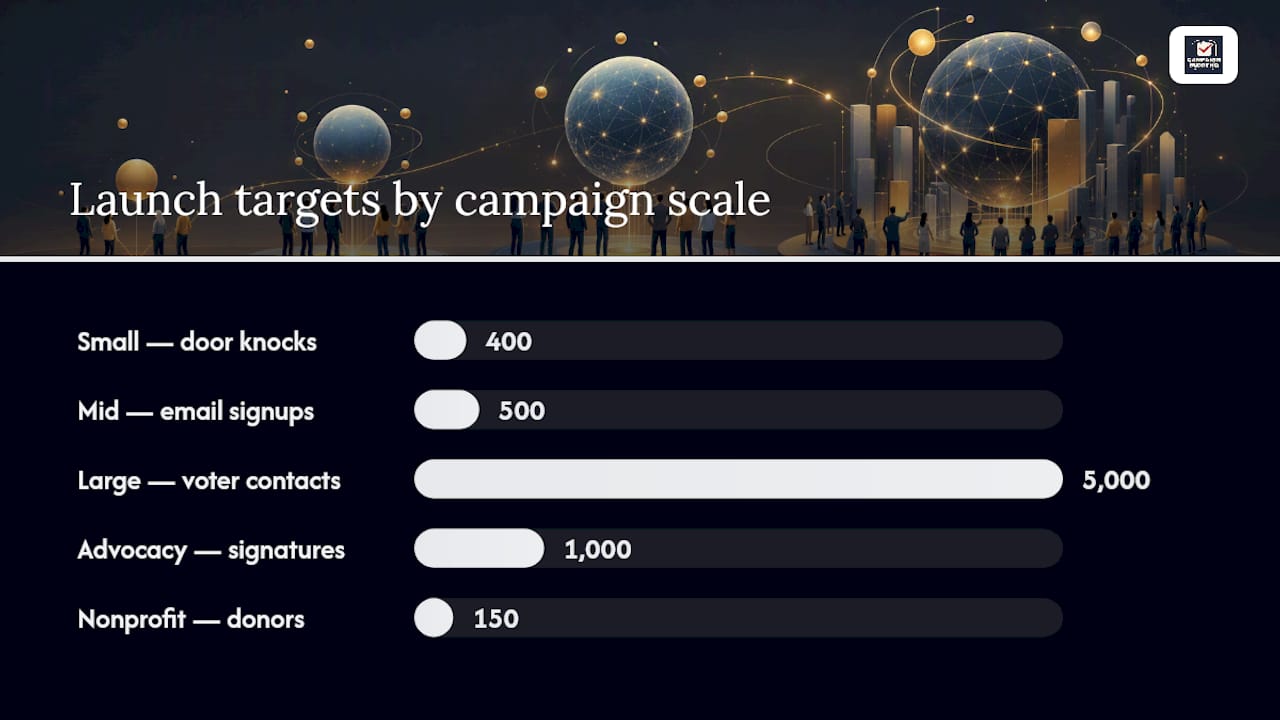
| Scale numeric targets to campaign size | Door-knock targets range from 400 (small) to 5,000 (large) for a 10-day launch window. |
| Track daily, not weekly, during launch | Pacing checks against daily targets catch stalled metrics before they compound into budget waste. |
| Campaignbuddyhq tracks phase goals in real time | The platform assigns tasks, logs outreach, and surfaces pacing alerts so teams hit targets without manual reporting. |
Table of Contents
- Why phase-specific goals make campaigns easier to run
- What should your planning phase goals actually look like?
- How do you set goals for messaging and creative development?
- Launch phase goals: what numbers should you be hitting?
- Growth and optimization phase: how do you sustain momentum?
- Closing phase goals: what does a clean campaign wrap-up look like?
- How do you write a SMART phase goal from scratch?
- What KPIs should you track in each campaign phase?
- A ready-to-use SMART goal bank by phase and campaign scale
- How do you turn phase goals into daily team tasks?
- How do you pick one North Star and get everyone to agree on it?
- What most campaign teams get wrong about phase goals
- Campaignbuddyhq puts your phase goals into daily practice
- Sources
Why phase-specific goals make campaigns easier to run
Campaigns that set one big goal and chase it for months tend to drift. Phase-specific goals fix that by breaking the work into defined windows, each with its own success criteria and exit point. When a phase ends, you know it ended because the numbers say so, not because the calendar flipped.
The five phases used throughout this guide map to the most common structures in political, advocacy, and nonprofit campaign playbooks:
- Planning / Pre-launch (Days 1–14 in a short sprint; 4–8 weeks in a multi-month campaign)
- Messaging & Creative Development (Days 15–28 or 2–4 weeks)
- Launch / Activation (Days 29–45 or the first 2–3 weeks of public-facing activity)
- Growth / Optimization (Days 46–75 or the sustained middle stretch)
- Closing / Evaluation (final 2–3 weeks plus post-close reporting window)
A phase goal is not the same as a campaign's North Star. The North Star is the single overarching outcome you are running toward: win the election, pass the bill, hit the fundraising target. A phase goal is the specific, measurable output that proves this phase did its job and the team is ready to move forward. The American Marketing Association identifies awareness, lead generation, acquisition, and retention as the common campaign-level objectives that phase goals feed into.
Short sprints (under six weeks) compress all five phases but keep the same structure. Multi-month campaigns expand each phase window without changing the logic. Either way, a phase is complete when its exit criterion is met, not when time runs out.
What should your planning phase goals actually look like?
The planning phase has one job: produce the decisions and documents every downstream phase depends on. If creative work starts before personas are locked, or if the KPI dashboard is still being built when launch day arrives, the whole campaign pays for it later.
Sample SMART goals for this phase:
- Complete audience segmentation with at least three defined personas, including demographic and behavioral data, by Day 7.
- Select and document three primary KPIs with baseline measurements and data sources by Day 10.
- Finalize the messaging framework, UTM taxonomy, and legal/privacy sign-off by Day 14.
- Get written stakeholder approval on the measurement plan before any creative production begins.
The Phase 1 planning playbook from ODPHP frames this phase around alignment, local tailoring, and producing defined outputs before activity begins. That framing holds across sectors: a city council race, a ballot initiative, and a nonprofit capital campaign all need the same pre-launch discipline.
Exit criteria checklist before moving to Phase 2:
- Audience personas documented and approved
- Primary KPI(s) selected with baseline data recorded
- Measurement dashboard built and tested
- UTM naming convention finalized
- Messaging framework drafted
- Legal and privacy sign-off obtained (required for public-facing campaigns collecting personal data)
- Budget guardrails confirmed in writing
Pro Tip: Lock your measurement plan before a single asset goes into production. Retrofitting UTMs and dashboard fields after launch is one of the most common sources of attribution errors in campaign reporting.
How do you set goals for messaging and creative development?
Creative phases fail when the goal is "make good content." The goal needs to be measurable: a specific number of validated concepts, a defined lift threshold, a hard deadline.
Sample SMART goals for Phase 2:
- Develop three hero message variants with copy and visual treatments complete by Day 21.
- Run an A/B test on the top two variants with a minimum sample of 500 impressions per variant, targeting a 15% or greater lift in click-through rate, with results by Day 28.
- Achieve a qualitative approval score of 4/5 or higher from at least two community validators before any variant advances to launch.
Running a test on 50 impressions per variant tells you nothing. Most campaign teams need at least 300–500 impressions per variant to get a signal worth acting on, and two weeks is usually enough time to collect that data without delaying launch.
KPIs to track during this phase: engagement rate on organic test posts, email open rate on subject-line variants, creative CTR on paid placements, and qualitative feedback scores from focus groups or community validators. These metrics feed the launch decision directly. If no variant clears the lift threshold, the team either iterates or launches with the best available option and flags it as a risk.
Launch phase goals: what numbers should you be hitting?
The launch phase is where the plan meets reality. Goals here need to be numeric, time-bound, and tracked daily. A real-world campaign plan template uses concrete outreach targets like doors knocked and calls completed as the primary phase-level KPIs, and that approach works because it gives field teams a daily number to hit.

Sample SMART launch goals by campaign scale:
Small campaign (1–3 staff, under 5,000 voters or constituents):
- Knock 400 doors in the first 7 days of launch.
- Complete 300 call attempts with a 25% contact rate (75 live conversations) by Day 10.
- Collect 150 petition signatures or event RSVPs in the first two weeks.
Mid-size campaign (4–10 staff, 5,000–25,000 voters or constituents):
- Knock 1,200 doors and complete 800 call attempts in the first 10 days.
- Generate 500 email signups at a 3% or higher conversion rate from digital ads within 14 days.
- Secure 200 donations averaging $35 or more in the first launch week.
Large campaign (10+ staff, 25,000+ voters or constituents):
- Knock 5,000 doors and complete 3,500 call attempts in the first 14 days.
- Hit 2,000 new email subscribers and 1,000 petition signatures within the first 10 days.
- Raise $50,000 from 500 or more unique donors in the launch window.
Daily tracking checklist for the launch phase:
- Log total doors knocked, calls completed, and texts sent versus daily target.
- Check email open rate and click-through rate against launch-week benchmarks.
- Review donation or signup conversion rate and compare to Day 1 baseline.
- Flag any metric that falls below 80% of the daily pacing target for immediate review.
- Confirm all outreach data is synced and attributed correctly before end of day.
Waiting until the weekly review costs you days of compounding momentum. You can track outreach activities in real time to catch these signals early.
Growth and optimization phase: how do you sustain momentum?
Once launch momentum is established, the optimization phase shifts the question from "are we moving?" to "are we moving efficiently?" The goals here target cost reduction, retention, and lift, not just volume.
Sample SMART optimization goals:
- Reduce cost-per-conversion by 20% from the launch-phase baseline within 30 days by rotating creative every 10 days and suppressing audiences with a frequency above 4.
- Increase repeat actions (second donation, second event attendance, second volunteer shift) by 25% compared to the launch phase within 45 days.
- Expand the active email list by 10% through referral and co-sponsorship outreach within 30 days.
Each tactic needs its own KPI target, not just a directional goal.
The optimization phase is where most campaigns leave the most value on the table. Teams that monitor CPA daily and rotate creative proactively can cut their cost-per-conversion by 15–25% over a 30-day window. Teams that wait for the weekly report to notice a stalled creative often spend that budget at full cost before anyone acts.
A generic but illustrative example: a mid-size advocacy campaign running digital ads for a ballot measure noticed that one creative variant was generating conversions at $4.20 each while a second variant sat at $9.80.
Closing phase goals: what does a clean campaign wrap-up look like?
The closing phase is not just about stopping activity. It is about capturing what you built and converting it into durable assets: retained donors, re-engaged volunteers, clean data, and a report that actually explains what happened.
Sample SMART closing-phase goals:
- Convert 40% of one-time donors to recurring monthly givers within 30 days of campaign close via a targeted follow-up sequence.
- Deliver a full post-campaign attribution report with UTM-level data, channel breakdown, and cost-per-outcome by Day 21 post-close.
- Re-engage 30% of volunteers who participated in the campaign with a follow-up ask or next-step communication within 14 days.
- Hand off a clean CRM export with no more than 2% null values in key fields (name, email, phone, action history) to the operations team within 7 days.
Post-campaign audit checklist:
- Verify all UTM parameters are intact and attributed correctly in the analytics platform.
- Check for duplicate records and merge or flag them before the final export.
- Confirm donation records reconcile with the finance team's figures.
- Document what each creative variant achieved and tag assets for future reuse.
- Record final KPI actuals against targets for every phase.
- Archive the measurement plan, messaging framework, and personas for the next cycle.
Campaign reporting guides for progressive managers recommend treating the post-campaign report as a planning document for the next campaign, not just a retrospective. The teams that do this consistently build institutional knowledge that compounds over time.
How do you write a SMART phase goal from scratch?
The template is simple. Fill in the blanks:
Example: "The field director will increase weekly door-knock completions from 200 to 350 by Week 3 of launch, measured by the outreach log in the campaign tracking system."
That one sentence answers every question a stakeholder will ask: who is responsible, what is being measured, where it starts, where it needs to go, and when.
Worked examples by sector:
Political campaign (launch phase): Generic objective: "Get more voters to the polls."
Advocacy campaign (messaging phase): Generic objective: "Improve our messaging."
Nonprofit campaign (closing phase): Generic objective: "Keep our donors."
Goal-writing worksheet:
- Name the owner (a specific role, not "the team").
- State the baseline metric with a source.
- Set the numeric target.
- Fix the deadline.
- Name the data source for measurement.
- Get written approval from the campaign manager or director before the phase begins.
The SMART framework guidance from Smart Insights recommends anchoring every goal to a specific percentage or numeric change within a defined time frame. Vague objectives like "increase awareness" fail because no one can agree on when they have been achieved.
What KPIs should you track in each campaign phase?
Tracking the wrong metric in the wrong phase is as costly as tracking nothing. Here is a phase-by-phase KPI matrix with dashboard fields and alert thresholds:
| Phase | Core KPIs | Dashboard Field | Alert Threshold |
|---|---|---|---|
| Planning / Pre-launch | Sign-off completion rate, baseline metric documented | Checklist % complete | Flag if any item is incomplete at Day 14 |
| Messaging & Creative | CTR by variant, open rate, qualitative score | A/B test results table | Pause variant if CTR falls below 0.5% after 300 impressions |
| Launch / Activation | Doors knocked, calls completed, conversion rate, cost-per-conversion | Daily outreach log, conversion dashboard | Alert if daily pacing falls below 80% of target for 2 consecutive days |
| Growth / Optimization | CPA, repeat action rate, creative frequency, list growth | CPA trend line, frequency cap tracker | Pause creative if frequency exceeds 4; escalate if CPA exceeds target for 2 days |
| Closing / Evaluation | Donor retention rate, data completeness %, report delivery date | CRM retention report, data audit log | Flag if null values exceed 2% in key CRM fields |
UTM naming conventions matter here. A consistent structure like utm_source / utm_medium / utm_campaign / utm_content / utm_term makes phase-level attribution reliable across channels. Without it, the closing-phase report cannot tell you which phase's activity drove which outcome.
For monitoring cadence and alert setup, campaign progress monitoring guides recommend daily check-ins during launch and optimization, weekly reviews during planning and creative phases, and a milestone review at each phase transition. Waiting costs budget.
A ready-to-use SMART goal bank by phase and campaign scale
Pull any goal below, fill in your numbers, and assign an owner. Goals are organized by phase and scaled for small, mid, and large campaigns.
Phase 1: Planning / Pre-launch
- Small: Complete audience research and document two personas with sign-off by Day 7.
- Mid: Finalize KPI dashboard with three primary metrics and baseline data by Day 10.
- Large: Complete full stakeholder alignment meeting and produce a signed planning brief by Day 14.
- Advocacy: Identify three coalition partners and confirm participation agreements by Day 10.
- Nonprofit: Document donor segments with giving history and contact preferences by Day 7.
Phase 2: Messaging & Creative
- Small: Produce two message variants and select a winner via 200-person email test by Day 21.
- Mid: Develop three hero creative assets (digital ad, email, social) with brand approval by Day 24.
- Large: Complete full creative suite (six ad variants, two email sequences, one landing page) by Day 28.
- Political: Test two candidate bio framings with 300-person sample; select winner by Day 21.
- Nonprofit: Validate impact story messaging with a 5-person focus group by Day 18.
Phase 3: Launch / Activation
- Small: Knock 400 doors and collect 100 petition signatures in the first 7 days.
- Mid: Generate 500 email signups at 3%+ conversion rate within 14 days of launch.
- Large: Complete 5,000 voter contacts (doors + calls) in the first 14 days.
- Advocacy: Secure 1,000 petition signatures and 50 event RSVPs in the first 10 days.
- Nonprofit: Raise $15,000 from 150 unique donors in the first 7 days of the campaign.
Phase 4: Growth / Optimization
- Small: Reduce cost-per-email-signup by 15% within 21 days by pausing the lowest-performing ad.
- Mid: Increase repeat volunteer shifts by 20% over the launch baseline within 30 days.
- Large: Expand active email list by 8% through referral outreach within 30 days.
- Political: Improve voter contact rate from 22% to 30% within 21 days by refining call lists.
- Nonprofit: Increase average gift size by 10% within 30 days through a mid-campaign upgrade ask.
Phase 5: Closing / Evaluation
- Small: Deliver a one-page post-campaign summary with final KPI actuals within 14 days of close.
- Mid: Convert 30% of new donors to recurring givers within 30 days of campaign close.
- Large: Complete full attribution report with UTM-level data and channel breakdown by Day 21 post-close.
- Advocacy: Re-engage 25% of petition signers with a follow-up action ask within 14 days.
- Nonprofit: Hand off a clean CRM export with under 2% null values within 7 days of close.
How the same goal scales across campaign sizes:
| Door knocks, call attempts, email signups, donations, and event RSVPs during launch phases are commonly planned targets that increase with campaign size. Specific numeric targets vary by context and should be tailored based on prior campaign data and resources.
For fundraising-specific benchmarks and outreach tactics, fundraising outreach guides offer sector-specific conversion rate context that helps calibrate donation targets by campaign type.
How do you turn phase goals into daily team tasks?
A goal on paper does nothing. The mechanics that make it real are role clarity, a tracking cadence, and a defined sign-off process.
Role map for each phase goal:
- Owner: the person responsible for hitting the number (field director, digital director, development director).
- Approver: the person who signs off on the goal before the phase begins and confirms exit criteria are met before the next phase starts (campaign manager or executive director).
- Reporter: the person who pulls and distributes the daily or weekly metric update (data manager or operations lead).
Cadence table:
| Check-in Type | Frequency | Who Attends | Output |
|---|---|---|---|
| Daily standup | Every day during launch and optimization | Owner + reporter | Pacing update vs. daily target |
| Weekly review | Every Monday | Owner + approver + reporter | Week-over-week trend, flag blockers |
| Phase milestone | At each phase transition | Full leadership team | Exit criteria review, sign-off to proceed |
For tool workflow, the pattern is: assign tasks in your campaign management platform, log outreach activities daily (doors, calls, texts), pull a dashboard view of KPI actuals versus targets, and escalate any metric that triggers an alert threshold. Generic campaign management tools that support this workflow include CRM platforms, outreach logging apps, and shared dashboards. The key is that every team member logs activity in the same system, in the same format, every day.
Pro Tip: Exit criteria enforcement works only when the approver has a written checklist and the authority to hold the phase open. If the campaign manager can be pressured into moving to launch before the measurement plan is signed off, the exit criterion is decorative. Put the checklist in writing and require a dated signature.
How do you pick one North Star and get everyone to agree on it?
The Rule of One is the most useful constraint in campaign planning: one campaign, one primary objective. Multiple competing objectives dilute both messaging and measurement. When the field team is optimizing for doors and the digital team is optimizing for email signups and the finance team is optimizing for donations, no one is optimizing for the actual outcome.
Decision flow for picking your North Star:
- List every outcome the campaign could plausibly pursue.
- Ask: which single outcome, if achieved, makes every other outcome easier or irrelevant?
- Confirm that outcome is measurable with data you can actually collect.
- Check that it is achievable given your budget, timeline, and team size.
- Get written agreement from every department head before Phase 1 ends.
Exceptions to the Rule of One are appropriate when a campaign has genuinely distinct audiences with non-overlapping goals (a ballot initiative that simultaneously targets voters and donors, for example). In that case, set one primary objective and one secondary objective with explicit priority ordering. Never treat them as equals.
Stakeholder sign-off checklist:
- North Star objective documented in writing with a numeric target and deadline
- All phase goals reviewed and approved by department heads
- KPI dashboard shared and confirmed accessible by all approvers
- Budget allocation confirmed against phase goals
- Legal and privacy review complete (required for campaigns collecting personal data per HHS guidelines)
- Escalation path documented: who decides if a phase goal needs to be revised mid-campaign
Common pushback in sign-off conversations usually takes one of two forms: "we need to track everything" or "the target is too aggressive." For the first, show the cost of split focus: campaigns that chase five metrics simultaneously rarely move any of them decisively. For the second, bring the baseline data. A target that looks aggressive in the abstract often looks reasonable when it is anchored to what a comparable campaign achieved in a prior cycle.
What most campaign teams get wrong about phase goals
The single biggest mistake is treating phase goals as aspirational statements rather than binding contracts. A goal without an owner, a baseline, and a sign-off process is a wish. The corrective practice is simple: before any phase begins, the owner writes the goal in SMART format, the approver signs it, and the reporter knows exactly which dashboard field to pull.
Dos and don'ts from running multi-phase campaigns:
- Do lock the measurement plan before creative production starts. Retrofitting attribution after launch is expensive and often impossible.
- Do assign a single named owner to every phase goal. "The team" owns nothing.
- Do set exit criteria in writing and enforce them. Moving to launch before the messaging phase is complete is one of the most common causes of weak launch performance.
- Don't set more than one primary objective per campaign. The messaging gets muddy and the measurement gets useless.
- Don't wait for the weekly review to act on a stalled metric. Daily pacing checks exist precisely to catch problems before they compound.
- Don't skip the post-campaign audit. The data you clean and archive after this campaign is the baseline for the next one.
A common scenario: a mid-size advocacy campaign skips the Phase 1 sign-off requirement and moves directly into creative production. Three weeks later, the digital team and the field team are using different audience definitions, the UTM taxonomy is inconsistent, and the closing-phase report cannot attribute conversions to specific channels. The fix takes two days of data cleanup that could have been avoided with a 90-minute planning meeting. Effective goal-setting for grassroots campaigns consistently points to this kind of pre-launch misalignment as the root cause of most mid-campaign measurement failures.
Campaignbuddyhq puts your phase goals into daily practice
Knowing your phase goals is one thing. Hitting them every day, across a distributed team, with real-time visibility into pacing, is where most campaigns struggle. Campaignbuddyhq gives political campaigns, advocacy groups, and nonprofit organizers a single platform to assign phase tasks, log outreach activity (doors, calls, texts, registrations), and watch KPI progress against targets without building a spreadsheet from scratch.
Here is what a launch-phase workflow looks like in practice: the campaign manager sets the 10-day door-knock target in Campaignbuddyhq, assigns it to the field director, and the system generates daily task breakdowns for each volunteer. Outreach is logged in real time. No manual aggregation, no end-of-week surprises.
Campaignbuddyhq is built specifically for progressive campaigns and works in rural and low-density communities where outreach volume targets look different from urban races. The free 7-day trial requires no credit card. Start tracking your phase goals today at Campaignbuddyhq.
Sources
The sources below informed the frameworks, templates, and numeric examples throughout this guide.
For SMART goal templates and framework guidance:
- Define SMART marketing objectives | Smart Insights
- Odphp
- 13 critical marketing goals to achieve your objectives | AMA
- Campaign Plan Example | Everytown
For campaign planning structure and phase playbooks:
For numeric outreach targets and real-world campaign structure:
For campaign-level objective mapping:
For operational implementation: