

Fundraising outreach is defined as the systematic, multi-channel process of connecting with potential supporters through email, SMS, social media, phone calls, direct mail, and in-person events to secure ongoing financial contributions. The industry term for this practice is "donor outreach," though campaign organizers use both terms interchangeably. What separates effective donor outreach from a failed appeal is not budget or volume. It is structure, personalization, and follow-through. Campaignbuddyhq is built specifically for organizers who need to manage these moving parts without losing momentum. This guide covers the core strategies, common mistakes, and practical frameworks that produce real results in 2026.
What is fundraising outreach and why does it matter?
Fundraising outreach is a systematic, multi-channel process that moves supporters from awareness to action through repeated, targeted contact. It is not a single email blast or a one-time phone drive. The shift from one-off campaigns to ongoing, data-driven engagement defines modern donor outreach. Campaigns that treat outreach as a continuous conversation rather than a periodic ask consistently build stronger donor bases and higher retention rates.
The core channels in any outreach program include email, SMS, social media, direct mail, phone calls, and events. Each channel reaches a different segment of your supporter base at a different cost and engagement level. Multi-channel approaches improve reach because supporters respond to different formats at different times. A donor who ignores an email may respond immediately to a text message or a personal phone call.

Technology and data management sit at the center of effective multi-channel campaigns. Tracking which channels produce responses, at what times, and from which donor segments lets organizers allocate effort where it counts. Campaignbuddyhq logs outreach activities across doors, calls, and texts in one place, giving organizers a clear picture of what is working. That visibility is what separates a campaign that learns from one that repeats the same mistakes.
| Channel | Reach | Cost | Engagement potential |
|---|---|---|---|
| High | Low | Moderate | |
| SMS/text | High | Low | High |
| Phone calls | Moderate | Moderate | Very high |
| Social media | Very high | Low to moderate | Moderate |
| Direct mail | Moderate | High | Low to moderate |
| In-person events | Low | High | Very high |
Pro Tip: Match your channel choice to where your supporters already spend time. A rural district with older voters responds better to phone and direct mail. A younger urban base responds faster to SMS and social media.
How does personalization improve donor outreach results?
A focused list of 50 well-researched prospects outperforms 500 generic contacts in donor prospecting. That finding reframes how organizers should think about list building. Quality beats quantity every time. Donor prospecting means qualifying potential supporters by their capacity to give and their affinity for your cause before you ever contact them.
Segmentation is the practical tool that makes personalization possible. Organizers segment donor audiences by demographics, past giving history, volunteer activity, and engagement metrics like email open rates. Each segment receives messaging tailored to where they are in their relationship with your campaign. A first-time donor gets a welcome sequence. A lapsed donor gets a re-engagement message that references their previous contribution.
Personalized outreach messages raise more money because donors feel seen and emotionally connected to specific outcomes. Personalization goes far beyond using a donor's first name. It means referencing the issue they care about most, the event they attended, or the amount they gave last cycle. That level of specificity signals that your campaign treats them as a partner, not a transaction.
Every interaction generates data that sharpens future messaging. Clicks, replies, donation amounts, and event attendance all tell you something about what motivates each supporter. Campaignbuddyhq tracks supporter activity so organizers can use those data points to refine outreach over time. The result is messaging that gets more relevant with every contact, not less.
Personalization best practices for campaign organizers:
- Reference the donor's most recent action (event, donation, volunteer shift) in your opening line.
- Segment by issue priority, not just giving level.
- Use the donor's preferred channel based on past response patterns.
- Limit each message to one clear call to action.
- Acknowledge previous contributions before making a new ask.
- Send impact reports to mid-level and major donors before renewal outreach.
Pro Tip: Generic outreach creates donor fatigue faster than silence. If you cannot personalize a message beyond a name, hold it until you have more data. One relevant message beats five generic ones.
Why do multi-step outreach sequences outperform single asks?
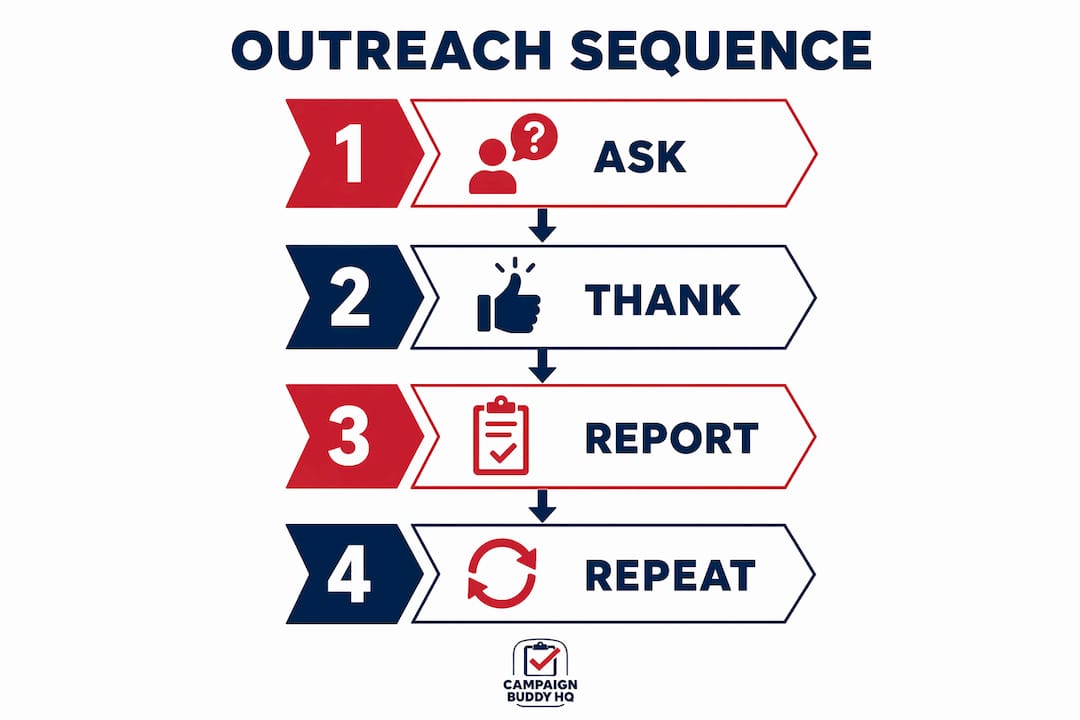
The "Ask-Thank-Report-Repeat" cycle is the structural backbone of effective fundraising sequences. Each step serves a distinct purpose. The ask initiates the relationship. The thank-you reinforces it. The report demonstrates impact. The repeat sustains momentum. Campaigns that skip the thank-you and report steps see sharply lower renewal rates because donors feel used rather than valued.
A/B testing on send times and message variations is not optional for serious campaigns. Open rates and click-through rates are the metrics that tell you whether your timing and subject lines are working. Testing two versions of a subject line on a small segment before sending to your full list can meaningfully improve results. The data from each send informs the next one, creating a feedback loop that compounds over time.
Phone outreach significantly improves mid-level donor retention and increases gift sizes by enabling live, donor-focused conversations. A phone call does something no email can: it lets a donor ask questions and feel heard in real time. Thank-you calls after a first gift are one of the highest-return activities a campaign can run. They cost almost nothing and dramatically increase the likelihood of a second gift.
A complete outreach sequence from first contact to re-engagement follows this structure:
- Initial contact via the donor's preferred channel with a single, clear ask.
- Immediate automated thank-you within 24 hours of any gift or action.
- Impact report sent within 30 days showing what the contribution achieved.
- Follow-up call or personal email from a campaign leader for mid-level donors.
- Upgrade conversation at the 90-day mark for donors who have given twice.
- Re-engagement message for lapsed donors at the 6-month mark referencing their history.
Outreach sequences managed as data-driven workflows track progress, objections, and timing so that every response leads to sustained engagement rather than a one-off gift. Campaignbuddyhq supports this with campaign phase tracking and daily planning tools that keep organizers on schedule.
Pro Tip: Automate the timing of your sequences but personalize the content. Automation handles consistency. Personalization handles connection. You need both.
What are the most common fundraising outreach mistakes?
Generic messaging is the single most damaging mistake in donor outreach. Personalization must reflect genuine awareness of donor interests and history to avoid fatigue and increase response. When every donor receives the same message, the implicit signal is that none of them matter individually. That signal kills retention.
Poor list quality compounds the problem. A large list of unqualified contacts wastes time, inflates unsubscribe rates, and skews your engagement metrics. Organizers who invest in building a quality supporter list before launching outreach consistently outperform those who prioritize volume. A clean, segmented list is a campaign asset. A bloated, unmanaged list is a liability.
Cold email outreach for nonprofits requires segmentation, personalization, and strategic follow-ups to overcome low response rates. Treating cold outreach as a one-off event rather than the start of a sequence is the most common structural mistake. A single email with no follow-up plan is not a campaign. It is a missed opportunity.
Common pitfalls and how to fix them:
- Broad, generic messaging: Segment your list and write to each group's specific interests.
- Poor list quality: Audit your contact list quarterly and remove unengaged contacts.
- No follow-up plan: Build a minimum three-touch sequence before any ask goes out.
- Unclear calls to action: Give each message one action and one link.
- Bad timing: Test send times by segment and adjust based on open rate data.
- Skipping the thank-you: Send a personal thank-you within 24 hours of every gift.
Pro Tip: Prioritize relationship over transaction. A donor who feels appreciated gives again. A donor who feels solicited unsubscribes. The thank-you is not optional. It is the most important message you send.
Key Takeaways
Effective fundraising outreach requires a structured, multi-channel approach built on segmentation, personalization, and consistent follow-up sequences that treat every donor as a long-term relationship.
| Point | Details |
|---|---|
| Multi-channel outreach wins | Combine email, SMS, phone, and events to reach supporters where they already engage. |
| Quality beats quantity | A focused list of researched prospects outperforms a large, generic contact list. |
| Sequences outperform single asks | Use the Ask-Thank-Report-Repeat cycle to build retention and increase gift sizes. |
| Personalization drives response | Reference donor history and interests, not just their name, to reduce fatigue and increase giving. |
| Track and adjust continuously | Use open rates, click-through rates, and conversion data to refine every outreach sequence. |
What I've learned about outreach after years of campaign work
The biggest misconception I see among organizers is that more outreach automatically means better results. It does not. Volume without structure creates noise. Donors tune out campaigns that contact them constantly without relevance or purpose.
What actually works is making supporters feel genuinely involved in something that matters. That means consistent outreach that respects their time, references their history, and shows them the impact of their contributions. The campaigns I have seen succeed treat every touchpoint as a chance to deepen a relationship, not close a transaction.
The hardest lesson is timing. Most organizers under-invest in the thank-you and over-invest in the ask. Flipping that ratio changes donor behavior faster than any messaging tweak. A donor who receives a genuine, specific thank-you call after their first gift is far more likely to give again than one who receives a second ask within a week.
Data workflows are not just for large campaigns. Even a small grassroots effort benefits from tracking which contacts responded, when, and to what message. That information is the foundation of every improvement you make. Without it, you are guessing. With it, you are learning. Campaignbuddyhq makes that tracking accessible for organizers at every scale, including those working in rural and low-density communities where every contact counts.
— Billy
How Campaignbuddyhq supports your outreach program
Running a multi-channel outreach program without a system to track it is like canvassing without a map.
Campaignbuddyhq gives campaign organizers and nonprofit leaders the tools to plan daily outreach, log calls, texts, and door contacts, and monitor progress toward fundraising goals in real time. The platform is built for real-world campaign conditions, including low-density areas where every contact matters. Supporter tracking and campaign phase management keep your sequences on schedule without requiring a large staff. Campaignbuddyhq offers a free 7-day trial with no credit card required, so you can test the full platform before committing. If you are ready to bring structure to your outreach activities, Campaignbuddyhq is where to start.
FAQ
What is fundraising outreach in simple terms?
Fundraising outreach is the process of contacting potential donors through multiple channels, including email, phone, SMS, and events, to build relationships and secure financial support for a campaign or cause.
What is the difference between fundraising outreach and donor outreach?
The terms are used interchangeably. Donor outreach typically refers to communication with existing supporters, while fundraising outreach includes prospecting new donors as well as nurturing current ones.
How many touchpoints does effective donor outreach require?
Effective outreach requires a minimum of three touchpoints before any major ask, following the Ask-Thank-Report-Repeat cycle to build trust and increase the likelihood of a gift.
What channels work best for fundraising outreach?
Phone calls produce the highest engagement for mid-level donors, while SMS and email reach larger audiences at lower cost. The best approach combines multiple channels based on supporter preferences and campaign goals.
How do you improve fundraising outreach response rates?
Segment your contact list by giving history and interests, personalize every message beyond the donor's name, and follow up within 24 hours of any action or gift to maintain momentum and reduce donor fatigue.