

Consistency in outreach is defined as maintaining a structured, repeated sequence of contact points that build voter trust and prevent missed opportunities. Campaign organizers who treat outreach as a daily discipline rather than a periodic sprint see measurably better results. Well-timed sequences of 4–6 touchpoints generate 3–4 times the response rate of single-message outreach. The psychological mechanism behind this is the mere exposure effect: repeated, spaced contact creates familiarity, and familiarity converts to trust. Tools like Campaignbuddyhq are built specifically to help campaigns maintain this kind of structured cadence across doors, calls, texts, and registrations.
Why consistency in outreach drives higher response rates
The difference between a voter who ignores you and one who shows up on election day often comes down to how many times you reached them, and when. Adding one well-timed follow-up can increase response rates by 40–65%. That number reflects a structural reality: most voters do not act on a first contact. They need repetition to move from awareness to engagement.
The mere exposure effect explains this behavior precisely. Recipients engage meaningfully after the 3rd or 4th contact rather than after the first. Each touchpoint reduces the psychological friction of responding. By the fourth contact, your campaign no longer feels like a cold call. It feels familiar.
Contrast this with single-message outreach. A lone door knock or one text blast produces a response rate that rarely exceeds 5% in cold conditions. A well-spaced sequence of 4–6 contacts, each building on the last, turns that same voter into a recognizable relationship. The message matters less than the architecture around it.
- Sequence length: 4–6 touchpoints per voter contact cycle
- Spacing: 3–5 days between contacts to avoid fatigue
- Channel mix: rotate between doors, calls, texts, and email to prevent desensitization
- Timing: mid-week sends on Tuesday through Thursday consistently outperform other days for engagement
Pro Tip: Log every contact attempt in real time. Campaigns that track touchpoints accurately can identify which voters are in their 3rd or 4th contact window and prioritize those conversations for maximum conversion.
Structured outreach vs. ad-hoc bursts: which sustains momentum?
Most grassroots campaigns fall into the same trap. They run a phone bank before a deadline, knock doors the week before an event, and then go quiet for two weeks. This feast-or-famine cycle is one of the most common reasons campaigns lose momentum before election day.
Structured outreach generates up to 28% higher engagement than ad-hoc outreach. Unstructured programs frequently collapse within the first 90 days due to burnout and inconsistency. That 90-day window is exactly when most campaigns are still building their voter contact lists and establishing name recognition.

The table below shows the practical difference between the two approaches:
| Factor | Structured outreach | Ad-hoc outreach |
|---|---|---|
| Engagement rate | Up to 28% higher | Baseline or lower |
| Volunteer burnout | Lower, due to predictable workload | Higher, due to intensity spikes |
| Pipeline visibility | Predictable, trackable | Erratic, hard to forecast |
| Voter trust built | Cumulative, compounding | Minimal, resets each cycle |
| Campaign scalability | High | Low |
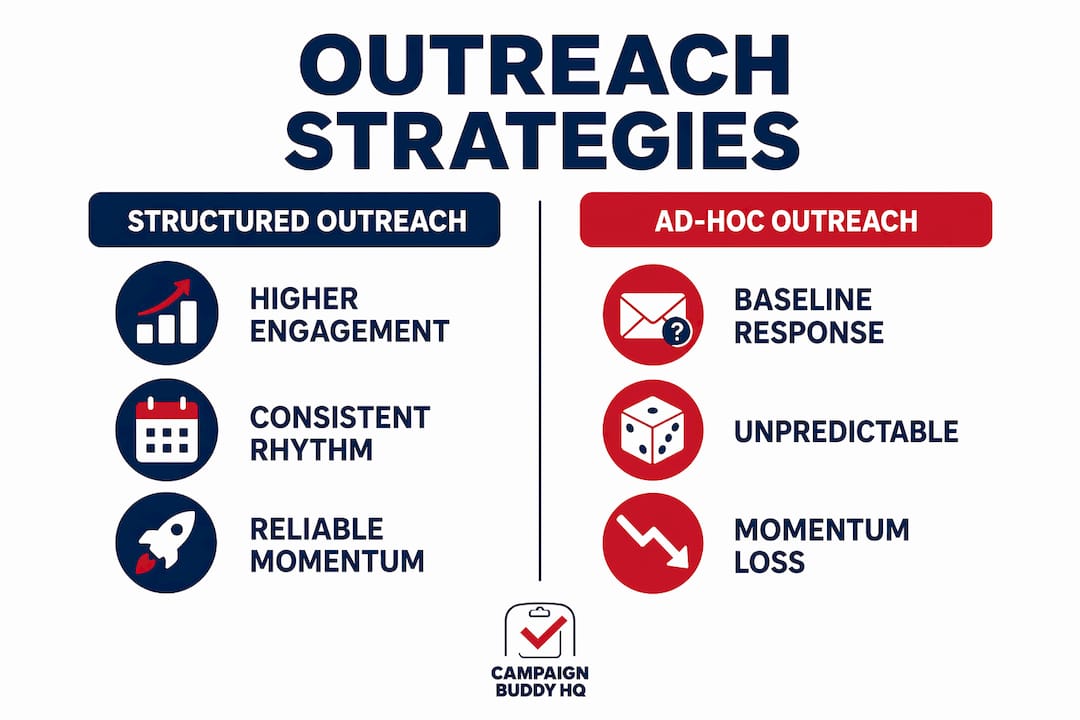
Intensity-based outreach followed by disappearance damages credibility and momentum. A voter who hears from your campaign three times in one week and then nothing for a month does not feel engaged. They feel marketed to, and then forgotten.
Sustainable rhythm beats intensity every time. When your team knows exactly how many contacts to make each day, they can pace themselves, track progress, and build on prior conversations rather than starting from scratch each cycle.
Pro Tip: Set a weekly outreach floor, not just a ceiling. Decide the minimum number of voter contacts your team will make every week regardless of what else is happening. That floor is your consistency baseline.
What are the best practices for consistent outreach sequences?
The structure of your outreach sequence determines success before a single voter reads your message. An average message sent consistently outperforms a good message sent irregularly. This is the most counterintuitive truth in campaign outreach, and most organizers never internalize it.
Here is a proven framework for building a consistent outreach sequence:
- Set your cadence first. Decide on 4–6 touchpoints per voter, spaced 3–5 days apart. Write this into your campaign calendar before you write a single script.
- Map your channels. Assign each touchpoint a channel. Contact 1 might be a door knock, contact 2 a text, contact 3 a call, contact 4 an email. Rotating channels reduces fatigue and increases reach.
- Schedule mid-week activity. Tuesday through Thursday outperform Monday and Friday for voter engagement. Build your highest-volume days around this window.
- Personalize by behavior. If a voter answered the door on contact 1, reference that conversation in contact 2. Each interaction should reference the last to build narrative continuity.
- Audit your sequence monthly. Review response rates by touchpoint number. If contact 3 consistently underperforms, adjust the channel or message for that step.
Common pitfalls to avoid:
- Over-contacting: More than 6 touches in a single cycle signals desperation and damages trust
- Inconsistent follow-up: Skipping contacts mid-sequence resets the familiarity you built
- Single-channel dependency: Relying only on texts or only on calls limits your reach and accelerates fatigue
- Ignoring timing data: Sending outreach on Fridays or weekends consistently underperforms
You can find a detailed breakdown of how to structure these sequences in this step-by-step outreach guide from Campaignbuddyhq.
Pro Tip: Treat your outreach sequence like a product, not a task list. Version it, test it, and improve it after every campaign phase. The campaigns that iterate on their sequences outperform those that run the same script cycle after cycle.
How can campaigns maintain outreach consistency long-term?
The hardest part of consistent outreach is not designing the sequence. It is executing it week after week when competing priorities pull your team in every direction. Campaigns that treat outreach as a secondary task see weaker pipelines and inconsistent execution. The fix is structural, not motivational.
Embed outreach into daily workflows the same way you embed staff check-ins or budget reviews. When voter contact is a scheduled, non-negotiable part of the day, it gets done. When it is treated as something to do after everything else, it gets skipped.
Practical tactics for long-term consistency:
- Set daily activity benchmarks. Define a specific number of doors, calls, or texts each team member is responsible for each day. Track these in a shared system.
- Use activity tracking tools. Campaignbuddyhq logs doors knocked, calls made, texts sent, and registrations completed in real time. That data keeps teams accountable without requiring manual reporting.
- Build in weekly reviews. A 15-minute weekly check-in on outreach numbers catches drift before it becomes a gap. Review what was planned versus what was completed.
- Rotate responsibilities. Burnout is the primary reason outreach consistency breaks down. Rotating which team members lead outreach each week distributes the load and keeps energy levels stable.
- Celebrate benchmarks publicly. When a volunteer hits their 100th door or their 50th call, acknowledge it. Positive reinforcement builds the habit loop that sustains long-term consistency.
Integrating outreach into daily operational workflows maintains psychological momentum with voters and with your team. The campaigns that win are not always the ones with the best message. They are the ones that showed up every single day. For a deeper look at how to track and organize these activities, the outreach tracking guide from Campaignbuddyhq covers the operational side in detail.
Key takeaways
Consistent outreach wins campaigns because structured, repeated contact builds voter trust, prevents momentum loss, and produces measurably higher engagement than any single-burst strategy.
| Point | Details |
|---|---|
| Sequence length matters | Use 4–6 touchpoints per voter, spaced 3–5 days apart, to maximize response rates. |
| Structure beats intensity | Consistent daily outreach generates up to 28% higher engagement than ad-hoc bursts. |
| Timing improves results | Schedule high-volume outreach on Tuesday through Thursday for the best engagement rates. |
| Daily workflows sustain consistency | Embed outreach into daily operations with tracked benchmarks to prevent momentum loss. |
| Message quality is secondary | An average message sent consistently outperforms a strong message sent irregularly. |
The discipline nobody talks about enough
I have watched campaigns with strong candidates, solid messaging, and motivated volunteers still lose ground in the final weeks. The common thread is almost always the same: their outreach was inconsistent. They had great weeks followed by quiet ones. They knocked 500 doors before a rally and then went dark for 10 days. By the time they ramped back up, the momentum they built had evaporated.
What I have learned from working with campaign organizers is that consistency is the discipline that separates campaigns that feel busy from campaigns that actually build power. Busy campaigns react. Consistent campaigns compound. Every contact your team makes today makes the next contact easier, because the voter already knows your name.
The campaigns I have seen succeed treat their outreach numbers the same way a serious athlete treats training logs. They track them, they protect them, and they do not negotiate them away when things get hectic. That discipline is not glamorous. It does not make for a great campaign story. But it is what fills your volunteer pipeline, builds your voter contact list, and gets your candidate across the finish line.
If you are running a campaign right now, the single most useful thing you can do this week is set a daily outreach floor and protect it. Not a goal. A floor. The number you will hit no matter what. Start there, and build from it.
— Billy
How Campaignbuddyhq helps you stay consistent
Maintaining outreach consistency across a full campaign cycle is an operational challenge, not just a motivation problem. Campaignbuddyhq is built to solve exactly that. The platform gives campaign organizers real-time tracking for doors, calls, texts, and registrations, so your team always knows where they stand against their daily and weekly benchmarks.
With features like daily and weekly planning, outreach logging, supporter tracking, and campaign phase management, Campaignbuddyhq removes the friction that causes teams to fall behind. It works for rural and low-density communities where outreach logistics are more complex, and it scales with your campaign as your operation grows. Start your free 7-day trial today, no credit card required, and see what consistent outreach looks like when it is built into your daily workflow.
FAQ
Why does outreach consistency matter more than message quality?
The structure of your outreach sequence determines success before a voter reads your message. An average message sent consistently outperforms a strong message sent irregularly because familiarity and repetition drive engagement more than content alone.
How many touchpoints should a campaign outreach sequence include?
The optimal sequence includes 4–6 touchpoints spaced 3–5 days apart. This cadence builds familiarity through the mere exposure effect without crossing into over-contact territory that damages trust.
What is the best day of the week to send campaign outreach?
Tuesday through Thursday consistently outperform other days for voter engagement. Monday and Friday contacts tend to underperform because voters are either transitioning into or out of their weekly routines.
How does consistent outreach prevent campaign burnout?
Structured daily outreach distributes workload evenly across your team, replacing unpredictable intensity spikes with a predictable rhythm. Unstructured programs frequently collapse within 90 days due to the burnout that follows burst-style campaigns.
How can small campaigns track outreach consistency without a large staff?
Platforms like Campaignbuddyhq log outreach activity in real time and provide daily benchmarks that keep small teams accountable. Tracking doors, calls, and texts in one place removes the manual reporting burden and makes consistency visible across the whole team.