

Canvassing data quality means every doorstep interaction gets logged as clean, structured, verifiable information rather than a rough note someone tries to interpret later. The single biggest upgrade a campaign can make right now is replacing free-text notes with structured fields, paired with automatic geolocation and timestamp checks on every submission. Campaign Buddy HQ builds its outreach tracking around exactly this pairing, because it's the fastest way to catch bad data before it corrupts your targeting.
TL;DR:
- Using fixed-choice dropdown fields instead of free-text notes reduces inconsistent labels and makes data easier to verify and clean later.
- Enforcing required fields and standardized vocabularies prevents incomplete or inaccurate records, especially under time pressure at the door.
- Automated, sampled, and pipeline checks are essential to catch data inconsistencies, improbable entries, and duplicates before they affect targeting.
- Proper training, supervision, and privacy protocols ensure canvassers understand why data quality matters and follow consistent procedures.
- Prioritizing schema design and data verification upfront significantly minimizes downstream cleanup and improves overall campaign data reliability.
Table of Contents
- What Fields Should You Capture at the Door?
- Why Does Canvassing Data Break So Easily?
- How Do You Verify Canvassing Data Is Real?
- What Operational Protocols Keep Field Data Clean?
- Does This Actually Work in the Field?
- An Editorial Take: Stop Treating Data Quality as an Afterthought
- Get These Protocols Running Without Building Them Yourself
- Sources
What Fields Should You Capture at the Door?
The door is not the place for essay questions. Every field a canvasser fills out under time pressure needs to be answerable in two seconds with a tap, not a sentence they have to compose. That single design choice determines whether your data is usable three weeks from now or just a pile of inconsistent notes.
A minimal, field-tested schema includes:
- Contact permission/opt-in status: yes, no, or unclear, captured as a fixed choice, never inferred later from a note.
- Preferred contact method: phone, text, email, or mail, so your follow-up sequence doesn't guess.
- Phone and email, validated against basic format rules (a phone field that accepts letters is a bug, not a feature).
- Supporter intensity, scored on a simple scale, for example: Strong Support, Lean Support, Undecided, Lean Oppose, Strong Oppose, Refused.
- Turnout likelihood, bucketed into probability tiers (Very Likely, Likely, Unsure, Unlikely) rather than an open guess.
- Issue preferences, picked from a short controlled list, not typed freehand.
- Follow-up action and timing, chosen from preset options like "callback in 3 days" or "send text reminder."
- Result code, a fixed outcome tag: Not Home, Moved, Refused, Contacted, Bad Address.
Formatting rules matter as much as the field list. Use dropdowns and fixed codes everywhere a free-text box would otherwise tempt a tired volunteer. Standardize labels across every shift and every app so "strong yes" and "SY" and "definitely voting for us" don't end up as three different values describing the same voter. Require the minimum viable set of fields before a card can submit, and keep controlled vocabularies short, five to seven options at most, because a fifteen-item dropdown is functionally the same as free text.
Pro Tip: If a canvasser has to think for more than three seconds about which option to pick, your vocabulary list is too long or too vague. Cut it in half and test again with your next shift.
Structured entry isn't a bureaucratic preference. CRM data-management research from Validity shows that structured, validated data consistently reduces downstream cleanup costs compared to unstructured entry, because someone on your team isn't stuck reverse-engineering intent from a scribbled note weeks after the door was knocked.
Why Does Canvassing Data Break So Easily?
Bad canvassing data rarely fails loudly. It fails quietly, showing up weeks later as a targeting list full of ghosts and duplicates. Here's the order in which it usually goes wrong.
- Inconsistent labels creep in first. One canvasser writes "leaning yes," another writes "soft support," and your database now treats them as unrelated categories instead of the same signal.
- Missing fields pile up under time pressure. A canvasser skips the result code because the door closed mid-conversation, and that record now looks like a completed contact when it wasn't.
- Unrealistic door rates slip through unnoticed. Someone logs 40 doors in twenty minutes, which is not humanly possible, and nobody catches it until the numbers roll up strange at the end of the week.
- Timestamp and geolocation gaps appear. A phone loses signal, the app caches an entry, and it uploads hours later with a location that doesn't match the assigned turf.
- Duplicate records multiply. The same voter gets logged twice by two different canvassers covering overlapping streets, and both entries carry different, conflicting notes.
The root causes are almost always the same three things: free-text fields that invite inconsistency, canvassers who weren't trained on why the fields matter (not just how to fill them), and apps configured loosely enough that required fields aren't actually required. Occasionally it's deliberate, a volunteer under quota pressure fabricating doors to hit a number.
The fixes are just as consistent. Enforce required fields at the app level so a card can't submit incomplete. Standardize your option sets before the first shift, not after the first mess. Deduplicate your voter file nightly, not weekly. And block or flag entries with improbable time or location data before they ever reach your targeting file.
How Do You Verify Canvassing Data Is Real?
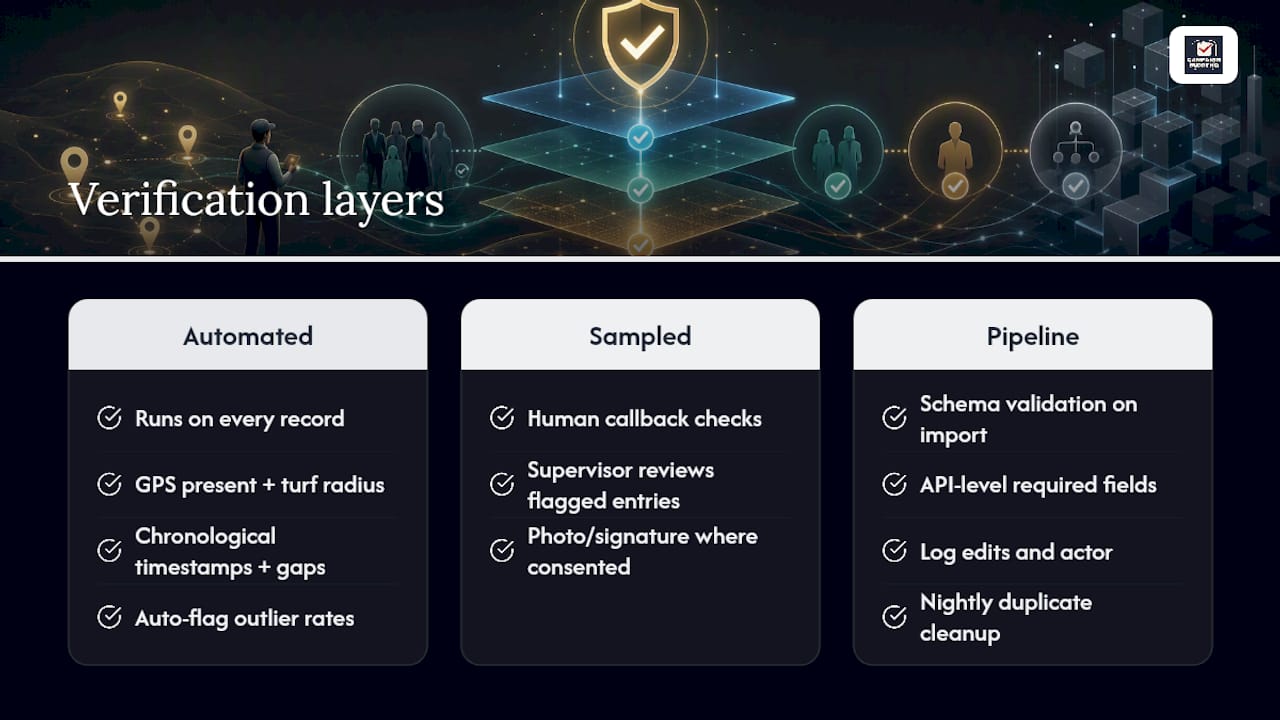
Verification works in three layers: automated, sampled, and structural. You need all three, because each one catches a different kind of failure.
Automated checks run on every single record, no exceptions. Confirm GPS coordinates are present and plausible for the assigned turf, flagging anything outside a reasonable radius. Check that timestamps run chronologically and that the gap between doors falls within a believable range, most canvassers spend a few minutes per contact, so a batch of doors logged in rapid succession is a red flag, not a fast worker. Flag outlier contact rates automatically rather than waiting for someone to notice a strange weekly total.
Sampling checks add a human layer automated systems can't replace. Call back a small percentage of logged contacts to confirm the conversation happened as recorded. Have a supervisor manually review every flagged entry before it enters your targeting universe. Where legally allowed and consented to, photo or signature capture adds a verification layer for high-stakes programs like petition or registration drives.
Pipeline checks catch problems at the infrastructure level. Run schema validation on import so a malformed file can't quietly corrupt your voter file. Set field requirements at the API level, not just in the app's user interface, because a determined workaround will find the gap. Log every edit and who made it. Run nightly clean-up scripts that catch duplicates and orphaned records before your data team starts the next day's targeting.
Pew Research's reporting on bogus respondents in opt-in surveys makes an important point that applies directly here: field programs now run at a scale where verification systems haven't caught up. Millions of contact attempts move through voter-contact apps every cycle, and no single technological fix solves data integrity on its own. It takes the combination of standardized schemas, automated plausibility checks, and human spot-checks working together.
Pro Tip: Run a simple exploratory pass on your data weekly, checking distributions, obvious outliers, and time patterns. It takes twenty minutes and catches problems a nightly script might miss. Simple exploratory workflows like the ones Statohub outlines for data teams work just as well on a voter file as they do on a spreadsheet of sales numbers.
What Operational Protocols Keep Field Data Clean?
Good tools don't fix bad training. The strongest schema in the world still breaks if the person entering data at the door doesn't understand why the fields matter.
New-canvasser training should cover:
- How to record a response using the exact controlled vocabulary, not a paraphrase.
- A short, consistent consent script read the same way at every door.
- Basic device handling: keeping location services on, submitting cards before the app closes, charging devices between shifts.
- A clear path for reporting errors or confusing situations back to a supervisor the same day, not at the end of the week.
Supervision needs a rhythm, not a one-time setup. Daily uploads, reviewed the same day. Exception reports that surface flagged records automatically. A feedback loop that turns recurring mistakes into a five-minute correction at the next shift briefing, not a memo nobody reads.
Privacy and security are not optional add-ons. Collect only the data you actually need. Encrypt information in transit. Limit access by role, so a volunteer coordinator doesn't have the same visibility as your data director. Document how long you retain records and when they get deleted.
Consent language should be short and specific: "May we text you campaign updates? Reply STOP to opt out anytime." Clear opt-in wording like this does more than satisfy a legal checkbox. In Field Strategies' analysis of canvassing accountability points out that transparency about what you collect and why builds the trust that keeps supporters responsive instead of guarded.
Pro Tip: Print your consent script on a small card clipped to every canvasser's clipboard. Consistency beats memory, especially by hour four of a shift.

Does This Actually Work in the Field?
The pattern holds up across every campaign that has tried it: standardize the schema, verify the inputs, and train people on the "why," and your data stops requiring weeks of cleanup before you can trust it. Operational guidance on campaign data collection from practitioners running real field programs shows that a short required schema, paired with consistent option sets, dramatically improves how complete and usable volunteer-collected data actually is.
Industry examples reinforce it too. Vendors building dedicated audit layers, such as Echo Canyon Consulting's Astralis platform, exist specifically because geolocation, timestamp, and door-timing checks catch irregularities that would otherwise slip straight into a targeting file.
An Editorial Take: Stop Treating Data Quality as an Afterthought
The conventional advice on canvassing data quality treats it as a cleanup problem, something you fix after the fact with a data team scrubbing spreadsheets in the final weeks before an election. That's backwards. By the time bad data reaches a data team, the damage is already baked into your targeting decisions, your volunteer scheduling, and your candidate's sense of where the race actually stands.
What the evidence actually supports is treating verification as a front-line activity, not a back-office one. Structured fields and geo/time checks aren't nice extras layered onto a canvassing program. They're the mechanism that determines whether anything downstream, your models, your GOTV lists, your resource allocation, is built on real information or noise dressed up as data.
If you can only prioritize one thing this cycle, prioritize the schema. Fix what canvassers can enter before you worry about auditing what they entered. A tight, well-designed form prevents ten times more bad data than any audit catches after the fact.
— Billy
Get These Protocols Running Without Building Them Yourself
This platform is built around the exact checklist this article just walked through: structured fields for supporter intensity, turnout likelihood, and result codes, daily reporting that surfaces exceptions instead of burying them, and supervisor tools that make flagged entries visible instead of lost in a spreadsheet.
Instead of assembling that stack from scratch, a campaign can pull outreach logging, supporter tracking, and daily planning into one workflow built specifically for field programs, including ones running in rural or low-density turf where every contact counts more. The 7-day free trial requires no credit card, which makes it a low-risk way to run a real pilot. Pick a single precinct or a single evening shift, run your schema and audit routine through Campaign Buddy HQ for that pilot, and compare the resulting data against whatever process you used last cycle. Most teams see the difference in a single week of shifts.
Sources
- No easy fix for bogus respondents in online opt‑in polls — Pew Research (2026)
- The importance of data integrity and accountability in political canvassing — In Field Strategies