
An election cycle is the structured sequence of phases governing how elections are organized, conducted, and officially concluded for political office. For the 2026 U.S. federal midterms, that sequence runs from candidate filing through the convening of the 120th Congress on january 3, 2027. Understanding this election cycle breakdown is not optional for serious advocates. The Federal Election Commission (FEC), state election boards, and bodies like the Bipartisan Policy Center (BPC) each play defined roles at specific points in the process. Miss a phase, and you miss your window to act.
What are the major phases of the 2026 election cycle?
The 2026 federal election cycle follows four distinct phases, each with fixed dates and specific activities. Knowing where you are in the sequence determines what actions are available to you.
Phase 1: Spring to fall primaries (march 3 through september 15, 2026)

Primaries begin as early as march 3 in some states and run through mid-september. This is when party nominees are determined, and it is the phase most advocates underestimate. Voter turnout in primaries is historically lower than in general elections, which means organized outreach carries outsized weight.
Phase 2: Election Day (november 3, 2026)
Election Day is fixed by federal law on the first Tuesday after the first Monday in november. All 435 U.S. House seats and 35 Senate seats are on the ballot, including two special Senate elections filling vacancies left by J.D. Vance and Marco Rubio. That scope makes 2026 one of the broadest midterm cycles in recent memory.
Phase 3: Post-election canvass and certification (november 4, 2026 through january 3, 2027)
Canvassing and certification begin the day after Election Day and continue through early january. Results during this period are provisional until each jurisdiction completes its official certification process.
Phase 4: 120th Congress convenes (january 3, 2027)
The newly elected Congress takes office on january 3, 2027. This date marks the legal end of the 2026 election cycle.
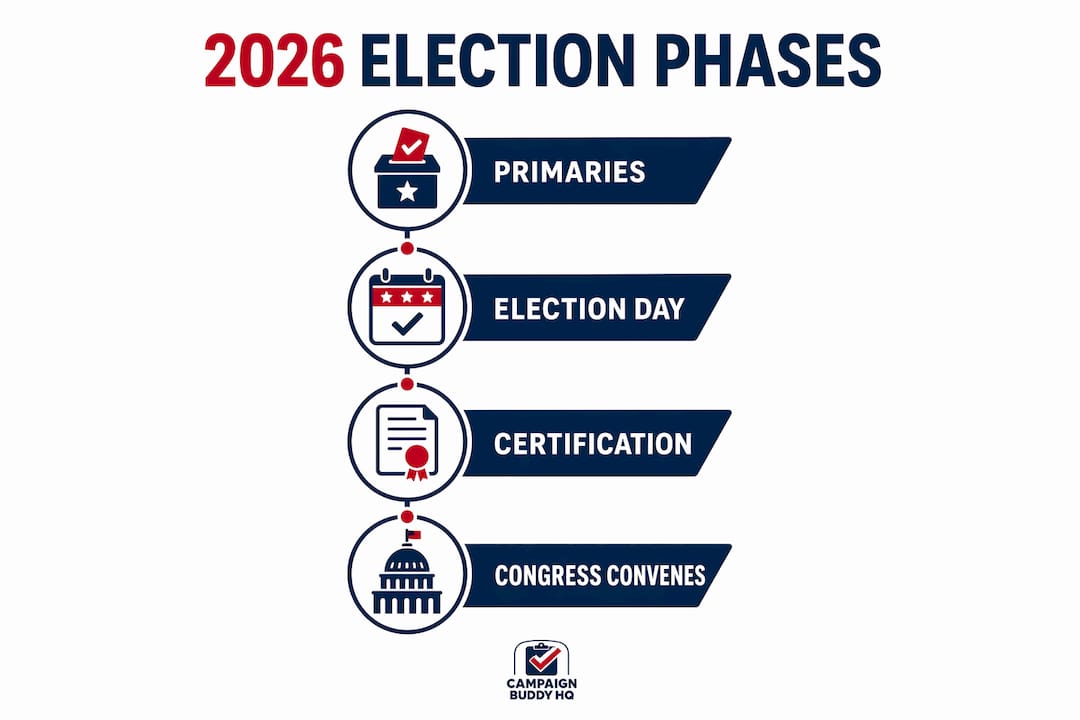
| Phase | Dates | Key Activity |
|---|---|---|
| Primaries | March 3 – September 15, 2026 | Party nominee selection |
| Election Day | November 3, 2026 | General election voting |
| Canvass and certification | November 4, 2026 – January 3, 2027 | Official result verification |
| 120th Congress convenes | January 3, 2027 | New Congress seated |
Special elections filling mid-term vacancies also occur throughout the year. Advocates should track these separately, as they follow compressed timelines with their own filing and voting deadlines.
How does each election phase work from filing to certification?
The election process follows a strict sequence. Each phase has a defined legal status, and only the final step produces official results.
- Candidate filing. Candidates submit paperwork and fees to qualify for the ballot. Deadlines vary by state, typically falling weeks or months before the primary date. Missing a filing deadline removes a candidate from the ballot entirely.
- Primaries. Voters select party nominees. Primary dates are spread across the calendar from march through september, so the window for primary-focused outreach is long but fragmented.
- Early and absentee voting. Most states open early voting in mid-october, roughly two to three weeks before Election Day. Absentee ballots are available even earlier in many jurisdictions.
- Election Day. In-person voting closes at the end of Election Day. This is the culmination of the voter decision window, not the end of the process.
- Canvassing. Election officials count, verify, and reconcile all ballots. This step can take days to weeks depending on the volume of mail and provisional ballots.
- Certification. Local and state jurisdictions certify results before any federal acknowledgment occurs. Only certified results are official. Every count, projection, or call made before certification is provisional.
The distinction between steps 5 and 6 is where public confusion most often occurs. Election night projections are media estimates, not legal results. Certification is the moment the law recognizes a winner.
Pro Tip: Pre-draft phase-specific statements for your campaign or advocacy group before Election Day. Having language ready for "results are still being counted" and "certification is underway" prevents your team from making premature declarations that could undermine credibility.
What state-level variations affect voter registration and early voting?
State law governs most of the voter-facing mechanics of the election process. The variation across states is significant enough to require state-by-state research for any serious advocacy operation.
- Voter registration deadlines fall 15–30 days before Election Day in most states. Some states offer same-day registration, while others have hard cutoffs weeks in advance. Missing the deadline means a voter cannot participate in that election.
- Early voting windows open mostly in mid-october 2026, but start dates differ by state. A few states offer no early voting at all and rely entirely on absentee ballots for pre-Election Day participation.
- Absentee ballot rules vary on submission method, witness requirements, and signature matching. Some states accept ballots postmarked by Election Day; others require receipt by Election Day.
- Overseas and military voters must use the Federal Post Card Application (FPCA) through the Federal Voting Assistance Program (FVAP) to register and request absentee ballots. Most states accept FPCA submissions by email or fax, but some require mail.
- Envelope and signature requirements for absentee ballots are a common source of rejection. Voters who skip a witness signature or use the wrong envelope risk having their ballot disqualified.
The FVAP publishes state-specific guidance for overseas and military voters. Advocates working with those communities should direct voters to FVAP resources well before the absentee request deadline, not the day before.
Pro Tip: Build a state-specific deadline tracker for every jurisdiction your campaign operates in. Registration deadlines, early voting start dates, and absentee rules should all be mapped at least 60 days before Election Day to give your outreach team enough lead time.
Absentee and overseas voting require workflows that are distinct from Election Day canvassing. The operational challenges of tracking FPCA submissions, confirming receipt, and following up on rejected ballots demand dedicated staff or volunteer capacity.
How does election cycle knowledge strengthen political advocacy?
Effective advocacy treats the midterm as a rolling process, not a single event. Campaigns and issue groups that plan only for Election Day leave significant mobilization capacity on the table.
The most useful framework splits the cycle into two distinct periods. The nomination period covers candidate filing and primaries. The voter decision period covers registration, early voting, and Election Day. Messaging and mobilization tactics should shift between these two windows. Primary outreach targets engaged party members. General election outreach targets a broader, less politically active audience.
Specific advocacy actions aligned to each phase include:
- Filing period. Identify and support candidates before primary ballots are set. This is the only window to influence who appears on the ballot.
- Primary season. Run turnout operations targeting low-propensity primary voters. Coordinate volunteer scheduling around state-specific primary dates.
- Voter registration window. Launch registration drives at least 45 days before Election Day to clear state deadlines. Track registration completions against your target universe.
- Early voting period. Shift from registration to turnout. Contact supporters who have not yet voted and provide polling location and hours information.
- Post-election period. Communicate clearly that results are provisional until certification is complete. Avoid declaring victory or defeat based on election night counts.
Certification timelines and jurisdiction-specific processes directly affect public perception of election legitimacy. Advocates who explain the certification process to their supporters reduce the spread of misinformation and build trust in the outcome, regardless of which direction it goes.
For a deeper look at campaign outreach strategies aligned to each phase, the Campaignbuddyhq blog covers 2026-specific trends and tactics in detail.
Key Takeaways
The 2026 election cycle is a six-phase process running from candidate filing through congressional certification, and advocates who plan across all six phases consistently outperform those who focus only on Election Day.
| Point | Details |
|---|---|
| Six defined phases | The cycle runs from filing through certification; each phase requires different tactics. |
| Certification is the legal finish line | All results before certification are provisional; only certified results are official. |
| State rules vary significantly | Registration deadlines, early voting dates, and absentee rules differ by state and require local research. |
| Overseas voters need FPCA | Military and overseas voters must use the FVAP's FPCA form; most states accept it by email or fax. |
| Advocacy must span the full cycle | Treating the election as a rolling process improves turnout and messaging effectiveness across all phases. |
What I've learned about election timing that most advocates get wrong
Most advocates I've worked with enter a cycle focused on Election Day. That instinct is understandable. Election Day is the moment that feels decisive. But the decisions that shape Election Day outcomes are made weeks and months earlier, during filing periods and primaries that most of the public ignores entirely.
The certification phase is the other blind spot. Campaigns routinely make public statements based on election night projections, then have to walk them back when canvassing shifts the count. Pre-drafting phase-appropriate statements before Election Day is one of the most underused practices in campaign communication. It takes two hours of preparation and prevents days of credibility damage.
State-level research is non-negotiable. I've seen well-funded advocacy operations miss voter registration windows in key states because they applied a national deadline assumption to a state with an earlier cutoff. That mistake is entirely avoidable with a simple deadline calendar built at the start of the cycle.
The most effective advocates I've observed treat the election timeline overview as a living document. They revisit it monthly, adjust volunteer schedules around primary dates, and shift messaging as the cycle moves from nomination to voter decision windows. That discipline, applied consistently across all campaign phases, is what separates campaigns that build momentum from those that scramble at the end.
Engage early, plan by phase, and never treat an uncertified result as final.
— Billy
Campaignbuddyhq: built for every phase of the 2026 cycle
Managing the 2026 election cycle across six phases, dozens of state deadlines, and hundreds of volunteer shifts requires more than a spreadsheet.
Campaignbuddyhq is a campaign management platform built for exactly this kind of work. It tracks outreach activities including doors knocked, calls made, texts sent, and registrations completed. Its campaign phases feature aligns your team's daily and weekly planning with the actual structure of the election timeline. Whether you're running a congressional race or an issue advocacy effort, Campaignbuddyhq gives you the workflow structure to stay organized from filing through certification. Start with a free 7-day trial and see how it fits your 2026 operation.
FAQ
What is an election cycle breakdown?
An election cycle breakdown is a phase-by-phase map of the events governing an election, from candidate filing through official certification of results. For the 2026 U.S. federal midterms, that sequence spans march 2026 through january 2027.
When does the 2026 election cycle officially end?
The 2026 election cycle ends on january 3, 2027, when the newly elected 120th Congress convenes. Certification of results occurs before that date, with timelines varying by state.
Are election night results official?
Election night results are not official. All counts and projections before certification are provisional. Certification by local and state jurisdictions is the legal step that makes results final.
How do overseas voters participate in the 2026 election?
Overseas and military voters use the Federal Post Card Application (FPCA) through the FVAP to register and request absentee ballots. Most states accept FPCA submissions by email or fax, but voters should confirm their state's specific rules well before the deadline.
Why do voter registration deadlines matter for advocacy?
Registration deadlines fall 15–30 days before Election Day in most states. Advocates who launch registration drives too late lose the ability to add new voters to the electorate, which directly limits turnout potential on Election Day.