

Keeping a political campaign moving forward is harder than most people expect. You can launch strong, build early energy, and watch it quietly drain away by week six. Finding effective ways to boost campaign momentum is not a one-time fix. It is a deliberate, ongoing practice that combines technology, authentic human connection, and disciplined organizing. This article gives you nine proven strategies grounded in 2026 data, real organizing frameworks, and the kind of practical specificity that actually changes how campaigns run.
Table of Contents
- Key takeaways
- 1. Know what campaign momentum actually means
- 2. Ways to boost campaign momentum: build your evaluation framework first
- 3. Use modern canvassing platforms to retain volunteers
- 4. Use data analytics to find your highest-opportunity voters
- 5. Add audio advertising to your channel mix
- 6. Adopt service-based grassroots organizing
- 7. Fix your volunteer onboarding process
- 8. Apply the 50/30/20 rule to your social media content
- 9. Track outreach daily and adjust weekly
- My honest take on what actually moves campaigns forward
- How Campaignbuddyhq helps you put this into practice
- FAQ
Key takeaways
| Point | Details |
|---|---|
| Define momentum with numbers | Track volunteer retention, voter contacts, and engagement rates to know if your momentum is real. |
| Technology multiplies outreach | Modern canvassing platforms significantly increase volunteer return rates compared to paper-based operations. |
| Audio drives trust at scale | Radio reaches nine in ten Americans monthly and outperforms digital alone for persuasion and message retention. |
| Grassroots depth beats quick wins | Service-based organizing builds durable political power by investing in relationships, not just transactions. |
| Match strategy to campaign size | Combine short-term activation tactics with long-term infrastructure building for maximum and sustained effect. |
1. Know what campaign momentum actually means
Before you can boost it, you need to define it. Campaign momentum refers to the compounding energy a campaign generates through consistent outreach, growing engagement, and increasing public visibility over time. It shows up as rising volunteer sign-ups, higher voter contact rates, more social media shares, and donors who return without being asked.
The danger is measuring the wrong things. Page views and follower counts feel good but tell you almost nothing about electoral progress. The indicators that actually matter are volunteer retention week over week, the number of doors knocked and calls completed each day, and the rate at which new contacts convert to committed supporters. If those numbers are trending up, you have momentum. If they are flat or falling, you need to act before the stall becomes permanent.
Pro Tip: Set a weekly momentum scorecard with three to five specific numbers. Review it every Monday with your core team. Without a shared definition of progress, everyone optimizes for different things.
2. Ways to boost campaign momentum: build your evaluation framework first
Not every tactic works equally for every campaign. A door-knocking blitz makes sense in a dense urban district. It does not make the same sense in a rural county spread across 800 square miles. Before adopting any new strategy, run it through four filters.
- Reach: How many voters or volunteers does this realistically touch in your geography?
- Sustainability: Can your team execute this for 10 weeks straight, not just one weekend?
- Cost per contact: What does each meaningful interaction actually cost in staff time and money?
- Channel trust: Are you reaching people through media and messengers they already believe?
Scalability matters too. A tactic that works for 20 volunteers needs to be re-evaluated before you scale to 200. The 2026 campaign outreach trends show that campaigns adopting data-driven workflows outpace those running on instinct, especially when volunteer capacity is limited.
3. Use modern canvassing platforms to retain volunteers
Volunteer attrition is one of the fastest ways a campaign loses momentum. When canvassers drop off after their first or second shift, you spend more time recruiting than organizing. The fix is not more pizza at training. It is better tools.

Campaigns using modern canvassing software see 35 to 50% higher volunteer return rates compared to paper-based operations, with hands-on training improving retention by 67%. That is not a marginal gain. That is the difference between a campaign that compounds its outreach week over week and one that constantly resets.
Here is what technology-driven canvassing actually improves:
- Volunteers get clear walk lists on their phone instead of shuffling paper packets.
- Real-time data entry means organizers see contact rates as they happen.
- Automated follow-up prompts remind volunteers of their next shift.
- Progress dashboards let your team celebrate milestones publicly, which reinforces motivation.
When volunteers feel organized and see their impact, they come back. When they feel like they are wasting time, they do not. It is that simple.
4. Use data analytics to find your highest-opportunity voters
Raw contact numbers matter, but contact quality matters more. Knocking on 500 doors in a low-propensity neighborhood produces less impact than 200 conversations with persuadable voters who have a history of showing up in midterms.
Building momentum with data means segmenting your voter file by likelihood to vote, likelihood to persuade, and preferred contact method. Then you assign your best volunteers to your highest-value conversations and your digital outreach to lower-cost segments. This is how you accelerate campaign success without burning out your team.
Pair your voter file analytics with post-contact tagging. When a volunteer marks someone as "leaning yes" or "needs follow-up," that data builds over time into a picture of where your real support lives. That picture tells you where to concentrate resources in the final weeks when every contact counts most.
5. Add audio advertising to your channel mix
Most campaigns default to digital advertising because it feels measurable and modern. But the data on audio is too strong to ignore if you want to improve campaign traction.
Radio reaches 9 in 10 Americans monthly and is the number one most trusted broadcast medium, with in-car listening accounting for 83% of ad-enabled audio time. That reach and that trust level are not matched by any single digital platform.
The cross-channel effect is what makes audio especially powerful. Adding audio to a political campaign boosts social media brand lift by 83% and engagement by 109%. When a voter hears your candidate's voice on the radio during their morning commute and then sees your ad on social media that evening, the second impression lands much harder than if it came alone.
| Channel | Monthly reach | Trust ranking | Cross-channel lift |
|---|---|---|---|
| Radio | 9 in 10 Americans | No. 1 broadcast medium | +83% social lift |
| Podcasts | Strong among ages 18 to 34 | High (host endorsement effect) | Moderate |
| Digital display | High but fragmented | Low to moderate | Baseline |
| Social media video | High, algorithm-dependent | Variable | Baseline |
Pro Tip: Audio ad-supported time accounts for over 80% of daily listens. If your candidate's voice is not in that space, you are handing that trust to your opponent.
"Effective political advertising requires trust, attention, and human connection. Audio channels uniquely deliver these better than digital alone." — iHeartMedia political insights
6. Adopt service-based grassroots organizing
Here is the honest truth about top-down, script-heavy canvassing: voters can tell when they are being processed, not talked to. The DNC's 2026 Organizing Playbook explicitly shifts toward service-based organizing, where organizers lead with listening and community investment instead of a persuasion pitch.
Service-based organizing builds more durable political power than traditional turnout tactics by investing in communities and long-term relationships. What that looks like on the ground:
- Hold neighborhood conversations where your candidate or organizer listens more than they talk.
- Partner with trusted local institutions like churches, unions, and community centers before you need their help on Election Day.
- Identify and develop local volunteer leaders who can organize their own networks without needing a staff person to initiate every action.
- Integrate coalition-based engagement that speaks authentically to distinct cultural and language groups in your district.
The payoff is not immediate. That is exactly the point. Campaigns that invest early in these relationships do not stall in month four because their base is genuinely committed, not just opted into an email list.
7. Fix your volunteer onboarding process
You can recruit a hundred volunteers and convert only twenty into reliable organizers if your onboarding is weak. This is one of the most overlooked places where campaigns bleed momentum.
A 2024 Trestle Collaborative survey found that 60% of organizers rated their onboarding experience as average or worse. When volunteers feel under-prepared, they feel less confident at the door, make fewer return commitments, and ultimately drop out. Every dropout is a double cost: you lose their future contacts AND you pay the time cost of training someone new.
Great onboarding is not longer training. It is clearer training. Give new volunteers one specific task on their first shift, not five. Pair them with an experienced canvasser for their first two doors. Follow up within 24 hours to ask how it went. These three practices alone will materially improve how many people come back for a second shift.
8. Apply the 50/30/20 rule to your social media content
Social media is where many campaigns chase momentum and lose it. Posting too much promotional content drives people to unfollow or tune out. The 50/30/20 rule is a practical content strategy: 50% of your posts should be value-driven content your audience genuinely wants to see, 30% should be branded content that reinforces who you are, and only 20% should be explicitly promotional.
For a political campaign, value-driven content means local news, policy explainers, constituent stories, and behind-the-scenes organizing moments. It is the kind of content people share because it is interesting or meaningful, not because you asked them to. That organic sharing is where real social momentum lives.
The discipline is in protecting that 50%. When election day gets close, the temptation is to flip the ratio and go full promotional. Resist that. An audience that trusts your content because it has been genuinely useful will amplify your final push far more effectively than an audience that has been advertised to for six straight weeks.
9. Track outreach daily and adjust weekly
Consistent outreach tracking is how campaigns separate the feeling of momentum from the reality of it. A campaign that knocks 50 doors one week and 20 the next is not building anything. Consistency compounds. And you cannot manage consistency without daily numbers.
Track doors, calls, texts, and event attendees every single day. Review totals weekly and compare them to your goal pace. If you are running 30% behind your contact goal in week three, that is fixable. If you discover it in week eight, it is a crisis.
The discipline of campaign checklists applied to daily outreach gives your organizers a shared standard. Everyone knows what a full day of work looks like. That clarity reduces inconsistency and makes it easier to spot when something is genuinely off versus when a single slow day is just noise.
My honest take on what actually moves campaigns forward
I've watched campaigns spend real money on the latest digital ad tools and see flat results. I've also watched a well-organized precinct team with a basic contact tracker outperform a high-budget operation that had no relationship with the community it was trying to reach.
What I've learned is that momentum is not generated by any single tactic. It is generated by repetition, trust, and visible progress. When volunteers see that their doors knocked yesterday became new supporters today, they come back. When voters hear a candidate's voice on the radio, then see them at a block party, then get a personal call, they show up. The compounding effect of consistent, multi-channel engagement is where campaigns are really won.
The biggest mistake I see is treating grassroots organizing as a fallback when advertising budgets run dry. It should be the foundation. Technology and audio advertising are accelerants, but they only work when poured on an existing fire. Build the fire first.
The good news is that the tools available in 2026 make it easier than ever to track what is working and course-correct quickly. The campaigns that use them well will have a real and measurable advantage.
— Billy
How Campaignbuddyhq helps you put this into practice
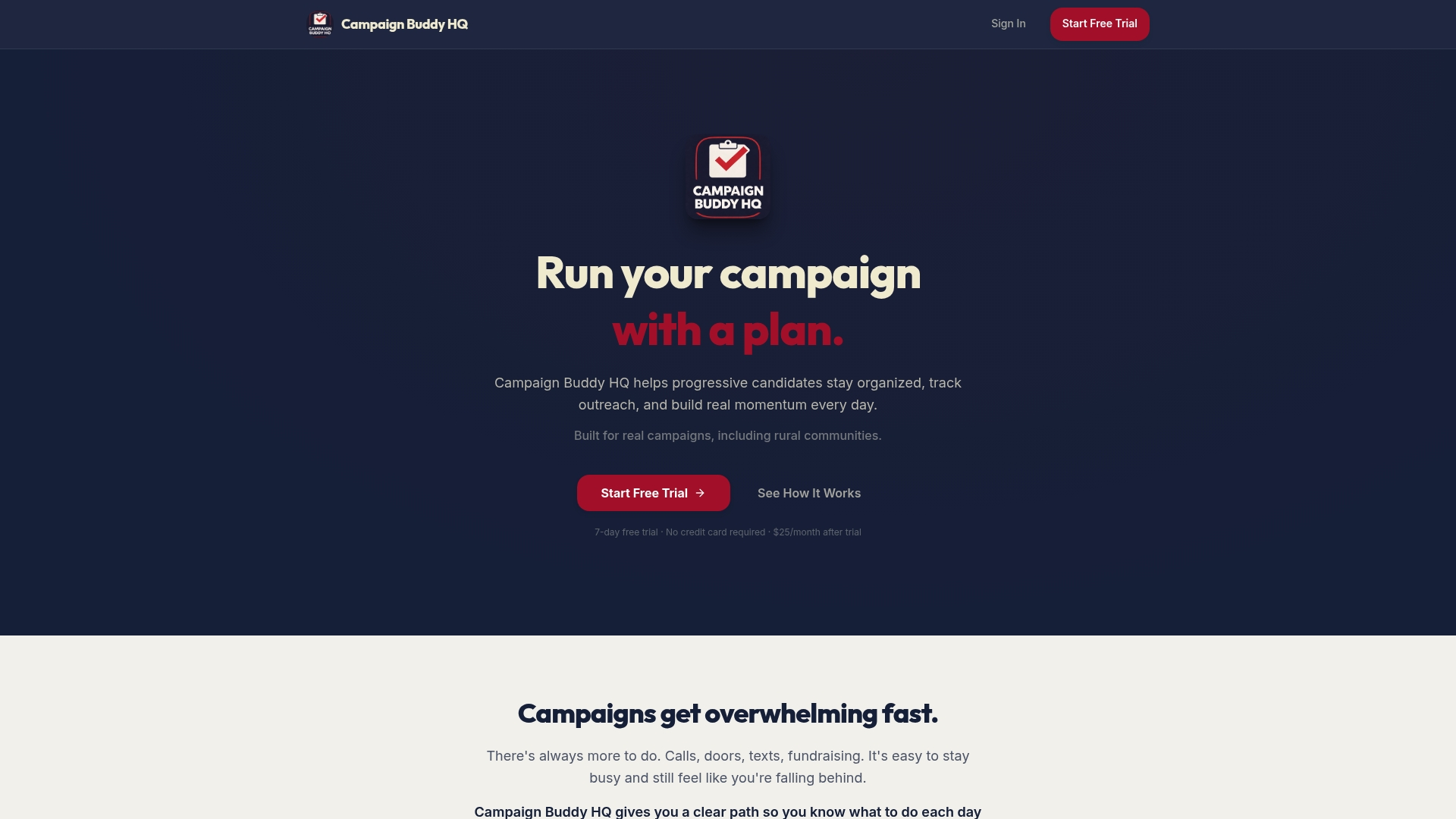
Every strategy in this article requires one thing to work: organized execution. Campaignbuddyhq is built specifically to give political campaigns and advocacy organizers the structure they need to turn good ideas into consistent daily action. The platform tracks doors knocked, calls made, texts sent, and registrations completed, all in one place, with daily and weekly planning tools that keep your team on pace toward your goals.
Whether you are running a rural county race or a statewide effort, Campaignbuddyhq gives your organizers clear assignments and gives you real visibility into progress. No more guessing whether your momentum is real. You can start managing your campaign with a free 7-day trial, no credit card required, and see the difference organized outreach makes within your first week.
FAQ
What is campaign momentum in a political race?
Campaign momentum is the compounding growth in voter engagement, volunteer activity, and public support that a campaign builds through consistent outreach. It shows up in measurable indicators like volunteer return rates, voter contact totals, and increasing event attendance over time.
Why does campaign momentum matter so much for political campaigns?
Momentum signals viability to donors, volunteers, and undecided voters, making each of those groups more likely to commit. A campaign that loses momentum mid-cycle often cannot recover because the enthusiasm that drives word-of-mouth and volunteer recruitment evaporates.
How can I increase volunteer engagement to build campaign momentum?
Use modern canvassing platforms with clear walk lists and real-time tracking, because campaigns with these tools see up to 50% higher volunteer return rates. Pair strong tools with a clear, brief onboarding process and rapid follow-up after every first shift.
Does audio advertising actually help political campaigns?
Yes. Audio adds to political campaigns an 83% boost in social media brand lift and 109% higher engagement compared to digital-only campaigns. Radio also holds the highest trust ranking among broadcast media, making it an especially effective channel for persuasion.
How do I know if my campaign momentum is growing or stalling?
Track three to five specific metrics weekly: volunteer retention, total voter contacts, and new supporter conversions. If those numbers are growing week over week, momentum is real. If they are flat for two consecutive weeks, treat it as an early warning signal and adjust your strategy before the stall becomes permanent.