

Multichannel voter contact works best when doors, calls, texts, mail, and digital touches are sequenced by a voter's behavior and by campaign phase, not fired off all at once. A field program that identifies supporters through blind texting and live calls, then routes them into targeted GOTV touches, has helped campaigns win 18 of 19 targeted races. A campaign management platform can build planning tools around that same sequencing logic.
TL;DR:
- Door-to-door canvassing remains the most effective channel for persuasion and turnout, with up to a 14 percentage point lift in voter participation.
- Behavior-triggered sequencing between channels significantly reduces wasted touches by responding to voter actions like texts or door responses.
- Allocation of budget should prioritize doors and calls for persuadables and low-turnout supporters, while digital and mail focus on early identification and reinforcement.
- Metrics like contact rate, pledge rate, persuasion lift, and turnout conversion are key indicators of multichannel campaign success.
- Using integrated platforms that synchronize data and automate sequencing prevents chaos and improves volunteer efficiency in multi-path voter outreach.
Table of Contents
- What Role Does Each Channel Play in Voter Outreach?
- How Should You Sequence Touches Across Channels?
- How Do You Prioritize Voter Lists for Follow-Up?
- Which Metrics Actually Prove Multichannel Is Working?
- How Do You Staff and Train a Multichannel Program?
- What Tools Does a Multichannel Program Actually Need?
- How Does Campaign Buddy HQ Support a Real Multichannel Plan?
- What Data Privacy Practices Go Beyond Basic Compliance?
- How Should You Budget Across Channels for the Best Return?
- When Does Full Multichannel Coordination Actually Pay Off?
- Run Your Multichannel Contact Plan Without the Spreadsheet Chaos
- Sources
What Role Does Each Channel Play in Voter Outreach?
Every channel earns its place in a voter outreach strategy by doing one job better than the others. Door to door canvassing remains the heavyweight for persuasion and turnout. Gerber and Green's original research and later replications found turnout lifts of up to 14 percentage points from face to face contact across six U.S. cities. Live calls and texts cost far less per contact but move the needle in smaller, still real, increments.
- Doors: highest persuasion and turnout impact, highest cost per contact, best for identification and late persuasion.
- Live calls: 2 to 4 percentage point turnout lift when conversational and culturally matched; robocalls routinely underperform.
- Text/SMS: early reminder studies showed roughly a 3 point lift at very low cost, but requires opt-in consent under TCPA rules before any bulk send.
- Direct mail: reinforces name recognition and message frequency; weak alone, strong as a repeat touch.
- Digital: cheapest reach at scale, best for early ID and event turnout, weakest for direct persuasion.
How Should You Sequence Touches Across Channels?
Two ways to build a sequence exist, and only one of them scales. Calendar-based sequencing sends every voter the same touches on the same days regardless of what they've done. Signal-based sequencing waits for a behavior, an opened text, a pledge, a door answered, and only then triggers the next channel. Behavior-triggered sequencing cuts wasted touches because you stop spending calls and doors on voters who already told you where they stand.
A workable sequence for most campaigns looks like this:
- Identification: blind ID text or digital ad drives a voter to respond or click.
- Confirmation: a live call follows within a short window to confirm support level and capture a pledge.
- Reinforcement: mail and digital touches repeat the message through the persuasion phase.
- GOTV: text reminder, then a door knock or live call for high-value or low-turnout-propensity supporters.
Pro Tip: Give every positive signal a 24 to 72 hour follow-up window on a different channel. If a text or email gets no response inside that window, escalate to a live call instead of repeating the same low-cost touch.
How Do You Prioritize Voter Lists for Follow-Up?
Every identification touch should sort voters into buckets that decide what happens next, not just who gets logged. The four categories that matter for a voter outreach strategy are persuadables, soft leaners, sure supporters, and low-turnout-propensity supporters who already back you but rarely vote.
- Persuadables get the most expensive touches: doors and live calls, repeated through the persuasion window.
- Leaners get a mix of mail, digital reinforcement, and one confirming call.
- Sure supporters move straight to the GOTV list, contacted mainly by text and one reminder call.
- Low-turnout supporters deserve doors late in the cycle since a knock outperforms a text for actually getting them to the polls.
Blind ID texts and calls update these buckets continuously. A shift of 300 to 400 dials or 500 to 800 texts per volunteer keeps quality high without burning out your list before election day.
Which Metrics Actually Prove Multichannel Is Working?
Five numbers tell you whether a coordinated program is paying off: contact rate (attempts that reach a live voter), ID/pledge rate (contacts that yield a support level), persuasion lift (movement among contacted persuadables versus a control group), turnout conversion (identified supporters who actually vote), and cost per converted vote.
A multi-mode program combining blind text identification with live calls converted identification into turnout at scale, contributing to wins in 18 of 19 targeted races in one documented case.
Run simple tests to confirm what's working: hold out a small control group from one channel, measure the lift, then reallocate budget toward whichever sequence produces the better cost per converted vote. If contact rates crater on a channel, check timing and list freshness before assuming the message is the problem.
How Do You Staff and Train a Multichannel Program?
Volunteers handle high-volume, lower-stakes touches: texting, phone banking, light canvassing. Paid staff should run data quality control, complex doors, and any relational organizing that depends on trained messengers. Training should prioritize three things before scripts: sounding authentic, matching the language and tone of the neighborhood, and capturing clean data every single time.
- Schedule shifts around peak contact windows: weekday evenings and weekend afternoons for calls and doors.
- Sample 5 to 10% of logged contacts weekly for a quick data audit.
- Escalate confusing or hostile responses to a paid organizer instead of letting a volunteer improvise.
- Rotate volunteers across channels to prevent burnout on repetitive tasks like dialing.
What Tools Does a Multichannel Program Actually Need?
A minimum viable stack needs four capabilities, not four separate logins if you can avoid it: two-way data sync between your voter file and field tools, a mobile canvassing app that works offline in rural areas, peer-to-peer texting with opt-in compliance built in, and analytics that roll doors, calls, and texts into one contact rate. Academic framing of omnichannel political marketing points to the same three requirements: analytics, alignment across channels, and infrastructure that doesn't buckle under volunteer load.
- Two-way sync so a door knock updates the same record a text touched an hour earlier.
- Offline-capable mobile canvassing for low-connectivity precincts.
- Compliant P2P texting with consent tracking baked in, not bolted on.
- Privacy controls limiting who can export or download the full voter file.
Smaller campaigns should resist buying five point solutions. One platform that logs doors, calls, and texts against the same supporter record beats five disconnected apps every time in multichannel marketing.
How Does Campaign Buddy HQ Support a Real Multichannel Plan?
A weekly plan in Campaign Buddy HQ typically breaks into daily targets: a set number of doors, calls, and texts logged against the same voter file, with progress visualized against the week's goal. That structure mirrors the multi-mode programs that combine blind ID with live follow-up calls.
- Daily/weekly planning calendar that assigns channel mix by campaign phase.
- Outreach logging that timestamps doors, calls, texts, and registrations against one supporter record.
- A three-step GOTV sequence template: text reminder, call confirmation, door knock for non-responders.
- Volunteer shift templates built for rural and low-density turf where drive time eats into contact time.
Read the field guide on channel effectiveness for a fuller breakdown of how these pieces fit together.
What Data Privacy Practices Go Beyond Basic Compliance?
Meeting TCPA consent rules and your state's data laws is the floor, not the ceiling. A voter file is one of the most sensitive datasets your campaign will ever handle, and treating it that way protects both your voters and your organization's reputation.
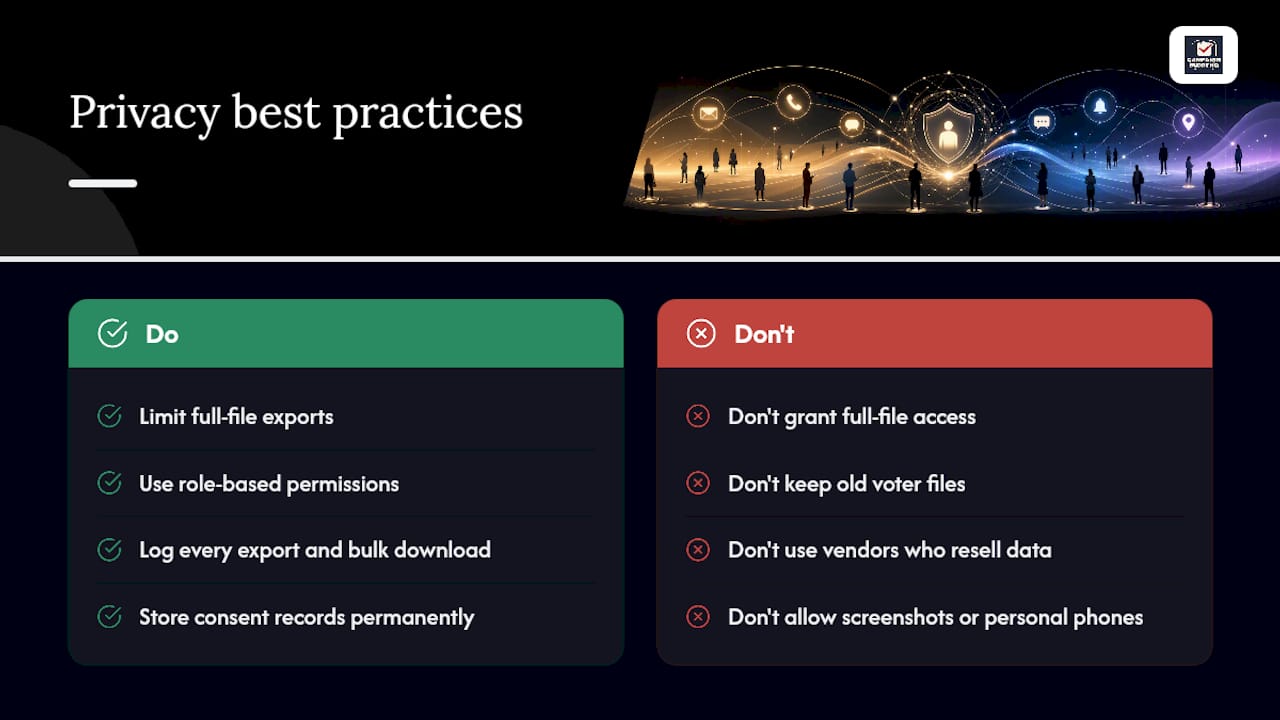
Limit who can export the full file. Most volunteers and even most staff only need access to their assigned turf or call list, not the entire database. Set role-based permissions so a canvasser sees the 40 doors on their route, not the county's full registration list. Log every export and every bulk download, so if something leaks, you know exactly where to look.
Store consent records separately and permanently. If a voter opts out of texts, that flag needs to survive list refreshes, vendor imports, and volunteer turnover. Academic reviews of omnichannel political marketing flag unequal data access and privacy gaps as real implementation barriers, not theoretical ones.
Vet every vendor that touches voter data, from your texting platform to your mail house, for how long they retain records and whether they resell or share them. Delete data you no longer need. A voter file from a race two cycles ago sitting in a shared drive is a liability with no upside. Train volunteers explicitly: no screenshots of the voter file, no personal phones for storing call lists, no posting turf maps to public social accounts. These habits cost nothing and prevent the kind of leak that ends up as a local news story.
How Should You Budget Across Channels for the Best Return?
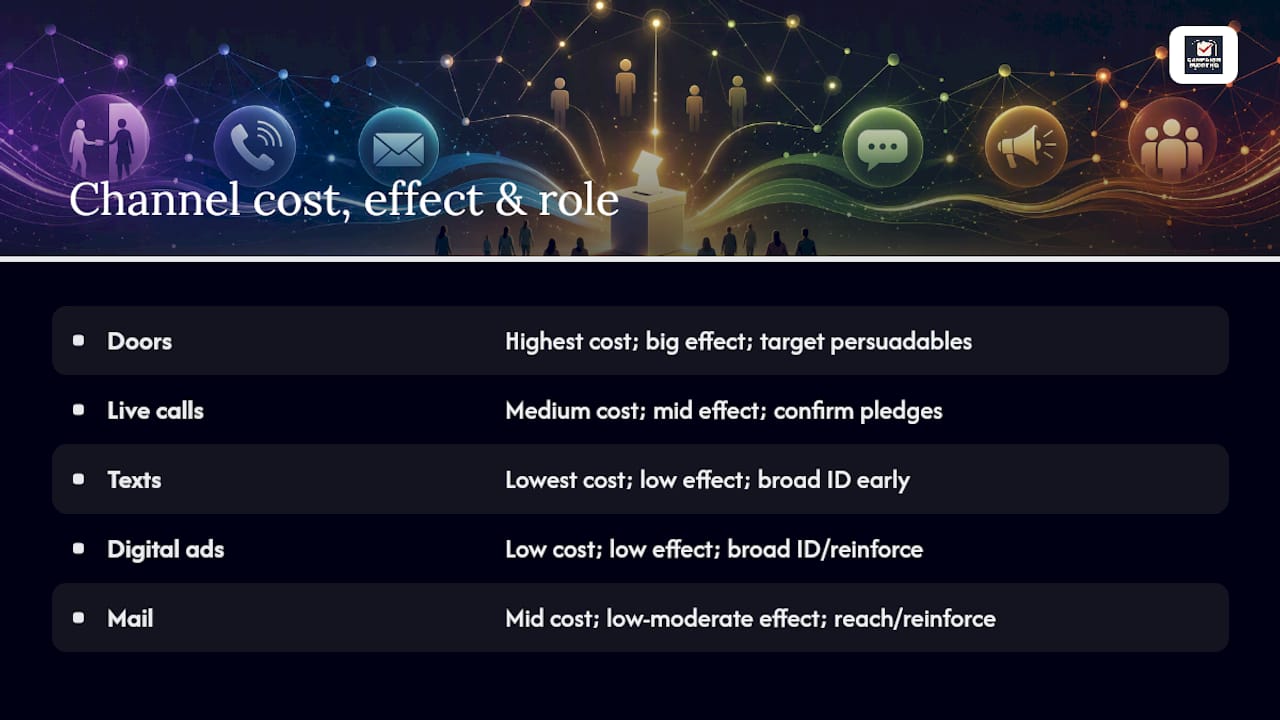
Cost per contact varies by an order of magnitude across channels, and that gap should drive your budget more than tradition does. Doors cost the most per contact once you count staff time, mileage, and volunteer coordination, but they also produce the largest persuasion and turnout effects, which makes them worth concentrating on persuadable and low-turnout-propensity voters rather than spreading thin across your entire universe.
Texts and digital ads cost the least per touch and work well for broad identification early in the cycle, when you're still figuring out who's persuadable in the first place. Live calls sit in the middle: cheaper than doors, more effective than automated outreach, and well suited to confirming pledges after an initial ID touch.
A workable split for a mid-size campaign puts the bulk of paid budget into digital and mail for reach and reinforcement, reserves live calls for confirmation and GOTV, and treats volunteer-powered doors and texting as the labor-intensive layer that stretches a limited budget further. Track cost per converted vote by channel, not just cost per contact. A cheap text that never converts to a vote is more expensive than an expensive door knock that does.
Reallocate mid-cycle. If your contact rate on one channel drops while another rises, that's your budget telling you something. Campaigns that lock in a spending plan in September and never revisit it usually leave money on a channel that stopped working weeks earlier. Trade publications covering modern voter contact planning consistently emphasize this kind of mid-cycle flexibility over a fixed plan.
When Does Full Multichannel Coordination Actually Pay Off?
Full coordination earns its cost in competitive races with real persuadable universes. In a lopsided race or a small local contest, a lean plan built around doors and texts alone often beats an elaborate five-channel operation nobody has the staff to run well.
Watch for volunteer fatigue as your signal to scale back, not push harder. If contact rates and shift signups both start dropping in the same week, that's diminishing returns talking. A rough rule: if your persuadable universe is under a few thousand voters, skip the mail and digital layers and put everything into doors, calls, and texts.
— Billy
Run Your Multichannel Contact Plan Without the Spreadsheet Chaos
Some campaign management platforms are built for sequencing like this: daily and weekly plans that assign the right channel mix by phase, outreach logging that keeps doors, calls, and texts tied to one supporter record, and progress tracking that shows whether persuasion touches are actually converting.
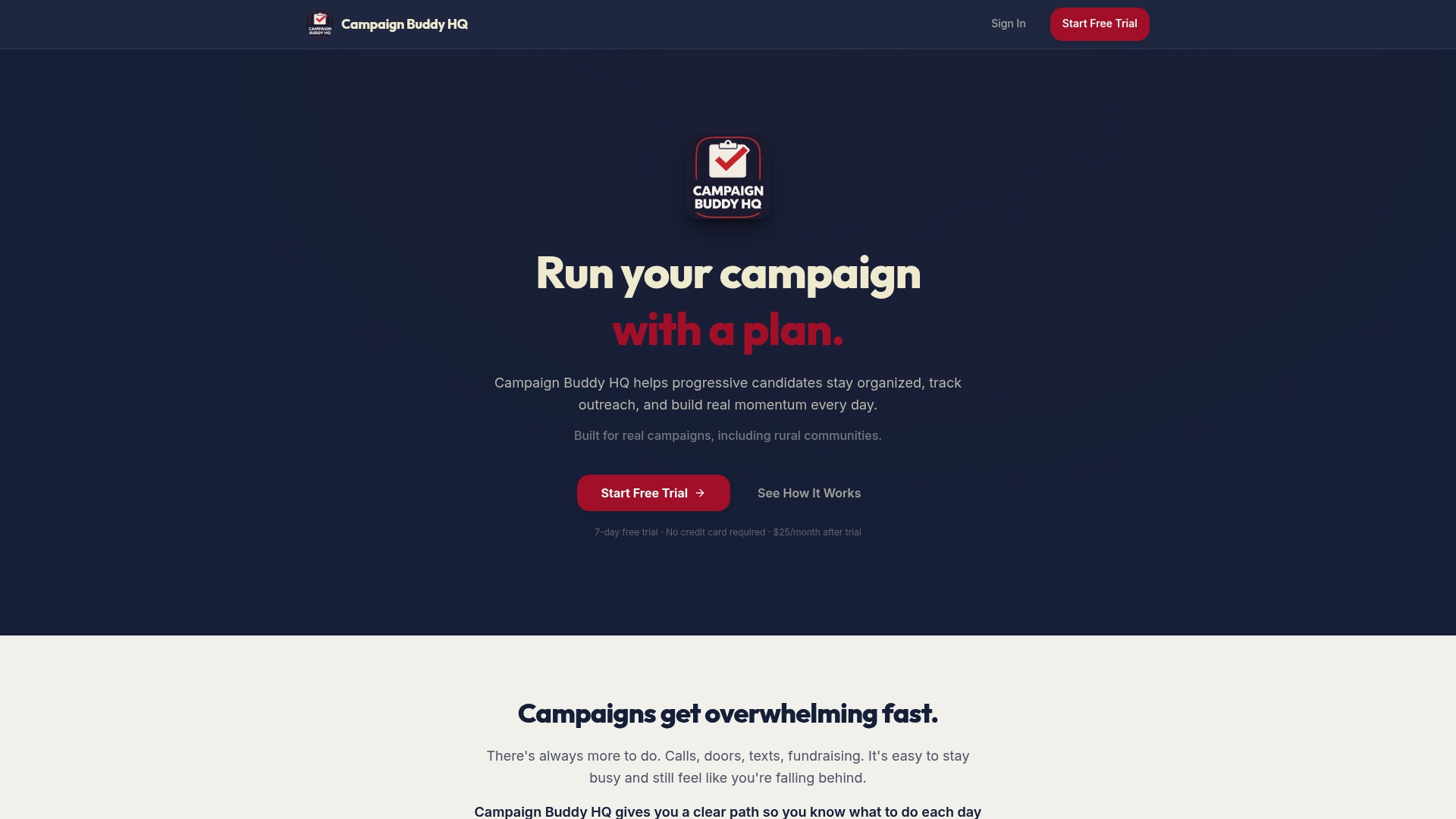
Instead of juggling a spreadsheet for doors, a separate app for texts, and a third tool for call logs, some platforms offer one workflow built for rural and low-density turf as much as dense urban precincts. Features may include supporter tracking, campaign phase management, and AI-assisted content for scripts and social posts, aimed at keeping a volunteer-heavy operation consistent week over week.
Start the 7-day free trial with no credit card required, and see whether your next canvass shift runs cleaner with a plan built around behavior-triggered sequencing instead of a calendar nobody follows.
Sources
- How to increase voter turnout: Evidence from around the world - Institute of Development Studies
- How a Multi-Mode Voter Contact Program Helped Win 18 of 19 Races
- Strategic Design and Execution of Omnichannel Political Marketing: Enhancing Voter Engagement in the Digital Democratic Era
- Voter Outreach in '24: Crafting a Winning Voter Contact Plan