
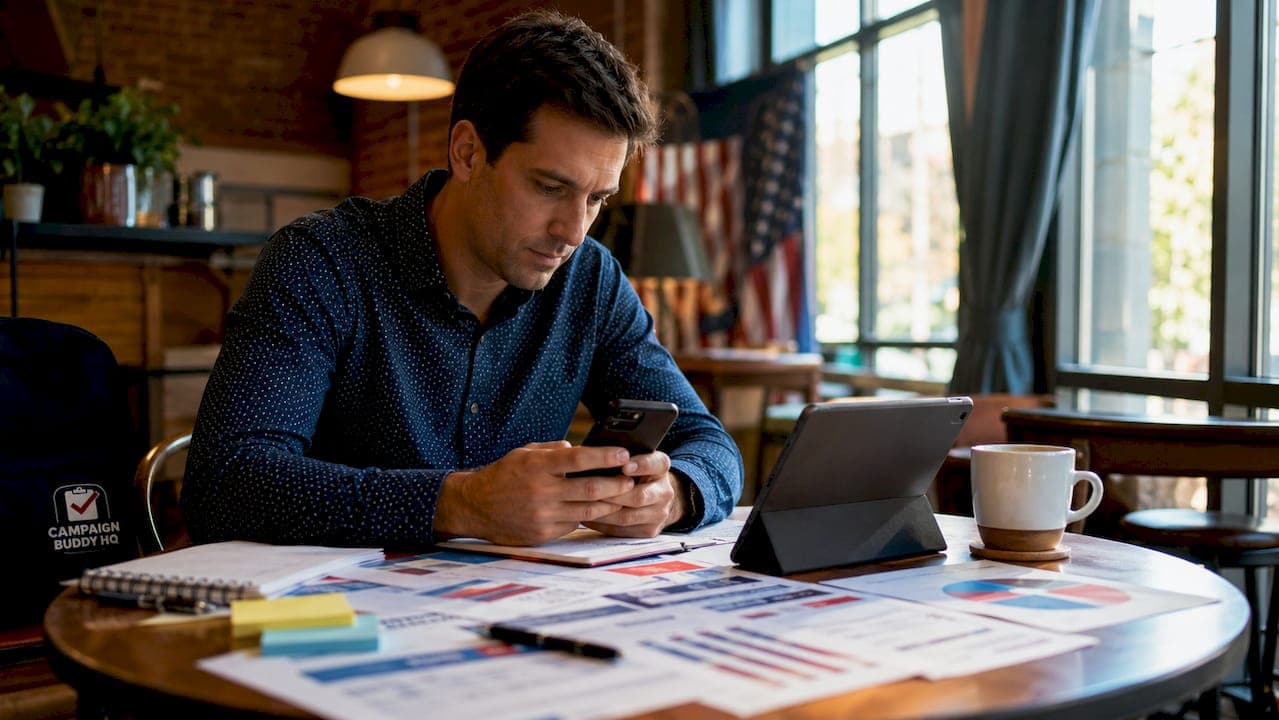
Campaign communications channels are the platforms and methods political campaigns use to deliver messages, mobilize voters, and build support. The industry term for this practice is multi-channel outreach, and mastering it separates winning campaigns from those that plateau. No single channel reaches every voter. Campaigns that combine SMS texting, live calls, Connected TV, social media, direct mail, and a central website consistently outperform those that rely on one method alone. This guide covers the top campaign communications channels, how to match them to your goals, and how to allocate your budget for maximum impact in 2026.
What are the most effective campaign communications channels in 2026?
The strongest outreach programs treat each channel as a distinct tool with a specific job. Here is the campaign communication channels list every organizer should know.
-
Connected TV and video advertising. CTV reaches voters on streaming platforms where they spend hours each week. Video advertising combines visuals, sound, and motion to create the most emotionally persuasive digital format, making it ideal for introducing candidates and sharing constituent stories. Spots run on YouTube, social platforms, and the open web, with high completion rates on CTV.
-
SMS text messaging. SMS is the fastest-growing channel as of april 2026, with markedly higher open rates than email. Texts work best for get-out-the-vote (GOTV) pushes, volunteer recruitment, and event reminders. Keep messages short and include one clear call to action.
-
Live phone calls. Live calls build deeper voter connections than any digital channel. Callers can answer questions, handle objections, and gather high-quality data in real time. A well-trained phone bank is one of the most reliable tools for qualifying supporters.
-
Social media platforms. Facebook, Instagram, and X reach broad audiences and allow paid targeting by geography, age, and interest. Organic posts build community and generate shares. Paid social ads work best for broad awareness and engagement with younger voters.
-
Direct mail. Physical mail lands in voters' hands and stays on kitchen counters. It reinforces digital messages and works especially well for action confirmations like polling location reminders. Offline signage integrates with digital channels to create cohesive campaign messaging that voters encounter in multiple environments.
-
Audio advertising. Audio advertising reaches voters during non-visual tasks via platforms like Spotify and iHeart. It strongly engages working-age adults and penetrates moments where visual channels cannot, such as commutes and workouts.
-
Campaign website. A campaign website serves as the single source of truth for all messaging. Every other channel points back to it for full details, policy positions, and donation links.
How does integrating multiple channels amplify voter identification?
Running channels in isolation produces weak results. Multi-channel campaign integration builds a voter journey from initial ad exposure through direct mail and into personal contact, improving persuasion far beyond isolated ads.
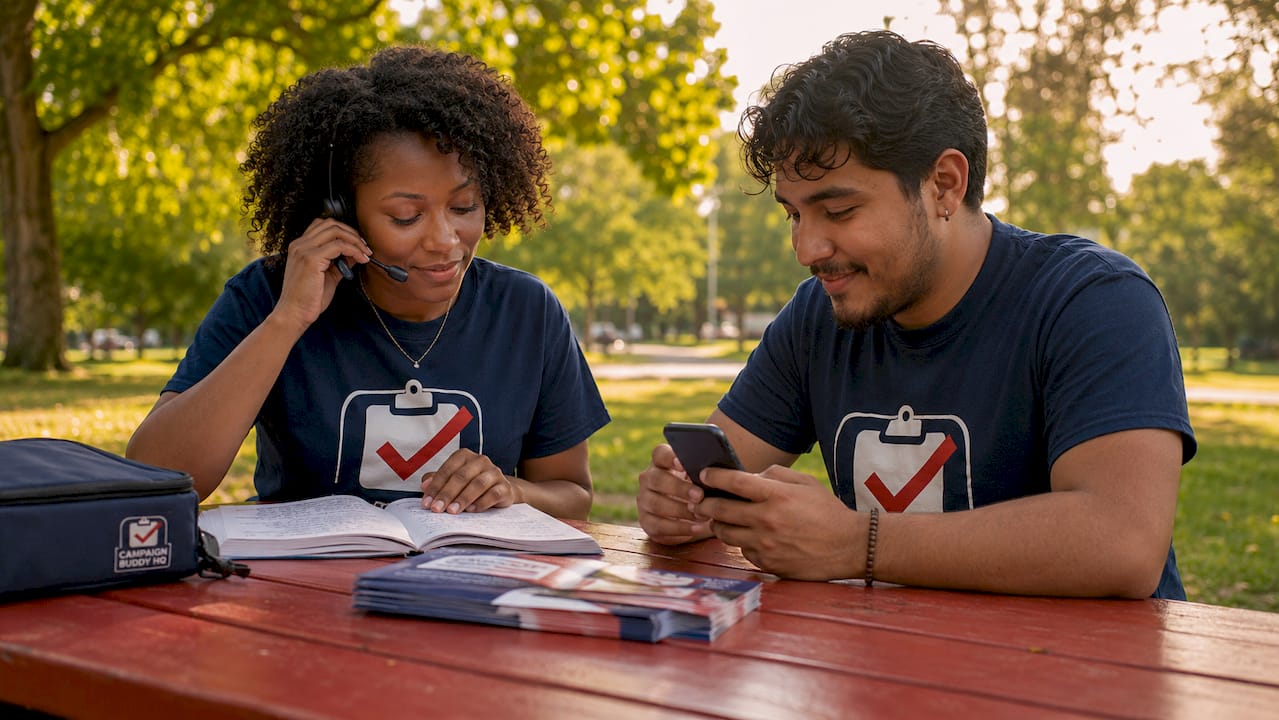
The numbers make this concrete. A multi-mode voter contact program combining text messaging and live calls identified over 36,000 supporters. Live calls accounted for 66.7% of those identifications, while texts produced 33.3%. That split shows each channel contributed something the other could not. Texts cast a wide net quickly; calls converted and qualified.
| Factor | Single-channel contact | Multi-channel contact |
|---|---|---|
| Voter reach | Limited to one audience segment | Reaches overlapping and distinct segments |
| Message reinforcement | One exposure per voter | Multiple touches across formats |
| Supporter identification | Slower, lower volume | Faster, higher volume |
| Data quality | Shallow, one-dimensional | Richer, cross-validated |
| GOTV effectiveness | Moderate | Significantly higher |
Siloed campaign departments cause messaging inconsistencies that confuse voters and reduce turnout. Successful campaigns establish a unified message architecture before launching any outreach. That means every channel carries the same core message, even when the format and tone differ.
Pro Tip: Sequence your channels deliberately. Start with a CTV or social ad to create awareness, follow with a direct mail piece to reinforce the message, then close with a live call or text to drive action. Each touch builds on the last.
A campaign website anchors all channels in consistent messaging and serves as the full-detail confirmation point. Texts and yard signs carry short calls to action. The website carries everything else. Without that anchor, voters who want more information hit a dead end.
Which channels best match specific campaign objectives?
Channel selection should align with campaign objectives and audience preferences. Face-to-face contact excels at trust-building, digital suits broad updates, and direct mail supports action confirmations. Here is how to apply that logic across your outreach program.
-
Trust-building and persuasion: Use face-to-face canvassing and live phone calls. Personal contact is the gold standard for moving undecided voters. A step-by-step outreach approach helps organizers structure these conversations for maximum impact.
-
Broad awareness and younger voters: Use social media ads and CTV. Younger voters spend more time on Instagram, TikTok, and streaming platforms than on any traditional channel. Paid targeting lets you reach them by zip code and age bracket.
-
Detailed information dissemination: Use email and your campaign website. Voters who want policy details, event schedules, or endorsement lists will look for them online. Email drives them there with direct links.
-
Reinforcing presence near Election Day: Use direct mail and yard signs. Physical visibility at polling locations and in neighborhoods signals momentum. Yard signs complement digital campaigns by keeping your candidate top of mind between digital exposures.
-
GOTV mobilization: Use SMS and live calls. Texts go out fast and get read within minutes. Calls confirm intent and handle last-minute questions about polling hours or locations.
Effective multi-channel campaigns assign each channel a distinct role rather than broadcasting identical messages everywhere. That role-based approach improves voter comprehension and drives action more reliably than repetition alone.
Pro Tip: Local media and existing community networks multiply your reach at low cost. A story in a local paper or a share from a trusted community organization carries credibility that paid ads cannot buy. Build those relationships early.
Emerging 2026 outreach trends show campaigns winning by combining digital precision with personal contact, not by choosing one over the other. Rural and low-density communities in particular benefit from this balance, where digital reach is lower and door-to-door contact carries more weight.
What are the best budget allocation strategies for 2026?
Budget decisions define which channels you can actually use. The recommended 2026 campaign advertising allocation reflects where voters spend their attention and where persuasion dollars go furthest.
| Channel | Budget share | Primary use |
|---|---|---|
| Connected TV and video | 40–50% | Candidate introduction, emotional persuasion |
| Display and audio advertising | 15–20% | Broad reach, commuter engagement |
| Social media | 15–20% | Awareness, engagement, younger voters |
| Texting and direct mail | 10–20% | GOTV, action confirmation, mobilization |
CTV and video command the largest share because they deliver the highest emotional impact at scale. A voter who watches a 30-second candidate story on a streaming platform is far more likely to remember that candidate than one who sees a banner ad. The 2026 budget shift toward CTV reflects data-driven allocation, not tradition. Campaigns that over-index on social media without integrating other channels often see high engagement but low turnout conversion.
Texting and direct mail sit at 10–20% because they are mobilization tools, not persuasion tools. They work best late in the campaign when voters already know the candidate and need a push to act. Spending heavily on texts in month one wastes budget that CTV could use more effectively.
Pro Tip: Track performance data weekly and shift budget toward channels that are producing results. If live call response rates drop, reallocate hours to texting or door knocking. Static budgets lose campaigns.
Key takeaways
Multi-channel outreach is the single most effective approach to campaign communications, combining CTV, SMS, live calls, and a central website to reach and mobilize voters at every stage.
| Point | Details |
|---|---|
| Lead with CTV and video | Allocate 40–50% of ad budget to video for the strongest persuasion impact. |
| Use SMS for mobilization | Text messaging delivers the highest open rates and works best for GOTV pushes. |
| Anchor all channels to your website | A campaign website prevents messaging drift and gives voters a reliable source of truth. |
| Sequence channels deliberately | Layer awareness, reinforcement, and action channels in order for compounding effect. |
| Match channels to objectives | Face-to-face builds trust, digital builds awareness, and direct mail confirms action. |
Why I think most campaigns still get multi-channel wrong
Campaigns talk about multi-channel outreach constantly. Few actually execute it well. The most common failure I see is treating channel coordination as a logistics problem when it is actually a messaging problem. Teams launch texts, calls, and social ads without agreeing on what each one is supposed to do. The result is a voter who gets three different tones and three different asks in the same week.
The fix is simpler than most organizers expect. Build your message architecture before you touch any channel. Decide what the website says in full, what the text says in short, and what the caller says in person. Then make sure those three things feel like they come from the same campaign. When that alignment exists, voters trust the message more and act on it faster.
The other mistake is abandoning traditional channels too quickly. Door knocking and live calls feel slow compared to blasting a text list. But coordinating outreach activities across both personal and digital channels consistently outperforms digital-only programs, especially in lower-density communities where personal contact still moves votes. The campaigns that win in 2026 will be the ones that treat every channel as a piece of the same conversation, not a separate campaign.
— Billy
How Campaignbuddyhq helps you coordinate every channel
Running multiple outreach channels without a central system creates the exact siloed messaging problem that loses campaigns. Campaignbuddyhq is built to solve that. The platform tracks doors knocked, calls made, texts sent, and registrations logged in one place, so your team always knows where outreach stands across every channel.
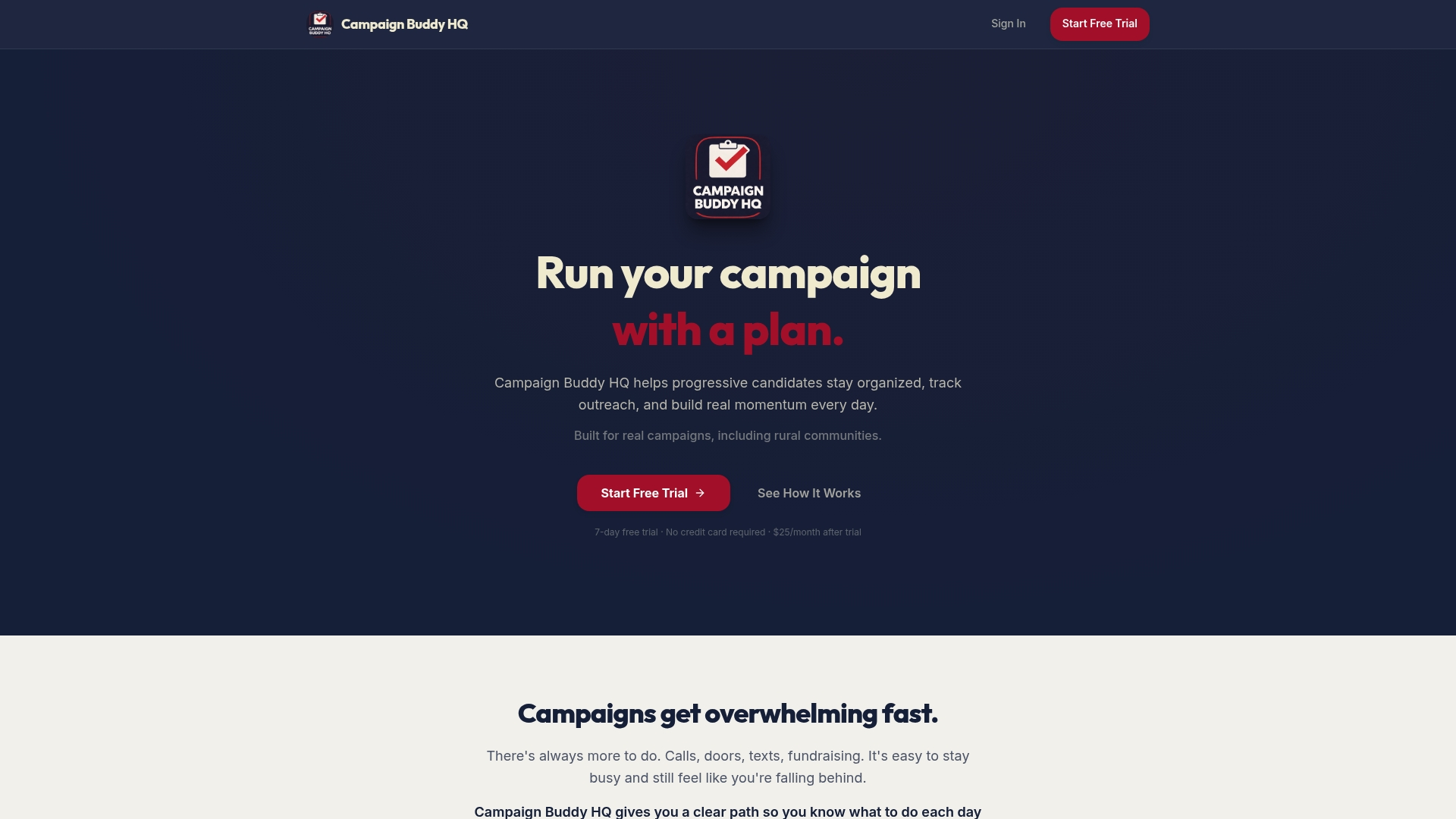
Campaignbuddyhq's daily and weekly planning tools keep volunteers and staff aligned on goals, whether they are working phones, walking precincts, or managing digital follow-up. The supporter tracking feature ties contact history to individual voters, so no one gets the wrong message at the wrong time. Explore Campaignbuddyhq and start your free 7-day trial with no credit card required. Your next campaign deserves a system that keeps every channel working together.
FAQ
What are the top campaign communication channels for 2026?
The top channels are Connected TV and video, SMS text messaging, live phone calls, social media, direct mail, audio advertising, and a campaign website. Each serves a distinct role in a coordinated outreach program.
Why is SMS considered one of the most effective outreach methods?
SMS delivers higher open rates than email and reaches voters almost instantly, making it the strongest channel for GOTV pushes and time-sensitive mobilization.
How much of a campaign budget should go to digital channels?
The recommended 2026 allocation puts 40–50% toward CTV and video, 15–20% toward social media, and 15–20% toward display and audio, with the remainder covering texting and direct mail.
What is the biggest mistake in multi-channel campaign outreach?
Siloed messaging across departments is the most common failure. Campaigns that launch channels without a unified message architecture confuse voters and reduce turnout.
How does a campaign website support other communication channels?
A campaign website acts as the central source of truth, providing full details that texts, signs, and social posts can only summarize. Every other channel should point voters back to it.