

Most campaigns treat communication as a support function. You put out ads, hold press events, post on social media, and call it done. That framing is exactly why so many well-funded campaigns lose to underdogs who figured out something more important: the role of campaign communication is not to broadcast your message. It is to shape how voters think, feel, and decide. When you understand that distinction, everything about how you plan and execute your campaign changes.
Table of Contents
- Key takeaways
- The role of campaign communication explained
- How messaging shapes voter perception
- Modern channels, compliance, and consistency
- Crafting and amplifying messages that land
- My take on what campaigns get wrong
- How Campaignbuddyhq supports your communication strategy
- FAQ
Key takeaways
| Point | Details |
|---|---|
| Communication drives decisions | Cognitive and emotional connections formed through messaging directly predict how voters choose at the ballot box. |
| Messaging differs from marketing | Strategic communication builds long-term credibility and interprets the voter environment, while marketing focuses on visibility and reach. |
| Speed wins in a crisis | Political campaigns must respond to attacks or misinformation within 2 to 4 hours before narratives set against you. |
| Consistency is non-negotiable | Social posts that contradict official messaging are among the most common and exploitable failure points in any campaign. |
| Owned channels are now proactive | Email and social media let campaigns set narratives before journalists or opponents can frame them. |
The role of campaign communication explained
Campaign communication is not a synonym for political marketing. That confusion causes real damage, and strategic communication in campaigns requires a different mindset entirely. Marketing concerns itself with visibility, persuasion at scale, and conversion. Communication concerns itself with how stakeholders interpret your candidate, your message, and your credibility over time.
The core objectives of campaign communication include:
- Persuasion: Moving undecided voters toward your candidate through emotionally and logically compelling content
- Narrative building: Constructing a coherent, recognizable story about who your candidate is and what they stand for
- Voter mobilization: Motivating your base to show up, donate, volunteer, and vote
- Reputation management: Protecting and shaping how the public and press perceive your candidate under pressure
- Feedback integration: Listening to voter responses, tracking sentiment, and adjusting messaging based on what you learn
These objectives require coordination across every channel, every spokesperson, and every piece of content your campaign produces. The moment those pieces fall out of alignment, you hand opponents and journalists the narrative instead.
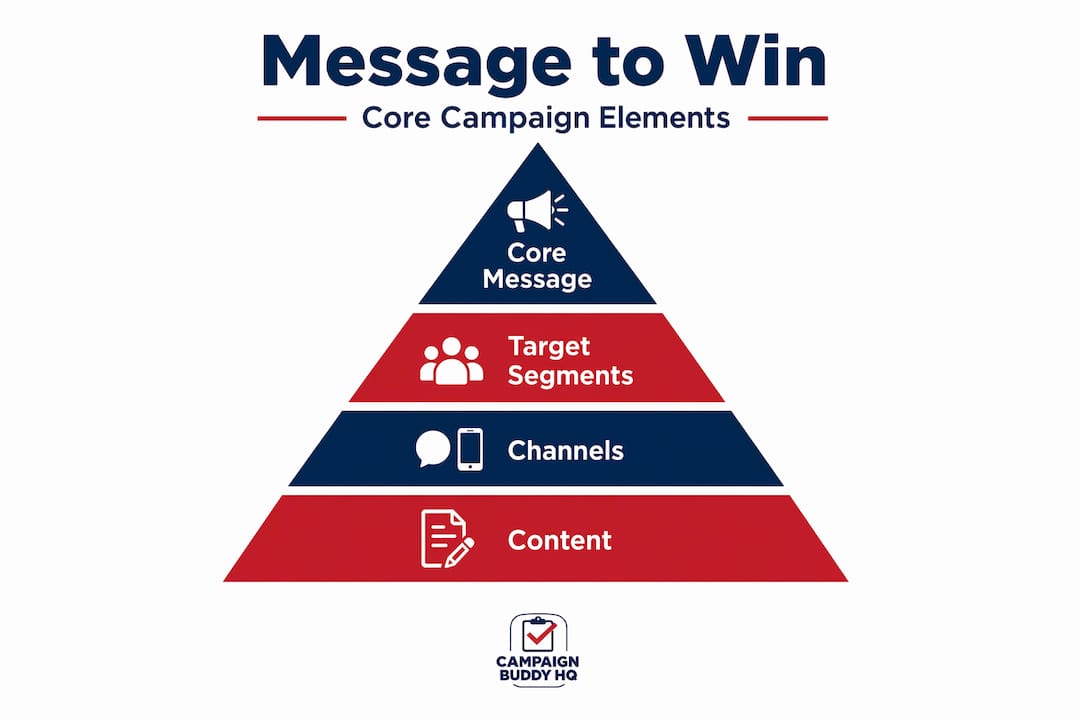
The foundational components that hold this together are your core message, your target voter segments, the channels you use to reach them, and the feedback loops that tell you whether your communication is working. Get your campaign messaging fundamentals wrong at this stage, and every tactic you layer on top will underperform.
How messaging shapes voter perception
Voters do not evaluate candidates the way policy analysts do. They form impressions through a mix of cognitive reasoning and emotional response, and the research makes clear that both matter enormously.
An integrated model of political communication found that cognitive linkage predicts electoral decisions at a statistically dominant level (β = 0.935), while emotional impact drives cultural and performative evaluation (β = 0.687). Together, these two factors explained 82.8% of political effect on young voter decisions. That is not a minor finding. It means that if your messaging does not connect on both a rational and emotional level, you are leaving most of your persuasive potential on the table.
What does this look like in practice? A few patterns stand out:
- Storytelling over statistics: Voters remember a story about a family who lost health coverage far longer than they remember a percentage point in a policy brief. Narratives that mirror core values increase persuasive power and emotional engagement.
- Authenticity as a signal: Scripted, overly polished delivery reads as inauthentic to most voters. Real moments, genuine reactions, and unfiltered candidate voices build more trust than a perfect teleprompter delivery.
- Repetition with variation: The same core message needs to appear across every channel and conversation, but the format, tone, and examples should shift to fit the audience. A union hall speech and a TikTok clip carry the same message differently.
The impact of communication in campaigns on voter perception is not abstract. It is measured, predictable, and highly responsive to deliberate strategy. Campaigns that treat messaging as a gut-feel activity are essentially competing with one hand tied behind their back.
Pro Tip: Before drafting any major message, write out the one emotional truth you want voters to feel about your candidate. Every piece of content you produce should trace back to that truth.
Modern channels, compliance, and consistency
Digital tools have transformed what effective campaign communication strategies look like operationally. You are no longer choosing between a TV ad and a flyer. You are managing a real-time, multi-channel communication environment where a single rogue tweet can unravel months of careful messaging.
Here is how the modern channel stack typically breaks down:
- Social media platforms (Facebook, Instagram, X, TikTok): Highest reach for organic engagement, especially for video content and real-time response
- Email lists: The most direct owned channel, with high conversion rates for fundraising and mobilization
- Mobile apps and text messaging: Best for get-out-the-vote efforts and time-sensitive calls to action
- Paid digital advertising: Meta and Google campaigns allow precise targeting by geography, demographics, and behavior
AI is now deeply embedded in this stack. 67% of political campaign marketers use AI to enhance content creation and search strategies, combining data and creativity to scale faster than traditional methods allow.
Compliance is not optional. Platforms like Meta enforce strict authorization and ad visibility requirements, and digital disclosure rules mean every paid message must be clearly attributed. More importantly, journalists and opposition researchers actively monitor whether your social posts contradict your official messaging. Inconsistency is one of the most common and most avoidable campaign failures.
| Channel type | Strength | Primary use case |
|---|---|---|
| Paid social ads | Precise targeting, measurable reach | Voter persuasion, fundraising |
| High conversion, owned audience | Mobilization, donor cultivation | |
| Organic social | Real-time, shareable, low cost | Narrative control, rapid response |
| Text messaging | Highest open rates | GOTV, event reminders |
The war room concept exists specifically to solve the consistency problem. A centralized communication command structure ensures every message gets approved before it goes out, every spokesperson is aligned, and contradictory communications are caught before they become tomorrow's headline.
Pro Tip: Build your message approval workflow before the campaign launches, not after your first crisis. Know exactly who approves what and how fast they can turn it around.
Crafting and amplifying messages that land
Knowing your message is not enough. You need systems for getting it in front of the right people, at the right time, in the right format. This is where campaign communication best practices move from theory to execution.
The most effective campaigns separate their channel strategy into owned and earned media, and they use each deliberately. Owned channels set narratives proactively, letting you get ahead of a story before a reporter frames it for you. Email and social media can respond to attacks faster than a press release cycle allows. Earned media, meaning coverage and commentary from journalists and influencers, adds credibility that paid content cannot buy.
For message crafting specifically, the candidates who cut through fragmented media do so by combining authenticity and storytelling to forge emotional bonds with voters. The details matter here. Specificity beats generality. "Maria, a nurse from Dayton, couldn't afford her son's insulin" lands harder than "working families are struggling with healthcare costs."
Rapid response is where many campaigns stumble. The political response window is brutally tight. Response time in politics runs 2 to 4 hours compared to the 12 to 24 hours that corporations typically allow themselves. That compressed window requires pre-approved response frameworks for your most predictable vulnerabilities, and decision-making authority sitting physically close to your communications team.
For amplification, video-first workflows are now the gold standard. Pulling short, subtitled clips directly from live events and pushing them with paid boosts outperforms repurposing long-form content. The goal is immediate, shareable proof of your candidate's presence and conviction.
A strong multi-channel coordination approach means your outreach activities across doors, calls, texts, and digital all reinforce the same core message. When a voter gets a door knock on Tuesday and a social ad on Wednesday, those two touchpoints should feel like chapters in the same story.
My take on what campaigns get wrong
I have watched campaigns allocate enormous budgets to communications and still lose the narrative. The common thread is almost always the same. They brought their communications director into the room after the strategy was already set.
In my experience, the campaigns that win treat communication strategy as the spine of the entire operation, not a layer added at the end. How you communicate a policy position shapes how voters decide whether that position is credible, relatable, and worth voting on. That is not a marketing decision. It is a strategic one. And communications must guide overall strategy from day one for it to work.
The second thing I have seen cause real damage is the belief that more content solves communication problems. It does not. I have seen campaigns posting three times a day on every platform while completely failing to answer the one question voters were actually asking about the candidate. Volume is not the same as clarity.
What actually works, and this surprised me the first few times I observed it, is restraint paired with speed. A campaign that says two things clearly and responds to attacks within two hours beats a campaign that says everything and takes two days to respond every time. The 2026 outreach trends back this up. Voters reward campaigns that feel organized and confident, not campaigns that feel busy.
— Billy
How Campaignbuddyhq supports your communication strategy
Knowing how to communicate campaign goals is one thing. Actually executing on that knowledge across dozens of moving parts, volunteers, and daily deadlines is something else entirely.
Campaignbuddyhq was built for exactly that gap. The platform helps political campaigns, issue advocacy groups, and grassroots organizers plan daily outreach activities, log doors and calls, track supporter data, and monitor progress toward campaign goals. Whether you are running in a dense urban district or a spread-out rural county, it gives your team the structure to stay consistent and on message at every touchpoint. Start organizing your campaign communication strategy with Campaignbuddyhq today. A free 7-day trial requires no credit card.
FAQ
What is the role of campaign communication?
Campaign communication shapes how voters perceive a candidate by building narrative, managing reputation, and driving emotional and cognitive connections that directly influence voting behavior.
How does messaging differ from campaign marketing?
Marketing focuses on visibility and reach. Strategic communication interprets the voter environment, builds long-term credibility, and guides overall campaign strategy beyond what ads alone can accomplish.
How fast should campaigns respond to attacks?
Political campaigns should respond within 2 to 4 hours, compared to the 12 to 24 hours that corporate crisis response typically allows. Pre-approved response frameworks make this possible.
What channels work best for modern campaign communication?
Owned channels like email and social media offer proactive narrative control, while earned media adds credibility. Text messaging delivers the highest open rates for mobilization and get-out-the-vote efforts.
Why is message consistency so important in campaigns?
Inconsistencies between social posts and official campaign messaging are actively monitored by journalists and opposition researchers, and they are among the most common and damaging communication failures in political campaigns.