

Direct, personal contact wins for persuasion and turnout. Door-to-door canvassing, paired volunteer outreach, and live conversations outperform every other channel because they're targetable and two-way, according to NDI's Campaign Skills Handbook. Phone banks, SMS, and targeted email deliver strong return on effort when tied to a clean voter list and a GOTV calendar. Paid social and precise targeting scale name recognition fast, but only if you test messages and adjust quickly.
Match the method to the goal:
- Persuasion: canvassing, paired doorstep conversations, phone calls with real dialogue
- Mobilization (GOTV): SMS reminders, call banks, doorstep nudges in the final week
- Name recognition: paid and organic social, targeted digital ads
- Fundraising: segmented email, personal asks, social proof from early donors
Key Takeaways
Effective candidate communication strategies combine high-touch personal contact for persuasion with efficient digital and mass-messaging channels for mobilization, scaled to a campaign's staff and volunteer capacity.
| Point | Details |
|---|---|
| Prioritize hot techniques for persuasion | Canvassing and paired phone calls move undecided voters more reliably than mass channels. |
| Scale expectations to salience | High-profile races see mobilization effects shrink by up to 76%, so calibrate targets accordingly. |
| Keep messaging consistent across channels | Use one core message document for canvass scripts, email, and social to avoid contradictory voter contact. |
| Track contact rate daily | Contact rates below roughly 20% weaken the reliability of turnout forecasts. |
| Centralize logging with Campaignbuddyhq | Daily planning, outreach logging, and supporter tracking keep door, call, and text data in one dashboard during GOTV crunch time. |
Table of Contents
- Match Outreach Methods to Your Campaign Goal and Capacity
- How to Run the Highest-Impact Field Tactics
- Which Digital Channels Actually Move the Needle?
- How Do You Design a Message That Actually Persuades?
- What Should You Track to Know If Outreach Is Working?
- The 30/7/1-Day GOTV Timeline
- What Ethics and Privacy Checks Does Every Outreach Plan Need?
- Handling Candidate Inquiries and FAQs from Voters
- Responding to Negative Feedback or Hostile Interactions
- Integrating Communication Strategies Across Multiple Channels for Consistency
- Personalization Techniques Beyond Segmentation
- Publisher Perspective: Lessons from Running Modern Outreach Operations
- Run These Strategies Without Losing Track of a Single Contact
- Frequently Asked Questions
- Sources
Match Outreach Methods to Your Campaign Goal and Capacity
Campaigns waste volunteer hours running the wrong tactic for the wrong goal. The fix starts with a simple framework: hot techniques versus cold techniques.
Hot techniques are personal and high-touch: door knocks, one-on-one calls, coffee meetups. They take more staff time per contact but move persuadable voters more reliably than anything else. Cold techniques, like yard signs, mass mailers, and generic social ads, cost less per contact but rarely change a mind. Most campaigns blend both, weighted by what the campaign actually needs that week.
Your goal should dictate the blend. Persuasion phases lean on canvassing plus digitally targeted ads aimed at swing voters. GOTV phases lean on SMS, phone calls, and doorstep reminders, since the job isn't to convince anyone. It's to convert intention into a completed ballot.
One wrinkle worth planning around: a meta-analysis of mobilization tactics found that effects attenuate by roughly 33% to 76% as electoral salience rises. A high-turnout, high-attention race dilutes the marginal value of an extra knock or call, because voters already have the message from a dozen other sources.
| Technique type | Effort per contact | Typical impact | Best use case |
|---|---|---|---|
| Hot (canvassing, calls) | High | High | Persuasion, close races |
| Cold (mailers, generic ads) | Low | Low to moderate | Name recognition, broad awareness |
| SMS/text | Low to moderate | Moderate | GOTV reminders, event RSVPs |
Pro Tip: Prioritize techniques that let you target specific voter segments directly. A canvass list filtered to persuadable voters beats a blanket knock of every registered household in the precinct.
How to Run the Highest-Impact Field Tactics
Canvassing outperforms other contact methods because it's personal, targeted, and generates real-time feedback from voters, according to NDI field guidance. Pair volunteers when possible for safety and to keep newer canvassers on pace with experienced ones. On each knock, collect support level, top issue, and any commitment (vote by mail, early vote plan, yard sign request).
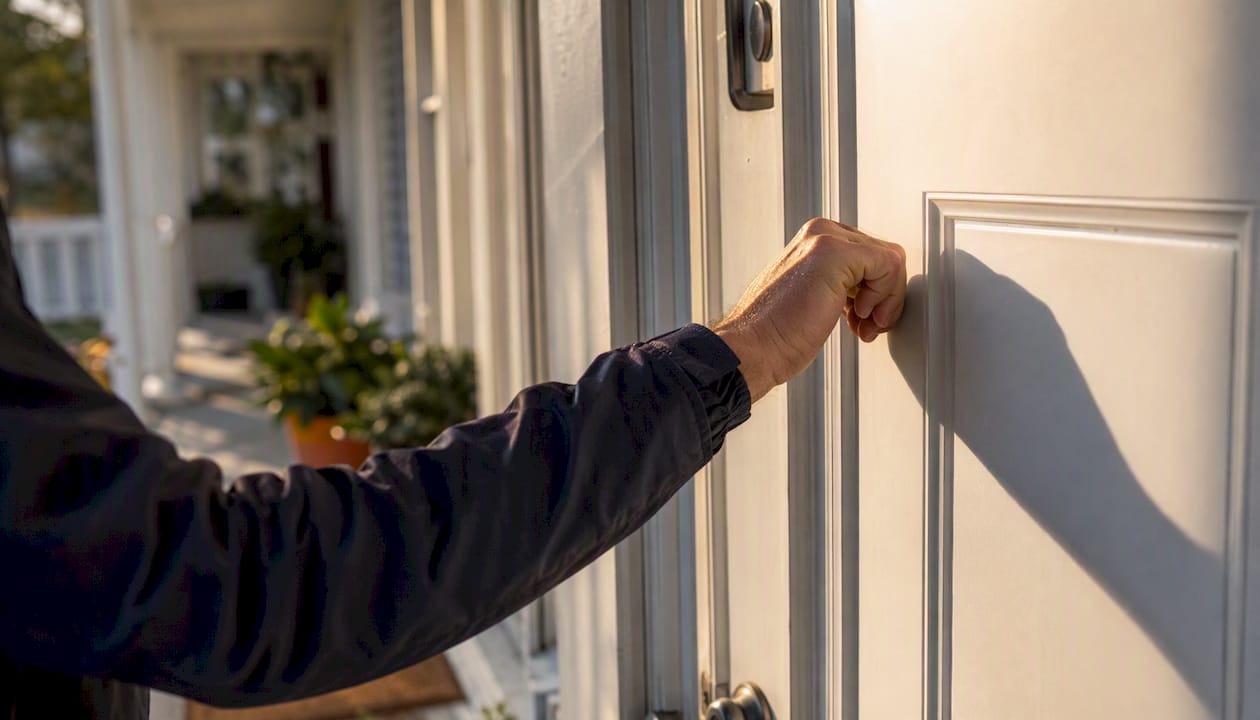
A workable canvass script stays short, uses plain language, and leaves room for the voter to talk:
"Hi, I'm [name], a volunteer with [candidate]'s campaign. We're talking with neighbors about [top local issue]. Can I ask where you stand on supporting [candidate] this election? [Listen, respond to concerns.] Thanks so much, and remember to vote for [candidate] on [date]."
Phone banks need three things to run well: a clean call list, a script volunteers can adapt on the fly, and clear rules for hostile calls (thank the voter, log the response, move on. Never argue). Track pace, not just calls made. A volunteer rushing through 40 calls an hour usually produces worse data than one making 20 careful ones.
SMS programs live or die on compliance and brevity. Keep messages short, identify the sender, always include an opt-out, and send during reasonable hours, generally late morning through early evening. A quick shift checklist helps keep contact rates high:
- Confirm the volunteer has the correct, current list before starting
- Review the script and answer any questions before the first knock or call
- Set a check-in time for mid-shift troubleshooting
- Collect and log all data before volunteers leave
Detailed scripts and a downloadable volunteer walkthrough are in Campaignbuddyhq's step-by-step canvassing guide.
Pro Tip: Assign one volunteer per shift to do nothing but data quality checks. Clean logs matter more than raw contact counts once you start building turnout models.
Which Digital Channels Actually Move the Needle?
Email still earns its keep for fundraising and GOTV nudges when it's segmented. Split your list by donor history, event attendance, or geography, and test two subject lines on every send. A simple GOTV template: "[First name], your polling place opens at 7am, here's how to get there."
Paid social works because the targeting is granular. Campaigns can reach voters by ZIP code, age, gender, and interest categories on platforms like Meta, according to reporting on political ad targeting. That precision helps with name recognition, but the creative has to match local culture, not generic campaign stock photography.
Organic social needs a consistent posting cadence and short-form video or images that supporters actually want to share. A single compelling clip from a canvass shift often outperforms a polished ad.
Check the Meta Ad Library before launching any ad campaign. It shows what your opponents are running, and publishing your own ads there builds public trust in an environment where voters are increasingly skeptical of political messaging.
- Segment email lists by donor tier and engagement history
- Match paid social creative to local interest clusters, not generic demographics
- Post organic content on a fixed cadence, not sporadically
- Review the ad library weekly during the final six weeks of a race
Statistic Callout: Roughly 87% of campaigners and strategists report using AI daily for tasks like data analysis and content drafting, per reporting on AI in political campaigns.
Pro Tip: Use AI drafting tools for a first pass on social copy, then have a human edit for local voice. Raw AI output reads generic, and voters notice.
How Do You Design a Message That Actually Persuades?
A strong core message fits in three lines: problem, solution, candidate's role. "[Candidate] will push for a tenant protection ordinance. [Candidate] has fought landlords in court for a decade."*
Tailor tone and proof points by segment without changing the underlying message. A message to union households leans on labor record; a message to young renters leans on the housing numbers. The core claim stays identical.
Test constantly, but keep the tests small:
- Run two subject lines on every fundraising email
- Test two versions of door-knock phrasing across separate turfs for a week
- Compare engagement on two social captions using the same image
Field notes from canvassers are an underused resource. Volunteers hear objections in real time, and syncing those notes, sometimes with AI-assisted synthesis of common canvass memos, into weekly message updates keeps talking points sharp instead of stale.
- Keep the core message to three lines: problem, solution, role
- Adjust proof points by segment, not the underlying claim
- Run micro-tests weekly on subject lines, captions, and door scripts
- Feed canvass feedback back into messaging within a week, not a month
What Should You Track to Know If Outreach Is Working?
Four numbers matter more than the rest: contact rate (percent of attempted voters actually reached), persuasion conversion (voters who moved from undecided to supportive), pledge-to-vote rate, and daily outreach velocity (doors, calls, and texts completed per day).
Door, call, and text logs should feed one dashboard, not three separate spreadsheets. When a canvasser logs a door in the morning, a campaign manager should see it by afternoon, not at the next staff meeting.
| Metric | What it tells you | Watch for |
|---|---|---|
| Contact rate | Reach efficiency of your list | Rates below 20% erode intent-to-treat estimates |
| Persuasion conversion | Message effectiveness | Compare across turfs and scripts |
| Pledge-to-vote rate | GOTV readiness | Should climb as election day nears |
Statistic Callout: Because mobilization effects attenuate 33% to 76% in high-salience races, don't assume a canvassing study's headline number applies directly to your contest. Track your own contact rate and treat published effect sizes as an upper bound, not a guarantee.
The 30/7/1-Day GOTV Timeline
A compact, repeatable schedule beats an improvised one. At 30 days out, ramp up voting reminders, push absentee ballot requests, and lock in volunteer shift schedules for the final stretch. GOTV work at this stage overlaps with persuasion, so canvassers should still be collecting support data, per NDI's GOTV guidance.
At 7 days out, intensify contact. Combine phone and SMS cadences with last persuasion knocks aimed at soft supporters. This is when call volume should peak.
On the final day and day-of, focus shifts entirely to logistics: personal reminders, ride coordination for voters without transportation, and polling-place information sent by text.
| Timeframe | Primary activity | Channel mix |
|---|---|---|
| 30 days out | Absentee pushes, volunteer scheduling | Canvassing, mail, calls |
| 7 days out | Intensified persuasion and reminders | Phone, SMS, doorstep |
| 1 day / day-of | Logistics and ride coordination | SMS, calls, in-person |
Day-of checklist:
- Confirm every volunteer shift and backup contact the night before
- Coordinate poll-watcher assignments and check-in times
- Text ride offers to voters who requested transportation help
- Log turnout gaps in real time and redirect volunteers to underperforming precincts
What Ethics and Privacy Checks Does Every Outreach Plan Need?
Mass messaging needs disclosures and opt-out language built in from the start, not bolted on after a complaint. Preserve consent records for every list you build.
Keep the legal guidance simple: consult counsel for jurisdiction-specific rules on texting, robocalls, and disclosure requirements. That's not a place to guess.
- Include clear sender identification and opt-out instructions on every text and email
- Archive or delete voter data according to your own retention policy
- Keep access logs for anyone touching the voter file
- Document any vendor or AI tool that processes voter data, including what it's used for
Handling Candidate Inquiries and FAQs from Voters
Voters ask predictable questions: where does the candidate stand on this issue, what's the voting deadline, how do I request an absentee ballot. A campaign that fumbles these basics loses credibility fast, regardless of how strong the core message is.
Build a shared FAQ document before the first canvass shift, not after volunteers start fielding confused calls. Cover the top ten questions voters actually ask: policy positions on local issues, the candidate's background, how to register, and where to vote. Every canvasser and phone banker should work from the same answers so a voter doesn't get three different responses to the same question from three different volunteers.
Route harder policy questions, the ones that need nuance or aren't yet finalized, to a designated staffer rather than letting volunteers improvise. A wrong answer from a well-meaning volunteer spreads faster than campaigns expect, especially once it hits a neighborhood group chat.
Voter contact isn't just persuasion. It's intelligence gathering. Every question a voter asks tells you something about what's confusing or concerning in your district, and those patterns should feed back into your FAQ and your messaging within days, not after the election. If canvassers keep hearing the same question about a policy position, that's a signal the campaign's public materials aren't clear enough.
Keep response time in mind too. A voter who emails a question and waits a week for an answer has likely already decided. Set an internal standard, ideally same-day for anything routed through official channels, and hold to it.
Responding to Negative Feedback or Hostile Interactions
Hostile doorstep encounters and angry replies online both call for the same instinct: de-escalate, don't engage the anger itself. On a canvass, if a voter gets aggressive, thank them for their time and leave. Arguing at the door wastes time and occasionally turns into a safety issue, which is exactly why NDI's field guidance recommends canvassing in pairs.
Phone banks need the same rule. A volunteer hearing an angry voter should acknowledge the frustration briefly, log the response accurately, and move to the next call. Trying to win an argument on a GOTV call almost never changes a vote and burns volunteer morale.
Online is trickier because hostile comments are public and permanent. A short, factual response works better than a defensive one. If a comment includes misinformation about the candidate's record, correct it plainly with a source, then stop engaging. Extended back-and-forth in a comment thread rarely persuades the original commenter and mostly serves as a spectacle for everyone else watching.
Not every hostile interaction deserves a response at all. Personal attacks, harassment, or clearly bad-faith trolling are usually better ignored or reported through the platform's tools than answered. Reserve your energy for substantive criticism that other undecided voters might actually be reading.
Train volunteers on this before it happens, not after someone's already had a bad encounter and doesn't know how to log it. A one-page guide with three or four example scenarios covers most of what comes up in the field.
Integrating Communication Strategies Across Multiple Channels for Consistency
Voters who see three contradictory messages from the same campaign, one at the door, another in a text, a third on social media, start to doubt the campaign's competence before they even consider the policy. Consistency across channels isn't a nice-to-have; it's what makes the core message actually land.
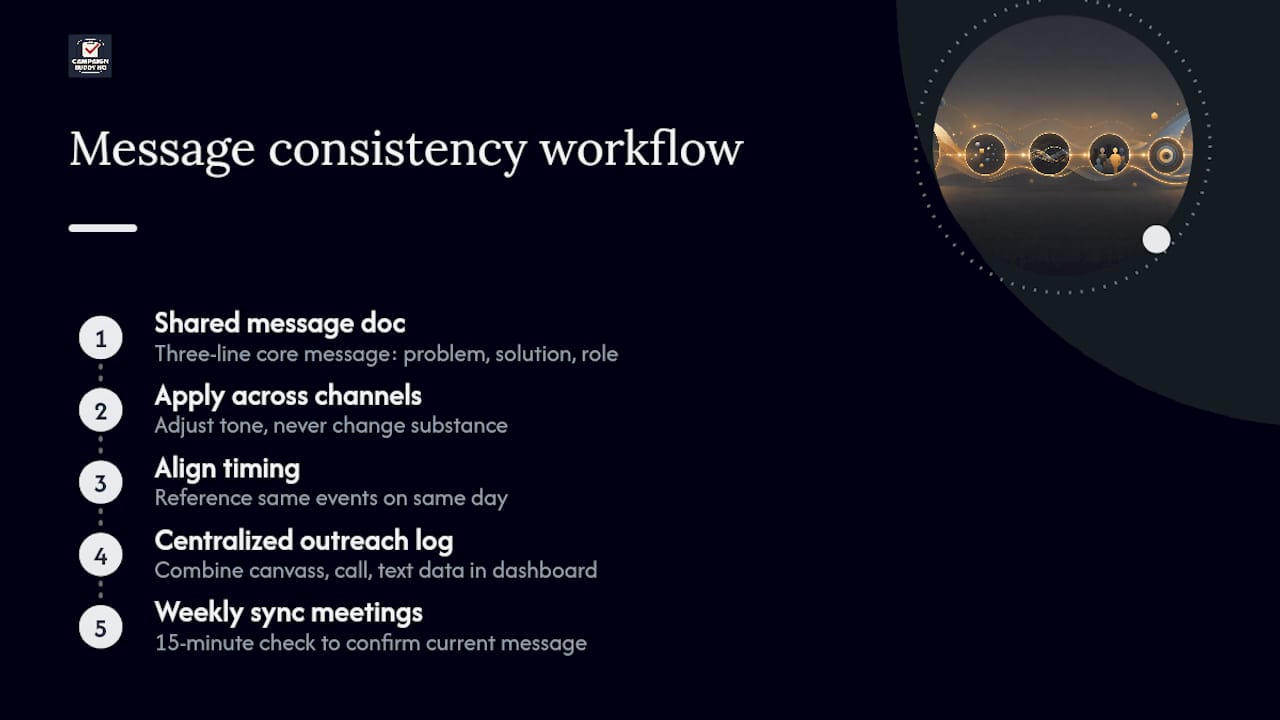
Start with a shared message document that every volunteer, staffer, and piece of creative pulls from. The three-line core message (problem, solution, candidate's role) covered earlier should be the base layer for a canvass script, an email subject line, and a social caption alike, adjusted in tone but never in substance.
Timing matters as much as wording. If a digital ad references an event, the email and text program should reference the same event on the same day, not a week apart. Disjointed timing makes even a well-crafted message feel like it's coming from disconnected teams rather than one campaign.
A centralized outreach log helps here in a way that's easy to overlook. When canvassing data, call logs, and text responses all live in one dashboard, campaign managers can spot when a talking point is landing on the doors but not showing up in email engagement, and adjust before the gap widens. Running that coordination out of separate spreadsheets for each channel is how campaigns end up with a field team pushing one message while the digital team pushes another.
Weekly message-sync meetings, even 15 minutes, catch drift before it compounds. Field, digital, and communications leads should confirm they're all working from the same current version of the core message and the same list of upcoming events worth referencing.
Personalization Techniques Beyond Segmentation
Segmentation gets you most of the way, but dynamic content pushes further. An email that swaps in a supporter's precinct-specific polling location, or references a local issue tied to their ZIP code, reads as considered rather than mass-produced, even though it's automated.
Microtargeting on paid social takes this further still. Instead of one ad for "renters," a campaign can run variations tied to specific interest clusters, one version referencing transit access for voters who follow local transportation advocacy pages, another referencing rent stabilization for voters engaged with tenant rights groups. The underlying message stays consistent; the entry point changes.
Dynamic text and email content can also reflect where a voter is in the funnel. A first-time contact gets an introduction to the candidate. Someone who's already pledged support gets a GOTV reminder instead of a persuasion pitch. Sending the wrong stage of message to the wrong voter wastes the contact and can read as tone-deaf.
The limit here is real, and worth naming plainly: microtargeting works only as well as your underlying voter data is accurate and current. A stale list turns clever personalization into an embarrassing mismatch, like sending a renter-focused ad to a longtime homeowner. Refresh voter file matches regularly rather than assuming a list built in the spring still reflects the electorate in the fall.
Publisher Perspective: Lessons from Running Modern Outreach Operations
Speed beats polish more often than campaigns admit. A small, trusted team empowered to respond within the hour, with a short list of topics that require extra sign-off, consistently outperforms slow approval chains, a pattern documented in reporting on campaign risk aversion. Good daily planning and clean outreach logs are what make that speed possible without chaos.
Run These Strategies Without Losing Track of a Single Contact
Every tactic in this guide, from the canvass script to the GOTV timeline, depends on one thing: knowing exactly who's been contacted, how, and what they said. That's the part spreadsheets fall apart on once a campaign scales past a handful of volunteers.
Campaignbuddyhq builds daily and weekly planning around exactly this workflow. Outreach logging tracks doors, calls, texts, and registrations in one place, so a canvass shift's data shows up on the campaign manager's dashboard the same day, not the next staff meeting. Supporter tracking keeps persuasion scores and pledge-to-vote status current heading into the 30/7/1 window, and campaign phase tools help teams shift from persuasion mode to GOTV mode without rebuilding the plan from scratch.
The platform includes a free 7-day trial with no credit card required. If your outreach data currently lives across three spreadsheets and a group text, start a Campaign Buddy HQ trial and see whether one dashboard changes how fast your team can act.
Frequently Asked Questions
What's the single most effective candidate communication strategy? Door-to-door canvassing consistently produces the strongest persuasion results because it's personal, targetable, and generates real feedback campaigns can act on.
How often should a campaign update its core message? Weekly, ideally, using field notes from canvassers and call banks. Waiting a full month lets a stale talking point circulate far longer than it should.
Do text messages need an opt-out included every time? Yes. Every mass text should identify the sender and include opt-out instructions, and consent records should be kept for the list being used.
How does electoral salience affect GOTV planning? In high-profile races, mobilization tactics show smaller marginal effects because voters already have more information from other sources, so plan for diminished returns rather than assuming published effect sizes apply directly.
Should small campaigns use paid digital ads at all? Yes, if targeting is precise. ZIP code and interest-based targeting on platforms like Meta can build name recognition efficiently even on a limited budget, as long as creative matches the local audience.
Sources
- Campaign Skills Handbook (Module 4: Voter Contact) — NDI
- A meta-analysis of voter mobilization tactics by electoral salience — ScienceDirect
- How campaigns and politicians use detailed targeting for voters’ interests in ads on Meta platforms — Deseret News
- Death to the content calendar: How risk aversion is clobbering progressive campaigns — Campaigns & Elections