
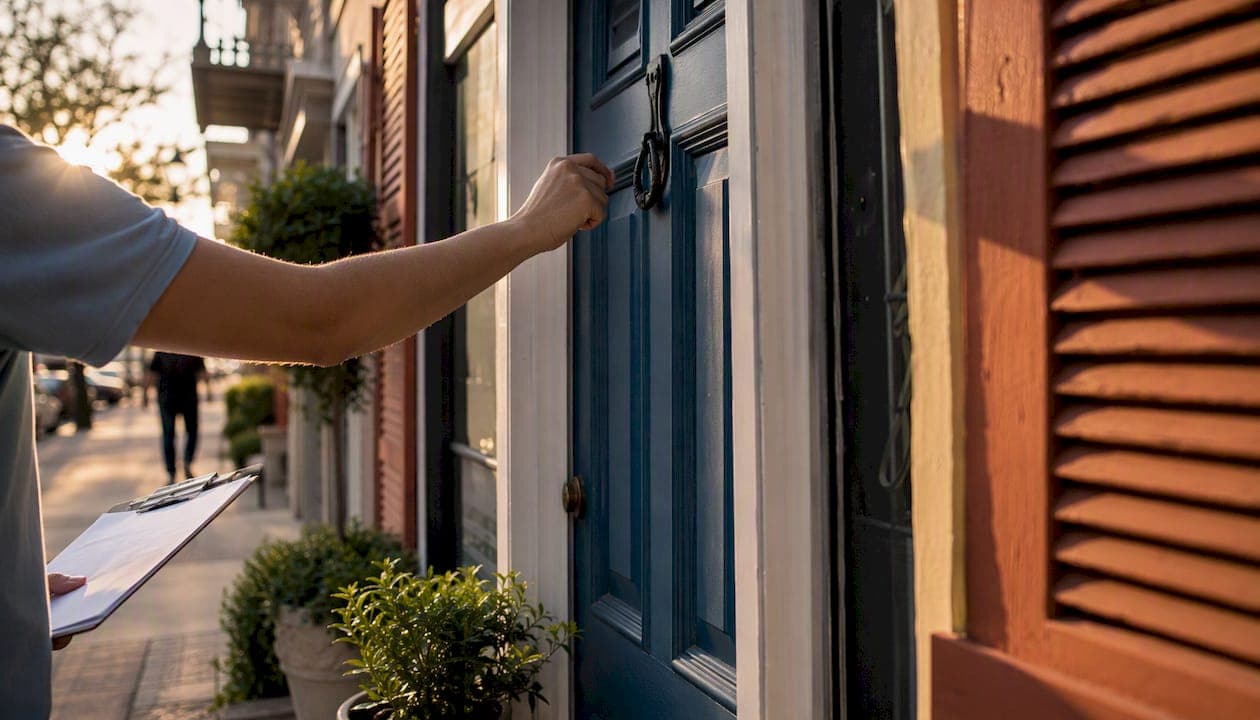
The five candidate promotion tactics worth prioritizing right now are door-to-door canvassing, peer-to-peer (P2P) texting, phonebanking, targeted digital ads, and events paired with earned media. Each one earns its place for a different reason: canvassing drives both persuasion and turnout through face-to-face contact; P2P texting reaches high-propensity voters at scale with personal tone; phonebanking fills contact gaps where doors are impractical; digital ads build name recognition and list size efficiently; and events generate earned media that money cannot buy.
- Door-to-door canvass: Highest persuasion and turnout impact per contact, especially in low-density districts.
- P2P texting: Scales personal outreach fast; reply rates outperform broadcast SMS by a wide margin.
- Phonebanking: Cost-effective for rural and spread-out voter universes where canvassing is slow.
- Targeted digital ads: Builds awareness and retargets warm audiences; lowest cost-per-impression.
- Events and earned media: Creates shareable proof of momentum and attracts local press coverage.
| Tactic | Impact | Relative Cost | Min. Staffing |
|---|---|---|---|
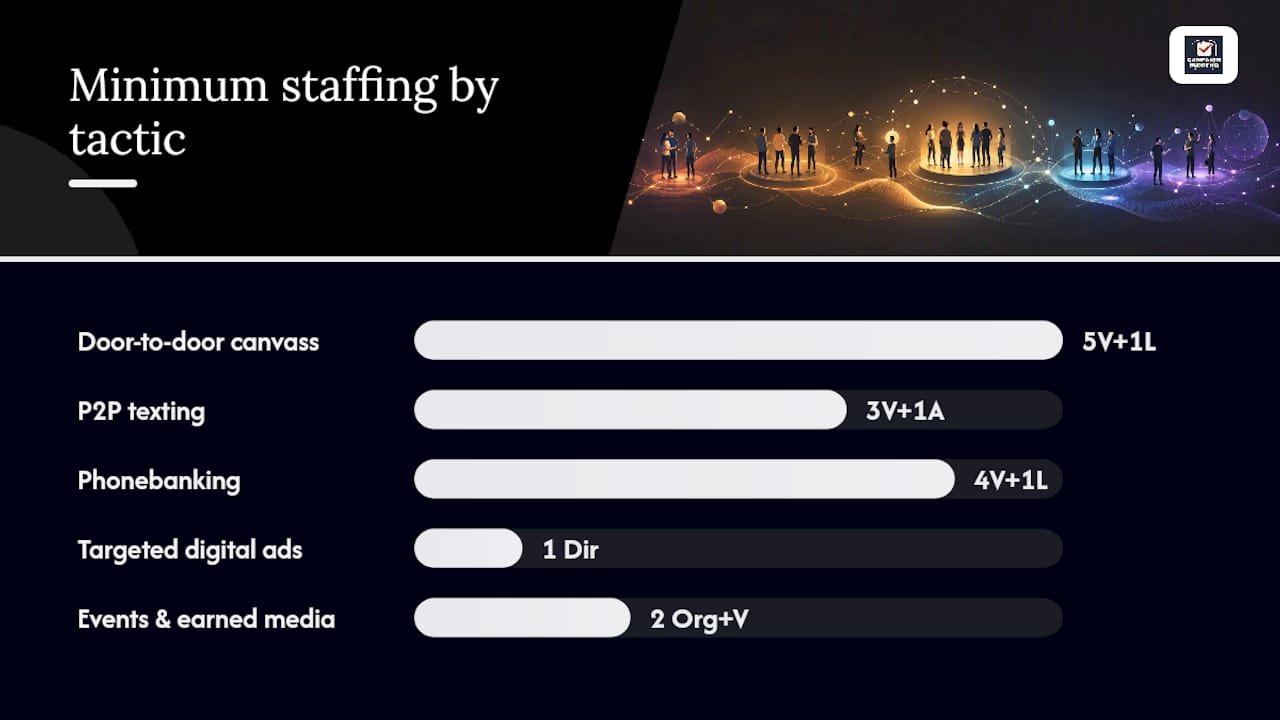
| Door-to-door canvass | Very high | Medium | 5 volunteers + 1 lead |
| P2P texting | High | Low | 3 volunteers + 1 admin |
| Phonebanking | Medium-high | Low | 4 volunteers + 1 lead |
| Targeted digital ads | Medium | Medium-high | 1 digital director |
| Events and earned media | High | Variable | 2 organizers + volunteers |
Pro Tip: Apply the 70-20-10 rule from leadership development research: roughly 70% of a field leader's growth comes from on-the-job stretch assignments, 20% from coaching, and 10% from formal training. Assign new volunteers to real canvass routes and live phone shifts from day one rather than keeping them in classroom prep.
Key Takeaways
The five highest-impact candidate promotion tactics are door-to-door canvassing, P2P texting, phonebanking, targeted digital ads, and events with earned media, executed in a sequenced, data-logged multi-channel plan.
| Point | Details |
|---|---|
| Prioritize canvass and P2P first | These two tactics combined produce the highest persuasion and turnout impact per dollar spent. |
| Segment before you contact | Divide your voter file into base, persuasion, and low-engagement groups before assigning any tactic. |
| Log every contact | Outreach data is only useful if volunteers record responses; discipline here drives all downstream decisions. |
| Apply the 70-20-10 rule | Roughly 70% of field leader development comes from on-the-job stretch assignments, per CCL research. |
| Campaignbuddyhq tracks it all | Daily planning, outreach logging, and supporter tracking in one platform built for real campaign workflows. |
Table of Contents
- What do the best candidate promotion tactics look like in the field?
- How do you design a multi-channel outreach plan that actually holds together?
- How do you segment voters into audiences that respond to different tactics?
- How do you build a campaign narrative and test messages that persuade?
- How do you recruit, train, and retain volunteers who actually show up?
- What KPIs and dashboards should you track to optimize outreach?
- What U.S. legal guardrails does every outreach team need to know?
- Which tools and templates help you execute these tactics quickly?
- What does a 30/60/90-day implementation plan look like?
- How do fundraising and promotion work together?
- How do you handle a crisis or negative press during a campaign?
- How do endorsements and coalition-building amplify your reach?
- How do local partnerships and community presence build support beyond events?
- What actually works, and what campaigns consistently get wrong
- Campaignbuddyhq puts this playbook into practice from day one
- Primary sources and further reading
- Sources
What do the best candidate promotion tactics look like in the field?
Door-to-door canvassing targets persuasion and turnout simultaneously. A well-run canvass produces several meaningful conversations per volunteer per shift. The door pitch runs about 30 seconds: "Hi, I'm [Name] with the [Candidate] campaign. We're talking to neighbors about [Issue]. Can I count on you to vote on [Date]?" Scale requires one experienced lead per five volunteers and a pre-loaded walk list from your voter file.
P2P texting works because it feels like a message from a person, not a blast. A sample thread: Initial: "Hi [Name], I'm [Volunteer] with [Candidate]'s campaign. We're fighting for [Issue] in [District]. Can we count on your support?" Follow-up if no reply after 48 hours: "Just checking in — any questions about [Candidate]?" Platforms like Hustle and Twilio power these conversations at scale, with Twilio handling the underlying messaging infrastructure and Hustle providing the volunteer-facing interface.

Phonebanking suits rural universes where doors are miles apart. A call script: *"Hello, may I speak with [Name]? Great — I'm calling on behalf of [Candidate]. We're reaching out to [District] voters about [Issue].
Targeted digital ads run best on Meta and Google for awareness, with retargeting pixels on your campaign site to re-engage warm visitors. Budgets for digital ads should be sufficient to pass the platform's learning phase, which typically requires consistent daily spend.
Events and earned media require a press angle, not just a gathering. Pair a policy announcement with a community location (a union hall, a school gym) and pitch local TV and print 72 hours in advance.
| Tactic | Volunteers/Shift | Supervisor Ratio | Weekly Cadence |
|---|---|---|---|
| Canvass | 5–10 | 1:5 | 2–3 shifts |
| P2P texting | 3–8 | 1:8 | Daily during GOTV |
| Phonebanking | 4–12 | 1:5 | 3–4 shifts |
| Events | 2–10 | 1:10 | 1–2 per month |
Common mistakes: sending volunteers to doors without a printed or digital walk list; launching P2P texts without opt-out language; running phonebanks without a debrief to capture voter responses.
How do you design a multi-channel outreach plan that actually holds together?
Each channel has a distinct job. Canvassing and phonebanking handle persuasion and turnout confirmation. P2P texting and email handle follow-up and list nurturing. Digital ads handle acquisition and re-engagement. Events handle credibility and press.
| Channel | Primary Role | Secondary Role |
|---|---|---|
| Canvass | Persuasion | Turnout confirmation |
| P2P text | Follow-up | List activation |
| Phonebank | Turnout | Persuasion |
| Digital ads | Acquisition | Retargeting |
| Retention | Fundraising | |
| Events | Credibility | Earned media |
A proven cadence for the final two weeks before election day: canvass on Saturday, send a P2P follow-up text to every door that did not answer on Sunday, run a phonebank Tuesday and Thursday, and push a digital ad burst Wednesday through Friday targeting the same voter universe. Selecting channels by where your audience actually spends time, rather than where you are most comfortable, is what separates high-performing campaigns from busy ones. Programmatic and mobile-first channels consistently outperform broad-broadcast approaches when audience behavior drives the selection.
Spend sequencing: invest in grassroots outreach (canvass, phones) first to build your persuasion universe, then layer paid ads in weeks 4–8 to reinforce the message at scale.
Pro Tip: Match channel frequency to audience readiness. A voter who has already been canvassed and replied positively needs a light turnout reminder, not another persuasion message. Segment your follow-up list by response code before the next touch.
How do you segment voters into audiences that respond to different tactics?
Segmentation turns a raw voter file into a tactical map. The five core segments are: base (reliable supporters who need turnout activation), persuasion (soft supporters or undecideds who need the candidate's message), persuadable-high-contact (voters who need multiple touches before moving), low-engagement (infrequent voters worth targeting only in close races), and opposition (do not contact).
Building micro-audiences from your voter file:
- Pull the full voter file from your state's voter registration database or through NGP VAN, which integrates voter data with outreach logging.
- Score each voter by party registration, voting history, and modeled support score.
- Layer in volunteer contact data and digital engagement (email opens, ad clicks, event RSVPs) from EveryAction or your CRM.
- Export segments with columns: Voter ID, Name, Address, Phone, Email, Segment Label, Last Contact Date, Response Code.
- Assign each segment to a tactic: base → turnout texts; persuasion → canvass + phonebank; persuadable-high-contact → all channels in sequence.
Building precise personas and targeting by behavior rather than broad demographics is what moves conversion quality over volume. The same principle applies whether you are filling a job pipeline or a voter universe.
Data privacy note: always collect explicit opt-in before texting or emailing. Honor opt-outs within one business day. Consult your state's voter data use agreement before sharing lists with third-party vendors.
How do you build a campaign narrative and test messages that persuade?
Your core narrative fits one sentence: "[Candidate] will [specific outcome] for [community] because [credible reason]." Three supporting pillars carry it: policy (what changes), character (who the candidate is), and local impact (what it means for this neighborhood).
[Candidate]'s plan caps increases for existing tenants and funds 500 new units by 2028. That means your family stays in the neighborhood."
Three A/B test variants for the same message across channels:
- SMS variant A: "Rents are out of control. [Candidate] has a plan. Reply YES to learn more."
- SMS variant B: "[Candidate] will cap rent increases for [City] families. Can we count on your vote?"
- Email subject line test: "Your rent vs. [Candidate]'s plan" vs. "500 new homes for [District]."
Testing checklist:
- Minimum sample: 200 contacts per variant before drawing conclusions.
- Primary metric: reply rate for SMS; click-to-action rate for email; persuasion lift score for canvass scripts.
- Iteration cadence: review results every 72 hours during active outreach; swap the losing variant after two cycles.
How do you recruit, train, and retain volunteers who actually show up?
Volunteer quickstart: the recruitment pitch is one sentence — "We need people for two-hour shifts who want to make a real difference in this race." Onboarding checklist: signed volunteer agreement, contact info captured in your CRM, assigned shift and location, script in hand, and a buddy assigned before the first shift.
Training cadence:
- Initial session (90 minutes): campaign overview, script practice, tool walkthrough (app or paper list), and a live role-play.
- Weekly refresh (30 minutes): review last week's contact rates, update the script for any new messaging, and answer questions.
- On-the-job stretch assignments: assign experienced volunteers to lead a four-person canvass team by week three. Visible, time-boxed projects produce measurable outcomes that campaign managers can cite when promoting volunteers to paid field roles.
Retention levers: post weekly contact totals publicly (doors knocked, calls made, texts sent) so volunteers see their collective impact. Clear pathways from volunteer to paid field lead, with documented selection criteria, increase both retention and performance. Replacing annual check-ins with quarterly growth conversations gives volunteer leaders four calibration points per year to measure progress and adjust.
Pro Tip: Pair every new volunteer with an experienced "amplifier" for their first two shifts. Shadow shifts cut the learning curve in half and reduce early dropout. See volunteer power strategies for a full retention framework.
What KPIs and dashboards should you track to optimize outreach?
Core KPIs: doors knocked per shift, contact rate (doors answered / doors attempted), call contact rate, P2P reply rate, persuasion lift (pre/post score change), turnout rate among contacted voters, cost per contact by channel, and ROI per channel.
| KPI | Daily Target | Weekly Review Metric |
|---|---|---|
| Doors knocked | 50 per volunteer | Total universe coverage % |
| Call contact rate | 10% | Contacts per shift |
| P2P reply rate | 8–12% | Opt-out rate |
| Cost per contact | Track by channel | Channel ROI comparison |
Data workflow: voter file and CRM (NGP VAN or EveryAction) feed raw contact data → normalize by removing duplicates and coding responses → push to a weekly dashboard → review Monday morning → adjust tactic assignments by Wednesday. Map the voter journey from first contact to confirmed supporter, and flag where drop-off is highest. Reducing drop-off between first contact and completed action is where most outreach pipelines lose momentum.
A/B test rule: trust a result only when each variant has at least 200 contacts and the difference in reply or contact rate exceeds 3 percentage points.
What U.S. legal guardrails does every outreach team need to know?
Any mass texting, robocall, or purchased list campaign requires legal review before launch.
Compliance checklist:
- TCPA opt-in: obtain prior express written consent before sending automated texts or robocalls to cell phones.
- Opt-out handling: include "Reply STOP to opt out" in every text; honor requests within one business day.
- Sender identification: every call and text must identify the campaign by name.
- Paid communication disclosure: any paid ad or mail piece must include a clear "Paid for by [Committee Name]" disclosure per FEC rules.
- Finance recordkeeping: log all expenditures over $200 per vendor per election cycle; file required FEC or state disclosure reports on schedule.
- Vendor contracts: confirm your P2P and SMS vendors (Twilio, Hustle) are compliant with carrier guidelines and TCPA requirements.
- Data handling: voter file use agreements vary by state; review terms before sharing data with third parties.
Compliance is not optional. TCPA violations carry fines of $500–$1,500 per text message. A single non-compliant blast to 10,000 numbers can generate liability that ends a campaign. Review every outreach channel with qualified legal counsel before launch, and build opt-in collection into your list-building workflow from day one.
This section is general information, not legal advice. Consult a qualified campaign attorney for your specific situation.
Which tools and templates help you execute these tactics quickly?
Tool stack by function:
- CRM and outreach logging: NGP VAN (voter file integration, canvass app) and EveryAction (supporter tracking, event management).
- P2P texting: Hustle (volunteer-facing interface) and Twilio (messaging infrastructure and API).
- Phonebanking: browser-based auto-dialer platforms integrated with your CRM.
- Ad management: Meta Ads Manager and Google Ads for targeted digital campaigns.
- Analytics and dashboards: Google Sheets or Airtable for lightweight tracking; your CRM's built-in reporting for contact rates.
- Campaign planning and workflow: Campaignbuddyhq for daily planning, outreach logging, supporter tracking, and rural workflow templates.
Integration notes: sync canvass results from your field app to your voter file nightly. Push updated action lists to volunteers each morning. Install a Meta pixel on your campaign site to enable retargeting of site visitors with digital ads.
Copyable call script: "Hi, may I speak with [Name]? This is [Volunteer] calling for [Candidate]'s campaign. We're reaching out to [District] voters about [Issue]. Do you plan to vote on [Date]? [Record response.] Great — can we count on your support? [Record.] Thank you for your time."
Copyable P2P text thread: "Hi [Name], I'm [Volunteer] with [Candidate]'s campaign. We're working to [Goal] for [Community]. Can we count on your vote on [Date]? Reply YES, NO, or MAYBE."
Copyable event invite email: Subject: Join [Candidate] in [Neighborhood] — [Date] "[Candidate] is hosting a community conversation at [Location] on [Date] at [Time]. We'll be talking about [Issue] and how we win this race together. RSVP at [Link]."
Campaignbuddyhq weekend canvass workflow: On Friday, a field organizer builds the weekend walk list inside Campaignbuddyhq, assigns turf to each volunteer team, and sets daily door targets. Saturday morning, volunteers log doors knocked and response codes directly in the app. Sunday, the organizer pulls the "no-answer" list and loads it into a P2P text sequence for same-day follow-up. By Monday, the dashboard shows total contacts, response breakdown, and updated supporter counts — ready for the weekly review.
What does a 30/60/90-day implementation plan look like?
Days 1–30: Foundation
- Pull and clean your voter file; build initial segments (base, persuasion, low-engagement).
- Set up your CRM (NGP VAN or EveryAction) and connect your outreach logging tool.
- Recruit and onboard your first volunteer cohort (target: 10–20 active volunteers).
- Run a pilot canvass in one precinct; test two door scripts and record contact rates.
- Launch a small P2P text test (500 contacts) to validate opt-in workflow and reply rate.
Days 31–60: Scale
- Expand canvass to full target precincts; add phonebanking shifts three days per week.
- Launch targeted digital ads on Meta and Google; set retargeting pixels.
- Begin weekly volunteer refreshes and assign first stretch leadership roles.
- Review KPI dashboard every Monday; swap underperforming message variants.
Days 61–90: GOTV
- Shift 70% of volunteer capacity to turnout contacts (confirmed supporters only).
- Run daily P2P texts to the "soft yes" universe in the final two weeks.
- Execute a digital ad burst in the final 10 days targeting your persuasion segment.
- Hold a post-election debrief to capture lessons for the next cycle.
| Phase | Typical Spend Range | Primary Allocation |
|---|---|---|
| Days 1–30 | $500 | CRM setup, list acquisition, print materials |
| Days 31–60 | $2,000 | Digital ads, vendor fees, volunteer stipends |
| Days 61–90 | $3,000 | GOTV ad burst, P2P platform fees, event costs |
Quick readiness audit before scaling: Is your voter file clean and segmented? Do volunteers have scripts and app access? Is opt-in collection live on every form? Are KPIs being logged daily?
For a deeper fundraising outreach framework to fund these phases, the Campaignbuddyhq blog covers allocation strategies specific to 2026 cycles.
How do fundraising and promotion work together?
Fundraising and outreach are not separate tracks. Every dollar raised determines how many doors you can knock, how many texts you can send, and how long your ad campaign runs. The most effective campaigns treat fundraising as a promotion tactic in its own right: a well-run fundraising email to your supporter list also reinforces the candidate's message and keeps your base engaged between major outreach pushes.
Small-dollar fundraising events double as community engagement opportunities and generate earned media when the candidate attends.
Integrate fundraising asks into your outreach cadence: a volunteer who just knocked 50 doors is a credible fundraising messenger. A post-canvass email to your list that says "Our volunteers knocked 500 doors this weekend — can you chip in $10 to keep them going?" converts at higher rates than a generic ask because it tells a specific story.
How do you handle a crisis or negative press during a campaign?
Speed and specificity beat silence every time. When a negative story breaks, the first 90 minutes determine whether the campaign controls the narrative or reacts to someone else's.
A rapid-response protocol has four steps. First, designate one spokesperson and one communications lead before any crisis happens. Second, within 30 minutes of a story breaking, issue a one-sentence holding statement: "We are aware of the report and will have a full response shortly." Third, within 90 minutes, release a factual, specific rebuttal or clarification through your owned channels (email list, social, press release). Fourth, brief your top volunteers and coalition partners with talking points so they can respond consistently if asked.
Common mistakes: going silent for hours while the story spreads; issuing a vague non-denial; letting surrogates freelance without talking points. The candidate's character pillar in your core narrative is your best asset in a crisis. A response that connects the rebuttal to a positive, specific story about the candidate's record lands better than a pure denial.
How do endorsements and coalition-building amplify your reach?
Endorsements work because they transfer credibility from a trusted voice to your candidate. The most valuable endorsements come from figures your persuasion segment already trusts: a local union, a respected pastor, a popular city council member, or a neighborhood association.
Prioritize three roles in your coalition: the Decider (the person whose endorsement signals to others that it is safe to support your candidate), the Amplifier (a trusted peer who shifts perception in a specific community), and the Validator (a cross-functional partner who confirms the candidate's competence on a specific issue). Building "proof that travels" means giving each of these allies a one-page brief with the candidate's record, key policy wins, and a shareable quote they can use without you in the room.
Endorsement outreach sequence: identify targets from your voter file and community mapping, request a one-on-one meeting with the candidate, present the brief, ask for a specific endorsement action (a quote, a social post, a co-event), and follow up within 48 hours. Track endorsement commitments in your CRM the same way you track voter contacts.
How do local partnerships and community presence build support beyond events?
Events get you a room. Partnerships get you a community. The distinction matters because a partnership with a local organization gives you ongoing access to their audience, their trust, and their communication channels.
Identify five to ten local organizations whose membership overlaps with your persuasion and base segments: labor unions, faith communities, neighborhood associations, PTAs, and small-business groups. Offer something concrete before asking for anything: a candidate forum, a volunteer day, or a policy briefing tailored to their members' concerns.
Local influencers, meaning people with genuine community credibility rather than just social media followers, are often more persuasive than paid advertising in tight geographies. A school principal who sends a personal email to parents, or a local business owner who posts a photo with the candidate, reaches an audience that no ad buy can replicate. Identify these people through your volunteer network and coalition partners, and treat them as Amplifiers in your endorsement strategy. Community engagement ideas that go beyond standard events are worth building into your calendar from the first 30 days.
What actually works, and what campaigns consistently get wrong
The campaigns that win in low-density and urban districts share one habit: they treat outreach like a product experiment. They pilot small, measure fast, and scale only what the data supports. The ones that lose tend to do the opposite: they run the same script in every precinct, skip the debrief, and wonder why their contact rates are flat by week six.
The canvass-plus-P2P sequence is the clearest example. A Saturday canvass that logs every no-answer door, followed by a Sunday P2P text to that exact list, consistently outperforms either tactic alone. The text feels like a follow-up from a neighbor, not a blast, because the volunteer knows the voter's address and can reference the neighborhood. That specificity is what drives reply rates above the platform average.
The honest caveat: this playbook requires consistent data entry. If volunteers do not log their contacts, the segmentation breaks down, the A/B tests are meaningless, and the dashboard shows nothing useful. The technology is not the hard part. The discipline of logging every door, every call, and every text response is where most campaigns leak value.
Campaignbuddyhq puts this playbook into practice from day one
Running a canvass, a P2P sequence, and a phonebank simultaneously is where most campaigns lose track of their data. Campaignbuddyhq is built specifically for that problem: daily and weekly planning tools keep your field team on target, outreach logs capture every door, call, and text in one place, and supporter tracking shows you exactly where your universe stands at any moment.
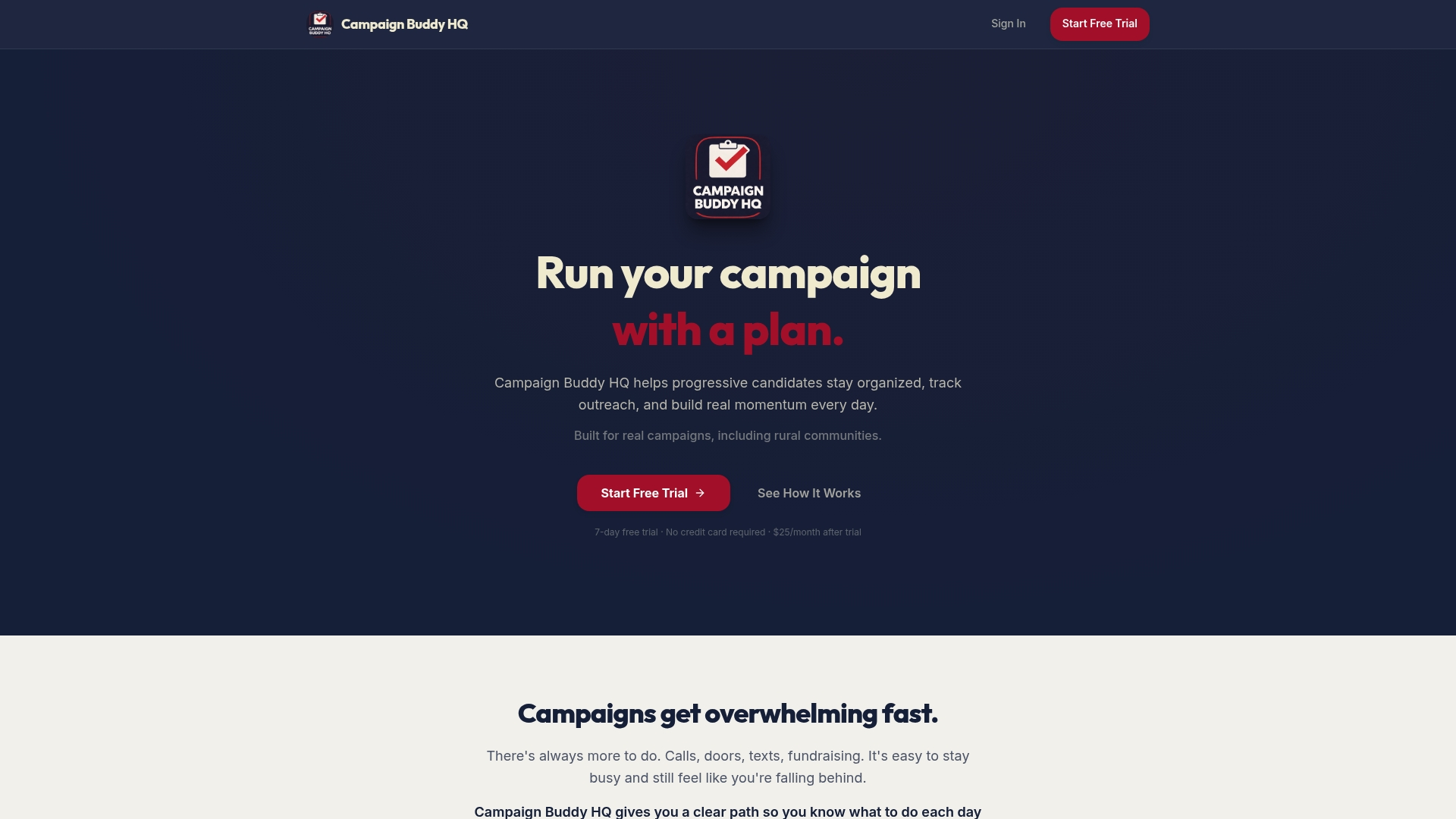
The platform includes rural workflow templates designed for low-density districts where standard walk lists do not map cleanly, plus AI-assisted content tools that generate stump speeches and social posts in minutes. A field organizer can set up a weekend canvass on Friday, assign turf to volunteers, and review the full contact breakdown by Monday morning without touching a spreadsheet.
Start a 7-day free trial at Campaignbuddyhq with no credit card required, and see how the workflow maps to your next canvass weekend.
Primary sources and further reading
- Center for Creative Leadership: experiential learning and the 70-20-10 model
- SPRA: Nurturing Growth — Strategies for Worker Advancement
- Lever: How to Build a Recruitment Marketing Strategy That Actually Connects
- LevelUpHRS: Career Growth Strategies HR Teams Should Implement
- Serendi: Recruitment Marketing Strategy — Guide and Real Examples
- Campaignbuddyhq: campaign planning and outreach SaaS
- Campaignbuddyhq blog: step-by-step campaign outreach guide
- Campaignbuddyhq blog: how to build a supporter list
Sources
- Center for Creative Leadership (CCL)
- Nurturing Growth: Strategies for Worker Advancement (SPRA)
- How to Build a Recruitment Marketing Strategy That Actually Connects (Lever)
- Career Growth Strategies HR Teams Should Implement (LevelUpHRS)