

What are the top political campaign priorities right now?
The economy, healthcare, and immigration are the three issues driving the 2026 midterm cycle, and every campaign manager who misreads that order is already behind. As of mid-2026, the economy leads voter concern at nearly 48%, healthcare follows at 38%, and democracy registers at 32%, according to the Issue Importance Tracker 2026. Those numbers shift by district, by party, and by week, but the hierarchy holds.
What makes this cycle different from 2024 is the emergence of trade and tariffs as a live economic issue. Market volatility tied to recent tariff policies has shifted Democratic messaging advantage on the economy in ways that were not predictable 18 months ago. Democrats are running hard on healthcare access and Medicaid cuts. Republicans are running hard on immigration and tax relief. Neither party is fighting on the same terrain.
The strategic implication is straightforward: you cannot build a winning campaign on generic "kitchen table issues" framing anymore. You need to know which specific issues your district's voters rank highest, which party holds the structural messaging advantage on each, and where you can credibly compete. That is the starting point for every resource allocation decision you will make.
Key issues shaping 2026 campaign priorities at a glance:
- Economy and cost of living: The top voter concern nationally, with nearly 48% of voters naming the economy as their top priority as of mid-2026 (Issue Importance Tracker 2026).
- Healthcare and Medicaid access: 41% of voters cite a healthcare issue, up from 33% last year, driven by the Medicaid debate
- Immigration: 44% of Americans name immigration as a top concern, with Republicans running nearly 300 ads on the issue compared to 62 from Democrats
- Democracy and government function: Cited by roughly a third of voters, with partisan confidence in federal government at historic lows
- Trade and tariffs: A newer entrant that intersects with economic anxiety and has reshuffled party advantages on fiscal issues
Which issues matter most to voters in 2024–2026?
The 2026 issue environment did not arrive out of nowhere. It evolved from 2024's dominant themes and then got reshaped by a single piece of legislation: the tax-cut and spending bill Trump signed on July 4, 2026. That bill became the unofficial starting gun for the midterm campaign, with Democrats attacking Medicaid cuts and Republicans touting tax provisions as relief for wage workers and seniors.
The economy: still number one, but the framing has shifted
A third of Americans still name inflation and cost of living as their top concern, per the AP-NORC poll from December 2025. But the specific texture of economic anxiety has changed. Personal financial issues jumped to 43% of voters naming at least one personal finance concern, up from 31% the prior year. Housing costs, food prices, and wages are now the specific pain points, not just a general inflation complaint. Campaigns that talk about "the economy" without drilling into those specifics are leaving persuasion on the table.
Trade and tariffs add another layer. Market volatility has given Democrats an opening on economic credibility they did not have in 2024. If your campaign is on the Democratic side, that opening is worth exploiting with concrete, local examples of tariff impact on jobs and prices.
Healthcare: the sharpest partisan divide
Half of all voters say healthcare costs are extremely important for candidates to address in the midterms, according to KFF polling. That number climbs to 60% among Democrats and 55% among independents. The Medicaid access debate has sharpened this further: 77% of voters say delayed federal payments to state Medicaid programs would likely cause eligible low-income people to lose healthcare access, including 61% of Republicans.
Republicans are not ceding healthcare entirely. More than half of Republican voters (55%) say fraud in government health programs is extremely important for candidates to discuss. That is a distinct framing: not "cut healthcare" but "protect it from waste." If you are running a Republican campaign, that distinction is the difference between a message that lands and one that backfires.
Immigration: the Republican anchor issue
Six in 10 Republicans cite immigration as a top issue for the government to address in 2026, compared to 37% of Democrats and 32% of independents. Republicans have run nearly 300 immigration-related ads nationwide since january, outspending Democrats on immigration advertising by about $36 million. National Republican Congressional Committee press secretary Mike Marinella put it plainly: "The most effective message depends on the district and how those issues affect that particular community."

Democrats are not ignoring immigration, but they are framing it differently, focusing on enforcement overreach and personal stories rather than policy specifics.
| Issue | % Voters Citing as Priority | Party with Messaging Advantage |
|---|---|---|
| Economy / cost of living | Nearly 48% | Contested (tariff shift favors Democrats) |
| Immigration | 44% | Republicans |
| Healthcare | 41% | Democrats |
| Personal finances | 43% | Democrats |
| Crime and taxes | Higher among Republicans | Republicans |
| Environment | 12% overall (Democrats) | Democrats |
Pro Tip: Map your district's issue salience against the national numbers before finalizing your message. A district with high housing costs and a large Medicaid-dependent population responds to very different healthcare framing than a suburban district where fraud prevention resonates.
How do you build a winning political campaign strategy?
Strategy and tactics are not the same thing, and confusing them is one of the most common ways campaigns waste money. Strategy is the decision about where to compete, which voters to pursue, and what core message will move them. Tactics are the specific activities, ads, door knocks, and events that execute that strategy. You need both, but you need strategy first.
A useful framework comes from political scientist Joel Bradshaw's four propositions: the electorate divides into your base, your opponent's base, and undecided voters; data lets you identify which voters fall into which group; you do not need everyone; and once you know how to win, you act to create the circumstances that bring it about. That last point is where most campaigns stall. They identify the path but never build the execution plan to walk it.
Core components of a campaign plan aligned with your priorities:
- Define a clear, measurable goal. "Win" is not a goal. "Receive more votes than any other candidate in District 7" is. The National Democratic Institute's Campaign Skills Handbook frames it as a short, well-defined declaration of what you realistically want to achieve.
- Conduct a voter universe analysis. Use registered voter data, past election results, and survey research to size your base, your opponent's base, and the persuadable middle. Allocate resources accordingly.
- Identify your two or three core issues. Based on district-level data, not national averages. The economy, healthcare, and immigration are the national leaders, but your district may weight them differently.
- Build a message architecture. A broad message that attracts the most voters without getting bogged down in policy detail. Barack Obama's 2008 "change" message is the textbook example of a simple frame that held across every audience.
- Distinguish informational from competitive campaign mode. An informational campaign focuses on low-cost awareness: news releases, door-to-door brochures, earned media. A competitive campaign requires paid staff, TV and digital advertising, and extensive field operations. The marginal cost of reaching more voters rises sharply once you cross into competitive mode, so make that decision deliberately and early.
- Build a fundraising plan tied to your timeline. Campaigns typically need more cash at the start to get operations running and again at the end to close strong with GOTV. Map your expected income against your spending timeline so you are not caught short in the final weeks.
- Create a detailed campaign timeline. Work backward from election day. Assign deadlines for filing, hiring, message testing, ad buys, and GOTV mobilization. A strong timeline prevents the common failure mode of running out of time for the activities that actually move votes.
For fundraising outreach strategy, the principle is the same: tie your asks to the issues your voters care about most. A donor who cares about Medicaid access responds to a different pitch than one who cares about border security.
How do you identify and target the right voters?
Voter targeting is where strategy becomes math. The goal is not to talk to everyone. It is to talk to the right people, with the right message, at the right moment. That requires segmenting your voter universe before you spend a dollar on outreach.
The three-segment model is the starting point: your base (likely supporters who need mobilization), your opponent's base (largely unreachable, do not waste resources), and undecided or persuadable voters (the campaign's real target). Past election results, registered voter lists, and survey research make it possible to assign voters to each group with reasonable accuracy. The discipline is in not chasing the opponent's base when you should be consolidating your own.
Targeting and microtargeting techniques that work:
- Voter issue profiling: Cross-reference voter file data with survey responses to identify which issues drive each voter segment. A voter who has donated to healthcare advocacy groups is a different persuasion target than one who has attended immigration town halls.
- Geotargeting: Focus field and digital resources on precincts where your margin of victory or defeat is likely to be decided. Spending equally across all precincts is how campaigns lose close races.
- Lookalike audiences: Use your known supporter list to build digital audiences that share demographic and behavioral characteristics with your base. This extends your reach without requiring individual-level data on every voter.
- Contextual advertising: Place digital ads alongside content that your target voters are already consuming, without relying on personal data profiles. As privacy-driven targeting becomes the norm, contextual placement is increasingly the reliable alternative to cookie-based targeting.
- Retargeting: Re-engage voters who have already visited your website or interacted with your digital content. These voters have already shown interest; the cost per persuasion is lower than cold outreach.
- Persuasion lift measurement: Run controlled experiments to measure whether your outreach is actually changing voter intent, not just generating activity. Sophisticated campaigns prioritize persuasion lift over raw contact counts because activity without movement is wasted spending.
Pro Tip: Before your first digital ad buy, build a cross-channel voter contact plan that maps each voter segment to a specific channel and message. A persuadable voter who sees your healthcare message on Facebook, gets a door knock reinforcing it, and then receives a text reminder before election day is far more likely to move than one who sees the same ad three times on one platform.
How do you build and manage a high-performance campaign team?
A campaign team is not a staff list. It is a system of roles, accountability structures, and communication flows that either accelerates your strategy or grinds it to a halt. The difference between a team that executes and one that spins its wheels usually comes down to three things: clear role definition, consistent training, and a feedback loop that catches problems early.
At the top, you need a campaign manager who owns the strategy and has authority to make resource calls without committee approval. Below that, the critical roles are a field director (owns voter contact operations), a communications director (owns message consistency across all channels), a finance director (owns fundraising and budget tracking), and a data director (owns the voter file and targeting). In smaller campaigns, one person may cover multiple roles, but the functions still need to be owned explicitly.
Team management practices that actually matter:
- Define roles in writing before hiring. Ambiguous responsibilities create turf conflicts that consume time you do not have.
- Run weekly all-hands check-ins tied to metrics. Not activity reports, but outcome metrics: doors knocked, persuasion contacts made, dollars raised against goal.
- Train volunteers before deploying them. An untrained canvasser who goes off-script on a doorstep can do more damage than no canvasser at all. Volunteer mobilization is only valuable when the volunteers are prepared.
- Build a volunteer pipeline, not a volunteer list. Recruit continuously, not just when you need bodies. Volunteers who are engaged early stay engaged; ones recruited at the last minute often do not show up.
- Allocate budget for personnel explicitly. Personnel costs are the largest line item in most competitive campaigns. Underfunding staff leads to burnout and turnover at the worst possible moments.
- Create a rapid communication protocol for the field. Field staff need to be able to escalate problems, share what they are hearing at doors, and receive updated talking points without a 48-hour lag.
- Use local volunteers for canvassing. Research shows that out-of-state volunteers are less effective at increasing turnout than local, trained ones. Invest in building local capacity rather than importing labor.
The momentum management challenge is real in the middle stretch of a campaign, when the initial energy fades and election day still feels distant. Teams that have clear weekly goals and visible progress tracking sustain effort better than those running on inspiration alone.
What grassroots tactics actually move voters?
Ground game is where campaigns win or lose close races. The research on this is consistent: personal contact outperforms every other form of voter outreach, and the more local and trained the person making that contact, the better the result.
Door-to-door canvassing increases turnout by an average of about 2.5 percentage points, volunteer phone calls raise it by about 1.9 points, and lawn signs increase vote share by 1.7 percentage points. Automated phone messages, by contrast, produce no measurable effect. Those numbers matter when you are allocating a finite field budget: every dollar spent on robocalls is a dollar not spent on canvassers.
Effective field tactics for 2026:
- Door-to-door canvassing: The highest-impact single tactic. Prioritize persuadable precincts in the first phase, then shift to base mobilization in the final two weeks before election day.
- Volunteer phone banking: Effective for both persuasion and GOTV, especially in low-density or rural districts where door-to-door coverage is harder to achieve. Use local volunteers, not commercial phone banks.
- Text banking: Lower cost per contact than phone calls, useful for reminders and event invitations. Less effective for persuasion than live conversation.
- Lawn signs: A visibility tactic, not a persuasion tactic. They signal community support and can reinforce name recognition, but they do not move undecided voters on their own.
- Earned media and community events: Town halls, candidate forums, and local press coverage extend reach without paid media costs. Particularly valuable for informational campaigns or candidates building name recognition.
- GOTV coordination in the final 72 hours: The last three days before election day are where field operations either deliver or collapse. Have a specific plan for each precinct: who is knocking, who is calling, who is driving voters to the polls.
Pro Tip: Track your outreach impact by precinct, not just by total contacts. A precinct where you made 200 contacts but only reached 40% of your target universe needs a different resource allocation than one where you hit 80%. Aggregate totals hide the gaps that cost you on election night.
For volunteer coordination specifically, the training investment pays off disproportionately. A canvasser who knows the three-sentence version of your healthcare message and can handle a pushback question on immigration is worth five canvassers who are reading from a script for the first time. Build the training into your field calendar, not as an afterthought.
How this article's issue data was gathered and analyzed
The issue importance rankings and partisan advantage assessments in this article draw on several distinct data sources, each with its own methodology. Understanding how that data was collected helps you apply it correctly to your specific race.
- Issue Importance Tracker 2026 (USPollingData.com): Tracks voter-reported issue salience through ongoing survey data. The economy at nearly 48%, healthcare at 38%, and democracy at 32% come from this tracker's mid-2026 readings. The tracker also captures emerging issues like trade and tariffs as they enter the voter consciousness.
- AP-NORC Center for Public Affairs Research (december 2025 poll): Asked respondents in their own words to name up to five issues the government should prioritize in 2026. This open-ended methodology captures genuine salience rather than prompted responses, which is why it produces slightly different rankings than forced-choice polls. The 71% economy figure and the 44% immigration figure come from this source.
- KFF Health Tracking Poll: Focused specifically on healthcare issue importance for the midterms, using a nationally representative voter sample. The 51% overall and 55% Republican figures on healthcare costs and fraud come from this poll.
- AdImpact advertising data (via NPR analysis): Tracks actual ad spending and volume by issue and party. The $53 million Republican immigration ad spend and the nearly 300 Republican immigration ads versus 62 Democratic ads come from AdImpact data covering january through june 2026.
- Cook Political Report and related race ratings: Used to assess which races are genuinely competitive and therefore where issue messaging is most consequential. Safe seats have different messaging needs than toss-up districts.
- Partisan advantage determination: Assessed by comparing which party is spending more on a given issue, which party's base ranks it higher, and which party's candidates are more likely to win on that issue based on polling cross-tabs. No single metric determines advantage; it is a convergence of spending, salience, and polling data.
The Pew Research Center's 2024 election issues analysis provides the prior-cycle baseline that makes 2026 shifts legible. When healthcare salience jumps from 33% to 41% year over year, that movement is only meaningful against the Pew 2024 data.
How Campaignbuddyhq helps you execute on your top priorities
Knowing your top campaign priorities is one thing. Executing against them every day, across a team of staff and volunteers, in multiple precincts, is where most campaigns lose ground. That is the operational problem Campaignbuddyhq was built to solve.
The platform gives campaign managers a single place to plan daily and weekly outreach activities, log every door knock, call, and text, track supporter contacts, and monitor progress against campaign phase goals. For a field director managing 20 volunteers across three precincts, that visibility is the difference between knowing your ground game is on track and finding out on election night that two precincts were under-contacted for three weeks.
What Campaignbuddyhq does for your campaign operations:
- Daily and weekly planning tools: Assign specific outreach goals to each team member or volunteer for the day. No more guessing whether the field team is hitting their numbers.
- Outreach logging: Record doors knocked, calls made, texts sent, and registrations completed in real time. This feeds the data you need to make mid-campaign adjustments before it is too late.
- Supporter tracking: Build and maintain a live record of identified supporters, undecided contacts, and follow-up priorities. Your voter universe stays current rather than stale.
- Campaign phase management: Structure your campaign into phases (early persuasion, base mobilization, GOTV) with distinct goals and activities for each. The platform keeps your team oriented to the current phase rather than running all tactics simultaneously.
- Rural and low-density community support: Most campaign tools are built for urban density. Campaignbuddyhq is designed for the real-world conditions of campaigns where a canvasser covers 15 miles to knock 30 doors, not 30 doors in three blocks.
- Progress monitoring: See at a glance whether you are on track to hit your voter contact goals for the week, the phase, and the campaign. Falling behind early is recoverable; falling behind in the final two weeks usually is not.
- Consistency and momentum building: The platform's structure promotes daily habits rather than burst-and-crash outreach patterns. Consistent contact over time outperforms last-minute surges.
The 2026 outreach trends point toward campaigns that combine data-driven targeting with disciplined daily execution. Campaignbuddyhq connects those two things: the targeting intelligence that tells you who to contact, and the operational structure that makes sure your team actually contacts them.
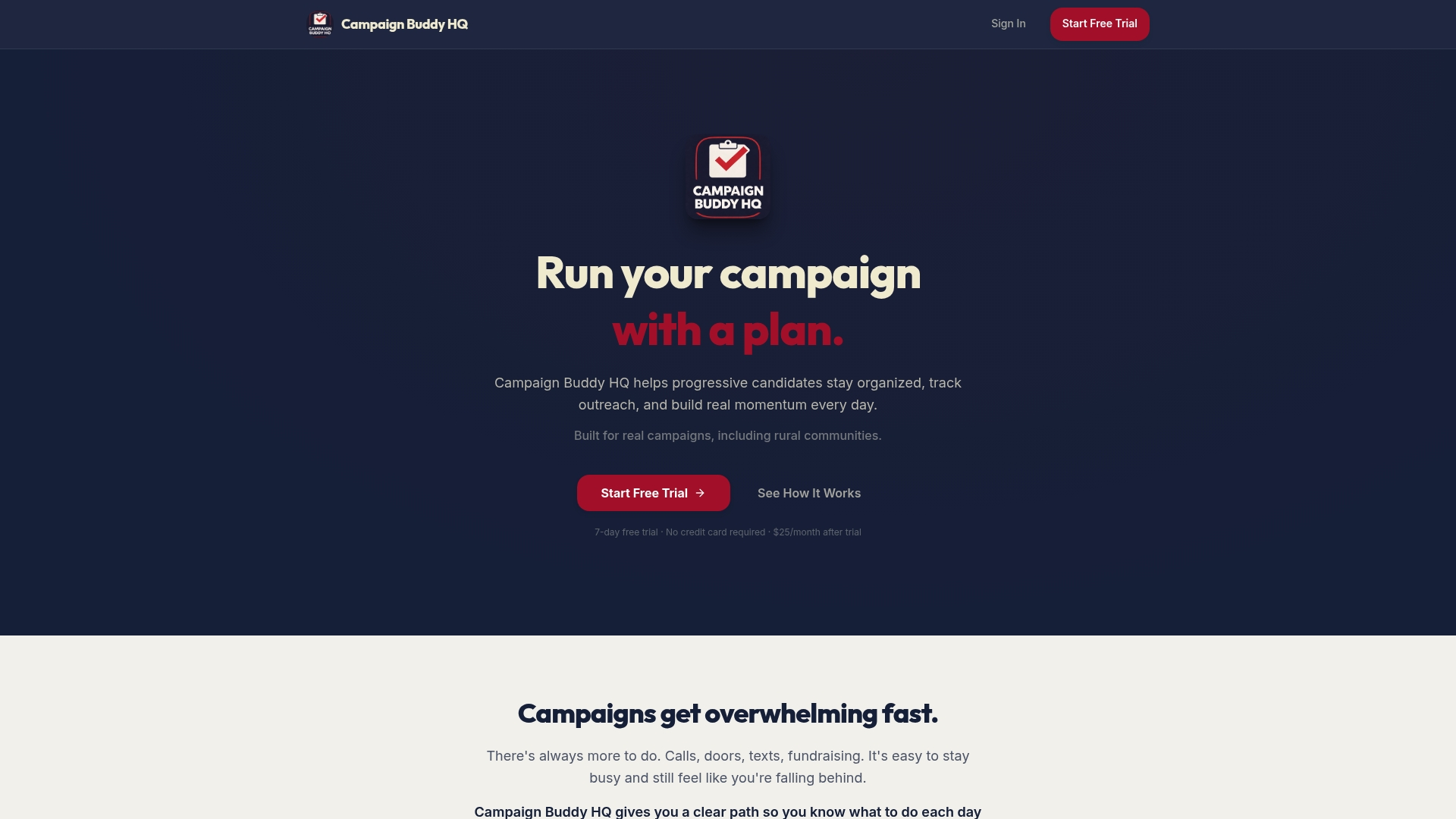
Campaignbuddyhq offers a free 7-day trial with no credit card required. If you are building a campaign around the issues that matter most to your voters and you need a system to execute that plan at the field level, start your trial and see how the platform fits your operation.
Key Takeaways
The economy, healthcare, and immigration are the three dominant voter priorities in 2026, and campaigns that align their messaging, targeting, and field operations to those issues with district-specific precision will outperform those running on generic platforms.
| Point | Details |
|---|---|
| Economy leads voter concern | Nearly 48% of voters name the economy as their top priority, with personal finances and housing costs driving the specifics. |
| Healthcare salience is rising | 41% of voters cite a healthcare issue in 2026, up from 33% last year, making Medicaid access a central Democratic message. |
| Immigration anchors Republican strategy | Six in 10 Republicans name immigration as a top concern; GOP campaigns have run nearly 300 immigration ads versus 62 from Democrats. |
| Personal contact drives turnout | Door-to-door canvassing raises turnout by about 2.5 percentage points; volunteer calls add about 1.9 points, far outperforming automated outreach. |
| Execution requires daily discipline | Consistent daily outreach tracking and phase-based planning, as supported by tools like Campaignbuddyhq, prevents the late-campaign gaps that decide close races. |