

A political advocacy workflow process is the structured sequence of planning, executing, and measuring strategic actions to mobilize supporters, influence policy, and win campaign goals. Without this structure, campaigns waste time on disconnected tactics that never add up to real pressure on decision-makers. The most effective advocacy teams treat their workflow as a repeatable system, not a series of improvised moves. Campaignbuddyhq is built around this exact principle, giving campaign managers a platform to plan daily activities, track outreach, and monitor progress toward measurable goals. This guide breaks down every stage of that system so you can build one that works.
What are the essential stages of a political advocacy workflow process?
The industry term for this framework is the GOST model: Goals, Objectives, Strategies, and Tactics. It gives every campaign a top-down structure where each layer directly supports the one above it.
Stage 1: Set a clear, measurable goal
Your goal is the single outcome you want to achieve, stated in concrete terms. "Pass HB 1042 by the end of the legislative session" is a goal. "Raise awareness" is not. Deep procedural knowledge of formal and informal policymaking machinery is critical here. Knowing which committee vote, which floor session, or which agency comment period to target shapes every decision that follows.
Stage 2: Define objectives, strategies, and tactics
Objectives are measurable milestones on the way to your goal. Strategies describe the general approach you will take. Tactics are the specific actions your team executes. Explicitly documenting excluded tactics prevents mission drift and stops your team from chasing activities that sound productive but do not move the needle.

Stage 3: Prepare your supporter data
Segment your contact list before you send a single message. Divide supporters by geography, issue priority, and engagement history. Advocacy teams that organize supporter stories by issue and district before legislative meetings consistently increase their impact with lawmakers. This preparation phase is not optional. Skipping it means your outreach lands on the wrong people at the wrong time.
Stage 4: Build your advocacy sequences
A standard automated advocacy sequence runs on a 14-day cycle, starting at day 0 with an initial contact and closing with a reactivation message by day 14. Design both a standard sequence for planned campaigns and an urgent sequence for fast-moving legislative moments. Map out every touchpoint, including email, text, and phone, before you launch.
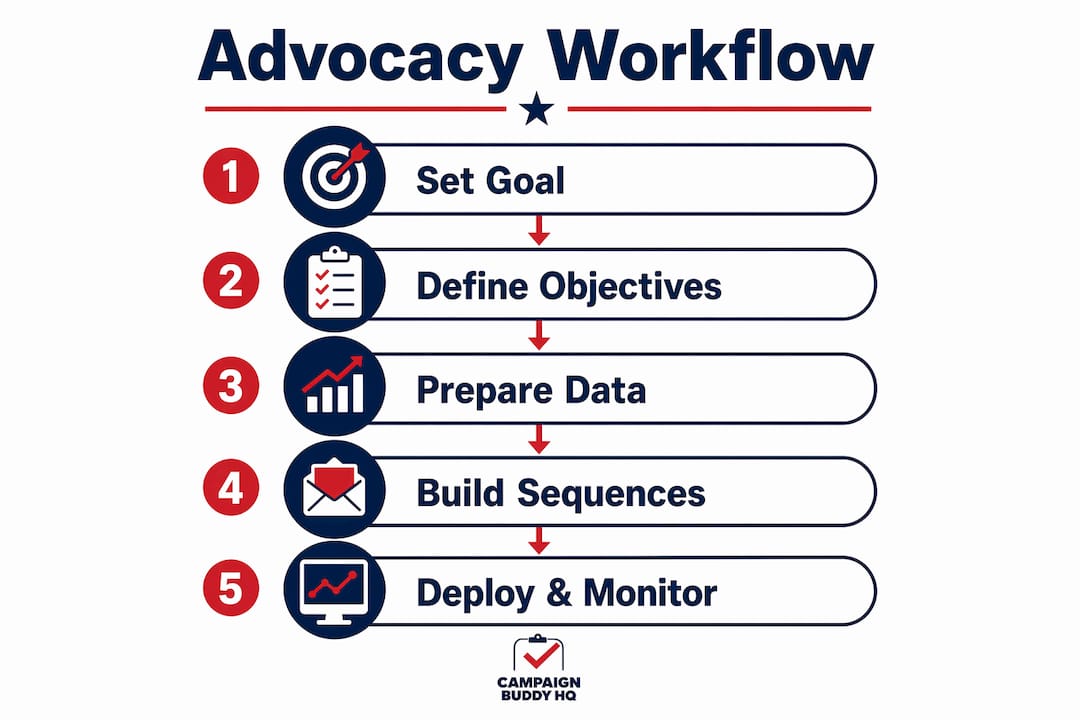
Stage 5: Deploy, monitor, and adjust
Launch your sequences and track results in real time. Compare your actual outreach numbers against your targets daily. Adjust messaging, timing, or channel mix based on what the data shows. This is not a one-time review. Effective workflow management in advocacy means treating every week as a feedback loop.
Pro Tip: Write your reactivation message before you launch your campaign. Teams that build the full 14-day sequence upfront avoid the scramble of writing urgent content under deadline pressure.
What tools and technologies optimize workflow management in advocacy campaigns?
The right tools do not replace your strategy. They execute it faster and with fewer errors.
- CRM systems are the backbone of any advocacy operation. A good CRM tracks every supporter interaction, flags lapsed contacts, and triggers follow-up actions automatically. For nonprofits and advocacy groups evaluating options, nonprofit CRM platforms vary widely in their automation depth and reporting features.
- Automation workflows handle email sends, SMS triggers, and social media scheduling based on supporter behavior. Automation saves advocacy teams roughly 8–13 hours of manual work per week by handling CRM updates and communication triggers. That time goes back into direct voter and supporter contact.
- Geographic routing assigns canvassers and callers to the right turf based on address data. This prevents overlap, maximizes coverage, and gives field directors a clear picture of where gaps exist.
- Dashboards and KPI tracking show you which actions are generating results and which are burning resources. Build your dashboard around the metrics that connect directly to your stated objectives.
Pro Tip: Complete your data import and message template build-out before you mark any setup phase as done. Skipping these steps delays your return on investment and forces you to patch problems mid-campaign.
The most common setup mistake is treating automation as a shortcut around preparation. Automation multiplies whatever you put into it. If your contact data is messy or your templates are vague, automation sends messy, vague messages at scale. Clean data and clear templates come first.
How to implement multi-channel political engagement tactics within your workflow?
Multi-channel outreach is not about being everywhere. It is about reaching the right supporter on the channel where they are most likely to act.
-
Text messaging. Text-based advocacy maintains a 98% open rate, making it the most reliable channel for time-sensitive calls to action. Use SMS for legislative alerts, event reminders, and urgent action requests. Keep messages short and include one clear action per text.
-
Email sequences. Email carries your longer arguments, your supporter stories, and your detailed asks. Sequence emails to build on each other. The first email introduces the issue. The second shares a constituent story. The third delivers the specific ask with a direct link to act.
-
Canvassing. Door-to-door contact remains one of the most persuasive political engagement tactics available. Canvassing can increase win probability by roughly one percentage point per 750 hours of effort. That math rewards organized, consistent field programs over sporadic pushes. Use a step-by-step canvassing guide to train volunteers on consistent messaging and data collection.
-
Social media engagement funnels. The engagement funnel moves supporters from awareness through action to leadership roles. Start with shareable content that introduces your issue. Follow with posts that ask for a specific low-friction action, like signing a petition. Then recruit your most active engagers into volunteer or leadership roles.
-
Peer-to-peer outreach. Supporters contacting their own networks carry far more credibility than any broadcast message from your campaign. Build peer-to-peer fundraising and action ladders into your workflow so your most committed supporters become recruiters.
Timing matters as much as channel selection. Coordinate your message sequence so each channel reinforces the others. A text message that references the email sent yesterday and previews the town hall tomorrow creates a coherent experience that builds momentum.
What are common challenges and best practices for monitoring advocacy workflows?
Most campaigns measure the wrong things. They count emails sent, doors knocked, and calls made without asking whether those actions are moving their goal forward.
The fix is distinguishing between leading and lagging indicators. Conflating leading and lagging indicators in your scorecard destroys strategic clarity. Leading indicators are actions your team controls, like the number of constituent meetings scheduled. Lagging indicators are outcomes you influence but do not control, like a committee vote. Track both, but never confuse motion for impact.
"Counting motion vs. capturing meaning is the central measurement challenge in advocacy. A campaign that logs 10,000 contacts but cannot show legislator behavior change has measured activity, not influence."
Common pitfalls and how to fix them:
- Activity inflation. Teams report high contact numbers while ignoring response rates and conversion to action. Add a response rate column to every outreach report.
- Missing qualitative data. Numbers tell you what happened. Supporter stories and legislator feedback tell you why. Collect both in every review cycle.
- Skipping the exclusion list. Tactics that are not in your plan should be explicitly listed as excluded. This prevents scope creep when a new idea sounds appealing mid-campaign.
- Infrequent reviews. Weekly check-ins catch problems before they compound. Monthly reviews are too slow for a fast-moving legislative calendar.
Manual processes increase friction and decrease supporter completion rates significantly with each added step. Automation removes those barriers and keeps supporters moving through your action sequence without drop-off.
Key Takeaways
A structured political advocacy workflow process is the single most reliable predictor of campaign efficiency, because it aligns goals, tactics, and measurement into one coherent system.
| Point | Details |
|---|---|
| Start with GOST | Define Goals, Objectives, Strategies, and Tactics before any outreach begins. |
| Prepare data first | Segment contacts by geography and issue before launching any automated sequence. |
| Use multi-channel tactics | Combine text, email, canvassing, and social media to reach supporters on their preferred channel. |
| Measure leading indicators | Track actions your team controls, not just policy outcomes you cannot directly control. |
| Automate to reduce friction | Automation saves 8–13 hours per week and keeps supporters moving through action sequences. |
What I have learned from building advocacy workflows from the ground up
The hardest lesson I have seen campaign managers learn is that a workflow is not a calendar. A calendar tells you when things happen. A workflow tells you why they happen in that order and what triggers the next step. Teams that confuse the two end up with a busy schedule and no strategic momentum.
The second thing I have seen derail otherwise solid campaigns is the assumption that automation handles the human element. It does not. Automation handles the logistics. The human element is the story you tell, the relationship your volunteer builds at the door, and the constituent who shows up at a town hall because someone personally asked them to. Campaign workflows for political strategists work best when they create space for those human moments, not replace them.
The teams I have seen sustain real political influence over multiple cycles share one habit. They build their supporters into leaders, not just recipients of action alerts. The engagement funnel is not a one-time campaign tool. It is a long-term organizing structure that turns a list of contacts into a self-sustaining movement. That is the difference between a campaign that wins once and one that builds lasting power.
— Billy
How Campaignbuddyhq supports your advocacy workflow
Campaignbuddyhq gives campaign managers and activists a single platform to plan, execute, and track every stage of their advocacy work.
The platform covers daily and weekly planning, outreach logging across doors, calls, and texts, supporter tracking, and campaign phase management. It is built for real-world conditions, including rural and low-density communities where field coordination is hardest. Campaignbuddyhq's reporting tools connect your daily activity to your campaign goals so you always know where you stand. A free 7-day trial requires no credit card, making it easy to test the platform against your next campaign before committing. If you are ready to put structure behind your outreach, Campaignbuddyhq is where to start.
FAQ
What is a political advocacy workflow process?
A political advocacy workflow process is a structured system of sequential steps that moves a campaign from goal setting through outreach execution to impact measurement. It connects strategy to daily action so every team member knows what to do and why.
How many steps does an effective advocacy sequence include?
An effective automated advocacy sequence spans a 14-day cycle with touchpoints at defined intervals from day 0 through day 14. Each step builds on the previous one to maintain supporter momentum.
Why does text messaging outperform other channels in advocacy?
Text messaging maintains a 98% open rate, which is higher than email or social media. That open rate makes SMS the most reliable channel for urgent legislative alerts and time-sensitive calls to action.
What is the difference between leading and lagging indicators in advocacy?
Leading indicators are actions your team controls, like meetings scheduled or calls made. Lagging indicators are outcomes you influence but cannot directly control, like a committee vote or a policy change.
How does automation improve advocacy campaign results?
Automation removes manual steps that create friction for supporters, and it saves advocacy teams roughly 8–13 hours of manual work per week. Fewer steps between a supporter and a completed action means higher completion rates across your entire sequence.