

Advocacy campaigning is an organized effort to influence public policy and rally community support to drive social change, distinct from both electoral politics and direct lobbying. Where a political campaign asks voters to choose a candidate, an advocacy campaign asks the public, decision-makers, or both to change a law, a policy, or a social norm. The industry term for this work is issue advocacy, and it spans everything from neighborhood zoning fights to national healthcare reform. Understanding what advocacy campaigning involves, and how it differs from lobbying, outreach, and fundraising, is the first step toward running one that actually moves the needle.
What is advocacy campaigning and how does it differ from lobbying?
Advocacy campaigning and lobbying are related but not interchangeable. Advocacy includes public education, civic mobilization, and stakeholder engagement rather than political electioneering. Lobbying is a narrower tactic within that broader world. It targets legislators or regulators directly, often through paid professionals, to influence a specific bill or rule. Advocacy campaigning, by contrast, builds the public and political conditions that make lobbying possible or unnecessary.

The table below shows where each concept sits in the broader ecosystem:
| Concept | Primary target | Core activity | Typical actor |
|---|---|---|---|
| Advocacy campaigning | Public and policymakers | Education, mobilization, coalition-building | Nonprofits, issue groups |
| Lobbying | Legislators and regulators | Direct persuasion on specific legislation | Paid lobbyists, associations |
| Advocacy outreach | Community members | Relationship-building, removing access barriers | Organizers, volunteers |
| Advocacy fundraising | Donors and supporters | Raising funds to sustain campaign activities | Development staff, grassroots teams |
What is advocacy outreach, specifically? Outreach focuses on relationship-building and removing access barriers rather than policy change. Every advocacy campaign includes outreach, but outreach alone does not aim to change laws. Think of outreach as the connective tissue that holds a campaign together, not the campaign itself.
What is advocacy fundraising? It is the financial engine of a campaign, raising money to sustain organizing, communications, and events. Grassroots fundraising, which draws from many small donors rather than a few large ones, is the form most aligned with issue advocacy because it keeps the campaign accountable to its community rather than to major funders.
Pro Tip: Treat lobbying, outreach, and fundraising as tools inside your advocacy campaign, not as separate programs. Each one should serve the same theory of change.
What are the essential strategies for effective advocacy campaigns?
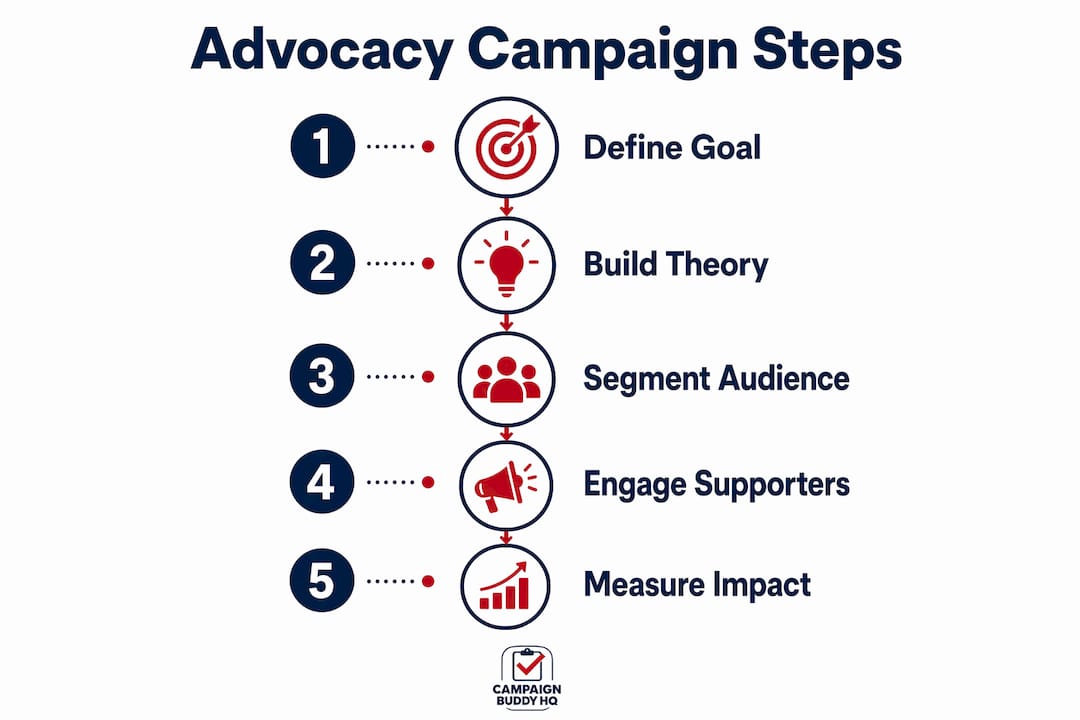
The single most common failure in advocacy is setting goals that are too broad. Campaign goals must be specific, measurable, and targeted to the right audience to maximize impact. "Raise awareness about housing costs" is not a goal. "Persuade the city council to pass a rent stabilization ordinance by November" is a goal. The difference determines whether you can measure success or just activity.
Build a theory of change first
A theory of change maps decision-makers, influencers, pressure points, and the specific shifts required at each step to produce the outcome you want. Without this map, campaigns drift into general awareness work that generates attention but no policy impact. Identify who has the power to make the change you want, who influences those people, and what it would take to move each of them.
Focus on behavior change, not just awareness
Successful advocacy campaigns shift behavior with clear calls to action rather than broad awareness. Specific, observable actions, such as registering to vote, attending a public hearing, signing a petition, or calling a council member, are what campaigns should be designed around. Awareness is a byproduct of good advocacy, not its purpose.
Use digital tools and social media strategically
Social media and digital tools give modern advocacy campaigns quick and cost-effective reach. Visual storytelling on platforms like Instagram and TikTok builds emotional connection, while data analytics let you see in real time which messages are landing and which are not. Organizations like the Sierra Club and the ACLU use segmented email lists, targeted social ads, and online petition tools to move supporters from passive followers to active participants. The 2026 outreach trends point toward short-form video and text-based mobilization as the highest-converting channels for issue campaigns.
Pro Tip: Define your primary audience before you write a single message. A campaign aimed at persuadable city council members needs different language than one designed to activate your existing base.
How can grassroots fundraising strengthen advocacy campaigns?
Grassroots fundraising is the practice of raising money from a large number of small donors rather than relying on a handful of major gifts. Small contributions from a large base build deeper community connections and reduce the financial risk that comes when one major donor pulls out. For advocacy organizations, this model also signals broad public support, which itself becomes a political argument.
The connection between fundraising and advocacy runs deeper than most organizers realize. Fundraisers that also educate increase total impact by developing advocates who influence others. A donor who understands the issue becomes a spokesperson. A spokesperson multiplies your reach without additional budget. This is why the best advocacy fundraising events combine a financial ask with a substantive briefing on the policy at stake.
Practical ways to integrate grassroots fundraising into your advocacy campaign:
- Pair every donation ask with a second call to action. Ask donors to share the campaign, attend an event, or contact their representative. This turns a transaction into a relationship.
- Segment supporters by interest and engagement level. A first-time donor receives a different message than a three-year volunteer. Tailored communication channels improve activation rates significantly.
- Set public fundraising milestones. Announcing that 500 donors have contributed signals momentum and encourages others to join. Milestone framing is a proven social proof tactic.
- Be transparent about how funds are used. Supporters who see a direct line between their donation and a specific campaign activity give again at higher rates.
For a deeper look at the mechanics, the grassroots fundraising guide from Campaignbuddyhq covers tactics specifically built for progressive issue campaigns.
What practical steps and tools help you launch an advocacy campaign?
Running an advocacy campaign requires moving from strategy to execution without losing the clarity you built in the planning phase. The steps below reflect how experienced organizers structure a campaign from start to finish.
- Define your goal and theory of change. Write a one-sentence goal that names the specific policy change, the decision-maker who controls it, and the deadline. Then map the path from your current position to that outcome.
- Identify and segment your audience. Separate your supporters into tiers: core activists, persuadable allies, and the general public. Each tier needs different messages and different asks.
- Build your outreach infrastructure. Assign volunteers to specific geographies or contact lists. Use a step-by-step outreach approach that tracks doors knocked, calls made, and texts sent so you know your actual reach, not just your intended reach.
- Launch with a public moment. A press conference, a rally, or a coordinated social media push signals that the campaign is real and has momentum. Reporters and policymakers pay attention to launches that demonstrate organized support.
- Track, adjust, and report. Measure weekly against your goal. If a message is not converting supporters into actors, change it. Share progress publicly to sustain donor and volunteer motivation.
Volunteer mobilization deserves special attention. Volunteer engagement strategies that assign clear roles, provide training, and recognize contributions consistently outperform campaigns that treat volunteers as interchangeable labor. A volunteer who feels ownership over a specific precinct or contact list works harder and stays longer.
Transparency about risks and data sharing is non-negotiable when asking supporters to take visible public action. Tell people exactly what you will do with their contact information, what risks come with signing a petition or attending a rally, and how their participation connects to the outcome. Campaigns that skip this step lose trust at the moment it matters most.
Pro Tip: Log every outreach activity in a central system from day one. Campaigns that track doors, calls, and texts in real time can identify dead zones early and redeploy volunteers before momentum stalls.
Key takeaways
Advocacy campaigning succeeds when it combines a specific, measurable policy goal with a clear theory of change, segmented outreach, grassroots fundraising, and transparent communication that turns donors into active advocates.
| Point | Details |
|---|---|
| Define a specific goal | Name the exact policy change, the decision-maker, and the deadline before any outreach begins. |
| Map your theory of change | Identify decision-makers, influencers, and pressure points to keep the campaign outcome-driven. |
| Integrate fundraising with education | Donors who understand the issue become advocates who multiply your reach without extra budget. |
| Segment and tailor outreach | Different supporter tiers need different messages and different calls to action to activate effectively. |
| Track activities in real time | Logging doors, calls, and texts weekly lets you catch stalled momentum before it becomes a problem. |
What I've learned from watching campaigns lose focus
I have watched well-funded advocacy campaigns collapse not because they lacked resources, but because they never committed to a specific target. The team spent months building awareness, generating impressive social media numbers, and hosting packed events. Then the vote came, and the council members they needed had no idea the campaign existed. The campaign had talked to everyone except the people who mattered.
The uncomfortable truth about advocacy campaigning is that focus feels like sacrifice. Narrowing your goal to one ordinance, one legislator, or one school board decision means saying no to every adjacent issue your supporters care about. That is politically uncomfortable. But campaigns that try to move everything move nothing.
The other pattern I keep seeing is the separation of fundraising from advocacy education. Organizations treat their development team and their policy team as separate departments with separate calendars. The result is donors who write checks but cannot explain what the campaign is trying to accomplish. Those donors do not become advocates. They do not bring in their neighbors. They just give money once and drift away.
The campaigns that win treat every donor interaction as an organizing opportunity and every organizing interaction as a potential fundraising moment. That integration is not a tactic. It is a philosophy, and it changes how you staff, how you communicate, and how you measure success.
— Billy
Run your next advocacy campaign with Campaignbuddyhq
Advocacy campaigns live or die on organized execution. Campaignbuddyhq is built specifically for issue advocacy groups, grassroots organizers, and political campaigns that need to track outreach, coordinate volunteers, and monitor progress toward real goals. The platform logs doors knocked, calls made, texts sent, and registrations completed, so your team always knows where it stands. Daily and weekly planning tools keep volunteers on task, and the supporter tracking system lets you segment and message different tiers of your base without managing a spreadsheet. Whether you are running a neighborhood zoning fight or a statewide ballot initiative, Campaignbuddyhq gives you the structure to execute consistently. Start a free 7-day trial with no credit card required.
FAQ
What is the advocacy campaign definition?
An advocacy campaign is an organized, sustained effort to influence public policy, change social norms, or mobilize community support around a specific issue. It differs from lobbying in that it targets the broader public and political environment rather than legislators alone.
How does advocacy outreach differ from advocacy campaigning?
Advocacy outreach focuses on building relationships and removing barriers to participation, while advocacy campaigning uses those relationships to drive a specific policy or behavioral outcome. All advocacy campaigns include outreach, but outreach alone does not constitute a campaign.
What makes grassroots fundraising effective for advocacy?
Grassroots fundraising builds financial sustainability by drawing from many small donors rather than a few large ones, reducing the risk of funding volatility. When fundraising is paired with education about the issue, donors become advocates who extend the campaign's reach organically.
What are the first steps in running an advocacy campaign?
Start by writing a specific, measurable goal that names the policy change, the decision-maker, and the deadline. Then build a theory of change that maps the path from your current position to that outcome before any outreach or messaging begins.
Why is transparency important in advocacy campaigns?
Transparency builds the trust required to ask supporters to take visible public action, such as signing petitions or attending rallies. Campaigns that clearly explain how data is used and what risks participation involves retain supporters at higher rates than those that do not.