

Campaign automation is defined as the use of AI-driven software and workflow systems to execute, optimize, and personalize political outreach tasks without constant manual input. The role of automation in campaigns has shifted from a tactical convenience to a structural necessity. 74% of campaign professionals now use AI daily for tasks ranging from ad creative to voter targeting, and that number is climbing. Tools like AI-driven copywriting platforms, audience segmentation software, and automated scheduling systems are no longer reserved for well-funded national campaigns. They are accessible to any strategist willing to build the right workflows.
What is the role of automation in campaigns?
Automation in campaigns refers to using technology to replace or reduce manual execution of repeatable tasks, including audience segmentation, message scheduling, ad bidding, and performance reporting. The industry term for this practice is marketing automation, though in political contexts it extends to voter outreach, canvassing follow-ups, and fundraising workflows. The impact is measurable and significant.
Full implementation of AI-driven workflows can reduce manual campaign tasks by 60 to 80% within 90 days, while producing 35 to 50% improvements in conversion rates. That means a five-person field team can execute the volume of outreach that previously required fifteen. The efficiency gain is not incremental. It is structural.
Specific functions that automation handles well include:
- Audience segmentation: AI tools analyze voter data and group contacts by geography, issue priority, and engagement history without manual sorting.
- Message scheduling: Automated systems send emails, texts, and social posts at optimal times based on past engagement patterns.
- Ad optimization: AI bid management adjusts digital ad spend in real time based on performance signals, reducing wasted budget.
- Reporting and tracking: Automated dashboards pull field data and display progress against goals without requiring manual data entry.
Campaign teams that bring campaigns to market up to 75% faster than competitors gain a decisive advantage in fast-moving election cycles where timing determines whether a message lands or gets buried.
Pro Tip: Start with one automated workflow, such as post-canvass text follow-ups, before expanding to multi-channel automation. Teams that pilot narrow use cases first avoid the coordination failures that come from deploying too many systems at once.

How does traditional automation compare to agentic AI?
Not all automation works the same way. Understanding the difference between rules-based automation and agentic AI systems determines how much autonomy you give your technology and where human oversight must remain.
| Feature | Traditional automation | Agentic AI |
|---|---|---|
| Decision logic | Fixed if-then rules | Reasons from real-time data |
| Budget management | Static allocations | Autonomous reallocation within set limits |
| Message delivery | Scheduled by human input | Adapts based on performance signals |
| Human approval | Required for most actions | Required only at defined thresholds |
| Risk profile | Low, predictable | Higher, requires governance |
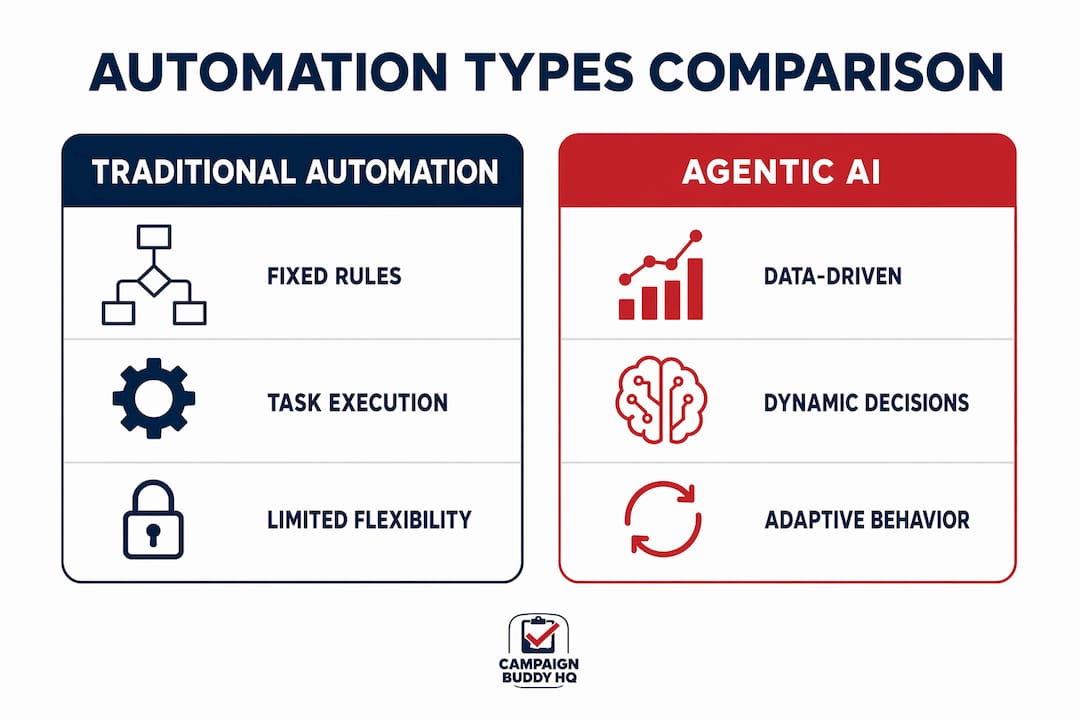
Traditional automation handles tasks like sending a thank-you email when someone donates or scheduling a social post three days before an event. These workflows are reliable and low-risk because every action is pre-defined. Agentic AI systems, by contrast, can autonomously adjust bids, reallocate budgets, and modify targeting parameters in real time without waiting for human approval on each action.
The practical difference is significant. A traditional system sends your planned email sequence regardless of how the first message performed. An agentic system notices that one subject line is generating three times the open rate and shifts resources toward that variant automatically. That kind of real-time responsiveness is what separates campaigns that optimize continuously from those that optimize quarterly.
The risk, however, is real. Campaigns lacking clear AI governance have experienced costly errors including budget mishandling and unintended message delivery to the wrong voter segments. Agentic AI requires defined boundaries, approval thresholds, and notification protocols before any autonomous system touches live campaign assets.
Pro Tip: Define a "human-in-the-loop" threshold before deploying agentic tools. For example, any budget reallocation above $500 or any message sent to more than 1,000 contacts should require explicit approval. Set those rules in writing before the system goes live.
What are the transparency and ethics challenges in campaign automation?
The efficiency gains from automation create a parallel obligation: disclosure. Voters have a right to know when AI generates the content they receive, and the current gap between what campaigns do and what voters expect is wide.
Only 12% of campaign professionals always disclose AI use in voter-facing content, while 31% never disclose it. At the same time, 78% of voters say disclosure of AI use is important to them. That gap is not a minor inconsistency. It is a trust liability that compounds over time.
Here are four steps to build an ethical automation framework for your campaign:
- Establish a disclosure policy before launch. Decide in advance which content categories require AI disclosure, such as AI-generated video, AI-written direct mail, or AI-personalized email. Write the policy down and share it with every staff member.
- Use layered disclosure. A brief "Created with AI assistance" label in the footer of digital content satisfies most voters without disrupting the message. Reserve more prominent disclosure for synthetic media or deepfake-adjacent content.
- Audit voter-facing content regularly. Assign one team member to review AI-generated outputs weekly for accuracy, tone, and compliance with your disclosure standards.
- Monitor AI-generated search results about your candidate. AI-powered search tools like Perplexity and Google's AI Overviews now surface candidate information automatically. Active monitoring of AI-generated search responses about your candidate is a critical operational task that most campaigns overlook entirely.
The 59% of professionals who worry about voter backlash from undisclosed AI use are right to be concerned. Transparency is not just an ethical position. It is a strategic one. Campaigns that get caught using undisclosed AI-generated content face a credibility problem that no amount of automation can fix.
How do you implement automation in a political campaign?
Practical implementation of campaign automation tools requires a phased approach. Deploying everything at once creates confusion, accountability gaps, and systems that nobody on your team actually uses.
The most effective starting point is a single high-volume, low-risk workflow. Canvassing follow-ups are ideal. AI workflows that transcribe canvasser voice memos, tag issues by voter concern, draft follow-up texts in the candidate's voice, and stage messages for review represent exactly the kind of intelligence-driven automation that saves hours of staff time per day without requiring autonomous decision-making.
From there, expand systematically:
- Pilot phase (weeks 1 to 4): Automate one channel, such as SMS follow-ups or email scheduling. Measure time saved and error rate before adding complexity.
- Governance setup: 33% of campaigns have no AI policy, which creates data security and accountability risks. Write yours before scaling. Include rules on voter data handling, approved tools, and content review requirements.
- Reporting integration: Connect your automation tools to a central dashboard so field data, digital performance, and outreach metrics appear in one place. Automated campaign reporting removes the manual aggregation burden that consumes hours every week.
- Team training: Automation tools only deliver value when your team knows how to use them. A structured approach to training on AI marketing tools reduces adoption friction and prevents misuse.
- Agentic expansion (months 2 to 3): Once governance is in place and your team is comfortable with basic automation, introduce agentic features like AI bid management or dynamic audience segmentation with defined approval thresholds.
The role of technology in campaigns is not to replace your strategists. It is to free them from the tasks that consume time without requiring judgment, so they can focus on the decisions that actually win elections.
Key takeaways
Automation in campaigns delivers its greatest value when it is governed, disclosed, and deployed in phases rather than all at once.
| Point | Details |
|---|---|
| Automation reduces manual work | AI workflows cut repetitive tasks by 60 to 80%, freeing staff for strategic decisions. |
| Agentic AI requires governance | Define approval thresholds and boundaries before deploying any autonomous system. |
| Disclosure gap is a liability | Only 12% of campaigns disclose AI use, while 78% of voters say it matters to them. |
| Phased rollout prevents failure | Start with one workflow, measure results, then expand with clear policies in place. |
| Monitoring AI search results matters | Track how AI-powered search tools represent your candidate to catch errors early. |
Why I think most campaigns are using automation wrong
After watching dozens of campaigns adopt automation tools over the past few years, the pattern I see most often is this: teams buy the technology, skip the governance, and then wonder why their results are inconsistent.
Automation is a force multiplier. That means it amplifies whatever is already true about your campaign. If your messaging is sharp and your targeting is accurate, automation scales those advantages fast. If your data is messy and your strategy is unclear, automation scales those problems just as fast.
The campaigns that get the most out of automation are not the ones with the most sophisticated tools. They are the ones that treat automation as an intelligence layer rather than a content factory. They use AI to surface insights, flag anomalies, and handle volume. They keep humans in charge of judgment calls, brand decisions, and anything that touches voter trust directly.
The transparency issue is where I see the most avoidable damage. Campaigns that quietly use AI-generated content without disclosure are making a short-term efficiency trade for a long-term credibility risk. Voters are not naive. When they find out, and they do find out, the story becomes about the deception rather than the candidate.
My honest advice: build your disclosure policy before you build your automation stack. It takes two hours and it protects everything else you build. The future of automation in campaigns is agentic, faster, and more capable than what exists today. The campaigns that will benefit most are the ones that earn voter trust first.
— Billy
How Campaignbuddyhq supports your campaign automation goals
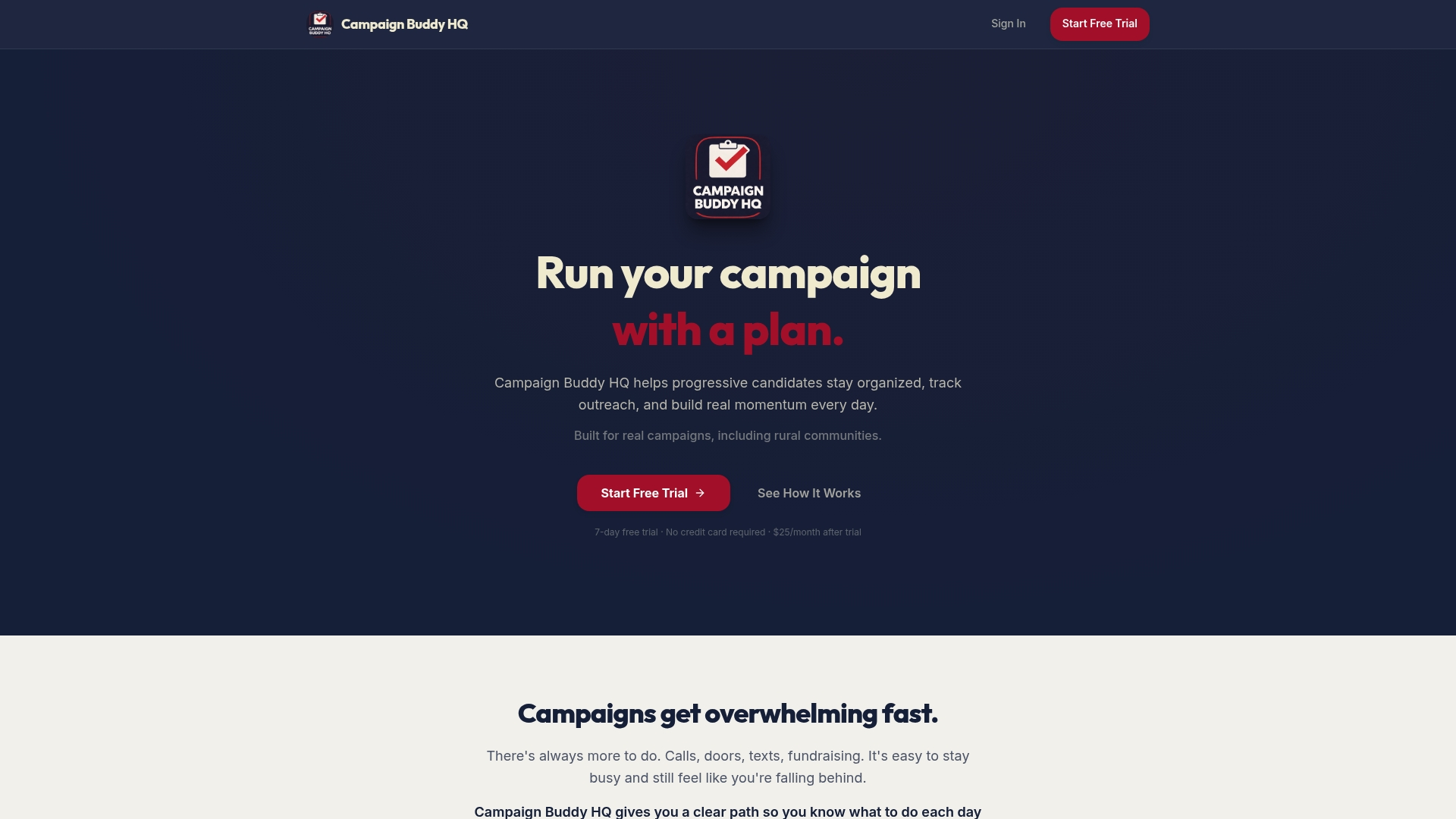
Campaignbuddyhq is built for exactly the kind of phased, organized automation approach this article describes. The platform gives campaign strategists a central place to log outreach activities, track doors, calls, and texts, monitor progress toward goals, and plan daily and weekly workflows without juggling disconnected spreadsheets. For progressive campaigns and issue advocacy groups that need structure without complexity, Campaignbuddyhq provides the operational backbone that makes automation actually work in the field. You can explore the platform free for seven days with no credit card required. If you are ready to build smarter campaign outreach workflows, start there.
FAQ
What is campaign automation in political campaigns?
Campaign automation is the use of AI-driven software to execute repeatable outreach tasks, including message scheduling, audience segmentation, and ad optimization, without constant manual input. It reduces staff workload and increases the speed and consistency of voter contact.
How much can automation reduce campaign workload?
Full implementation of AI-driven workflows can reduce manual campaign tasks by 60 to 80% within 90 days, according to marketing automation research. That reduction frees staff to focus on strategy, relationship-building, and high-judgment decisions.
Do campaigns need to disclose AI use to voters?
78% of voters say AI disclosure is important, but only 12% of campaigns always disclose it. Establishing a clear disclosure policy before deploying AI-generated voter content is both an ethical obligation and a practical protection against backlash.
What is the difference between traditional automation and agentic AI?
Traditional automation follows fixed if-then rules set by humans, while agentic AI reasons from real-time data and takes autonomous actions like reallocating budgets within defined limits. Agentic systems require stronger governance frameworks to prevent costly errors.
Where should a campaign start with automation?
Start with one high-volume, low-risk workflow such as post-canvass text follow-ups or email scheduling. Pilot it for four weeks, measure results, establish an AI policy, and then expand to additional channels with defined approval thresholds in place.