

Technology is the defining competitive advantage in modern political campaigns, determining which candidates reach voters first, most persuasively, and at the lowest cost per contact. The role of technology in campaigns now extends far beyond social media posts and email blasts. AI tools like ChatGPT, Claude, and Grok are reshaping internal operations, voter targeting, and content creation at every level of the ballot. Platforms like Campaign Buddy HQ and HubSpot give campaign managers real-time visibility into outreach performance that was impossible to achieve manually just five years ago. If you are running or advising a campaign in 2026, understanding how digital tools transform strategy is not optional. It is the baseline.
How AI and digital tools transform internal campaign operations
The biggest misconception about AI in campaigns is that it is primarily a voter-facing tool. The data tells a different story. Nearly 90% of internal campaign AI usage is focused on backstage operations: research (65%), news monitoring (64%), and content drafting (59%), with voter targeting at only 22% and chatbots at 18%. This means the real productivity gains are happening behind the scenes, not in front of voters.
The operational intelligence use cases are where campaigns gain the most ground. AI tools now transcribe canvasser voice memos, tag voter issues, and draft personalized follow-ups automatically, replacing hours of manual data entry with near-instant processing. A field organizer who previously spent two hours logging door-knock notes can now speak a 90-second voice memo and have structured, searchable data in the campaign's system within minutes.
The time savings compound quickly. AI tools save marketing teams 10 to 15+ hours per week on content and administrative tasks. For a campaign with a staff of ten, that is the equivalent of adding two full-time employees without the payroll cost. Understanding campaign workflow automation helps campaign managers identify exactly where those hours are being lost today.
- Research and monitoring: AI scans news sources, opposition filings, and social media in real time, flagging relevant developments for staff review.
- Content drafting: Tools like Claude and ChatGPT produce first drafts of mailers, scripts, and social posts that human writers then refine.
- Data entry and tagging: Voice memos, call logs, and canvassing notes are automatically transcribed and categorized by voter issue.
- Automated follow-ups: AI drafts personalized outreach messages triggered by specific voter interactions or data signals.
Pro Tip: Assign one staff member to own your AI workflow audit each month. Have them document which tasks are still done manually and evaluate whether an AI tool can handle the first 80% of that work, freeing your team for judgment calls only humans should make.
What digital tools are most impactful in campaigns today?
86.4% of marketers now use AI tools, primarily for content creation (42.5%) and media creation (37.2%). Political campaigns are adopting the same tools, but the use cases are more operationally specific. The table below compares the major categories of technology platforms campaign professionals rely on in 2026.

| Tool category | Primary function | Examples |
|---|---|---|
| AI content assistants | Draft speeches, scripts, social posts, and emails | ChatGPT, Claude, Grok |
| CRM and outreach platforms | Track voter contacts, calls, texts, and door knocks | Campaign Buddy HQ, NGP VAN |
| Marketing automation | Multi-channel messaging and personalized voter sequences | HubSpot, Mailchimp |
| Data analytics | Voter segmentation, predictive modeling, and reporting | Civiqs, L2 Political |
| Content repurposing tools | Reformatting long-form content for multiple channels | Content Remix |
The most impactful technology in campaigns is not always the most sophisticated. A well-configured CRM that your volunteers actually use consistently outperforms a complex AI system that confuses your field team. The impact of tech in campaigns depends almost entirely on adoption rates and workflow integration, not raw capability.
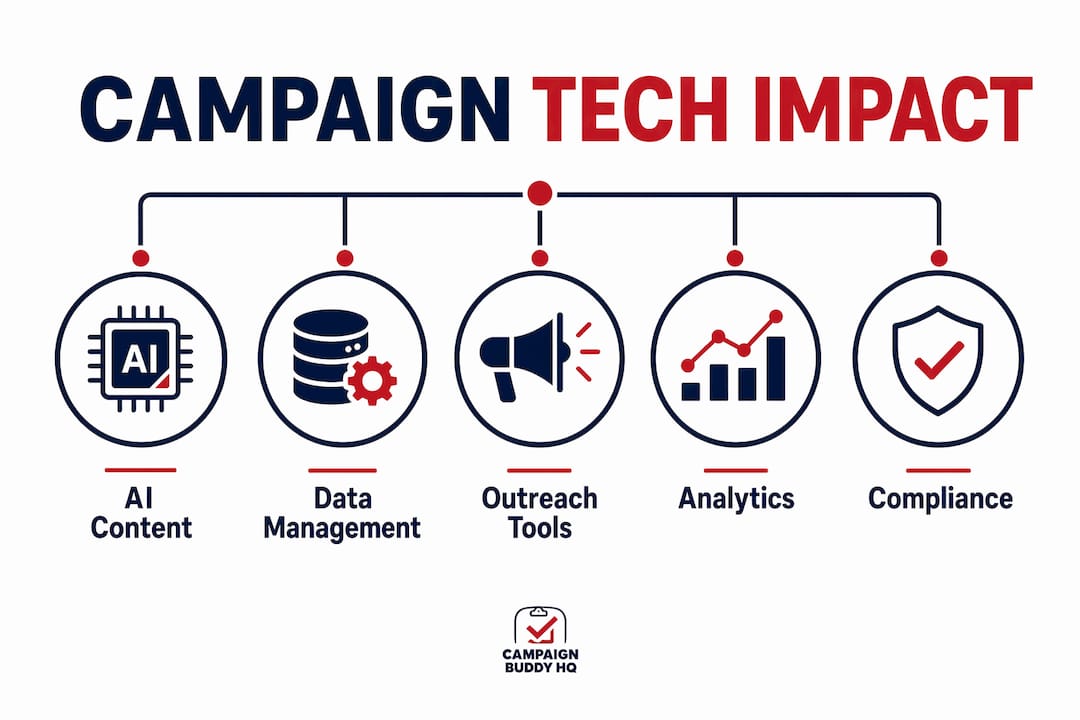
Campaign Buddy HQ sits in the CRM and outreach category, but it is purpose-built for the specific rhythms of political campaigns, including daily and weekly planning cycles, rural canvassing routes, and volunteer coordination. That specificity matters. Generic marketing tools like HubSpot require significant customization to handle the nuances of voter outreach, while purpose-built platforms are ready to deploy from day one.
How does technology improve voter targeting and outreach?
Voter targeting has moved from demographic guesswork to data-driven precision, and the shift is measurable. AI-powered segmentation models now analyze hundreds of variables per voter record, including past voting behavior, consumer data, and geographic patterns, to predict which message will resonate with which household. The result is personalized outreach at a scale that was previously impossible without a massive staff.
Here is how the most effective campaigns structure their tech-driven outreach process:
- Build a clean voter file. Start with a deduplicated, verified voter database. Tools that manage supporter databases efficiently are the foundation of every targeting decision that follows.
- Segment by persuadability and priority. Use AI models to score voters by likelihood to support, likelihood to turn out, and sensitivity to specific issues. Focus your highest-touch outreach on the segments where contact actually changes behavior.
- Deploy multi-channel personalized messaging. Automated text sequences, targeted social ads, and personalized email campaigns should all reference the voter's specific issue priorities, not generic campaign talking points.
- Track every contact and outcome. Log doors knocked, calls made, texts sent, and responses received. Platforms that track campaign activities in real time give managers the data they need to reallocate resources mid-campaign.
- Use agentic AI for follow-up sequences. Emerging agentic AI tools can autonomously trigger follow-up messages based on voter responses, escalating engaged contacts to volunteer outreach and deprioritizing non-responders without manual intervention.
Pro Tip: Do not wait until the final six weeks of a campaign to analyze your outreach data. Run weekly performance reviews against your contact goals from the start. Early data reveals which voter segments are underperforming so you can adjust before it is too late to recover.
The 2026 campaign outreach environment rewards campaigns that use smarter outreach strategies built on real-time data rather than intuition. The campaigns winning competitive districts are not necessarily the ones with the biggest budgets. They are the ones with the tightest feedback loops between field activity and strategic decision-making.
What are the ethics and regulatory challenges of AI in campaigns?
The transparency gap in campaign AI use is one of the most significant risks campaign professionals face in 2026. Only 12% of campaigns that use AI for voter-facing content always disclose AI use, despite 57% of voters valuing AI disclosure highly. That gap is not just an ethical problem. It is a strategic vulnerability.
26 U.S. states have enacted legislation regulating or requiring disclosure for AI-generated political content, particularly deepfakes. Campaigns operating across multiple states face a patchwork of compliance requirements that change frequently. Violating these rules, even unintentionally, creates earned media problems that no campaign can afford.
The risks extend beyond legal compliance:
- Voter distrust: Voters who detect AI-generated content without disclosure report significantly lower trust in the candidate, according to multiple post-election surveys.
- Misinformation liability: AI tools can generate plausible but factually incorrect claims. Without human review at every stage, campaigns risk publishing errors that opponents will amplify.
- Deepfake exposure: AI-generated audio and video of candidates saying things they never said is now technically accessible to low-budget opposition operations.
"Campaigns that prioritize honesty and disclosure maintain trust better" than those that rely on unacknowledged AI content, according to research on voter perception risks without AI transparency.
The solution is not to avoid AI. It is to build internal policies that specify which content requires disclosure, which requires human review before publication, and which AI outputs are purely internal and never voter-facing. Campaigns that build voluntary disclosure models proactively will be better positioned as regulations tighten through the 2026 and 2028 cycles.
Practical steps to implement technology effectively in your campaign
Technology adoption fails in campaigns for one consistent reason: too many tools, too little focus. Campaigns should prioritize three to five key high-impact AI workflows rather than accumulating tools that overlap in function and confuse staff. This value engineering approach produces better results than broad adoption.
- Audit your current workflows before buying anything. Map every recurring task your staff performs. Identify the three to five that consume the most time and require the least human judgment. Those are your first AI automation targets.
- Develop a written AI use policy. Specify which tools are approved, which content categories require human review, and what disclosure language applies to voter-facing AI content. This protects your campaign legally and operationally.
- Invest in Answer Engine Optimization (AEO). AEO is critical for campaigns because voters increasingly ask ChatGPT and Claude about candidates before visiting campaign websites. Structuring your content clearly and factually improves how AI assistants represent your candidate in those responses.
- Choose integrated platforms over point solutions. A platform that combines outreach tracking, data management, and reporting in one interface reduces training time and eliminates data silos. Reviewing what campaign reporting requires helps you evaluate which platforms actually deliver the visibility you need.
- Establish a human review standard for all voter-facing content. No AI output should reach a voter without a staff member reading it first. This single rule prevents the majority of AI-related campaign errors.
Key takeaways
Technology adoption in campaigns succeeds when campaigns prioritize focused AI workflows, maintain human oversight, and build transparency standards that protect voter trust.
| Point | Details |
|---|---|
| Backstage AI dominates | Nearly 90% of campaign AI use is internal: research, monitoring, and drafting, not voter-facing tools. |
| Time savings are real | AI tools save teams 10 to 15+ hours per week, equivalent to adding staff without payroll costs. |
| Transparency gap is a liability | Only 12% of campaigns always disclose AI use, despite 57% of voters wanting disclosure. |
| Regulatory exposure is growing | 26 U.S. states now regulate AI-generated political content, requiring active compliance management. |
| Focus beats breadth | Campaigns that target three to five high-impact AI workflows outperform those that adopt tools broadly. |
Why the transparency trap is the real test for campaign technologists
I have watched campaigns adopt every new tool with genuine enthusiasm, only to create problems they did not anticipate. The pattern is consistent: a campaign discovers AI can produce 20 pieces of content in the time it used to take to produce two, and they scale output immediately without building the review infrastructure to match. That is where things go wrong.
The transparency trap is real. Voters are more sophisticated about detecting AI-generated content than most campaign managers assume. A slightly off-cadence email, a stock-photo-style image, or a speech that lacks the candidate's actual verbal tics gets noticed. When it gets noticed without disclosure, the story becomes about the deception, not the policy.
My honest view is that the campaigns winning on technology in 2026 are not the ones with the most tools. They are the ones that treat AI as an intelligence layer with clear human oversight at every voter-facing touchpoint. The ethical SEO principles that apply to nonprofit digital strategy apply equally here: transparency builds long-term trust, and trust is the only currency that survives a campaign cycle.
The future of campaign technology is agentic AI that autonomously manages follow-up sequences, flags at-risk voter segments, and drafts responses to breaking news. That future is arriving faster than most campaigns are prepared for. The professionals who will lead it are the ones building the human oversight structures now, before the automation pressure makes it feel impossible.
— Billy
How Campaign Buddy HQ puts these tools to work for your campaign
Running a tech-driven campaign requires more than good intentions. It requires a platform built for the specific demands of political outreach, from tracking doors knocked in rural precincts to monitoring weekly progress toward voter contact goals.
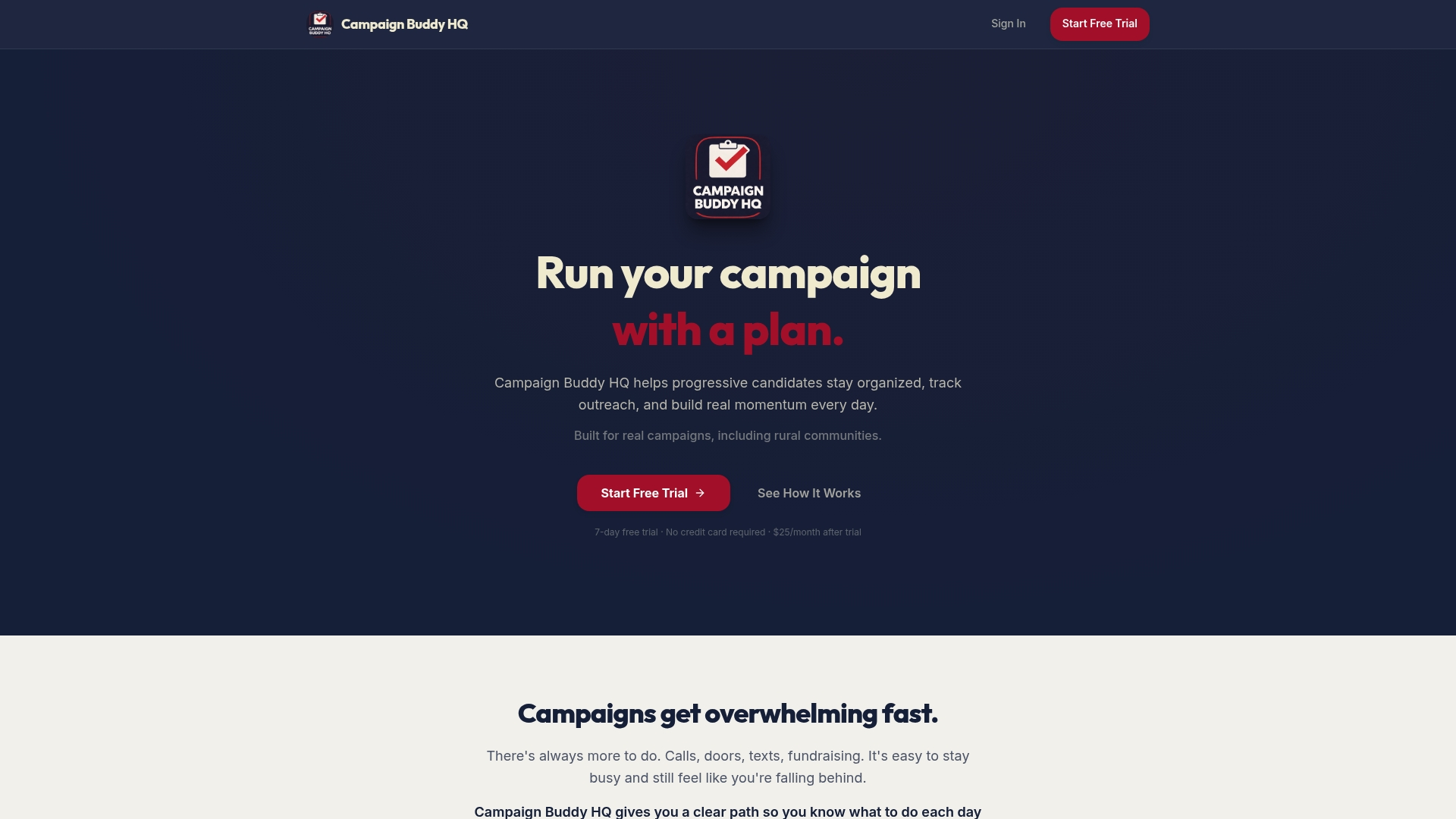
Campaign Buddy HQ integrates outreach tracking, supporter data management, and campaign reporting in one interface designed for progressive campaigns and issue advocacy groups. You can log calls, texts, doors, and registrations in real time, monitor progress by campaign phase, and give your volunteers a daily plan that keeps everyone moving in the same direction. The platform is built for campaigns that cannot afford to waste a single contact or lose track of a committed supporter. Start your free 7-day trial today, no credit card required, and see how organized outreach changes your results.
FAQ
What is the role of technology in political campaigns?
Technology in political campaigns covers AI-powered content creation, voter data analysis, outreach tracking, and operational automation. The primary impact is on internal efficiency, with nearly 90% of campaign AI use focused on backstage operations like research, monitoring, and drafting.
How do campaigns use AI for voter targeting?
Campaigns use AI to segment voter files by persuadability, issue priority, and turnout likelihood, then deploy personalized texts, emails, and social ads to each segment. Agentic AI tools can now autonomously trigger follow-up sequences based on voter responses.
Are there legal requirements for AI disclosure in political campaigns?
Yes. 26 U.S. states have enacted laws regulating AI-generated political content, particularly deepfakes. Campaigns should maintain a written AI use policy and apply disclosure language to all voter-facing AI content to stay compliant across jurisdictions.
What is Answer Engine Optimization and why does it matter for campaigns?
Answer Engine Optimization (AEO) is the practice of structuring campaign content so AI assistants like ChatGPT and Claude accurately represent the candidate when voters ask questions. Campaigns that ignore AEO risk having AI tools surface outdated or inaccurate information about their candidate.
How many AI tools should a campaign use?
Research recommends focusing on three to five high-impact AI workflows rather than adopting many overlapping tools. Targeted adoption produces better automation, clearer staff training, and stronger decision-making than broad tool accumulation.