

Campaign reporting is the systematic process of collecting, analyzing, and presenting data on a campaign's activities, finances, and outcomes to measure effectiveness and guide decisions. For political teams and activists, it covers everything from FEC disclosure filings to digital outreach metrics like doors knocked and calls completed. Without structured reporting, 67% of marketers lose money to wasted ad spend and misdirected effort. That number reflects a broader truth: campaigns that track nothing optimize nothing. Campaignbuddyhq was built specifically to close that gap for grassroots and political teams.
What is campaign reporting and why does it matter?
Campaign reporting is the formal practice of documenting, measuring, and communicating what a campaign is doing and whether it is working. In political contexts, this includes both legal compliance reporting to bodies like the Federal Election Commission and internal performance tracking across outreach channels. In advocacy and issue campaigns, it means showing donors, volunteers, and leadership exactly where resources went and what they produced.
The importance of campaign reporting goes beyond accountability. Effective reports show performance vs. goals, explain the reasons behind results, and define the next steps. That three-part structure transforms raw data into a decision-making tool. A campaign manager who can say "we hit 80% of our door-knocking goal but only 40% of our call goal, and here is why" is in a fundamentally stronger position than one who simply logs activity.

Good reporting also builds trust. Donors want to know their money is being used well. Volunteers want to see that their time matters. Stakeholders at every level respond better to campaigns that communicate clearly and consistently. Reporting is the mechanism that makes that communication possible.
What are the core campaign reporting metrics and why do they matter?
Campaign performance analysis depends on choosing the right metrics. The wrong ones create a false picture of success. The right ones reveal exactly where to invest more and where to pull back.
For digital advertising campaigns, the five metrics that matter most are cost per click (CPC), click-through rate (CTR), cost per acquisition (CPA), return on ad spend (ROAS), and conversion rate. Inadequate measurement wastes 15 to 25% of ad spend, which means even a modest digital budget suffers real losses without proper tracking. Each metric tells a different part of the story.
| Metric | What it measures | Why it matters |
|---|---|---|
| CTR (Click-Through Rate) | Percentage of viewers who click an ad | Indicates message relevance and creative effectiveness |
| CPC (Cost Per Click) | Average cost for each click | Controls budget efficiency on paid channels |
| CPA (Cost Per Acquisition) | Cost to convert one supporter or donor | Reveals true cost of results, not just activity |
| ROAS (Return on Ad Spend) | Revenue or value generated per dollar spent | Measures overall financial return on digital investment |
| Conversion Rate | Percentage of visitors who take a desired action | Shows how well landing pages and messaging perform |
For political and grassroots campaigns, the list of campaign reporting metrics shifts. Doors knocked per hour, contact rate, volunteer retention, and voter registration completions matter more than ROAS. The principle stays the same: track what connects to your actual goal, not what is easiest to count.
Pro Tip: Build your metrics list before the campaign launches, not after. Decide what a "win" looks like for each channel, then set up tracking to measure exactly that. Retrofitting metrics to existing data almost always produces misleading conclusions.
What are the different types of campaign reports?
The types of campaign reporting fall into three broad categories: compliance reports, performance analysis reports, and stakeholder communication reports. Each serves a distinct purpose and audience.
Compliance reports are legal documents. For federal political committees, these include FEC disclosure filings that must be submitted when a committee crosses $1,000 in aggregate contributions or expenditures. They document donor identities, contribution amounts, and expenditure categories. Nonprofits file IRS Form 990 instead, which carries less public disclosure but still requires accurate financial categorization.
Performance analysis reports are internal tools. They compare actual results against targets, identify trends across time periods, and flag channels that are underperforming. A weekly canvassing report that shows contact rates by neighborhood is a performance analysis report. So is a monthly digital advertising summary that breaks down CPA by audience segment.
Stakeholder communication reports are external-facing. They translate raw data into narrative form for donors, board members, or coalition partners. These reports prioritize clarity over completeness. A major donor does not need a spreadsheet of every expenditure. They need a clear story about impact.
- Compliance reports: FEC filings, IRS Form 990, state-level disclosure documents
- Performance analysis reports: Weekly outreach summaries, digital ad dashboards, A/B test results
- Stakeholder reports: Donor impact letters, board presentations, end-of-campaign summaries
Reporting frequency also varies by type. FEC reports are due quarterly, or monthly for high-activity committees during election years. Performance reports work best on a weekly cycle. Stakeholder reports typically go out monthly or at major campaign milestones.
How do legal and compliance requirements shape campaign reporting in 2026?
Federal compliance reporting is one of the most consequential and least forgiving parts of running a political campaign. The rules are specific, the deadlines are fixed, and the penalties for errors are real.
Here is what every campaign treasurer needs to know for 2026:
- Disclosure thresholds: Federal political committees must report contributions over $200 per donor. The federal contribution limit is $3,300 per election in 2026, and any amount above that triggers a compliance issue regardless of intent.
- Filing deadlines: Reports are due quarterly in non-election years and monthly for high-activity committees during election cycles. Missing a deadline triggers automatic review.
- Expenditure classification: Misclassified expenditures and donor attribution errors are the most common audit triggers. In-kind contributions are especially prone to misvaluation. A volunteer who provides printing services worth $500 must be logged at fair market value, not ignored.
- Donor verification: Proactively verifying donor limits before accepting contributions prevents compounding errors that become expensive to unwind later.
- Record retention: Keep all financial records, bank statements, and donor documentation for at least three years. FEC audits can reach back further for serious violations.
The difference between candidate committees and nonprofits matters here. Candidate committees operate under strict FEC rules with full public disclosure. Nonprofits file IRS Form 990, which is public but less granular. Advocacy groups organized as 501(c)(4) entities face their own disclosure rules depending on the level of political activity they conduct.
Pro Tip: Use cloud-based financial software that timestamps every transaction entry. If the FEC questions a filing, a clear audit trail with dated records is your strongest defense. Paper logs and spreadsheets create gaps that are hard to explain under scrutiny.
How do you turn campaign data into decisions?
Dashboards show real-time data, but true reports require manual synthesis to explain why numbers changed. That distinction separates teams that react from teams that strategize. A dashboard tells you that your call contact rate dropped 12% this week. A report tells you it dropped because you shifted to a new phone banking script that volunteers found confusing, and here is how to fix it.
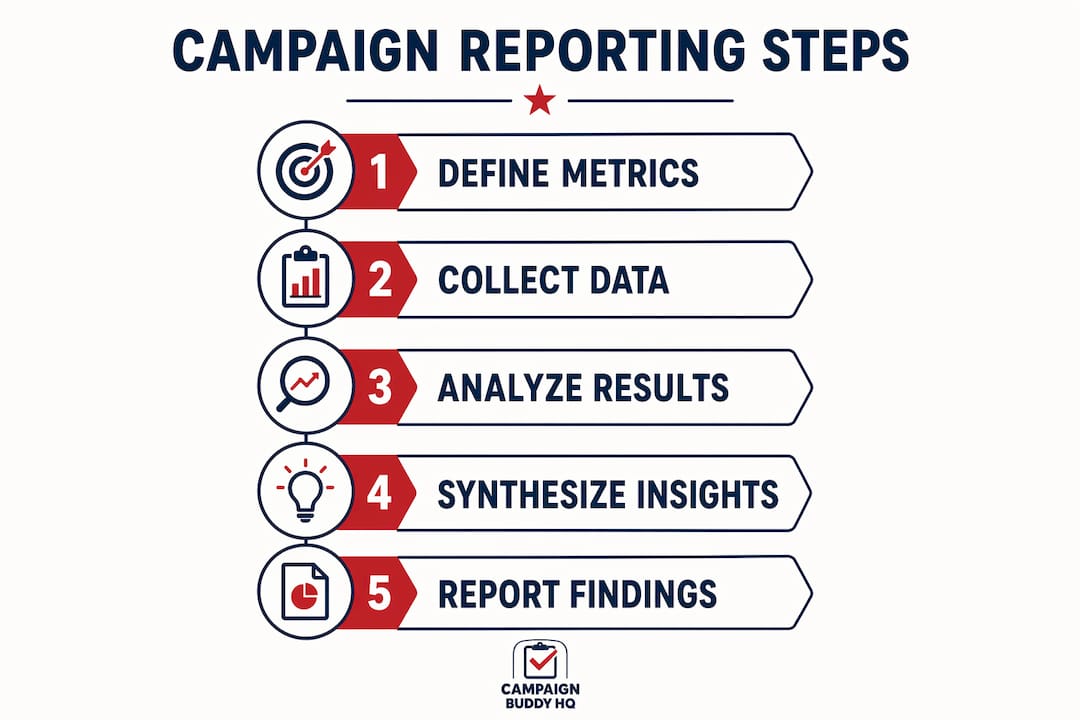
The process for turning data into decisions follows a clear sequence. First, compare results against the goals you set before the campaign started. Second, identify the two or three metrics that moved most significantly, in either direction. Third, look for the cause behind each movement. Fourth, define a specific next step: scale what worked, pause what did not, and retarget audiences that showed partial engagement.
The most common mistake in campaign performance analysis is fixating on vanity metrics like impressions rather than conversion-focused KPIs. A digital ad that reaches 100,000 people but converts none of them is not a success. It is a signal that the message, the audience, or the offer needs to change. Treating impressions as proof of impact obscures that signal entirely.
Qualitative context matters as much as the numbers. If your canvassing data shows strong contact rates in one precinct and weak rates in another, the explanation might be a local event, a volunteer scheduling gap, or a neighborhood characteristic that the data alone cannot capture. The best campaign data drives results when managers pair it with field observations.
Pro Tip: Write a one-paragraph narrative summary at the top of every performance report. Force yourself to answer three questions: What happened? Why did it happen? What are we doing about it? That discipline alone will improve your team's decision-making speed.
What best practices and tools make reporting more reliable?
Reliable reporting is built on consistent habits, not just good software. The tools matter, but the workflow matters more.
- Daily reconciliation: Experienced campaign managers reconcile bank transactions daily or weekly to avoid last-minute filing crises. Waiting until the deadline to sort through weeks of transactions is where errors multiply.
- Integrated tracking: Use platforms that connect outreach logging, donor management, and financial tracking in one place. Disconnected spreadsheets create version control problems and data gaps.
- Deadline calendars: Build FEC filing deadlines, internal report cycles, and stakeholder update schedules into a shared team calendar at the start of every campaign phase.
- Standardized templates: Create report templates for each audience type before the campaign starts. Consistent formats reduce preparation time and make it easier to spot anomalies across reporting periods.
- Role clarity: Assign one person as the reporting lead for each report type. Shared ownership of reporting almost always means no one owns it.
Effective automation of campaign reporting enables daily monitoring, weekly optimization, and monthly strategic summaries without proportionally increasing staff time. The goal is to reduce the manual hours spent compiling data so your team spends more time acting on it. For teams tracking outreach activities like doors, calls, and texts, platforms like Campaignbuddyhq are built specifically to track campaign activities in real time and surface the numbers you need without manual data entry.
Key takeaways
Campaign reporting works when it combines legal compliance, performance tracking, and stakeholder communication into one consistent practice.
| Point | Details |
|---|---|
| Define metrics before launch | Set specific KPIs for each channel before the campaign starts to avoid retrofitting data. |
| Separate report types by audience | Use compliance reports for regulators, performance reports for internal teams, and narrative reports for donors. |
| Reconcile finances daily or weekly | Routine reconciliation prevents audit flags and last-minute filing errors that compound over time. |
| Contextualize every dashboard | Pair real-time data with written analysis that explains why numbers moved and what to do next. |
| Avoid vanity metrics | Impressions and clicks matter less than CPA, conversion rate, and contact rate for real campaign decisions. |
Why most campaigns report too late and too little
I have worked with enough campaign teams to know the pattern. Reporting gets treated as a task you do after the campaign is over, or right before a deadline forces your hand. The data sits in spreadsheets, the FEC deadline looms, and someone spends a frantic weekend trying to reconstruct three months of transactions. That is not reporting. That is damage control.
The campaigns that actually use their data well treat reporting as a weekly discipline, not a quarterly obligation. They know their contact rates on Monday morning. They know which precincts are underperforming by Wednesday. They adjust before the window closes. That kind of campaign tracking is what separates campaigns that learn from campaigns that just finish.
I also want to push back on the idea that a good dashboard replaces a good report. Dashboards are useful. They are not sufficient. The "why" behind any number requires human judgment, field context, and honest interpretation. I have seen teams stare at a beautiful real-time dashboard and completely miss the fact that their volunteer retention was collapsing because no one wrote the narrative that would have made it obvious. Automate the data collection. Do not automate the thinking.
The other thing I would say is this: your stakeholder reports are a political asset, not just an administrative task. A well-written donor update that shows exactly how their contribution moved the needle is one of the most effective retention tools you have. Treat it that way.
— Billy
How Campaignbuddyhq makes reporting work for your campaign
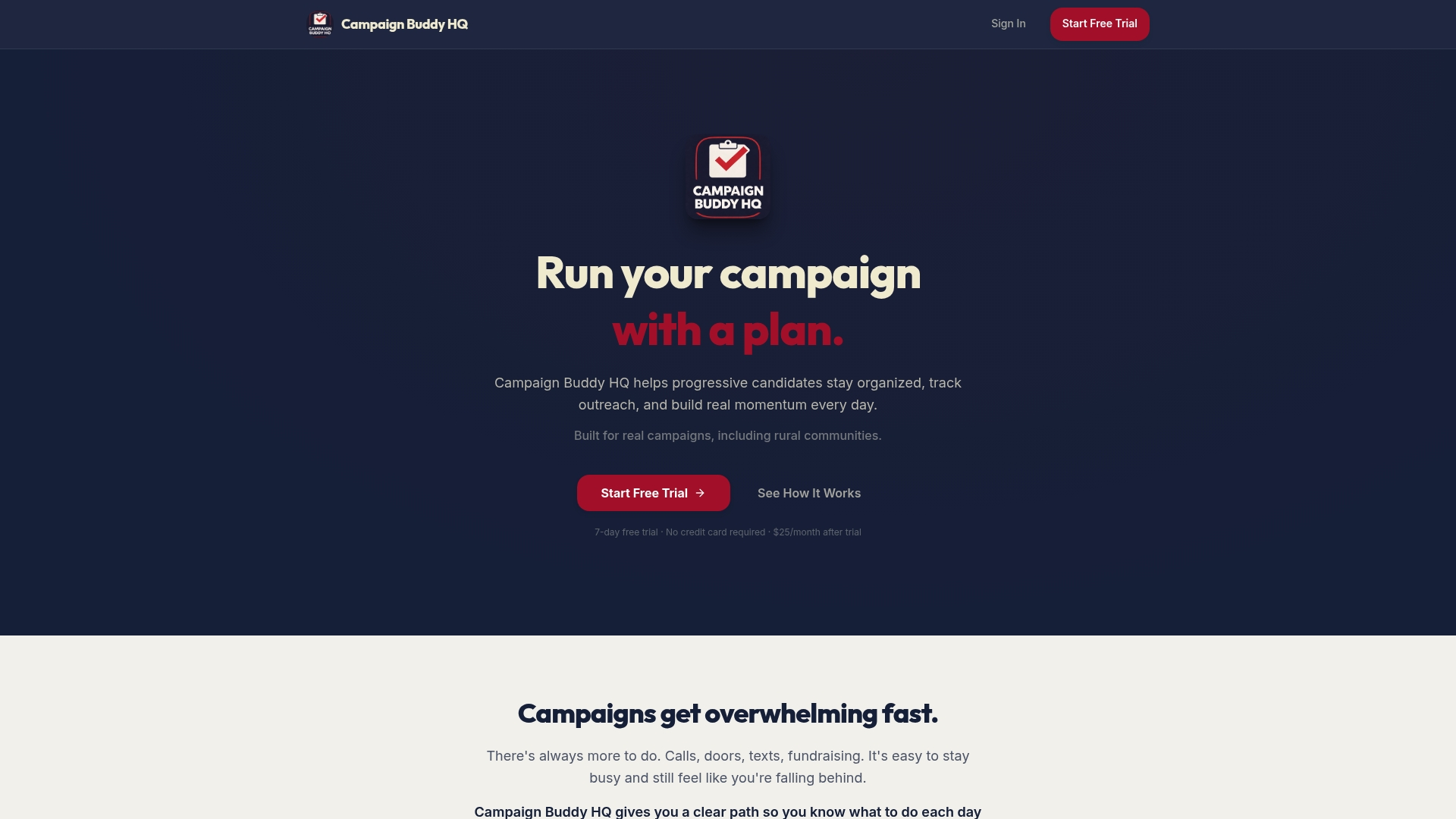
Campaignbuddyhq is built for exactly the kind of reporting discipline this article describes. The platform gives political campaigns, issue advocacy groups, and grassroots organizers a single place to log outreach activities, track progress toward goals, and monitor performance across doors, calls, texts, and registrations in real time. Instead of chasing data across disconnected spreadsheets, your team sees what is working and what needs attention every single day. The campaign management tools at Campaignbuddyhq are designed for real-world campaign conditions, including rural and low-density communities where outreach data is hardest to capture consistently. Start your free 7-day trial with no credit card required.
FAQ
What is campaign reporting in simple terms?
Campaign reporting is the process of tracking, analyzing, and presenting data on a campaign's activities and results to measure progress and guide decisions. It covers both legal compliance filings and internal performance measurement.
What metrics should a campaign report include?
A strong campaign report includes outreach metrics like contact rate and doors knocked alongside financial metrics like cost per acquisition and conversion rate. The specific list depends on whether the campaign is political, digital, or advocacy-focused.
How often should campaign reports be filed or reviewed?
Compliance reports for federal political committees are due quarterly, or monthly for high-activity committees during election years. Internal performance reports work best on a weekly review cycle to allow timely adjustments.
What is the most common campaign reporting mistake?
Focusing on vanity metrics like impressions instead of conversion-focused KPIs is the most common error. It creates a false sense of progress while hiding the metrics that actually reflect campaign health.
Do nonprofits and candidate committees report differently?
Yes. Candidate committees file FEC disclosures with full public transparency, while nonprofits use IRS Form 990, which has less granular public disclosure. The reporting obligations differ significantly in format, frequency, and the level of detail required.