

A campaign headquarters is the central hub where every voter contact, volunteer shift, and strategic decision connects. Getting the setup right separates campaigns that build momentum from those that stall after the first week. This campaign headquarters setup guide covers the full arc: from securing your space and assembling your team to choosing digital tools and running your operation through election day. Campaign managers who treat their HQ as both a physical and digital command center consistently outperform those who treat it as just an office.
What does a campaign headquarters setup guide actually cover?
A campaign headquarters, often called a campaign HQ or command center, is the physical and digital base from which all campaign activities are coordinated. The term "campaign office" is the standard industry label, but modern setups extend far beyond four walls. Your HQ is where volunteer schedules are built, voter data is managed, outreach is tracked, and daily priorities are set.
The most effective HQ setup integrates three elements: a defined physical space, a digital infrastructure for data and communication, and a clear team structure with assigned roles. Campaigns that skip any one of these three elements tend to hit the same problems: volunteers who show up without direction, data that lives in disconnected spreadsheets, and managers who spend their days firefighting instead of leading.

Campaignbuddyhq is built around exactly this model. It gives campaign managers a single platform to log outreach activity, track supporter data, and plan daily and weekly operations, whether the team is working from a storefront office or a hybrid remote setup.
What prerequisites do you need before setting up a campaign HQ?
Securing your space early
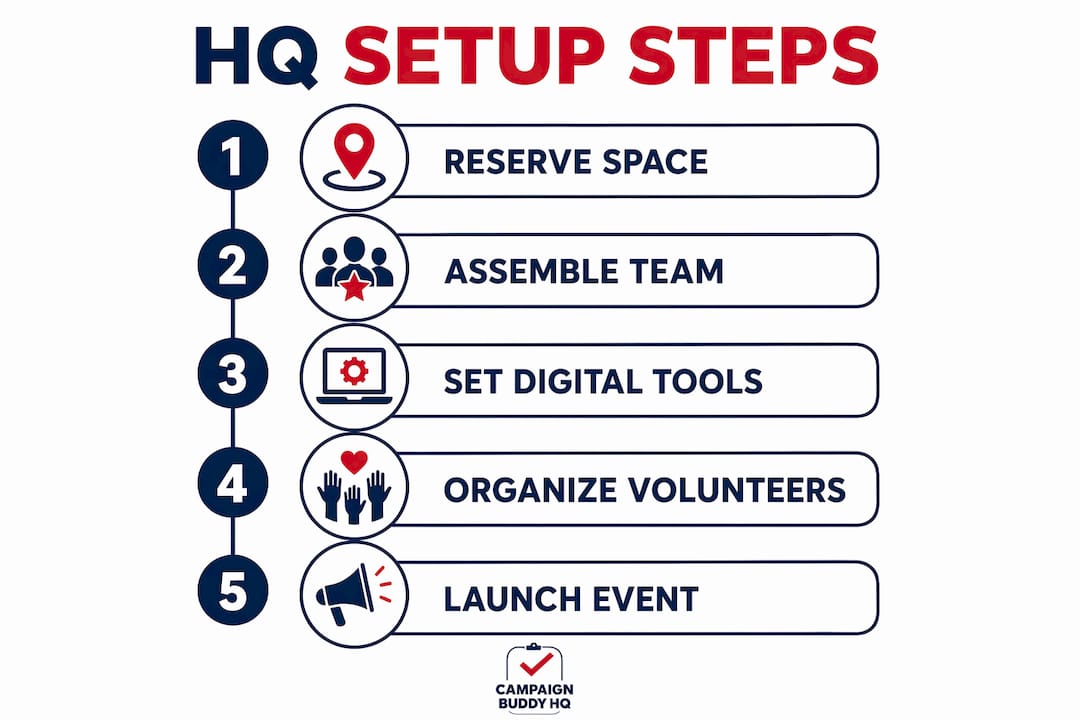
Reserve your campaign office and launch venue at least 4–6 weeks before your official announcement. That timeline gives you room to handle permits, furniture, internet installation, and signage without rushing. Campaigns that skip this step often find themselves launching from a borrowed conference room with no reliable Wi-Fi.
Your venue size depends on your team and district. A local city council race may need only a single room with six workstations. A statewide campaign needs dedicated zones for phone banking, data entry, volunteer check-in, and staff meetings. When evaluating venue options for your launch, prioritize parking access, public transit proximity, and ADA compliance.
Pro Tip: Negotiate a month-to-month lease if possible. Campaign timelines shift, and locking into a 12-month lease for a 6-month race is a common and expensive mistake.
Assembling the right team before day one
Your core team needs to be in place before the HQ opens. The four roles that every campaign needs from the start are a campaign manager, a finance chair, a volunteer coordinator, and a communications lead. Each role has a distinct function, and understanding those distinctions prevents overlap and dropped tasks.
| Resource Type | Minimum Requirement | Notes |
|---|---|---|
| Venue size | 400–600 sq ft for small races | Scale up for larger districts |
| Internet | Dedicated business-grade connection | Consumer plans fail under team load |
| Staffing | 4 core roles filled before launch | Manager, finance, volunteers, comms |
| Digital tools | Data platform, scheduling, communication | Replace spreadsheets from day one |
Physical vs. hybrid HQ models
A hybrid HQ model blending essential physical presence with a strong digital command center offers flexibility, lowers costs, and improves security. Rural campaigns especially benefit from hybrid setups, where volunteers in distant precincts can log activity remotely while the core team operates from a central location. The key is that your digital infrastructure must be in place before you go hybrid. A hybrid model without a shared data platform is just a disorganized remote team.
How do you organize your HQ for daily operations and volunteer management?
Building a volunteer system that holds
Volunteer retention improves significantly when new volunteers are paired with experienced mentors and when meetings follow a predictable schedule. Campaigns that run ad hoc volunteer sessions see high turnover. Campaigns that hold weekly check-ins at the same time, with the same format, build a culture of reliability.
A layered volunteer management system works best. Use digital scheduling tools to assign shifts, pair new recruits with veteran volunteers for their first three contacts, and hold brief debrief sessions after each major canvassing push. Campaignbuddyhq supports this workflow by letting coordinators log outreach activity in real time and track each volunteer's progress toward weekly goals.
- Set a fixed weekly volunteer meeting time and protect it.
- Assign every new volunteer a mentor for their first two weeks.
- Use a shared digital platform to post shift schedules and task assignments.
- Hold a 10-minute debrief after every major canvassing or phone bank session.
- Recognize top volunteers publicly at weekly meetings.
Pro Tip: Providing food and drinks to returning volunteers is not a luxury. It directly reduces turnover by addressing the psychological need for care and community after a demanding shift.
Physical HQ setup for morale and security
The physical layout of your HQ sends a message to every volunteer who walks in. A clean, organized space with clear signage, a check-in table, and a hospitality station signals that the campaign is run well. A cluttered room with no clear entry point signals chaos.
Data security in a physical office requires specific protocols. Paper voter lists left in vehicles or public spaces cause severe security incidents. Every paper list that leaves the HQ needs a check-out log with the volunteer's name, the list ID, and the expected return time. When lists come back, they go directly into a locked cabinet, not a desk drawer.
What digital tools are critical for a unified campaign HQ toolkit?
Technology-driven toolkits replace fragmented spreadsheets and give campaigns the ability to adapt and scale as the team grows. The core toolkit for any campaign HQ covers four categories: voter and supporter data management, volunteer scheduling and task assignment, team communication, and outreach tracking.
Core tool categories
- Voter data platform: Stores supporter records, contact history, and canvassing results. Every volunteer interaction should feed back into this system.
- Scheduling and task management: Assigns shifts, tracks completion, and flags gaps in coverage. Spreadsheets fail here once your volunteer count exceeds 20.
- Team communication: A shared channel for staff and a separate channel for volunteers prevents message overload. Keep campaign-sensitive information out of personal text threads.
- Outreach tracking: Logs doors knocked, calls made, texts sent, and registrations completed. Campaignbuddyhq handles this natively, including support for rural and low-density canvassing routes.
Scaling your toolkit as the campaign grows
Start with the minimum viable toolkit and add tools only when a specific gap appears. Regular monitoring and optimization of your toolkit based on team feedback and data analysis improves operational effectiveness over time. A tool that works for a 10-person team may need to be replaced or supplemented at 50 people. Build that review into your monthly operations check. For deeper guidance on tracking outreach activities efficiently, the process matters as much as the platform.
| Tool Category | Entry-Level Option | Enterprise-Level Option |
|---|---|---|
| Voter data | Basic CRM or spreadsheet | Dedicated voter file platform |
| Scheduling | Shared calendar | Full volunteer management system |
| Communication | Group messaging app | Tiered staff and volunteer channels |
| Outreach tracking | Manual log sheets | Integrated platform like Campaignbuddyhq |
How do you launch and maintain your campaign HQ through election day?
Pre-launch steps
A structured campaign timeline with defined milestones improves organization and results. The pre-launch phase covers website readiness, venue reservation, invitation list preparation, press contact outreach, and endorsement collection. Each of these tasks has a dependency. Your website must be live before you send press invitations. Your venue must be confirmed before you print launch event materials.
- Confirm venue and sign lease or agreement.
- Set up your website and digital donation page.
- Build your press contact and endorser lists.
- Finalize your core team and assign HQ roles.
- Send launch event invitations with at least two weeks' notice.
Launch event and follow-up
Your launch event sets the tone for volunteer culture. Keep it focused: a brief candidate speech, a clear ask for volunteer commitments, and a sign-up process that takes less than two minutes. Follow up with every attendee within 48 hours. Campaigns that wait a week to follow up lose half their launch momentum.
Maintaining momentum through GOTV
The final phase of your HQ operation shifts from recruitment and training to execution and turnout. Get-Out-The-Vote (GOTV) coordination requires tighter shift scheduling, faster data turnaround, and more frequent team check-ins. Reduce your volunteer meeting cadence from weekly to daily in the final two weeks. Every shift report should feed back into your outreach tracker before the next shift begins. Building campaign infrastructure that holds up under this pressure is what separates well-prepared campaigns from those that scramble at the end.
Key Takeaways
A well-built campaign headquarters combines a secured physical space, a digital command center, and a structured volunteer system to drive consistent voter outreach from launch through election day.
| Point | Details |
|---|---|
| Reserve space early | Book your office and launch venue 4–6 weeks before your announcement. |
| Build the core team first | Fill manager, finance, volunteer, and communications roles before opening day. |
| Prioritize digital infrastructure | Set up your data and outreach tracking platform before investing in physical upgrades. |
| Protect paper voter data | Use check-out logs and locked storage for all paper lists leaving the HQ. |
| Maintain volunteer morale | Pair new volunteers with mentors, hold regular meetings, and provide hospitality after shifts. |
What I've learned from watching campaigns get their HQ wrong
Most campaign managers I've worked with spend the first two weeks of a campaign arguing about furniture and signage. The physical office feels tangible and controllable, so it gets attention. The digital infrastructure, which actually determines whether the campaign can scale, gets deferred. By the time the team realizes the data is a mess, they've already lost three weeks of clean outreach records.
The other mistake I see constantly is treating volunteers as free labor rather than as the campaign's most valuable asset. Volunteer morale, driven by clear communication and genuine social connection, often determines HQ success more than any tool or system. A volunteer who feels seen and appreciated will recruit two more. A volunteer who shows up to a disorganized office with no food and no clear task will not come back.
The hybrid model is the right default for most campaigns in 2026. A small physical anchor point for in-person coordination, combined with a solid digital platform for remote volunteers and data management, gives you flexibility without sacrificing accountability. The campaigns I've seen struggle most are the ones that went fully remote without a shared platform, or fully physical without any digital tracking. Neither extreme works.
Start earlier than you think you need to. Build the digital layer first. Feed your volunteers. Those three things will carry you further than any amount of office furniture.
— Billy
Campaignbuddyhq: your campaign HQ in one platform
Running a campaign headquarters means managing dozens of moving parts at once. Campaignbuddyhq brings volunteer coordination, outreach tracking, supporter data, and daily planning into a single platform built for real-world campaign conditions, including rural districts and low-density canvassing routes.
Campaign managers use Campaignbuddyhq to log doors knocked, calls made, and texts sent, then review progress against weekly goals without digging through spreadsheets. The platform supports every phase of the campaign, from pre-launch setup through GOTV. A free 7-day trial requires no credit card, so you can test it against your actual workflow before committing.
FAQ
What is a campaign headquarters?
A campaign headquarters is the central physical and digital base where a political campaign coordinates volunteer activity, manages voter data, and directs outreach operations. Modern HQs combine a physical office with a digital command center for remote coordination.
How early should I set up my campaign office?
Reserve your campaign office at least 4–6 weeks before your official announcement to allow time for logistics, internet setup, and team onboarding.
What are the most critical digital tools for a campaign HQ?
Every campaign HQ needs a voter data platform, a volunteer scheduling system, a team communication channel, and an outreach tracker. Platforms like Campaignbuddyhq integrate these functions into a single tool.
How do I keep volunteers engaged at the campaign HQ?
Pair new volunteers with experienced mentors, hold meetings on a predictable schedule, and provide food and drinks after shifts. Structured mentorship and consistent communication drive long-term volunteer retention.
How do I protect voter data at a physical campaign office?
Use a check-out log for every paper list that leaves the office, require volunteers to return lists directly to a locked cabinet, and train all staff on data handling protocols before their first shift.