
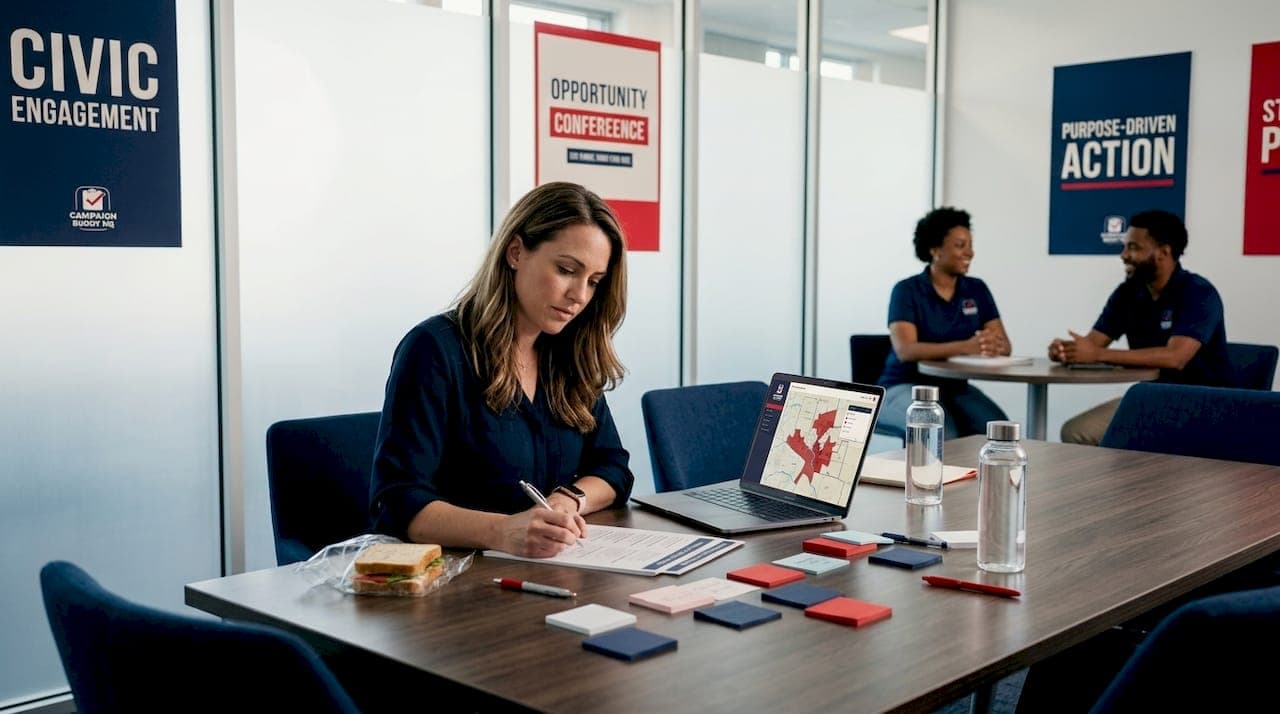
Most political campaigns don't lose on strategy. They lose on logistics. Explaining campaign logistics clearly is one of the most underrated skills a campaign manager can develop, because the gap between a winning plan and a winning result almost always comes down to execution. You can have the best polling data, the sharpest messaging, and the most motivated candidate on the ballot. But if your yard signs are stuck in a warehouse two counties away, your volunteers don't know where to report, and nobody has authority to approve an emergency supply run, none of that matters. This guide gives you the frameworks to fix that before it costs you.
Table of Contents
- Key Takeaways
- What campaign logistics actually covers
- Strategic planning and risk management
- Operational execution: coordinating volunteers and materials
- Navigating disruptions and staying crisis-ready
- My take on why logistics discipline wins campaigns
- Build your logistics foundation with Campaignbuddyhq
- FAQ
Key Takeaways
| Point | Details |
|---|---|
| Logistics shapes outcomes | Most campaign failures trace back to coordination breakdowns, not bad strategy or weak messaging. |
| Plan contingencies before crises | Build fallback systems and pre-approved triggers before disruptions occur, not while managing them. |
| Decentralize your materials | Store yard signs and literature at local offices to prevent distribution bottlenecks during transport failures. |
| Authority structures matter | Clear approval chains let field staff act fast without waiting on decisions that should be pre-delegated. |
| Use data to drive decisions | Tracking outreach activities and inventory in real time prevents last-minute chaos and wasted resources. |
What campaign logistics actually covers
A lot of campaign managers hear "logistics" and think it just means ordering yard signs and booking venues. The real scope is much wider. Campaign logistics management covers every system and process that moves people, materials, and information to the right place at the right time throughout the life of your campaign.
The core components include:
- Supply chain management: Sourcing and distributing printed materials, branded merchandise, technology equipment, and voter contact tools
- Volunteer coordination: Recruiting, scheduling, training, and deploying people across precincts and events
- Event logistics: Site scouting, permitting, setup, crowd management, and teardown for rallies, canvasses, and town halls
- Communication flows: Establishing who talks to whom, through what channels, and under what authority at every level of the organization
- Data and reporting systems: Tracking doors knocked, calls made, texts sent, registrations completed, and progress toward goal
Understanding campaign logistics also means getting fluent with the "5 P's" framework that experienced field directors use: Planning, Procurement, Production, Placement, and Performance. Planning sets the timeline and resource requirements. Procurement secures those resources at the right cost and time. Production prepares materials and trains volunteers. Placement puts everything where it needs to be. Performance measures whether it actually worked. Miss any one of these, and the others start to break down.
Pro Tip: Build your logistics overview before you build your voter contact plan. If you don't know what you can physically deliver, your outreach targets are fiction.
Strategic planning and risk management
The best time to plan for a logistics failure is when nothing has gone wrong yet. Building logistics contingency systems proactively rather than during crises is one of the most consistent lessons from experienced campaign planners. That means creating pre-approved fallback budgets, alternative vendor contacts, and decision rules before you ever need them.
One practical framework uses a risk assessment score for each geographic market or district you're working. Score each area from 1 to 5 across categories like inventory depth, transportation infrastructure, staff concentration, and voter density. A market scoring 16 to 20 on that scale needs immediate contingency action. A score of 10 to 15 warrants a partial fallback plan. Anything below 10 can operate with standard procedures.
Here's what those tiers look like in practice:
- Tier 1 (score 16 to 20): Activate backup vendor contracts, shift volunteer deployment from the affected area, and notify regional leadership of potential supply gaps within 24 hours
- Tier 2 (score 10 to 15): Pre-position additional materials in adjacent counties, identify alternate transportation routes, and flag the district for elevated monitoring
- Tier 3 (score below 10): Standard operations with weekly review of inventory levels and volunteer commitment rates
Another critical piece of campaign logistics management is building micro-inventories. Effective logistics requires county-level micro-inventories to prevent the kind of bottleneck that happens when everything is stored at one central location and a single transportation failure cuts off three districts at once. Store enough yard signs, door hangers, and canvassing materials at local offices to run at least two weeks of operations independently.
Your campaign also needs emergency purchase authority and petty cash funds for fuel, lodging, and expedited shipping. Price spikes and last-minute costs are not rare edge cases. They happen in almost every competitive campaign. Pre-approving spending up to a defined threshold at the regional or county level eliminates the approval delays that turn manageable problems into campaign-day disasters.
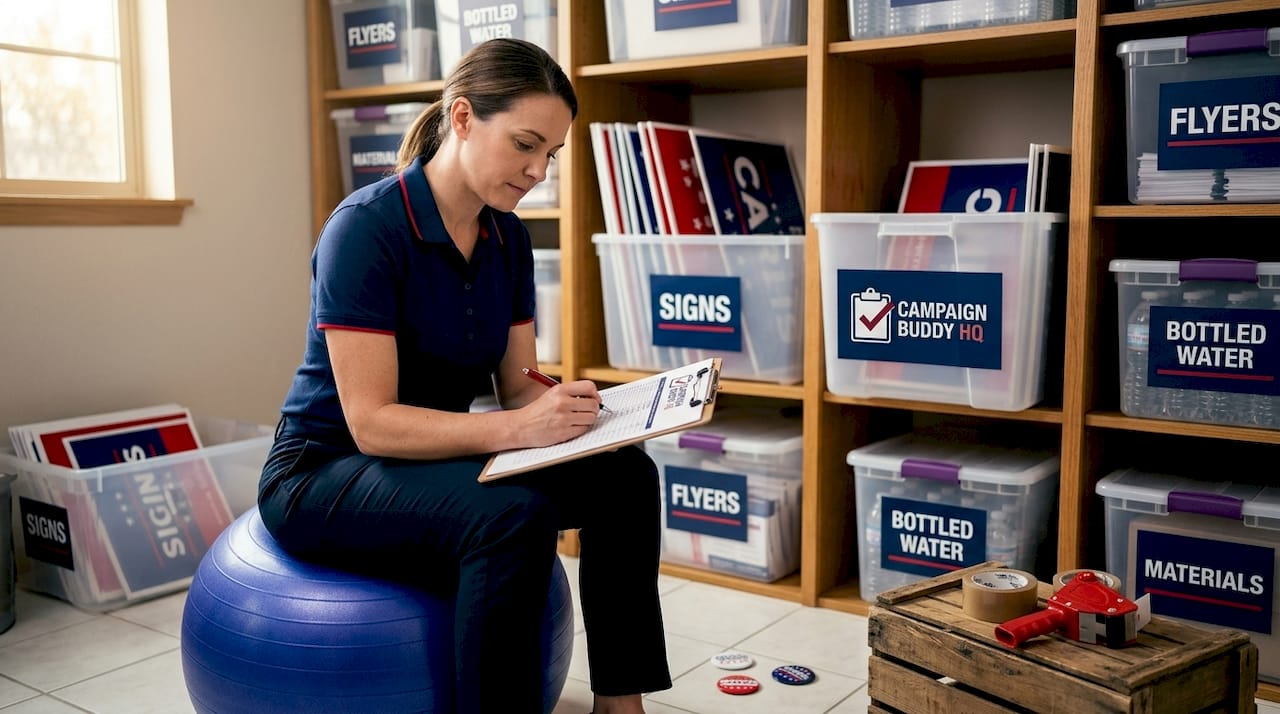
Pro Tip: Give your county captains a printed one-page "disruption card" that lists their pre-approved spending limit, the backup vendor phone numbers, and the three trigger conditions that activate their fallback plan. They should never have to search for this information during a crisis.
Operational execution: coordinating volunteers and materials
Effective campaign planning and logistics depends on having the right people operating at every layer of your field organization. Your field director sets strategy. Your regional organizers translate that into weekly priorities. Your precinct captains execute it door by door. When those layers aren't synchronized, even the best logistics plan falls apart at the last mile.
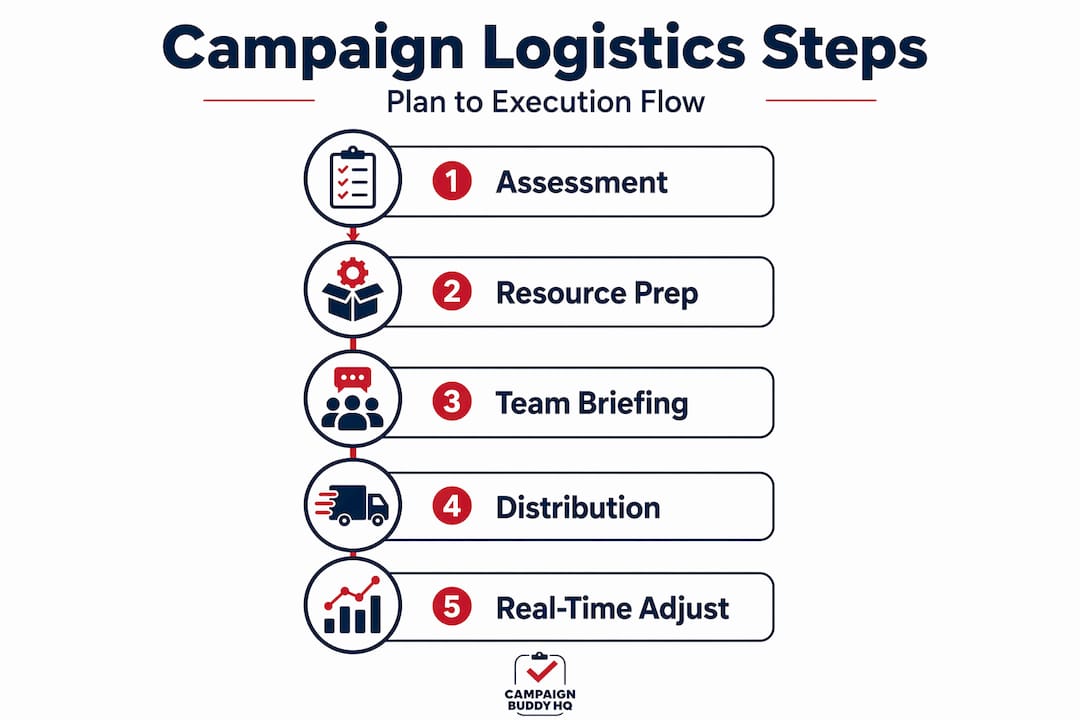
Advance teams are a good example of a logistics function that campaigns frequently underestimate. Advance work scouting locations and event logistics requires independent judgment and the ability to make on-site decisions without constant supervision. It's often assigned to junior staff, which can work well if those people are given real authority and clear briefing documents. What kills events is the combination of under-briefed staff and no decision-making power.
For volunteer management, a few operational details make a significant difference:
- Create commuter kits with maps, contact lists, materials checklists, and a brief role description for every volunteer shift. Volunteers facing transit disruptions are significantly more likely to stay committed when they feel prepared rather than abandoned.
- Use geo-inventory mapping to assign volunteers to the nearest supply cache rather than routing everyone back to campaign headquarters for materials
- Build a training ladder so volunteers with three or more shifts can quickly onboard newer volunteers, reducing your staff's direct training burden on high-activity days
- Establish clear approval workflows by documenting who can authorize a supply reorder, who can cancel a canvass, and who has authority to reassign volunteers across precincts
The role of data in logistics decisions is not just about reporting after the fact. When you're logging doors, calls, and texts in real time, you can spot a district that's falling behind its contact goal on Wednesday and redirect resources before it's too late to recover by Sunday.
Navigating disruptions and staying crisis-ready
Every campaign will face at least one significant logistical disruption. Weather, transportation failures, a venue cancellation, a sudden spike in demand for materials in a contested district. Effective campaign logistics means having a response structure that doesn't require starting from scratch every time something goes wrong.
The key is tiered response scenarios with clear activation procedures:
- Define your disruption categories: weather events, supply shortages, volunteer shortfalls, communication failures, and regulatory changes each require a different response pathway
- Assign ownership: each disruption category should have a named owner on your staff who activates the response plan, not just whoever happens to notice the problem first
- Pre-write your messaging variants: when a canvass is canceled or an event is relocated, you need to notify supporters immediately. Local messaging that addresses disruptions transparently maintains supporter trust in ways that silence and vague delays do not.
- Review and adjust spending: if regional supply constraints develop, consider reducing acquisition spend in affected areas. Cutting paid social spend by 30% when stock falls below 14 days of demand is a tested trigger point that balances outreach momentum against operational reality.
- Conduct post-event debriefs: every disruption is a logistics audit. Document what triggered the response, what worked, and what the plan should have included.
The KPIs that matter most for logistics resilience are: volunteer fulfillment rate by precinct, materials availability by district, average response time from trigger to action, and days of supply on hand at each local office. If you track these weekly, you'll never be caught by surprise.
Pro Tip: Set your trigger thresholds conservatively. If 14 days of supply feels safe, act at 18. The cost of acting early is almost always lower than the cost of scrambling late.
My take on why logistics discipline wins campaigns
I've spent enough time watching campaigns collapse in the final stretch to have a clear opinion on this. Campaign failures are organizational problems. Most of the campaigns I've seen lose did not lose because they had bad data or wrong assumptions. They lost because they couldn't translate what they knew into coordinated action on the ground.
Information is genuinely valuable. Knowing which precincts are persuadable, which doors have soft supporters, which neighborhoods trend toward late turnout decisions. That intelligence shapes everything. But execution remains the hardest part of running any political operation, and having good data doesn't make logistics easier. It just makes the gap between knowing and doing more visible.
What I've found works is treating logistics infrastructure as campaign infrastructure. Not a support function. Not something you figure out once you have the strategy locked. If you don't know what your volunteers can physically accomplish, what your supply chain can support, and what your approval structure can handle under pressure, your strategy is built on assumptions that will eventually fail you.
Invest early. Build the authority chains before you need them. Put someone with real organizational discipline in charge of logistics from week one. That investment pays back on Election Day in ways no additional data purchase ever will.
— Billy
Build your logistics foundation with Campaignbuddyhq
Managing campaign logistics across volunteers, materials, outreach activities, and geographic districts is a lot to track manually. Campaignbuddyhq was built specifically for this kind of work. The platform lets you log doors, calls, texts, and registrations in real time, track progress toward daily and weekly goals, manage supporter data, and keep your entire field operation moving from a single organized system.
Whether you're running a rural district race with 20 volunteers or a multi-county operation with rotating shifts, Campaignbuddyhq gives you the structure to run effective campaign outreach without the chaos that comes from spreadsheets and disconnected tools. You can also explore volunteer strategy resources to build out your field coordination alongside your logistics systems. Start your free 7-day trial today. No credit card required.
FAQ
What does campaign logistics include?
Campaign logistics covers every system that moves people, materials, and information to the right place at the right time. This includes supply chains, volunteer coordination, event planning, communication structures, and outreach tracking.
Why do campaigns fail at logistics?
Most campaign failures trace back to organizational breakdowns rather than bad strategy. Campaigns often have good information but lack the field operations discipline to translate that into coordinated action on the ground.
How do you manage campaign logistics effectively?
Effective campaign logistics management requires early planning, decentralized supply storage, clear authority structures, pre-approved contingency triggers, and real-time tracking of outreach activities and material availability across all districts.
What are micro-inventories and why do they matter?
Micro-inventories are local stockpiles of campaign materials stored at county or precinct-level offices rather than at a central warehouse. They prevent distribution bottlenecks when transportation is disrupted and keep field operations running independently.
When should a campaign activate its contingency logistics plan?
Use a risk scoring system to evaluate each geographic market. Markets scoring 16 or higher on a five-category scale warrant immediate contingency action. Markets scoring 10 to 15 need partial fallback measures activated before conditions worsen.