

Campaign infrastructure is the integrated set of systems, workflows, and processes that allow a political campaign to find voters, contact them, and track every interaction from the first knock to election day. Without it, even the best candidate runs on instinct instead of data. The most effective ways to build campaign infrastructure combine technology consolidation, structured intake processes, and adaptable frameworks that respond to real conditions on the ground. This article breaks down nine proven approaches that political candidates and campaign organizers can apply immediately, whether running in a rural county or a competitive urban district.
1. Ways to build campaign infrastructure start with a unified tech stack
Platform sprawl is the single biggest operational threat to a modern campaign. When your SMS tool, email platform, CRM, and voter file all live in separate systems, your team wastes hours on manual exports, file cleaning, and re-uploading data before a single voter gets contacted.
Political organizations are consolidating their communication stack by integrating SMS, email, and voter data into one environment. That integration means a team can move from audience identification to outreach execution without ever leaving the platform. The result is cleaner reporting and faster activation during the high-pressure final weeks of a race.

The risks of poor integration are concrete. Disconnected systems create duplicate records, missed follow-ups, and reporting gaps that make it impossible to know which outreach is actually working. Consolidation fixes all three problems at once.
Pro Tip: Before buying any new tool, map every platform your campaign currently uses. If two tools do the same job, cut one. Fewer logins mean fewer mistakes.
2. Design a structured campaign request and intake process
The intake process is the front door of your campaign infrastructure. Every outreach effort, whether a canvass, a phone bank, or a text blast, should begin with a formal request that captures the campaign type, target audience, messaging goals, channel plan, and success metrics before any work starts.
A mature intake process includes a mandatory review step where a team lead checks for missing elements and sets a realistic timeline. This triage step protects staff capacity. Without it, teams spend hours chasing missing information after a campaign has already launched, which kills momentum and accuracy.
Structured intake also prevents scope creep. When every request is documented upfront, it is far harder for a campaign to quietly expand its goals mid-execution without a formal conversation about resources and timelines.
- Define required fields: campaign type, audience segment, channel, message, and KPIs.
- Route every request through a single intake form before any execution begins.
- Assign a reviewer to flag incomplete submissions within 24 hours.
- Set a written timeline and capacity estimate before approving any campaign.
- Archive all approved requests for post-campaign review and learning.
Pro Tip: Treat your intake form like a legal brief. If a field is blank, the campaign does not move forward. That single rule eliminates most execution errors before they happen.
3. Consolidate voter data and messaging into one environment
Integrated voter data and messaging platforms eliminate file cleaning and re-uploading, two tasks that consume enormous staff time and introduce errors. When your voter file and your outreach tools share the same database, you build and activate audiences immediately.
This matters most during peak pressure periods. In the final two weeks of a race, a team that can pull a targeted list and send a text message in the same platform will always outpace a team that needs three tools and a spreadsheet to do the same job. Speed is a competitive advantage, and unified data is what creates it.
The practical setup requires choosing a platform that natively connects voter file data to outreach channels. If your current CRM requires a CSV export to send an email, that is a structural problem worth solving before the campaign heats up.
4. Build a living, adaptable campaign framework
Campaign infrastructure must be adaptable to different races and able to pivot based on ground realities rather than rigid pre-set systems. A framework that works in a dense urban district will fail in a rural county where door-to-door canvassing covers far fewer households per hour.
Living infrastructure means building systems with modular components. Your voter contact workflow should be separable from your volunteer coordination system, which should be separable from your reporting dashboard. When one component needs to change, you update it without rebuilding everything else.
Experienced field organizers advocate for flexible infrastructure that adapts to specific races and local needs rather than one-size-fits-all solutions. That flexibility shows up in team structure too. A campaign that can redeploy volunteers from phone banking to canvassing based on weekly data has a real operational edge.
- Build modular workflows that can be updated independently.
- Review infrastructure assumptions every two weeks based on field feedback.
- Document what is working and what is not after each major outreach push.
- Allow team leads to propose structural changes without bureaucratic delays.
5. Enforce a consistent campaign taxonomy
Well-designed campaign taxonomy enforces consistent tagging across every campaign dimension: type, channel, audience segment, funnel stage, and fiscal period. Without that discipline, even the best analytics tools cannot produce useful reports.
Taxonomy is not glamorous work, but it is the foundation of every insight your campaign will ever generate. If one organizer tags a door-knock event as "canvass" and another tags it as "field outreach," your data is already broken. Standardized naming conventions, enforced from day one, prevent that problem entirely.
The practical approach is to create a master taxonomy document and make it part of every new staff member's onboarding. Every campaign activity gets tagged before it launches, not after. Post-launch tagging is almost always incomplete and inconsistent.
| Taxonomy dimension | Why it matters |
|---|---|
| Campaign type | Separates canvassing, phone banking, and digital outreach in reports |
| Audience segment | Tracks which voter groups are being reached and at what rate |
| Channel | Identifies which contact method drives the highest response |
| Funnel stage | Shows where voters are in the persuasion and mobilization process |
| Fiscal period | Connects outreach activity to budget cycles for accountability |
6. Build a supporter database before you need it
A strong supporter database is not something you build during a campaign. It is something you build before one. Campaigns that start with a clean, segmented list of supporters, volunteers, and persuadable voters have a measurable head start on every outreach goal.
The database should capture contact information, preferred communication channel, volunteer availability, and any prior interaction with the campaign. That last field is the most underused. Knowing that a voter attended a town hall six months ago is far more valuable than knowing only their address.
Maintain the database actively. Remove bad numbers, update addresses after moves, and flag supporters who have gone cold. A clean list of 2,000 engaged contacts outperforms a bloated list of 10,000 unverified records every time.
7. Invest in staff training and onboarding from day one
60% of campaign organizers rated their initial onboarding experience as non-existent to average in a 2024 survey. That number reflects a structural failure, not a personnel one. When staff do not know how to use the tools or follow the workflows, the infrastructure collapses regardless of how well it was designed.
Effective onboarding covers three things: the tools your campaign uses, the workflows those tools support, and the standards for data entry and reporting. All three need to be documented, not just explained verbally in a first-day meeting.
Ongoing training matters as much as initial onboarding. When a new outreach channel gets added or a workflow changes, every team member needs a structured update, not a forwarded email. Campaigns that treat training as a one-time event pay for it in execution errors throughout the race.
- Create a written onboarding guide for every role before hiring begins.
- Schedule a weekly 15-minute workflow check-in for the first month of each new hire's tenure.
- Record short video walkthroughs of key platform features for asynchronous reference.
- Assign a peer mentor to every new organizer for their first two weeks.
Pro Tip: Build your training materials as if the person reading them has never run a campaign. Assume nothing. The organizer who has run five campaigns still needs to know how your specific system works.
8. Track outreach activities with documented workflows
Documented workflows for tracking outreach activities turn individual actions into campaign-wide data. Every door knocked, call made, and text sent should be logged in a consistent format that feeds directly into your reporting dashboard.
The workflow itself should be simple enough that a volunteer can follow it without supervision. If logging a contact requires more than three steps, the workflow is too complex and compliance will drop. Simplicity is not a compromise. It is a design requirement.
Campaigns that track at the activity level, not just the aggregate, can identify which organizers, which neighborhoods, and which messages are producing the best results. That granularity is what separates a campaign that learns from one that just executes.
9. Use measurement frameworks to drive rapid adjustments
Measurement is not a post-campaign activity. It is a weekly operational tool. A campaign reporting framework captures contact rates, conversion rates, volunteer retention, and message response by channel, then surfaces that data in a format that lets a campaign manager make decisions in real time.
The most useful metrics are the ones that predict future performance, not just describe past activity. Contact rate per hour tells you whether your canvassing is efficient. Volunteer retention rate tells you whether your team culture is working. Response rate by message tells you whether your persuasion strategy is landing.
Set a weekly review cadence where the campaign manager and team leads examine the previous week's numbers and make at least one structural adjustment based on what they find. Campaigns that review data weekly outperform those that review it monthly because they catch problems before they compound.
Key takeaways
Building effective campaign infrastructure requires integrating technology, enforcing data discipline, and training people to use both correctly from the start.
| Point | Details |
|---|---|
| Consolidate your tech stack | Integrate SMS, email, CRM, and voter data into one platform to eliminate manual file handling. |
| Enforce intake discipline | Capture all campaign details upfront with a formal review step before any execution begins. |
| Build living frameworks | Design modular workflows that can adapt to different races and local conditions without a full rebuild. |
| Standardize taxonomy | Consistent tagging across campaign type, channel, and audience makes reporting accurate and useful. |
| Train staff from day one | Documented onboarding and ongoing training prevent execution errors that undermine even well-designed systems. |
What I have learned about campaign infrastructure the hard way
The campaigns I have seen fail at infrastructure almost always made the same mistake. They built systems for the campaign they planned to run, not the campaign they were actually running. By week three, the ground realities had shifted, but the infrastructure had not. The team kept logging data into a system that no longer matched their workflow, which meant the data was useless and morale was low.
The fix is not more technology. It is a weekly commitment to asking whether the current system is still serving the current campaign. That question sounds simple. Almost no one asks it consistently.
The other pattern I keep seeing is campaigns that underinvest in intake and overinvest in analytics. They buy sophisticated reporting tools but never capture the data those tools need to function. A clean intake process costs nothing except discipline. It produces better data than any analytics platform you can buy.
My honest advice: start with the simplest possible version of each system. Get your team using it correctly before adding complexity. A campaign that executes a simple workflow perfectly will always beat a campaign that executes a complex one poorly. Adaptability and consistency matter more than sophistication.
— Billy
How Campaignbuddyhq supports your campaign infrastructure
Building campaign systems from scratch is hard. Campaignbuddyhq gives political candidates and organizers a single platform to plan daily outreach, log doors, calls, and texts, track supporter progress, and monitor campaign phases from one dashboard.
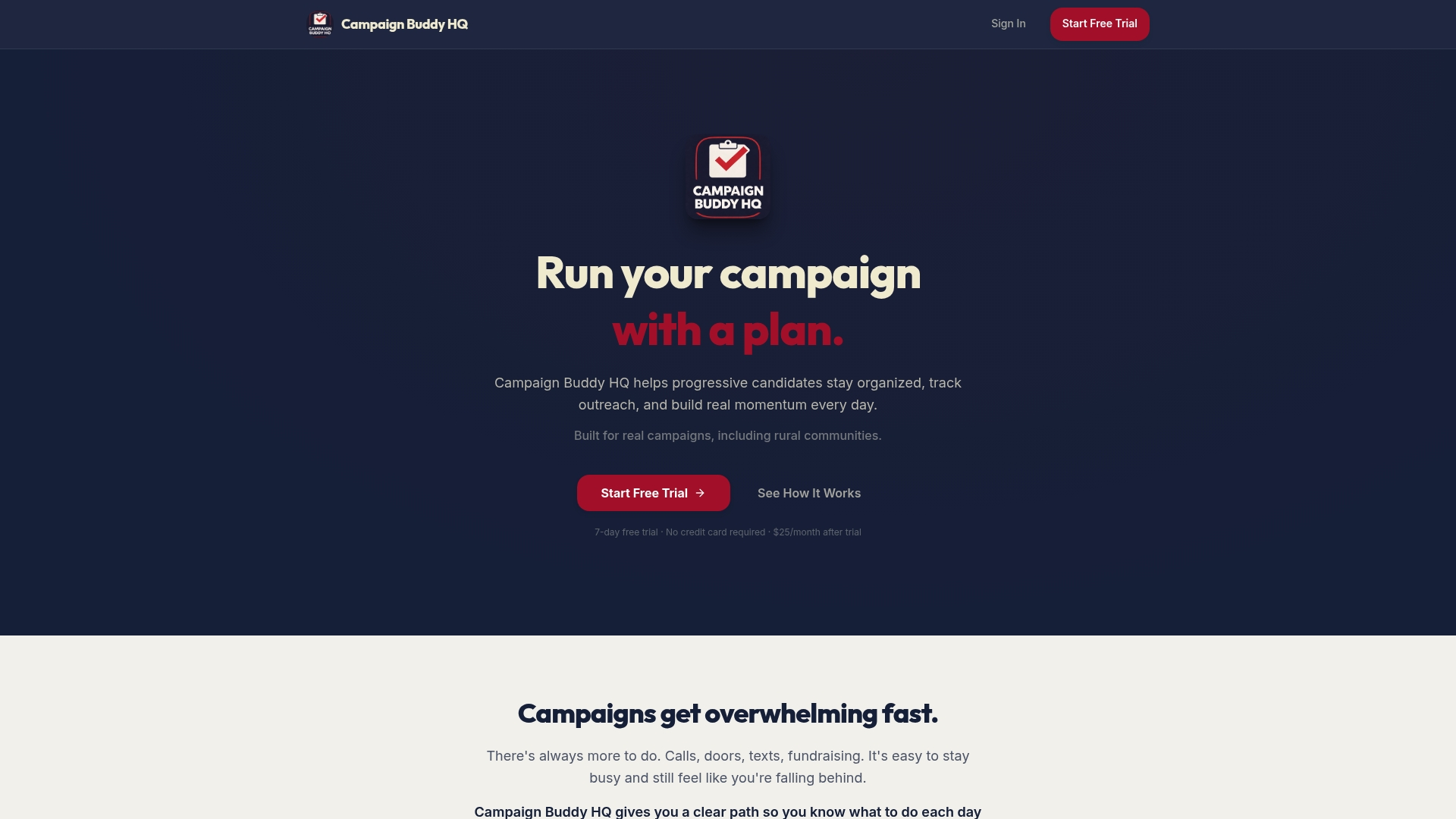
Campaignbuddyhq is built for real-world conditions, including rural and low-density communities where standard tools fall short. The platform supports the kind of step-by-step outreach planning that turns infrastructure from a concept into a daily practice. A free 7-day trial requires no credit card. Start building your campaign systems today at Campaignbuddyhq.
FAQ
What is campaign infrastructure?
Campaign infrastructure is the integrated set of systems, workflows, and data processes that support voter outreach, staff coordination, and performance tracking throughout a political campaign.
Why do campaigns consolidate their tech stack?
Consolidating systems reduces manual data handling, eliminates duplicate records, and allows teams to move from audience identification to outreach execution in one environment.
What should a campaign intake form include?
A strong intake form captures campaign type, target audience, messaging goals, outreach channel, and success metrics. A formal review step then checks for missing fields before any execution begins.
How does campaign taxonomy improve reporting?
Consistent tagging across campaign type, channel, audience, and funnel stage means your analytics tools can produce accurate, comparable reports across every outreach effort your campaign runs.
How can campaigns improve organizer onboarding?
A 2024 survey found 60% of organizers rated their onboarding as non-existent to average. Written guides, peer mentors, and recorded platform walkthroughs are the most direct fixes.